UOCAVA Ballot Controversy Embroils Adrian Fontes As Rep. Hamadeh Pushes For Reform
By Matthew Holloway |
The Uniformed and Overseas Citizens Absentee Voting Act (UOCAVA) has become the center of controversies in Arizona in the past few days, involving Arizona’s Democrat Secretary of State Adrian Fontes and a raft of reforms to the act proposed by Congressman Abraham Hamadeh (R-AZ08).
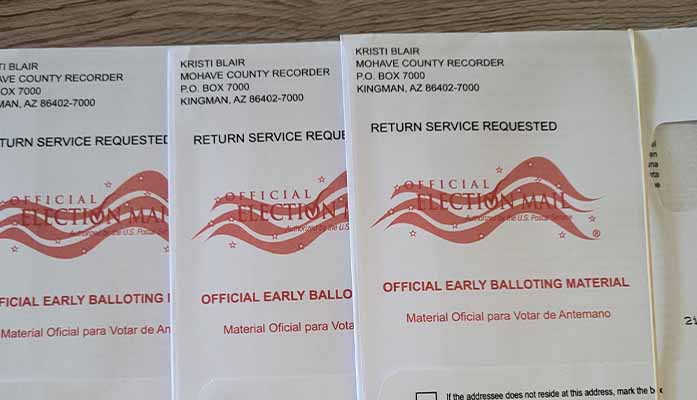
According to a press release from State Representative John Gillette’s office (R-LD30), “Fontes ordered counties to abandon the secure, state-managed Uniformed and Overseas Citizens Absentee Voting Act (UOCAVA) ballot processing system and instead use a third-party platform controlled solely by his office.”
Gillette condemned Fontes, saying, “UOCAVA exists to ensure that our deployed service members, their families, and Arizona residents living overseas can securely exercise their right to vote. He explained, “It does not give voting rights to foreign nationals, illegal immigrants, or U.S. citizens with no prior Arizona residency. This directive is a reckless expansion of voting access beyond what the law allows.”
The release from Gillette’s office added, “The change undermines the clear intent of federal law, circumvents the Arizona Election Procedures Manual—which requires a public process and legislative oversight before such changes—and risks improper use of federal funds designated for legitimate UOCAVA services. Removing counties from control also weakens ballot verification and tracking safeguards that protect against fraud.”
In a statement released by the Secretary of State’s office, Fontes characterized his change as “the upgrade we’ve been working toward for 20 years.”
On the federal stage, the Proving Residency for Overseas Voter Eligibility (PROVE) Act, introduced by Rep. Hamadeh earlier this month, drew the ire of elections reporter Garrett Archer of ABC 15. The self-proclaimed “data guru” held the reforms to be unnecessary, according to the Arizona Daily Independent. Archer has been in an ongoing social media feud with Hamadeh and his staff regarding UOCAVA voting totals.
Introducing the measure, Hamadeh warned that the UOCAVA allows people who have never resided in the U.S. to vote in state elections, undermining the integrity of the electoral process. “The loophole in UOCAVA allows citizens living overseas, with no current ties to a state, to arbitrarily choose where their vote counts,” he said. “This threatens electoral integrity and is an affront to everyone who believes in fair and free elections. The PROVE Act will close this loophole and go far to restore trust in our elections.”
Hamadeh explained in a post to X:
“The military and overseas citizen voting data reveals some concerning patterns: Volume Stats:
• Total UOCAVA ballots transmitted: 1,327,324
• Here’s the kicker: 70% went to overseas citizens, not military voters
• That’s the largest gap between overseas civilians and uniformed services since 2014.”
Archer accused the congressman of “still lying. Just with numbers this time.” He argued, “The four states with a concentration of UOCAVA voters are Virginia, Florida, Washington, and California. The UOCAVA voters in the first three are all majority military. Virginia is near the seat of government, Washington and California both have aerospace and tech industries. Abe is implying its suspicious that a random county in Oklahoma or Nebraska DO NOT have over 100 UOCAVA voters. Quite the opposite in fact. If a random county in Oklahoma or Nebraska had over 100 UOCAVA voters, that would be suspicious.”
In response to another post from Archer, who shared his breakdown of UOCAVA registrations in 2024 by Arizona counties, Hamadeh asked, “Why aren’t you using the military numbers? Is it because it completely invalidates your rebuttal? This bill ensures that military voters are protected and loopholes are closed.”
Hamadeh then cited Hans von Spakovsky, Election Law Reform Initiative and Senior Legal Fellow at the Edwin Meese III Center for Legal and Judicial Studies: “‘The typical civilian Congress was looking at [when UOCAVA was created] was, for example, a State Department foreign service officer in Europe for a several-year assignment who would return to his or her home in Maryland or Virginia or another state when that assignment ended,’ Spakovsky told The Federalist. Spakovsky explained the legislation was surely not intended to permit expatriates, or other individuals who left the country and have no intention of ever returning, to continue voting.”
Answering the efforts of Adrian Fontes to interfere, and blasting the Democrat in a post to X, Hamadeh wrote, “Overstepping his authority & again demonstrating his flagrant disregard for the integrity of our elections, @Adrian_Fontes is exploiting voting in the name of the very servicemembers who protect that freedom. Congressman Hamadeh’s PROVE Act fixes this.”
Matthew Holloway is a senior reporter for AZ Free News. Follow him on X for his latest stories, or email tips to Matthew@azfreenews.com.