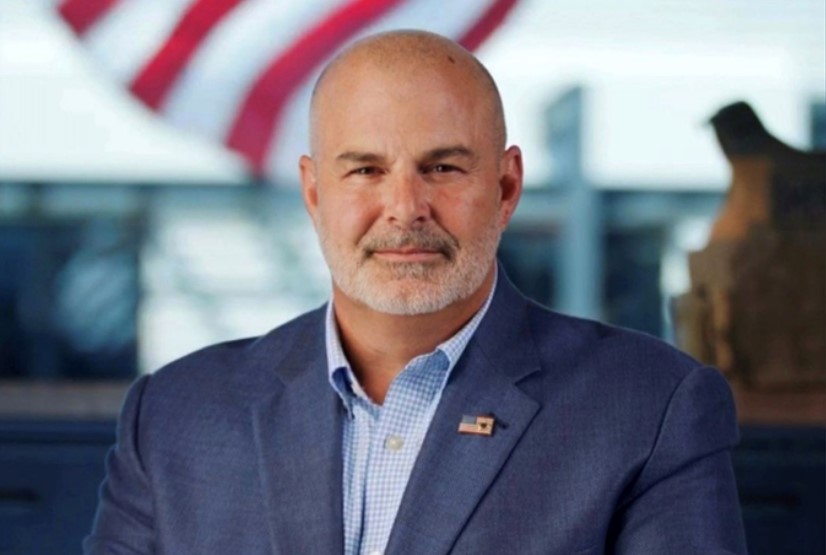
A first-year mayor is getting recognition for his emerging leadership as a government official.
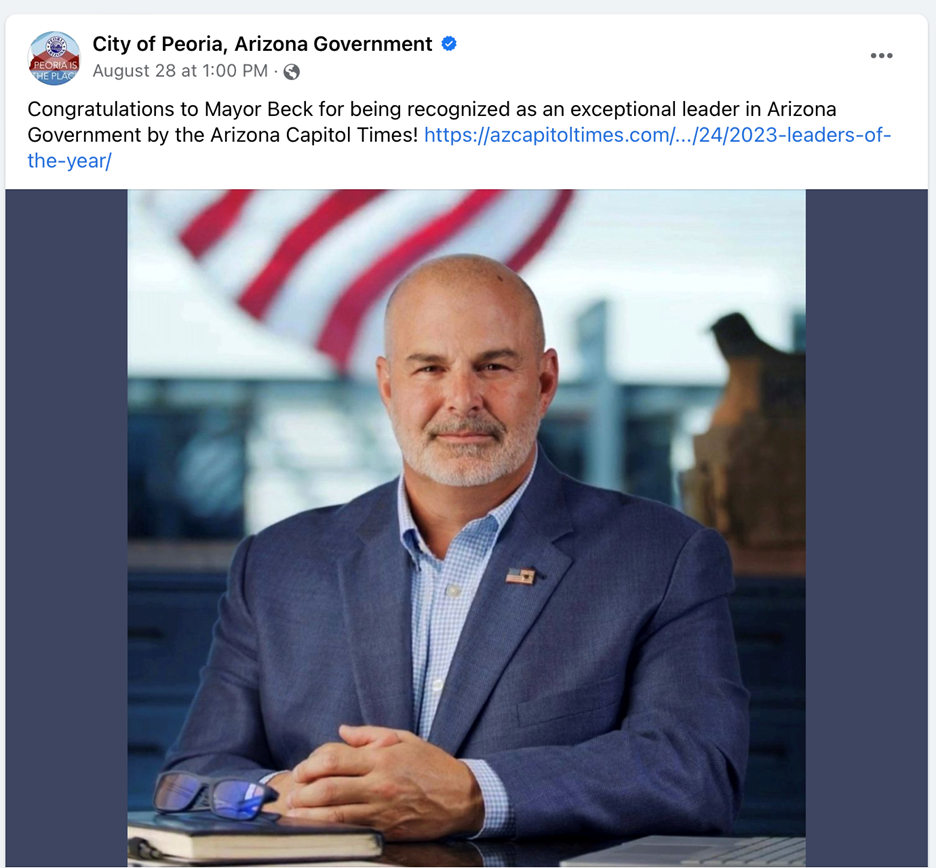
Late last month, the Arizona Capitol Times released its 2023 Leaders of the Year awards, highlighting Peoria Mayor Jason Beck as a winner for the “Government” category.
In addition to congratulating Mayor Beck and others who earned recognition under various categories, the Arizona Capitol Times wrote, “These individuals have demonstrated a commitment to serving their communities that are second to none. Their passion and talent have made Arizona a better place for all that live here.”
Since entering office at the beginning of this year, Mayor Beck has proven he is up for the task of leading his city forward, working with the council to keep several of the promises he made during his 2022 campaign. Beck made public safety a key focus of his campaign, and he has delivered on multiple fronts to increase funding and resources for Peoria’s police, fire, and school.
In July, Beck announced that there would be a police presence at all Peoria Unified School District schools during the 2023-2024 year. He added that there would be four new SLOs (School Liaison Officers) and rotating SLOs at every school, that this presence would be expanded to all elementary schools, and that there would be 22 Peoria schools with police coverage and an increase in SLO salary.
The action to provide additional school safety personnel for Peoria schools comes on the heels of an earlier announcement from Mayor Beck on funding for the city’s police pension funding. In a social media post, Beck noted that the Peoria City Council had moved $6 million to the police pension funding, which was now 80% funded – compared to 48% funded in 2020.
Earlier this spring, the mayor highlighted his vote “to approve the Peoria Police Association’s proposal for a wage increase for Peoria Police Officers.” His communication on March 16 stated that the Peoria City Council “unanimously voted to increase police wages by a 10% market adjustment and a one time lump sum payment of $2,500 to go in effect March 18th.”
Beck also revealed that his city had just arranged for the acquisition of land for a new, “state-of-the-art” police and fire station, which would ensure “efficient collaboration between the two crucial services in times of emergency.” Mayor Beck explained that he is “committed to ensuring that Peoria remains a safe and secure place for everyone,” and that he “understands the vital role that our police officers and firefighters play in maintaining this safety.” He expressed his pride in supporting the city’s first responders in “their tireless efforts.”
The mayor’s success at the helm of his city comes as no surprise to those who have interacted with him in the private sector before he entered the political realm. Before taking the oath as Peoria’s chief executive, Beck founded TYR Tactical, which manufactures police and military equipment. Beck has served as the company’s CEO since its inception in 2010, growing his operation into one of the city’s top businesses. In a letter posted on TYR’s site, Beck asserts that “protecting and serving the men and women of U.S. and Allied Armed Forces, as well as Law Enforcement and Federal Agencies, has always been my number one priority.”
At the beginning of March, Beck announced that he had been presented with the Patriotic Employer Award from the Office of the Secretary of Defense’s Employer Support of the Guard and Reserve. The honor is a recognition for “contributing to national security and protecting liberty and freedom by supporting employee participation in America’s National Guard and Reserve Force.” Beck wrote, “Those that have worked at TYR know the intensity in which we focus on perfection of the product and why we say every stitch matters. Every Police Office, Every Soldier and Every Life Matters! It’s what I am proud of TYR’s performance and we are proud of Renato and the many vests that have worked for us in the past and currently working for us now.”
Daniel Stefanski is a reporter for AZ Free News. You can send him news tips using this link.
More of Arizona’s municipalities are increasing their water conservation efforts, leading taxpayers to pay more for less.
Preexisting sustainability goals and the burgeoning Colorado River drought have offered justification for these municipalities’ efforts, which have now resulted in lawn bans, increased water rates, and restricted water usage over the last few years.
Multiple cities recently traded in their Colorado River water rights in exchange for federal funding: Tucson, Phoenix, Peoria, Glendale, Scottsdale, Gilbert, Mesa, Surprise, Queen Creek, along with the state, Apache Junction Domestic Water Improvement District, Central Arizona Groundwater Replenishment District, Metropolitan Domestic Water Improvement District in Tucson, Salt River Project, and EPCOR.
Last month, Gov. Katie Hobbs announced the Arizona Department of Water Resources (ADWR) ban on the construction of new Phoenix homes that would rely on groundwater.
These progressive restrictions and charges also continue despite noted successes in conservation in comparison to past years with smaller populations.
The answer may lie with other developments in the state over the years. Big Tech’s data centers may be one of the major drains on water supply outweighing the net savings of residents’ water conservation efforts.
Mesa
In comparison to the other cities, Mesa doesn’t impose major water conservation restrictions. It does offer $1,000 in rebates for grass removal, with an additional $100 maximum for planting native trees.
However, the city may be contributing to the water burdens faced by its neighbors. In 2019, it approved the development of a data center for Google that could use one to four million gallons of water daily. Arizona residents average about 146 gallons daily currently.
Yet, as Time pointed out, Arizona Municipal Water Users Association (AMUA) — an organization that Mesa helped found — chastised Arizona residents several weeks after the deal between Mesa and Google for using 120 gallons on average daily.
Meta (formerly Facebook, which also owns Instagram) is now building a data center there as well. The year they broke ground in Arizona, they promised to be “water positive” — meaning, restoring more water than they consume — by 2030.
Like Google centers, data centers could use around one to five million gallons of water a day according to Texas Tech University’s Water Resources Center director, Venkatesh Uddameri.
Microsoft also operates data centers out of El Mirage and Goodyear. They made the same promise to be water positive by 2030.
Over 30 percent of the world’s data centers are located in the U.S.
Scottsdale
Scottsdale banned lawns on new builds earlier this month.
The city also offers to pay residents up to $5,000 for lawn removals, and up to $1 per square foot of water surface area plus $400 for pool or spa removals. For multifamily properties, homeowner associations (HOAs), and commercial businesses, the city offered up to $40,000 to remove their lawns, with an additional $10,000 bonus for grass strips adjacent to streets.
Since Scottsdale launched its rebate program in 1992, total rebates amounted to over $4.7 million; about half of which came from grass removals. The city has removed 94 acres of grass since the program’s launch. This fiscal year’s rebate budget sits at $450,000.
Last September, Scottsdale banned HOAs from requiring overseeding lawns.
Residents surpassed the city’s goal of 10 percent water conservation, achieving 12 percent over the last two years.
Tucson
Last month, Tucson banned lawns and reduced water flow in new constructions. The city also required all new residential dwelling units to include piping for a separate discharge of gray water for direct irrigation: the untreated, leftover water from washing machines, bathtubs, and sinks.
In 2008, Tucson required all commercial development and site plans to include a rainwater harvesting plan that provided for 50 percent of the annual landscape water supply.
In 2014, Tucson passed a water waste ordinance fining individuals $250 on the first offense and $500 on subsequent offenses up to $2,500 for allowing water to escape or pool onto public property; washing driveways, sidewalks, parking areas with a hose (unless a residential customer); operating a misting system in unoccupied non-residential areas; having an irrigation head or emitter that’s broken or spraying more than 10 percent onto a street, parking lot, or sidewalk; failing to control a leak; and failing to meet the 50 percent rainwater harvesting requirement for landscape irrigation.
Tucson also offers multiple rebates: $100 per residential, multi-family, or commercial premium high-efficiency toilet; $150 for a flushometer valve/bowl combination; $200 for high-efficiency or water-free urinal installation; $100 or $200 for a residential high-efficiency clothes washer; up to $2,000 for a residential rainwater harvesting system; and up to $1,000 for a gray water system. The city also offers special incentives for low-income residents: free high-efficiency toilets, grants up to $1,000 and loans up to $2,000 for a rainwater harvesting system, grants and loans up to $500 for a gray water harvesting system, discounted high-efficiency clothes washers, and free plumbing repairs.
Each year, Tucson makes available up to $250,000 in grant money to establish stormwater harvesting in neighborhoods.
Phoenix
Last month, the Phoenix City Council approved the Sustainable Desert Development Policy, requiring rezoning cases on new developments to satisfy city-approved standards on EPA WaterSense efficiency certifications; drought tolerant and/or native landscaping; restrictions on turf usage; outdoor irrigation efficiency standards; green infrastructure or low-impact development provisions for surface parking areas, streets, and sidewalks; participation in the city’s Efficiency Checkup program; new swimming pool standards; new wet-cooling system standards; and preservation of natural open spaces.
Additionally, the policy will require any entities that use over 250,000 gallons of water per day to submit a water conservation plan, approved by city staff. Any entities that use over 500,000 gallons of water per day must derive 30 percent of their water consumption from a recycled or conserved water source.
Entities dubbed “large water users,” may be denied operation even if their conservation plan is acceptable to the city. The policy stated that the city may reject the large water user if there’s inadequate water resource availability in their proposed location, inconsistency with the city’s planning documents; undesirable economic value and impact of their proposed water use; undesirable impact to water rates; or incompatibility with the city’s definition of a key industry beneficial to the economy.
The city doesn’t offer any rebate programs, though last December city officials expressed a desire to launch one to incentivize lawn removals. The city signed a joint pledge between locales in California and Nevada to remove ornamental turf.
The city also imposes an ordinance onto new developers, the Water Resources Acquisition Fee (WRAF) ordinance, which may be mitigated via credit if the developer provides a permanent reduction in annual water demand on the city.
The city has promised that it won’t institute mandatory water use restrictions in the near future, though it warned that severe or worsening drought conditions within the next 10-15 years may warrant such restrictions. Policy changes could include water waste punishments similar to Tucson’s, requiring child safe pool covers to reduce evaporation, banning turf irrigation, and banning car washing.
Flagstaff
Flagstaff has stricter water use requirements than some of the other Arizona cities.
The city has a watering allowance schedule during which residents may water their landscape: even-numbered addresses on Sundays, Wednesdays, and Fridays, and odd-numbered addresses on Tuesdays, Thursdays, and Saturdays. Nobody may water on Mondays, and the city prohibits watering between 9 am and 5 pm. Gardeners wishing to water by hand — “incidental hand watering” — may do so on any day, except from 9 am to 5 pm. However, vehicle washing is not subject to the water schedule restrictions.
The schedule is only permitted to be used when the city is at the first stages of burdened water demand. At level two, the city bans irrigation; car washing at home; driveway, sidewalk, and tennis court washing; filling of fountains, ponds, streams, or pools over 100 gallons. The city also increases water rates for those using over 6,400 gallons, and potable standpipe rates increase by 130 percent. At level three, potable water use is banned outside.
Those who violate the rules within any of the three levels are subject to fines starting at $25, doubling with each violation.
The city implements a diverse set of rebate programs. Commercial properties may receive free high-efficiency sink aerators, free high-efficiency shower heads, free pre-rinse spray valves, $86 rebate or 50 percent of project cost for commercial toilets, $158 or 50 percent of project cost for hotel toilets; and $157 or 50 percent of the project cost for commercial urinals.
Both residential and commercial properties may receive a rebate at 25 cents per square foot for converting to low-water landscaping. They may also receive a $100 rebate on installation of a rainwater harvesting system with 1000-gallon minimum capacity, and free 55-gallon rainwater harvesting barrels.
The city reported that their conservation efforts, beginning in 1988, have yielded a 50 percent water use reduction.
Gilbert
The town of Gilbert is offering up to $800 to residents and up to $3,000 to non-residential customers who swap their lawns for desert landscaping that uses less water. The city set aside $60,000 for the residential program, and $15,000 for the non-residential program.
A Gilbert spokesperson told AZ Free News that they have a total of $120,000 per year to issue on their rebate programs, and that the allocated funding within that budget may change from year to year based on the popularity of each program.
Anyone who receives $600 or more in water bill credits must complete a W9 for the Gilbert Water Conservation, as per the Biden administration IRS reporting requirement enacted last year.
Those aren’t the only water conservation financial incentives that Gilbert has offered. The town introduced rebates up to $250 for residential, $400 for non-residential properties to install smart irrigation controllers.
In May, the town applied for a $3 million grant from the Water Conservation Fund to replace grass on government property with desert-tolerant landscaping. The grant money ultimately comes from federal COVID-19 relief funds.
Gilbert announced that it saved 254 million gallons due to its conservation efforts in 2019, and 375 million in 2018.
Corinne Murdock is a reporter for AZ Free News. Follow her latest on Twitter, or email tips to corinne@azfreenews.com.
The mother and father of a middle school student, Amy and Shawn Souza, filed a statement of allegations against Peoria Unified School District (PUSD) with the Arizona State Board of Education for attempting to hide reportedly politicized curriculum from them and ignoring their opt-out requests. According to emails shared with AZ Free News, PUSD Director of Social Studies Curriculum and Instructional Specialist Jennifer Mundy suggested that the teacher and school in question, 7th grade social studies teacher Holli Trentowski at Sunset Heights Elementary, disguise or manipulate the curriculum on its face so that inquisitive parents like them wouldn’t look too closely. Mundy deferred to Marla Woolsey, the district’s Executive Director of Curriculum and Instruction, for final say on the matter.
“[Trentowski’s] titles could be toned down a bit. For example, instead of saying ‘Science behind mob mentality,’ she could say ‘The science behind the KKK’s behavior’ or just put Tuesday’s title on Wednesday as well. I’m assuming that she’s teaching about the Ku Klux Klan on Tuesday and following that up with how it’s possible that people could commit the atrocities they did toward African Americans in the South during Reconstruction (and for a century and a few decades afterwards). If kids are thinking, they’ll [sic] on there [sic] own to take it to what happened this past summer as well as what happened at the Capitol a few weeks ago. Analyzing connections and explaining the multiple causes and effects of events past and present are both standards in social studies. The problem does not lie in what Holli is teaching (assuming I’m correct about the path she’s taking this week).”
According to the Souzas’ complaint, PUSD officials attempted to pull a workaround as soon as the Souzas first began to communicate concerns with them about their daughter’s 7th-grade social studies curriculum. Sunset Heights Elementary Principal Rae Conelley even complained about having to meet with the Souzas to discuss their concerns frequently: she stated that she was “going to lose [her] mind.” Conelley also speculated to Mundy and Woolsey that Trentowski was “baiting” the Souzas with her curriculum. “I am going to lose my mind,” wrote Conelley. “If I am off track in my guidance to [Trentowski] please let me know. I almost feel like she’s baiting them now but I’m the one who’s spending time I don’t have meeting with them.”
The Souzas asserted that Trentowski’s curriculum was “developmentally inappropriate and inherently political.” For a section on work conditions in the early 20th century, one of the assigned resources was a graphic, hour-long documentary by PBS on the Triangle Shirtwaist Factory Fire. The 1911 tragedy claimed nearly 150 lives, most of whom were young women and girls.
Despite Trentowski promising to give the Souzas’ daughter an alternative text and place to work, she reportedly gave her the disputed assignment and had her complete it.
The entire ordeal caused the Souzas to remove their children from PUSD. Last week, the Souzas appeared before the PUSD governing board to warn parents and confront the board members about their experience. “We hear all the time at these meetings and from district employees that if you don’t like [the curriculum] opt them out,” said Amy. “We have lost all faith in [the] Peoria Unified School District having the best interest of our kids at heart.”
Must Watch.
Tonight, the Souza family stepped forward to share how @peoriaunified11 violated their parental rights by forcing their daughter to complete an assignment they had opted her out of. pic.twitter.com/Ebpt6edmrG
Free to Learn – a nonprofit organization that advocates for parental rights in education and the removal of political agendas from schools – assisted the Souzas in filing their complaint. In a statement, President Alleigh Marré said that the Souzas’ action should empower other parents.
“By shining a light on this incident with their complaint, Amy and Shawn are setting an example for other parents in Arizona and around the country as they pursue a quality education for their children free of activism,” said Marré. “If parents work within the parameters of the school and follow all the rules, they should see results. Instead, what we saw in Peoria was deceit and an intentional push to keep parents in the dark. At Free to Learn, we want to empower these parents and give them a platform to advocate for their children when all else fails.”
Corinne Murdock is a reporter for AZ Free News. Follow her latest on Twitter, or email tips to corinne@azfreenews.com.
One week into Peoria Unified School District’s (PUSD) school year, parents are already reporting that their students have been required to quarantine until they receive a negative test result – even if they’re not symptomatic or feeling sick in the slightest. Students are required to quarantine 10 days at most, 3 if they test negative for the virus. However, these rules don’t apply to everybody.
Only fully vaccinated individuals, “essential worker” educators that are asymptomatic, and those who’ve recovered from COVID-19 in the last three months aren’t required to quarantine. According to PUSD policy, the district will continue to quarantine all others exposed to COVID-19 at the discretion of Maricopa County Department of Public Health (MCDPH). If the county determines that there’s been an “outbreak,” they will require all students exposed to the infected student to be quarantined.
Educators may remain in school so long as they wear masks if they’ve been exposed and are asymptomatic – but unvaccinated, asymptomatic students who haven’t contracted COVID in the last three months must go home.
“Students, staff, and educators who are close contacts of someone who has COVID-19 and are not fully vaccinated (or have not tested positive for and recovered from COVID-19 in the prior 3 months) must quarantine away from others for up to 10 days following their last exposure per MCDPH. Importantly, per CDC, ADHS, and MCDPH, all close contacts who have been fully vaccinated (starting 2 weeks after the final COVID-19 vaccine dose) do not need to quarantine if they do not have any symptoms. In other words, if identified as a close contact, the need to quarantine depends on a person’s COVID-19 vaccination status and/or COVID-19 infection history. MCDPH recommends that close contacts be tested for COVID-19 3-5 days following their last exposure, regardless of vaccination status.
Close contacts who must quarantine need to be excluded from school and extracurricular activities during their quarantine period. The duration of quarantine is either 10 full days or 7 full days following their last exposure, as long as a COVID-19 test performed on day 6 or 7 is negative and the contact has no symptoms. If a staff member or an educator is determined to be a close contact who must quarantine and they are considered to be an essential worker (as designated by the school), they can continue to work during their quarantine period if they do not have any symptoms and wear a mask while working. Please see the Quarantine Guidance on the MCDPH website for more detailed information.” (original emphasis included and emphasis added)
Previous Arizona Superintendent of Public Instruction Diane Douglas told AZ Free News that quarantining healthy students is negatively impacting their education. Douglas referenced the stunted reading skills of younger children who’d done distance learning due to COVID-19.
“The parents I hear from, they’re not happy. They don’t want their kids quarantined, potentially without an illness,” said Douglas. “We’re taking very extreme responses to something I don’t think deserves such an extreme response and we’re not looking at the damage it’s doing to our children’s learning.”
Douglas relayed the story of one mother who’d confided that her son was forced to quarantine 6 times for COVID-19 exposure – altogether, he missed 2 months of school – but he never became sick.
The former superintendent asserted that this continued exercise of power has gone too far.
“Unfortunately, and this in my opinion, they’ve just pretty much been given free reign to do whatever they want to do – I think it’s the old saying, absolute power corrupts absolutely,” said Douglas.
Corinne Murdock is a reporter for AZ Free News. Follow her latest on Twitter, or email tips to corinne@azfreenews.com.
On Wednesday, the Governor’s Office notified the superintendents of Peoria Unified School District and Catalina Foothills School District that their policies requiring quarantine for unvaccinated students who have been exposed to COVID-19 are illegal.
READ: Our office today notified the superintendents of Peoria Unified School District and Catalina Foothills School District of their unlawful policy to require unvaccinated students who have a #COVID19 exposure to quarantine. @dougduceypic.twitter.com/iCuCuAoq53
The letter from the governor’s education policy advisor, Kaitlin Harrier, to the schools says requiring unvaccinated students exposed to COVID-19 to isolate for 14 days is discriminatory. Vaccinated students are exempt from this requirement according to the districts’ policies.
The Governor’s Office says that’s against the law because a school district or charter school can’t “require a student or teacher to get the COVID-19 vaccine or wear a face mask to participate in in-person instruction.”
In her letter to the Peoria Unified School District, Harrier cited the district’s policy of keeping students out of the classroom for 14 days would have detrimental effects on their education and could even keep students from meeting attendance requirements to advance to the next grade level.
“This policy must be rescinded immediately,” Harrier wrote in the letter.