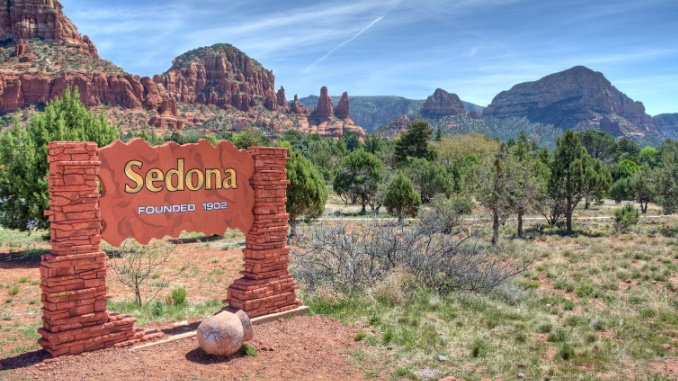
Sedona Residents Face Major Water Rate Increase To Pay For Camouflaged Water Tank
By Matthew Holloway |
During its July 24th Contingency Open Meeting, the Arizona Corporation Commission (AZCC) unanimously assigned the construction cost of a massive 1.5-million-gallon subterranean water tank to the Sedona customers of Arizona Water Company. The decision follows a nearly four-decade efffort to find a location for the water tank that was agreeable with the City of Sedona and local residents.
According to the AZCC, the “extra costs incurred” by the water tank, concealed with a fake home, will fall “solely on the Sedona customers of Arizona Water Company.” However, Pinetop Lakes, Munds Park, and Payson will also see a significant rate increase.
According to a press release from the AZCC, for Sedona residents, the estimated rate increase is 45%, which would bring the average residential bill to approximately $60 per month. Meanwhile, other Northern Group customers will see an increase of roughly 34%, with a billing estimate of $52 per month.
Prior to the meeting, the notion of assigning the costs to the ratepayers outside of Sedona was opposed by Republican Arizona Rep. David Marshall (R-LD7), who publicly condemned it in a press release. Marshall cited the “City’s requirement that Arizona Water Company bury a new water storage tank underground and disguise it with a fake home built on top—an aesthetic demand that made the project one of the most expensive the utility has ever undertaken.”
Rep. Marshall stated, “Arizona Water Company’s northern Arizona ratepayers—including the good people of Pinetop-Lakeside, Heber-Overgaard, Rimrock, Munds Park, and the Village of Oak Creek—did not ask for these costly design features. Quite frankly, it’s absurd to ask them to fork over millions to subsidize the excessive, big-government design mandates of a city nearly 200 miles away. This is a matter of fairness and affordability. Sedona chose to inflate the cost of this project for its own benefit. The rest of northern Arizona shouldn’t be stuck footing the bill for Sedona’s multi-million-dollar expectations.”
According to the AZCC release, an amendment to the decision by Commissioner Rachel Walden resulted in the “non-operational aesthetic expenses” being shifted to Sedona Residents. “My job is to ensure expenses are just, reasonable, and prudent,” Walden said. “That is why I offered my amendment to ensure that non-operational aesthetic expenses will not be paid for by those who do not benefit from them. I thank my fellow Commissioners for fully supporting my amendment.”
The Corporation Commission said in a statement, “The Commission deemed a new tank was prudent and appropriate; however, it was adamant that the extra costs from the aesthetic requirements were not to be assigned to the other 15,000 customers who do not reside in Sedona. The City and residents expressed disapproval for construction of an above ground water tank, which is the conventional design. The Sedona Project is one of only three water tanks that have been undergrounded in the state, by Commission regulated companies.“
The construction tab for the East Sedona Water Storage Tank and Booster Project came to approximately $20 million, as reported by the Arizona Daily Independent. The Arizona Water Company explained that to obtain approval for a conditional use permit (CUP) by the Sedona Planning and Zoning Commission and City Council, it was required to comply with requirements to bury the storage tank and “camouflage” the tank by building a structure on top of the tank that resembles a home for aesthetic purposes, so that it will blend in with the neighborhood and scenery.
“Hopefully this is a strong signal to all water companies, local governments, and residents moving forward that if you require special conditions or place limitations on infrastructure based upon aesthetic preferences, you may be responsible for those extra costs,” said Chair Thompson. “I’m sympathetic to the majority of the Sedona customers who will be solely responsible for these added costs, but it is not an equitable requirement for the 15,000 customers in other communities to be responsible for millions in extra costs because a vocal minority didn’t like the way a water tank looked.”
“After a robust discussion today, the Commission reached a Decision in Arizona Water Co.’s Northern Group’s rate case that strikes a fine balance between ratepayer protections and company viability,” Commissioner René Lopez said. “Thursday’s Decision also signals to ratepayers and local governments that, even in a consolidated group, the Commission will equitably allocate costs to certain customer groups when extraordinary expenses are incurred at their request or for their exclusive benefit. Nevertheless, the compromises and decisions made ensures ratepayers continue to have access to reliable and safe drinking water in some of Arizona’s most beautiful terrains.”
“The final determination of rates for Arizona Water came after a very thoughtful discussion at the Commission about the additional requirements by the City of Sedona for the undergrounding of the water tank and the appropriateness of the financial burden on other ratepayers within their northern division,” stated Commissioner Lea Márquez Peterson, who voted in support of the amended case. “I am appreciative of my fellow Commissioners’ support for my amendment that requires the company to present possible improvements to their customer assistance programs within their next rate case.”
“I’m pleased the Commission directed Arizona Water to engage in discussions with the City of Sedona about funds to help cover the incremental costs to bury the East Sedona Storage Tank,” Vice Chair Nick Myers added. “Because the City required and is directly benefitting from undergrounding the tank, it’s only fair that they contribute financially to cover the City-imposed aesthetic costs. Otherwise, the entire incremental cost of burying the tank will be borne by Arizona Water’s Sedona System customers.”
Matthew Holloway is a senior reporter for AZ Free News. Follow him on X for his latest stories, or email tips to Matthew@azfreenews.com.