by AZ Free Enterprise Club | May 14, 2025 | Opinion
By the Arizona Free Enterprise Club |
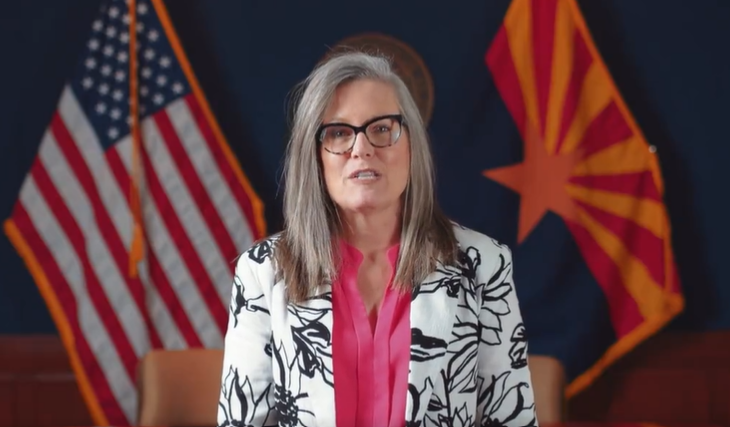
Since becoming Governor of Arizona in 2023, Katie Hobbs’ name has been synonymous with corruption. Now, one of her latest vetoes shows the lengths she is willing to go to protect her own schemes.
Buried on the afternoon of Friday, May 2, Hobbs vetoed SB 1612, along with 21 other bills. Sponsored by Arizona State Senator TJ Shope, SB 1612 would have required anyone applying for grants to various state agencies to disclose gifts, donations, or other support provided to the sitting governor. That sort of transparency should be something that every Arizonan can get behind—Republicans, Democrats, Independents, you name it—unless, of course, your agenda doesn’t involve the best interests of Arizona citizens, right Katie Hobbs?
This whole story starts at the very beginning of Hobbs’ tenure as governor. If you’ll recall, at the time, Hobbs set up a shady slush fund to provide donors with a conduit to buy political favor from her administration. While setting up and managing the fund, Hobbs illegally used public resources—like the state’s website—to solicit money for her inauguration. And she also tried to stop the disclosure of the names of those who donated to her inaugural fund.
But after immense political pressure and public records requests filed by groups like the Arizona Freedom Foundation (who operates AZ Free News), Hobbs finally released the names of the donors. One of the names of the groups on the list was Sunshine Residential Homes Inc., a for-profit company that contracts with the State of Arizona to provide some child welfare services. At the time, Sunshine Residential Homes made a donation of $100,000. But in June 2024, an eye-opening report revealed a deeper level of corruption—an alleged pay-to-play scheme between Hobbs and the group home…
>>> CONTINUE READING >>>
by AZ Free Enterprise Club | Mar 12, 2025 | Opinion
By the Arizona Free Enterprise Club |
If the Hobbs administration has proven itself to be uniquely skilled at anything over the past two years, it’s incompetence and negligence. But now, Arizona’s governor has taken the next step toward outright fraud.
As a part of her recent budget proposal, Hobbs has asked for a supplemental appropriation to the Arizona Department of Economic Security (DES) to cover a shortfall in the Division of Developmental Disabilities (DDD). Without the additional funding, the DDD could run out of money by May, affecting many people under a program that provides services to Arizonans with disabilities.
For weeks, Hobbs has been trying to push the blame onto the legislature, but the reality is, she has no one to blame but herself.
The problem stems from a COVID-era program funded entirely by the federal government that would pay parents who operate as caregivers for their children with disabilities—the Parents as Paid Caregivers program. The program was intended to be temporary, but Hobbs received approval from the federal government in February 2024 to make it permanent.
That approval came with a catch. Beginning on April 1, the State of Arizona would have to cover 32% of the costs, which Hobbs attempted to get funding for in last year’s budget. Her proposal was not approved by the legislature, which she mutually agreed to as part of the budget process. But she continued funding the program anyway—likely believing that she would be able to flip the legislature in November’s election or bully lawmakers into giving her the money. She failed on both counts and now has created a shortfall in the DDD program that has exceeded $100 million…
>>> CONTINUE READING >>>
by AZ Free Enterprise Club | Jun 15, 2024 | Opinion
By the Arizona Free Enterprise Club |
June has been off to a brutal start for Arizona Governor Katie Hobbs. She kicked off the month by breaking her own hiring freeze to bring in a new press secretary. Then, a few days later, a Maricopa County Superior Court judge ruled that Hobbs violated the law when she sidestepped the Senate’s confirmation process for agency directors. And to top it all off, an eye-opening report was released uncovering an alleged pay-to-play scheme between Hobbs and an Arizona group home.
This shouldn’t come as much of a surprise. After all, this is the same Katie Hobbs who broke the law to take credit for the Republican tax rebate. And it’s the same Katie Hobbs who required the nonprofit behind her $30 million medical debt relief program to give her credit. But this latest scandal shows that Hobbs’ corruption has reached a new level.
According to the report, Sunshine Residential Homes has donated approximately $400,000 toward the Arizona Democratic Party, Hobbs’ gubernatorial campaign, and her inaugural fund. And what did the group home receive in return? A nearly 60 percent rate increase! And this was at a time when the Arizona Department of Child Safety (DCS) cut loose 16 providers, and no other standard group home provider received a rate increase.
That’s convenient.
Sunshine Residential Homes could potentially receive millions of dollars more at the taxpayers’ expense from their investment (sorry…donation). And that must have their CEO—who also happened to serve on Hobbs’ inaugural committee—excited.
Hmmm…Hobbs’ inauguration fund. Do you remember that?
This entire saga began when Hobbs set up a shady inaugural slush fund to provide donors with a conduit to buy political favor from her administration…
>>> CONTINUE READING >>>
by Daniel Stefanski | Jun 13, 2024 | News
By Daniel Stefanski |
Arizona’s Attorney General is facing yet another instance of Republican opposition to her desire to sideline Maricopa County Attorney Rachel Mitchell in an investigation of the Governor’s Office.
This week, State Representative David Livingston became the latest Arizona official to weigh in on the brewing scandal and investigation over the Governor’s Office’s alleged impropriety with taxpayer dollars, writing a letter to Attorney General Kris Mayes, demanding that she “immediately recuse [herself] from investigating the pay-to pay scandal, which involves substantial donations to both the Arizona Democratic Party and Governor Hobbs’ inaugural fund.”
In his letter, Livingston reminded the state’s top cop that he had previously communicated with her office to “express disappointment with your disposition of my public resources complaint, which alleged that then-Governor-Elect Hobbs misused public resources in violation of A.R.S. S 16-192 by impermissibly funneling 53 contributions to the Arizona Democratic Party through a state website.”
Livingston pointed to Mayes’ handling of this issue, in what he called a “clear conflict of interest in investigating my public resources complaint,” as fuel for his latest transmission to the Attorney General’s Office. He wrote that Mayes’ “conflict of interest and mishandling of my complaint warrants your recusal from investigating the pay-to-play scandal because it likewise stems from Governor Hobbs’ unprecedented inaugural fundraising and political donations to the Arizona Democratic Party.”
The Republican legislator also told Mayes that she “either grossly misunderstand[s] Arizona law or [is] making a desperate attempt to claim jurisdiction over the pay-to-play investigation to protect Governor Hobbs and/or the ADP” with her efforts to shield the Maricopa County Attorney’s and Arizona Auditor General’s Offices from the inquiry. Livingston explained that “it is the county attorney that may refer criminal matters to [the Attorney General’s Office] for investigation by the State Grand Jury if the offenses fall within its jurisdiction,” and that “the Auditor General routinely works with county attorneys to conduct investigations and is statutorily authorized to do so.”
As he concluded his letter, Livingston opined that “if [Mayes] dislike[d] Arizona’s laws or the limits of [her] authority imposed by those laws, you are welcome to advocate for statutory changes through the legislative process. He added a warning, stating that “what you may not do, however, is make false statements about Arizona law to micromanage the conduct of other elected officials and public servants or prevent them from exercising their own powers and duties.”
Livingston’s letter to Mayes comes after letters from two of his Republican colleagues in the State Legislature, Senate President Pro Tempore T.J. Shope and Representative Matt Gress, were sent to Mitchell and Mayes. Shope sent a letter on June 5 to both Mayes and Mitchell, asking both officials to “examine the facts surrounding the Department of Child Safety’s alleged decision to approve a nearly 60% rate increase for Sunshine Residential Homes and determine if conduct by any of the involved parties warrants a criminal or civil investigation.”
Gress followed up with a letter on June 6 to Mitchell, letting her know that “the Auditor General’s Office stands ready to partner with you in getting the facts about this troubling matter,” and that the Joint Legislative Audit Committee “will allocate the resources the Auditor General needs to help restore what appears to be a major breach of trust in our government.”
That day (June 7), Mayes fired off two letters to both Mitchell and the Arizona Auditor General, Lindsey Perry, over the investigation. Mayes told County Attorney Mitchell that “it would not be appropriate or in the best interest of the state to conduct parallel investigations into the same matter,” and that “a separate process conducted by the MCAO could jeopardize the integrity of the criminal investigation that my office will now proceed with.”
Mayes similarly told Auditor General Perry that “while [the Auditor General’s] office is statutorily authorized to examine records and conduct audits at the direction of the Joint Legislative Audit Committee, at this time, the assistance of [her] office is not needed by the Attorney General’s Office for our investigation.”
After the letters from Mayes, Arizona State Treasurer Kimberly Yee sent a letter to Maricopa County Attorney Rachel Mitchell, requesting “that [she] investigate the allegations that have occurred in [her] jurisdiction.” Yee also delivered a letter to Arizona Attorney General Kris Mayes, highlighting the state’s top cop’s recent assertion to the State Auditor General and the Maricopa County Attorney that her office had singular control over any investigation “is not appropriate or authorized by law, as those entities have separate jurisdiction to investigate this matter.”
Daniel Stefanski is a reporter for AZ Free News. You can send him news tips using this link.