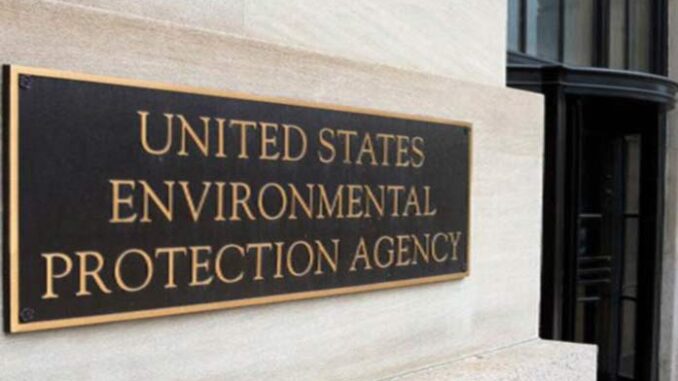
On a crisp, sun-drenched afternoon in the spring of 2023, I found myself walking down Constitution Avenue in Washington, D.C., in front of the William Jefferson Clinton Building, headquarters of the U.S. Environmental Protection Agency (EPA).
Standing in its shadow, I wondered when, or if, sanity would ever return to the building. My mind drifted to the regulatory malfeasance that gave this agency power to treat carbon dioxide (CO2) as a pollutant, the 2009 Endangerment Finding.
For years, this bureaucratic decree masqueraded as settled science. Climate zealots claimed CO2 and other greenhouse gases threatened public health as agents of planetary overheating, ignoring both a paucity of supporting data and contradictory evidence that inexorably accumulated.
Now, three years after my visit, EPA has rescinded the regulation as it applies to motor vehicles. The basis of its action is twofold: First, the agency has concluded that by attempting to regulate greenhouse gases, EPA exceeded its authority under the 1970 Clean Air Act. Second, the environmental effect of regulating tailpipe emissions of greenhouse gases is negligible.
There is more to be done. Reason and good sense would have the EPA remove the Endangerment Finding’s hold over industrial emissions of greenhouse gases, like those coming from power plants, and would undertake to dismantle the rule’s flimsy scientific justifications.
Nevertheless, EPA’s action undermines an ideological foundation for the broad attacks on fossil fuels that have constrained American prosperity and choked the developing world’s aspirations for modern lifestyles.
The 2009 regulation was used to justify the Obama administration’s Clean Power Plan – part of the so-called War on Coal – and tailpipe emissions standards that forced unwanted electric vehicles onto dealership lots. The rule has contributed to the closing of power plants, energy shortages, high electricity prices, and multiple billion-dollar losses for car manufacturers whose customers mostly prefer internal combustion engines. It has also fueled endless litigation against producers of hydrocarbon fuels.
Because CO2 is necessary for all life, beginning with its role in plant photosynthesis, regulation of the gas gave EPA jurisdiction over the entire U.S. economy. Climate crusaders abroad followed EPA’s lead.
Worldwide, the economic waste resulting from the rule is staggering. The Climate Policy Initiative estimates that between 2011 and 2020 that climate spending totaled $4.8 trillion. Estimates for “energy transition investment” – money dumped into the wind, solar and EV rat hole – was $2.3 trillion in 2025 alone.
That is trillions diverted from healthcare, infrastructure, education and genuine alleviation of suffering and advancement of human flourishing. Imagine those resources being directed to improving carbon-intensive energy sectors that have produced the wealthiest and healthiest civilizations in all of history.
Since the dawn of the industrial age, we have witnessed an unprecedented increase in global life expectancy. We have seen a drastic reduction in deaths from natural disasters – not because the weather is milder, but because people are better protected by modern infrastructure and technology made possible by fossil fuels. We have achieved historic highs in agricultural production, feeding a population of 8 billion.
CO2 has played a pivotal role in the greening of the Earth, acting as an atmospheric fertilizer that boosts crop yields and expands forests. Even methane, demonized alongside CO2, is merely a byproduct of a livestock industry essential for providing protein to a ballooning global population. Emissions of neither gas contribute significantly to global temperatures.
Once the EPA designated CO2 a legal hazard, U.S. diplomats, aid agencies and technical experts carried that framing into global climate negotiations, development programs and financing arrangements.
Over time, the EPA’s stance became a de facto reference point for regulators elsewhere. If the U.S. “gold standard” for environmental protection treated CO2 as an endangerment, ministries from Europe to Asia would use similar language in national climate laws.
With the EPA backing away from its regulation of greenhouse gases, developing countries should waste no time in severing whatever restrictions Western climate overseers have placed on their use of fossil fuels. For too long, climate policies have impeded economic growth and denied access to reliable supplies of electricity, to safer indoor fuels for cooking and heating, to refrigeration and to clean water. The result has been higher rates of morbidity and mortality among the world’s poor.
CO2 is not the enemy of humankind. Misguided attempts to criminalize its emissions are!
Vijay Jayaraj is a contributor to The Daily Caller News Foundationand Science and Research Associate at the CO2 Coalition, Fairfax, Va.He holds an M.S. in environmental sciences from the University of East Anglia and a postgraduate degree in energy management from Robert Gordon University, both in the U.K., and a bachelor’s in engineering from Anna University, India. He served as a research associate with the Changing Oceans Research Unit at University of British Columbia, Canada.
Energy Secretary Chris Wright says high electricity costs are a political choice in the United States today. The evidence at hand indicates the Secretary isn’t wrong.
“If you have expensive energy in your state…it’s because politicians and regulators chose to do that,” Wright said in a recent interview with the Wall Street Journal. “It is not bad luck, it is not marketplace…there is no reason to have these rapid increases in electricity prices – no reason, but politics.”
This is correct, and the disparity that exists in electricity bills in red states and blue states can be easily seen in a national map published by the U.S. Energy Information Agency (EIA), along with its supporting data.
EIA’s data shows the states with the highest rates include Democratic strongholds like California, New York, Hawaii, and the New England states. Meanwhile, the states with the lowest utility bills include the reddest of red states like Louisiana, Arkansas, Oklahoma, Texas, Nebraska, Wyoming, Idaho, North Dakota, and Iowa. This all ties directly in with the findings in a recent study by the Institute for Energy Research that I wrote about in January.
There is no real mystery here: Democrats seek to exploit the “affordability” issue in the upcoming midterm elections, but the truth is their policies created that issue to begin with. In his interview, Wright provides the proof points:
Electricity prices were up 6.7% year over year in December, nearly 40% since 2020. That is due to the United States adopting “UK-style” energy policies under the Biden and Obama presidencies, like forcing coal plant closures and wind/solar mandates.
Utility rates rose two times the rate of inflation in Democrat-governed states over the last five years, in GOP states, only half the inflation rate.
States with Renewable Portfolio Standards (RPS) have 50% higher prices than those without; 28 states enforce them, driving costs up.
Biden’s $5 trillion stimulus (for a $1.5T GDP gap) fueled inflation across the board but is now fixable via policy reversals like the ones Wright and other Trump officials are now pursuing.
“We’ve had a tailwind of these things to drive up our own energy prices,” Wright says, “And so that’s a battleship we’re stopping and turning back.”
Turning a policy battleship in the middle of an ocean takes time, but Wright’s efforts produced results during the recent major winter storm. In several regions, coal-fired power plants for which Wright acted to delay scheduled premature retirements generated needed baseload power to avoid blackout conditions as wind and solar failed to perform. Keeping many of those coal plants – and natural gas plants also scheduled for premature retirements under absurd RPS mandates – running will be crucial to maintaining integrity and reliability on grids from coast to coast in the years to come.
The good news for Americans is that this country enjoys an incredible abundance of all the natural resources and raw materials needed to restore sanity and reliability to our power grid. All that’s really needed is the political will to get it done while keeping electricity bills affordable.
Wright and the red states on EIA’s map have shown us the way. That’s true even in Texas, one of the few red states that maintains an RPS of its own. There, policymakers fell asleep at the wheel about the need to maintain a needed fleet of dispatchable reserve capacity, a mistake for which Texans dearly paid during 2021’s Winter Storm Uri.
But, in contrast to their peers in many blue states, Texas policymakers showed a capacity to learn from their mistakes, enacting a series of effective reforms over the last five years that vastly improved grid reliability.
In the recent Winter Storm Fern, the ERCOT-managed Texas grid, which proved to be the national poster child for grid failure in 2021, came through as a shining object lesson on how to fix past mistakes while remaining one of the 10 states with the lowest utility rates.
If you live in a state where power bills are too high, that is a choice your political leaders have made for you to endure. You should factor that reality into your thinking next time those politicians are up for re-election.
David Blackmon is a contributor to The Daily Caller News Foundation, an energy writer, and consultant based in Texas. He spent 40 years in the oil and gas business, where he specialized in public policy and communications.
During the latest marathon cabinet meeting on Dec. 2, Energy Secretary Chris Wright made news when he told President Donald Trump that “The biggest determinant of the price of energy is politicians, political leaders, and polices — that’s what drives energy prices.”
He’s right about that, and it is why the back-and-forth struggle over federal energy and climate policy plays such a key role in America’s economy and society. Just 10 months into this second Trump presidency, the administration’s policies are already having a profound impact, both at home and abroad.
While the rapid expansion of AI datacenters over the past year is currently being blamed by many for driving up electric costs, power bills were skyrocketing long before that big tech boom began, driven in large part by the policies of the Obama and Biden administration designed to regulate and subsidize an energy transition into reality. As I’ve pointed out here in the past, driving up the costs of all forms of energy to encourage conservation is a central objective of the climate alarm-driven transition, and that part of the green agenda has been highly effective.
President Trump, Wright, and other key appointees like Interior Secretary Doug Burgum and EPA Administrator Lee Zeldin have moved aggressively throughout 2025 to repeal much of that onerous regulatory agenda. The GOP congressional majorities succeeded in phasing out Biden’s costly green energy subsidies as part of the One Big Beautiful Bill Act, which Trump signed into law on July 4. As the federal regulatory structure eases and subsidy costs diminish, it is reasonable to expect a gradual easing of electricity and other energy prices.
This year’s fading out of public fear over climate change and its attendant fright narrative spells bad news for the climate alarm movement. The resulting cracks in the green facade have manifested rapidly in recent weeks.
Climate-focused conflict groups that rely on public fears to drive donations have fallen on hard times. According to a report in the New York Times, the Sierra Club has lost 60 percent of the membership it reported in 2019 and the group’s management team has fallen into infighting over elements of the group’s agenda. Greenpeace is struggling just to stay afloat after losing a huge court judgment for defaming pipeline company Energy Transfer during its efforts to stop the building of the Dakota Access Pipeline.
350.org, an advocacy group founded by Bill McKibben, shut down its U.S. operations in November amid funding woes that had forced planned 25 percent budget cuts for 2025 and 2026. Employees at EDF voted to form their own union after the group went through several rounds of budget cuts and layoffs in recent months.
The fading of climate fears in turn caused the ESG management and investing fad to also fall out of favor, leading to a flood of companies backtracking on green investments and climate commitments. The Net Zero Banking Alliance disbanded after most of America’s big banks – Goldman Sachs, J.P. Morgan Chase, Citigroup, Wells Fargo and others – chose to drop out of its membership.
The EV industry is also struggling. As the Trump White House moves to repeal Biden-era auto mileage requirements, Ford Motor Company is preparing to shut down production of its vaunted F-150 Lightning electric pickup, and Stellantis cancelled plans to roll out a full-size EV truck of its own. Overall EV sales in the U.S. collapsed in October and November following the repeal of the $7,500 per car IRA subsidy effective Sept 30.
The administration’s policy actions have already ended any new leasing for costly and unneeded offshore wind projects in federal waters and have forced the suspension or abandonment of several projects that were already moving ahead. Capital has continued to flow into the solar industry, but even that industry’s ability to expand seems likely to fade once the federal subsidies are fully repealed at the end of 2027.
Truly, public policy matters where energy is concerned. It drives corporate strategies, capital investments, resource development and movement, and ultimately influences the cost of energy in all its forms and products. The speed at which Trump and his key appointees have driven this principle home since Jan. 20 has been truly stunning.
David Blackmon is a contributor to The Daily Caller News Foundation, an energy writer, and consultant based in Texas. He spent 40 years in the oil and gas business, where he specialized in public policy and communications.
Since taking office in January, President Trump has worked hard to restore sanity in America. While the wins have been stacking up in many areas, perhaps his administration’s most notable efforts have been in its pushback against the junk science driving the climate agenda.
Along with executive orders in January and April to unleash American energy, Trump’s Environmental Protection Agency (EPA) announced that it would be reversing a Biden administration regulation that held Arizona accountable for the eighty percent of emissions in the Maricopa County nonattainment area that emanated from outside of the state—primarily from China and Mexico.
While all that is good news, the Trump administration delivered quite possibly the best news yet for American energy last month when the EPA released its plan on rescinding the Endangerment Finding. And it has the climate cult drowning in their tears.
What is the Endangerment Finding?
Back in 2009, the Obama administration declared carbon dioxide (CO2) as a pollutant that threatens public health and welfare under the Clean Air Act. Of course, this ignored the fact that CO2 is one of the most important ingredients for building and sustaining life on Earth. But the Obama administration was never known for exercising commonsense, so it gave birth to this controversial policy by relying on cherry-picked scientific data to justify a vast expansion of regulatory power at the EPA.
Since its inception, the Endangerment Finding has been used as the basis for many of the green scam regulations impacting Arizona’s economy. During both the Obama administration and the Biden administration, the EPA passed new regulations on vehicles, factories, power plants, and other mobile sources all based on the alleged dangers of CO2. These mandates have cost the U.S. economy over a trillion dollars, and here in Arizona, they have been responsible for higher energy prices and higher utility bills.
But if the climate cult gets its way, it wouldn’t stop there…
The Environmental Protection Agency officially proposed to terminate what President Trump has long called the “climate hoax.” If successful, the federal government will be out of the climate regulation business with no hope of returning to it without congressional authorization.
The Trump EPA proposed to rescind a 2009 Obama EPA rule called the “endangerment finding.” In that rulemaking, the Obama EPA determined that emissions of greenhouse gases threatened human health and welfare by causing global warming. Simultaneously with the EPA proposal, the Trump Department of Energy issued a scientific report summarizing why emissions are actually a good thing and threaten nothing.
The scientific findings, however, are superfluous since EPA never had express authority from Congress to regulate greenhouse gases under the Clean Air Act in the first place. Controversy and litigation about EPA’s authority to regulate greenhouse gases resulted in the 2007 Supreme Court decision in Massachusetts v. EPA. In that case, the Court determined in a 5-4 holding that EPA could, but did not have to, regulate emissions.
But the decision was controversial. Clean Air Act co-author and famed Democrat Congressman, the late John Dingell, afterwards stated: “I think the Supreme Court came up with a very much erroneous decision on whether the Clean Air Act covers greenhouse gases. I was present when we wrote that legislation and we thought it was clear enough that it did not, and we didn’t clarify it thinking that even the Supreme Court was not stupid enough to make that finding.”
Following the decision, the Bush EPA decided that it would not regulate emissions. When the Obama administration came into power in 2009, it reversed the Bush EPA’s decision and began using the endangerment finding as the basis for regulation of smokestack and tailpipe emissions of greenhouse gases.
Although many questioned the scientific basis of the Obama EPA’s decision, it was impossible to get a judicial hearing on the science. Federal judges informally decided decades ago that they would defer to regulatory agency decisions on questions of science.
With the endangerment finding apparently firmly in place, the Obama administration, and later the Biden administration, proceeded to regulate tailpipe and power plant emissions of greenhouse gases.
Cracks in the ability of EPA to use the endangerment finding soon began to appear. In 2014, the Supreme Court determined that the Clean Air Act did not authorize EPA to use the endangerment finding to regulate emissions of greenhouse gases from industrial smokestacks. In 2022, the Supreme Court in West Virginia v. EPA nullified an effort to regulate emission from power plants, holding that EPA could not launch major regulatory programs without express congressional authorization.
Today, all that remains of EPA’s endangerment finding-based rules are tailpipe regulations in the form of the Biden EPA’s de facto EV mandate, a rule that the Trump administration is in the process of reversing.
Since the Obama EPA made the endangerment finding, electricity prices have soared. Gas prices and inflation soared during the Biden administration. Tens of thousands of high-paying coal miner jobs have been destroyed and their communities devastated.
Our electricity grid has been made less reliable by the advent of existentially subsidized wind and solar power. Periods of peak electricity demand like summer heat waves and winter cold spells now routinely result in blackout/brownout warnings. This problem will get worse before it gets better with the ongoing electricity demand from AI data centers and the re-industrialization of America.
Blue states and their climate activist allies will no doubt sue the Trump EPA to stop the rescission of the endangerment finding. But all this will accomplish is the Supreme Court almost certainly reversing its original sin committed in Massachusetts v. EPA. Some of us can’t wait.
Steve Milloy is a contributor to The Daily Caller News Foundation, a biostatistician, and lawyer, who publishes JunkScience.com and is on X @JunkScience.