by Ethan Faverino | May 20, 2026 | News
By Ethan Faverino |
The U.S. Department of Justice has formed the West Coast Healthcare Fraud Strike Force, a new multi-district initiative targeting the significant rise in healthcare fraud across Arizona, California, and Nevada. The effort unites federal prosecutors with law enforcement partners to protect Arizona taxpayers, patients, and legitimate healthcare services from sophisticated fraud networks.
Assistant Attorney General Colin McDonald of the DOJ’s Fraud Division cited data showing sharp increases in fraud activity in the three states. “The Fraud Division is committed to bringing that same relentless, data-driven prosecutorial force to bear across every corner of this region,” said McDonald, “making unmistakably clear that no scheme is too sophisticated, no network too large or small, and no fraudster too distant to escape federal accountability.”
Arizona has been particularly hard-hit and is already on the front lines of enforcement. U.S. Attorney Timothy Courchaine for the District of Arizona noted that federal law enforcement and his office have already disrupted fraud schemes worth over a billion dollars of taxpayer money in the state. “Our mission as part of the West Coast Health Care Fraud Strike Force is to ensure Americans who need critical services are not used as pawns to make bad actors rich,” Courchaine stated. “Through excellent investigations, trial work, and seizures of ill-gotten gains, the District of Arizona will continue safeguarding those services.”
Arizona Attorney General Kris Mayes told The Center Square, “Arizona has been on the front lines of fighting Medicaid fraud for the past several years, and we welcome the federal government’s help in combatting this problem.” Mayes also highlighted that since 2023, her office has indicted 166 individuals and entities and recovered or seized more than $139 million in cash and assets.
Recent Arizona cases underscore the scale of the threat. In one scheme, Farrukh Jarar Ali, a 41 year old Pakistan-based operator, was charged with conspiracy to commit healthcare fraud and related offenses after allegedly submitting approximately $650 million in false and fraudulent claims to Arizona’s Medicaid program (AHCCCS) through at least 41 substance abuse treatment clinics.
Many patients were recruited from homeless populations or Native American reservations, and clinics often provided little or no legitimate care. AHCCCS paid out roughly $564 million before the scene was uncovered. Ali personally received about $24.5 million and used some proceeds to purchase luxury real estate in Dubai.
In another prosecution, Phoenix residents Alexandra Gehrke and her husband Jeffery King were sentenced to 15.5 years and 14 years in prison, for orchestrating a massive wound graft fraud scheme. Between November 2022 and May 2024, they and co-conspirators submitted over $1.2 billion in false or fraudulent claims to Medicare and other insurers for medically unnecessary bioengineered skin substitutes applied to elderly and terminally ill patients — often through illegal kickbacks and regardless of medical need.
Federal programs paid out nearly $615 million. Authorities seized substantial assets from the couple, including $97 million from bank accounts, luxury vehicles, life insurance annuities, cash, and gold and silver.
Mayes also referenced a prior $2.5 billion Medicaid fraud scheme involving fraudulent sober living homes targeting Native Americans, from which the state recovered only about 5% of losses. Her office has since launched a $6 million grant program to assist affected tribal nations.
The new Strike Force builds on these successes and addresses emerging threats identified by Scott Lampert, Acting Deputy Inspector General for Investigations at the U.S. Department of Health and Human Services. Lampert pointed to “sham operations designed to appear legitimate while exploiting patients and inflating claims through increasingly sophisticated methods.”
Ethan Faverino is a reporter for AZ Free News. You can send him news tips using this link.
by Matthew Holloway | Nov 14, 2025 | News
By Matthew Holloway |
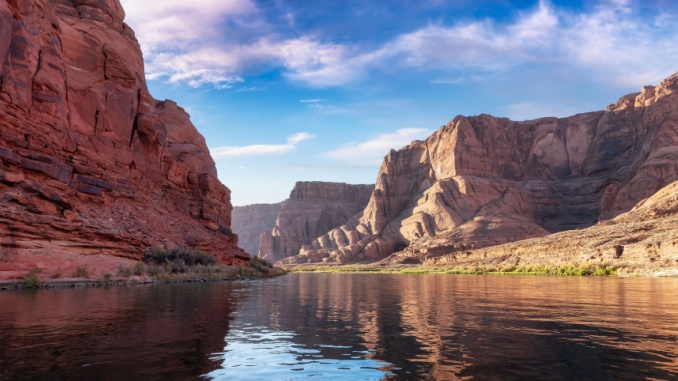
Arizona’s top elected leaders — Democrats and Republicans alike — have joined forces to demand federal action after the seven Colorado River Basin states missed a critical deadline to finalize post-2026 water-sharing rules. In a letter to Interior Secretary Doug Burgum, they warned that refusal by upper basin states to commit to verifiable conservation has pushed the negotiations to a breaking point.
The letter, dated November 11, 2025, highlights Arizona’s role as a leader in water conservation and criticizes upper basin states for refusing to commit to verifiable reductions, which the signatories say have stalled a seven-state agreement needed to sustain the river amid ongoing droughts.
The seven Colorado River Basin states—four in the upper basin (Colorado, Utah, Wyoming, New Mexico) and three in the lower basin (Arizona, California, Nevada)—missed a federal deadline on November 11th to submit a consensus plan for sharing water shortages after 2026, when current operating guidelines expire. Federal officials, including the Bureau of Reclamation, have urged the states to reach an accord to avoid potential court intervention or unilateral action by the Trump administration.
In the letter, the Arizona leaders commended Burgum’s efforts over the past year to develop a framework preserving the century-old 1922 Colorado River Compact, which allocates water among the states. They emphasized the river’s critical role in fueling Arizona’s advanced technology ecosystem, world-class agriculture, military bases, and communities home to millions, including 22 of the basin’s 30 Native American tribes.
“Arizona’s cutting-edge semiconductor industries and IT infrastructure are making it possible for the onshoring of manufacturing operations that are critical for maintaining American technological leadership,” the letter states. It notes that Yuma County, one of the world’s most sophisticated agricultural regions, produces over 90% of the winter leafy greens supplied to the United States and Canada each year.
The signatories stressed that Arizona’s allocation is vital not only to the state’s citizens but to national economic growth and independence. They warned that the upper basin states’ refusal to offer “meaningful, verifiable conservation commitments” over the last two years risks these foundations of growth.
Arizona has positioned itself as a basin-wide leader in water efficiency, the letter asserts, partnering with California and Nevada to propose creative and significant post-2026 operating criteria. Under most scenarios, Arizona’s plans would conserve 1.5 million acre-feet of water per year, representing more than 27% of the state’s entitlement in most years. This follows more than 3 million acre-feet in efficiencies already offered by the lower basin states since 2023 to stabilize Lakes Mead and Powell.
In contrast, the letter points out that upper basin states have repeatedly refused to implement any volume of binding, verifiable upper basin reductions. “This extreme negotiating posture—four of the seven Basin States refusing to participate in any sharing of water shortages—has led to a fundamental impasse that is preventing successful development of a 7-State consensus plan for management of the Colorado River,” it reads.
The group urged Burgum to use his authority to ensure that any alternative considered by the Department of the Interior “contains measurable and enforceable conservation requirements” for the upper basin, guaranteeing the resource remains available for Arizona’s contributions to the economy and national security.
Signatories to the letter include Governor Katie Hobbs (D), Senate President Warren Petersen (R-LD14), House Speaker Steve Montenegro (R-LD29), Senate Democratic Leader Priya Sundareshan (D-LD18), and House Democratic Leader Oscar De Los Santos (D-LD11).
A joint statement from the seven states and federal officials acknowledged the missed deadline. Still, it affirmed a shared recognition of the basin’s challenges, with negotiators committing to continuing talks despite the setback. Lake Mead’s surface elevation stood at 1,057 feet as of recent measurements, with commenters noting that’s just 37 feet above levels that could trigger a “devastating” crisis for Arizona, including potential mandatory cuts to urban and agricultural users.
The full text of the letter is available here.
Matthew Holloway is a senior reporter for AZ Free News. Follow him on X for his latest stories, or email tips to Matthew@azfreenews.com.
by Matthew Holloway | Sep 5, 2025 | News
By Matthew Holloway |
Congressman Juan Ciscomani (R-AZ06) has joined with colleagues from seven western states to reconstitute the Colorado River Caucus, which he will co-chair with Democrat Rep. Joe Neguse of Colorado.
As Arizona is heavily dependent on water flowing from the Colorado River, with 2.85 million acre-feet allocated to the state annually, the state’s political representation in decisions that govern the river has always been critical.
Initially launched as a bipartisan effort by members of the 118th Congress in 2023, the 12-member Colorado River Caucus includes representation from Arizona, California, Utah, Nevada, New Mexico, Wyoming, and Colorado.
“The Colorado River is the beating heart of the American Southwest,” said Congressman Ciscomani. “Millions of people in Arizona and six other states depend on it as a source of water for our homes and businesses, our farms and ranches – our way of life. The Colorado River Caucus will help us understand and manage this precious resource as we deal with the impacts of a record-breaking drought that has lasted more than two decades. Collaboration is key and that’s the goal of this bipartisan caucus.”
In May 2023, Arizona Governor Katie Hobbs and the Colorado River Lower Basin States agreed to a new plan under the Biden administration “to conserve 3 million acre-feet over the next three years to protect the Colorado River system.”
However, in March of this year, Common Sense Institute (CSI) Arizona released a report that pointed to gaps in “infrastructure and ingenuity,” rather than supply scarcity as the state’s greatest water resource issue. CSI advised at the time, “If Arizona opts to address its water future by ending growth and limiting development, rather than investing in infrastructure and addressing water policies, the Grand Canyon state faces the potential of billions in lost economic activity and thousands of new jobs.“
The release from Ciscomani indicated that the Caucus will task itself with advocating for a seven-state solution that incorporates efficient conservation measures to preserve water rights across the board.
Secretary Karen Cesare of the Central Arizona Water Conservation District (CAWCD), representing Pima County, said in a statement, “The Colorado River has been and continues to be one of the most vital issues for the State of Arizona. Since the days of Senator Carl Hayden and Representative John Rhodes, our state has always had leaders in Congress that work on this important issue. I am very happy that Representative Ciscomani is returning as co-chair of the Colorado River Caucus and is continuing this legacy of leadership.”
Matthew Holloway is a senior reporter for AZ Free News. Follow him on X for his latest stories, or email tips to Matthew@azfreenews.com.
by Daniel Stefanski | Nov 7, 2024 | News
By Daniel Stefanski |
An attempt to transform Arizona’s elections systems on Tuesday night fell well short after voters went to the polls.
Proposition 140, which would have imposed a mixed system of Ranked Choice Voting and jungle primaries for future elections in Arizona, was defeated with almost 60% of the vote share, as of Wednesday evening.
“We are so grateful for the Arizonans who stood up to oppose this radical transformation of our elections systems,” said Pinal County Sheriff Mark Lamb and former Arizona Supreme Court Justice Andrew Gould, co-chairs of the No on Prop 140 Committee. “Voters of all political persuasions wisely concluded that Prop 140 would do irreparable harm to our state if enacted. Arizona elections must be free, fair, and transparent, and that is what our system remains after this just result.”
One of the measure’s fiercest opponents, Scot Mussi, the President of the Arizona Free Enterprise Club, praised the outcome. He said, “Prop 140 was one of the worst ideas to ever be proposed in our great state, and it is fitting that it met its demise from a vast majority of Arizonans. Radical leftists, out-of-state billionaires, and scheming consultants tried to hoodwink voters into adopting this failed system, spending millions of dollars and duplicating signatures to qualify for the ballot. We are so pleased that millions of Arizonans did their homework and said ‘hell no’ to, what would have been, a disastrous transformation of our elections system. California can keep their destructive policies and systems on their side of the state line.”
The organization behind Prop 140, Make Elections Fair Arizona, did not appear to issue a statement as of Wednesday on its website or social media platforms. Immediately following the close of polls on Tuesday night, its account promised to be “back online soon with an Election Day campaign update,” but that does not seem to have materialized yet.
In a Wednesday press release, the Arizona Free Enterprise Club highlighted the defeat of Ranked Choice Voting questions in several states in Tuesday’s General Election. Those results were as follows:
- Colorado: Proposition 131 was defeated with almost 55% of the vote
- Idaho: Proposition 1 was defeated with almost 70% of the vote
- Montana: Both CI-126 & 127 were defeated
- Oregon: Measure 117 was defeated with almost 60% of the vote
- South Dakota: Amendment H was defeated with more than 65% of the vote
- Nevada: Question 3 was defeated with almost 54% of the vote
- Alaska: Measure 2, which repeals the state’s ranked choice voting system, appears headed toward passage
Daniel Stefanski is a reporter for AZ Free News. You can send him news tips using this link.
Page 1 of 11