by Daniel Stefanski | Mar 26, 2023 | News
By Daniel Stefanski |
A bill to limit a certain government agency’s arsenal of communications is advancing through the Arizona Legislature, though it became a tough sell for Democrats on the House floor after earlier bipartisan votes in committees.
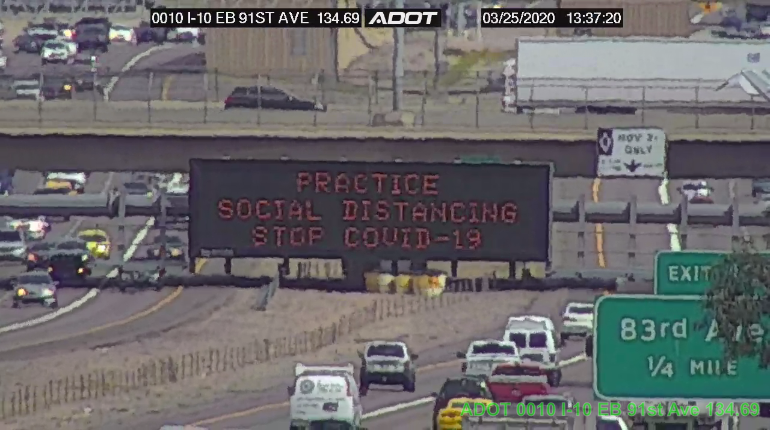
HB 2586, sponsored by Representative Neal Carter, “restricts the Arizona Department of Transportation’s (ADOT) dynamic message signs (DMSs) to display only messages that are directly related to transportation or highway public safety and outlines exceptions,” according to the purpose provided by the State Senate.
During his testimony to the House Transportation & Infrastructure Committee, the bill sponsor, Representative Carter, explained that “this bill is the law in other states.” His reasons for introducing the bill were that some of the ADOT freeway signs are a “little bit distracting” because there are messages that may not be related to transportation and otherwise inappropriate to share with commuters; and that there was good cause to worry “about government effectively using it as an advertisement for other things.” He told the committee that this would be worrying “because the people making those decisions should be elected people,” and it would be a “slippery slope” to have bureaucrats at ADOT deciding what to market or message.
When questioned about the legislation by the committee chairman, Representative David Cook, Carter clarified that it would not be the intent of HB 2586 to “specify how to make the messaging” – for example, limiting the creativity of the content as long as it was directly related to transportation. Representative Carter’s chief concern was signs that aren’t communicating directly about transportation – like “No Burn Days.”
Chairman Cook and Carter both agreed that ADOT messaging about vaccines would be a good example of what should not be included on the signs for passersby.
Representative Carter amended his bill to allow “the Arizona Department of Transportation to display reminders to vote on dynamic message signs.”
The bill passed out of the House Transportation & Infrastructure Committee with a 7-4 vote, with one member absent from the final deliberation. One Democrat voted in support. The Rules Committee unanimously approved the legislation with an 8-0 tally.
On the House floor, Democrat Representative Cesar Aguilar highlighted his opposition to the bill, arguing that the policy “would impact Arizona’s culture of signs we see on the road,” noting his perception that the ADOT “Don’t Drink and Drive” signs would be banned should this legislation be signed into law. Carter rejected that assertion, saying that the aforementioned signs were transportation-related and would not be subjected to the updated regulations of his bill. Carter also touted the bipartisan support for the bill during the committee process. Unlike in committees, though, HB 2586 did not receive any support from Democrats on the House floor, passing 31-28 – with one Democrat member not voting.
HB 2586 was transmitted to the Senate and was approved by the Transportation and Technology Committee earlier this month with a party-line 4-3 vote. It awaits further action from that legislative body.
Daniel Stefanski is a reporter for AZ Free News. You can send him news tips using this link.
by Daniel Stefanski | Feb 18, 2023 | News
By Daniel Stefanski |
Over the past two years, Arizonans have experienced higher inflation than other parts of the country, and their state legislators are working on a solution to combat these higher prices.
This week, Republican legislators held a press conference at the Arizona State Capitol Rose Garden in Phoenix, promoting their efforts to eliminate the rental tax to help constituents struggling with high inflation.
Representative Neal Carter introduced HB 2067 in the House, and Senator Steve Kaiser introduced SB 1184 in the Senate. The bills would prohibit “municipalities from levying municipal tax on the business of renting or leasing real property for residential purposes effective January 1, 2024,” according to the overview provided by the Arizona House of Representatives.
SB 1184 was co-sponsored by six Senators (Ken Bennett, Jake Hoffman, Warren Petersen, Wendy Rogers, Janae Shamp, and Justine Wadsack). HB 2067 was co-sponsored by twenty Representatives (Leo Biasiucci, Selina Bliss, Joseph Chaplik, John Gillette, Travis Grantham, Gail Griffin, Liz Harris, Justin Heap, Rachel Jones, David Livingston, David Marshall, Cory McGarr, Quang Nquyen, Barbara Parker, Jacqueline Parker, Michele Peña, Beverly Pingerelli, Austin Smith, Ben Toma, and Justin Wilmeth.
In an exclusive interview with AZ Free News, House bill sponsor Neal Carter shared his thoughts on why he led this legislation in his chamber: “A tax on a citizen’s rent is terrible tax policy because it’s unfair. It’s anti-progressive, it inordinately affects lower-income Arizonans, and at a time of unprecedented rising inflation, taxing rents further exacerbates the affordability crisis that we are facing. Consider the neighborhood that I live in: about one-third of the houses are rentals, so about one-third of the people I see at the community center, or pass on the sidewalk walking our dogs are paying a tax that I don’t pay to live there, just because they pay rent but I pay a mortgage? It’s unfair.”
Legislative Republicans are serious about sending these bills to Governor Hobbs’ desk without delay. SB 1184 passed the Arizona Senate on February 9 with a party-line 16-14 vote. On Wednesday, February 14, the House passed SB 1184 with a 32-28 vote.
After the House vote on Wednesday, Representative Matt Gress tweeted, “NEW: I just voted to eliminate rental taxes in the state of Arizona #CommonSense”
Following the conclusion of the press conference, the Arizona Senate Republicans released a statement on Twitter, writing, “Your Senate and House Republicans are calling on @GovernorHobbs to support inflation relief for the hard-working citizens of our state, who are struggling to make ends meet in the face of historic inflation. SB1184 would eliminate the rental tax tenants are paying. This tax ranges from $20 to a couple-hundred bucks each month. That extra cash could help with a medical bill, gas, groceries, or other necessities. Governments are FLUSH with cash. It’s time to give back to families that are hurting right now. We are urging the Governor to sign SB1184.”
According to analysis from the Joint Legislative Budget Committee (JLBC), it is estimated that “municipalities will collect a total of $200.9 million in sales tax revenue from residential leases in FY 2023,” and “the municipal revenue loss is an estimated $(230.2) million” in FY 2025 – the first full-year impact of the legislation if signed into law.
When asked by AZ Free News about his support for this historic bill, House Speaker Pro Tempore Travis Grantham replied, “There is nothing more evil than taxing people’s food or the roof over their head. It’s time to get rid of this immoral residential lease tax and bring some needed relief to renters in our state.”
Democrats are not supporting their Republican colleagues’ attempt to give Arizonans a break from the rental tax. All committee action in both the House and Senate – as well as the vote from the entire Senate and House – has featured party-line votes, which may give a strong indication on what the Ninth Floor will do with the bill after it clears both chambers. Governor Hobbs has already set her sights on eliminating another tax, though – the state sales tax on feminine hygiene products.
Instead, Democrats have introduced other policies aimed at combatting the massive increase Arizonans have experienced in housing costs – specifically those in the rental market. On Thursday, House Democrats held their own press conference in the Rose Garden to push strategies to make the state’s housing more affordable. One of the Democrats’ solutions was HB 2161, a bill introduced by Representative Judy Schwiebert, dealing with caps on rental increases. That bill has been assigned to both the House Regulatory Affairs Committee and the Commerce Committee, and it has not been heard in committee.
Daniel Stefanski is a reporter for AZ Free News. You can send him news tips using this link.
by Daniel Stefanski | Feb 16, 2023 | Education, News
By Daniel Stefanski |
Over the past three years, many parents in a number of school districts across the nation have demanded more transparency and involvement with their children’s education. The Republican-led Arizona Legislature has been working on solutions, and Members have introduced new bills this session to give parents the access and information that they have been requesting.
Representative Justin Heap has introduced one of those bills, HB 2786, which deals with requirements for parental notification for teacher training. The bill “mandates a school district governing board develop parental notification and access procedures if the school district is involved with a training for teachers or administrators,” according to the bill overview provided by the Arizona House of Representatives. If passed by the Legislature and signed into law, the bill would “require a school governing board to notify parents of these trainings and give parents access to any printed or digital materials used for the training.” It also stipulates that the governing boards adopt “a policy to provide parents the information contained in its parental involvement policy in an electronic format.”
In an exclusive interview with AZ Free News on why he introduced this legislation, Representative Heap stated, “Transparency will have the added benefit of bringing school district and school boards back into alignment with the values of the parents of the students they serve. The knowledge that their training materials must be made public will discourage school districts from implementing policies that are hateful to the parents of students in their districts. If any school district official, any school board member, principal, or teacher believes that what is going on in their schools should be hidden from the parents in their district, then they have no business being involved in education.”
The legislation currently has ten co-sponsors: Representatives Neal Carter, Lupe Diaz, Liz Harris, Rachel Jones, Teresa Martinez, Cory McGarr, Barbara Parker, Jacqueline Parker, Michele Peña, and Beverly Pingerelli.
On Tuesday, February 14, HB 2786 cleared the House Education Committee with a 6-4 party-line vote. Republican Representatives David Cook, Liz Harris, Lupe Diaz, Michele Peña, David Marshall, Sr (Vice Chairman), and Beverly Pingerelli (Chairman) voted in favor; while Democrat Representatives Jennifer Pawlik, Laura Terech, Judy Schwiebert, and Nancy Gutierrez voted against passage.
Representative Pingerelli gave the following statement to AZ Free News on why she decided to hold a hearing on this bill in her committee: “Parents should have information readily available about what teachers are learning as part of their professional development programs. Are they receiving instruction about better ways to teach reading, math, or science? Or, as was pointed out during the February 14 hearing and testimony, are the topics covered controversial, ideological or morally objectionable to parents? As I’ve always stated, the focus in K-12 education should be academics. Since it is a reasonable assumption that the training teachers receive is translated into classroom instruction, parents should have the right to be informed. That’s why I decided to hear House Bill 2786 in my committee.”
HB 2786 generated much opposition leading up to and during the hearing in the Education Committee, starting with the Arizona House Democrats. They posted that Representative Heap’s bill demands that “parents get to review every type of training teacher gets (including copyrighted materials),” adding that “he was upset when he learned teachers can get training about equity, inclusion and cultural sensitivity. The Arizona Education Association tweeted that “teachers need to focus on students’ learning – not spend all their time trying to satisfy the demands of people who see our classrooms as a way to score political points.”
Representative Heap disagrees with these analyses of the bill, saying, “I believe that sunlight is the best disinfectant. My bill does not ban this teacher training, or any training, which a school district wishes to implement. It simply requires that if a school district requires, endorses, recommends, funds, or facilitates teacher training programs then they must make all those materials used (Digital or Physical) in that training available for parents to review.”
Due to the partisan breakdown of HB 2786s support and opposition in the early stages at the Arizona Legislature, it is highly likely that Democrat Katie Hobbs would veto this bill should it pass through both chambers and reach the Ninth Floor later this session.
Daniel Stefanski is a reporter for AZ Free News. You can send him news tips using this link.
by Ben Beckhart | Dec 27, 2022 | Opinion
By Ben Beckhart |
In January, Arizona’s 55th legislature will convene with new challenges. Republicans managed to maintain slim majorities in both chambers, but what can we possibly accomplish with a Democratic Governor? It will certainly be more difficult to get pro-liberty legislation signed into law, but there are still tangible goals worth fighting for. We just have to be realistic and narrow down our agenda.
The Republican Liberty Caucus of Arizona has published its top five priorities for the 2023 legislative session. These are pragmatic ideas to advance the principles of individual rights, limited government, and free markets, even under a Democratic Governor. Several of these goals were included in Senate President Warren Petersen’s plan to help Arizonans combat rising prices, which we fully support.
The first priority is the same for every legislative session: kill the bad bills. Moderate legislators will be looking for ways to compromise with our new Governor by promoting legislation that will expand the size and scope of government. Our primary focus will be to fight these bills in the legislature, preventing them from reaching the Governor’s desk.
Our second priority is one of Senate President Petersen’s priorities: to repeal the municipal rental taxes on residential properties. These are taxes imposed on residential rental properties by cities and towns. The cost of housing has skyrocketed in recent years, especially in Arizona. As many municipalities sit on massive surpluses, they should be looking for ways to cut taxes and alleviate the cost of housing. Sadly, few cities have done this. It’s time for the legislature to change Arizona statute by revoking the cities’ authority to tax residential rental properties. Rep. Shawnna Bolick ran a bill last session to repeal this tax, and it passed the House with bipartisan support. With support from multiple Democratic lawmakers, this is something Governor Hobbs might sign.
Priority number three is also one of Senate President Petersen’s priorities: eliminate the food tax. One of the reasons why cities are seeing record high revenues is because inflation forces people to spend more. This means more sales tax revenue. Food is a necessity and a tax on food is a regressive tax that especially hurts the middle and lower class who are already struggling with inflation. Some Republicans might object to a repeal of food sales taxes because sales taxes are less invasive than income or property taxes. While we agree a reduction to income or property taxes would be preferable, we should be looking to cut any and all taxes wherever there is a consensus for it. By amending statute to prohibit municipalities from taxing food, we would compel local governments to address the rising cost of living by cutting an unnecessary, regressive tax. We can try to pass this as a normal bill, but if the Governor vetoes it, we could also pass it as a referral that goes to the ballot for the voters to decide, bypassing the Governor’s pen. High inflation has decreased the appetite for taxes, as seen by the rejection of Proposition 310 and many failed bonds and overrides. If placed on the ballot, a repeal of the food tax would likely pass.
Our fourth priority is to prohibit the Governor, or any state agency, from shutting down private businesses under the guise of an emergency declaration. Last session, Governor Ducey signed Sen. Warren Petersen and Rep. Leo Biasiucci’s bill to ban cities and counties from shutting down private businesses. Now we must ensure that the state government cannot impose lockdowns. The Governor would surely veto this bill, but the legislature can instead pass a measure to put this on the ballot in 2024. Once again, this would allow the legislature to go around the Governor. It’s unclear if the voters would pass this measure, but with a leftist Governor, we must do all we can to reign in the powers of the executive branch. We cannot allow our private businesses to be shut down by petty tyrants.
Finally, priority number five is a criminal justice reform that would allow simple drug possession offenses to remain undesignated, allowing the court to designate the offense a misdemeanor upon completion of probation. This is not soft on crime because it would only apply to first-time, victimless drug possession charges, and the offense would still be designated a felony if the individual fails to complete probation. By giving people a chance to avoid a permanent felony, this would be a huge incentive for first-time drug offenders to complete probation and become productive, law-abiding citizens. The end result would be reduced recidivism and less taxpayer spending. This bill was sponsored by Rep. Neal Carter last session, and it passed the House unanimously before getting stuck in the Senate. With new committee chairs and bipartisan support, this reform has a real chance at passing.
This is not an exhaustive list, but these are the top five priorities of the Republican Liberty Caucus of Arizona heading into 2023. This legislative session will look different, but there is always work to be done to advance liberty. We must remain vigilant as we fight to keep Arizona a free and prosperous state!
Ben Beckhart is the Vice-Chair for the Arizona chapter of the Republican Liberty Caucus and the Secretary for the national Republican Liberty Caucus board.
by Corinne Murdock | May 25, 2022 | News
By Corinne Murdock |
Arizona state law now prohibits government properties from requiring masks, with the exception of areas with workplace safety and infection control measures unrelated to COVID-19.
Governor Doug Ducey signed the bill, HB2453, last Friday. Its sponsor, State Representative Neal Carter (R-Queen Creek) declared in a subsequent press release that mask-wearing shouldn’t be a prerequisite for accessing the government.
“Citizens should not be required to wear a mask to access government services,” said Carter. “This law prevents policy setting by unelected bureaucrats which, in my own experience, led to the public being denied entry to some county buildings that continued to impose mask requirements long after such mandates had been widely dispensed with or prohibited around the state.”
Opponents of the bill, like the Arizona House Democratic Caucus, insisted that an outright ban on mask mandates contradicted scientific knowledge.
Proponents of the bill argued that masks were a choice derived from personal liberty.
The Senate didn’t have any discussion over the bill during their final vote last Tuesday. It passed along party lines, 16-12.
Corinne Murdock is a reporter for AZ Free News. Follow her latest on Twitter, or email tips to corinne@azfreenews.com.