“Rust Belt city benefits from Bidenomics” headlined an article last month in the Wall Street Journal, detailing the economic rebound being experienced by Terre Haute, Indiana, a former manufacturing center in decline for many decades.
Suddenly, due to an infusion of stimulus funding from the 2021 American Rescue Plan Act and the 2022 Inflation Reduction Act, this community is experiencing such a windfall that the mayor is “running out of room on his whiteboard” tracking infrastructure projects. New factories are being built, new home starts have tripled, long vacant properties are rehabbed. The venerable Charlie’s Pub and Grub will get a new roof and awnings.
The new initiatives in Terre Haute are part of the hundreds of billions of dollars in federal subsidies supporting manufacturing, housing, and clean energy ventures doled out during the Biden administration.
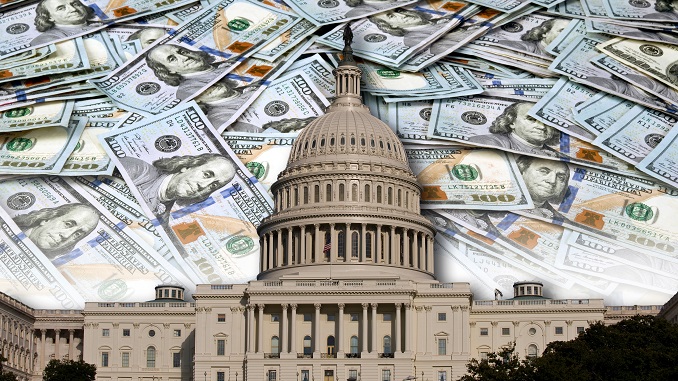
But one question was never asked. Where is all this money coming from? You might think “taxpayers,” but the truth is that we spend $2 trillion more every year than we take in. There are no available tax-derived funds available to distribute.
Instead, we spend fantasy money, loans charged off to future generations who don’t vote yet. We really do love them, just not as much as the luxury of getting to have things that we don’t have to pay for.
The Terre Haute story, just one of thousands like it, contains several insights into why spending cuts are so difficult and rare. The public habits of mind we have developed about the role of government and the responsibility of government to live within its means are the ultimate reason we have fallen into such fiscal danger.
Earlier generations of Americans would have been alarmed, not heartened, at the gigantic unfunded Biden spending surge. We instead assume that none of us should endure hardship or decline and that if we do, it is the duty of government to rescue us. Personal responsibility is outmoded.
Government has never been known for its efficiency, so all these “free” things are actually quite expensive. The good news is we still have a productive economy that has generated 1.4% revenue growth, net of inflation, since 2001, the last year the budget was balanced. Reasonably prudent governance would have achieved budget surpluses.
But that’s not what happened. Politicians spent so much feeding our welfare addiction that spending grew by an inflation-adjusted 3.0% annually, creating the true crisis we now face. Present projections by the Congressional Budget Office indicate spending will continue to outpace revenues, absent reform. Our national debt stands at an unimaginable $36 trillion, while borrowing costs are rising.
We’re in deep trouble. It may well be too late to avoid fiscal collapse. Interest on the national debt, the only truly non-negotiable item in the budget, tripled during the Biden years. It now exceeds total defense spending.
Interest payments amount to half of the total amount borrowed We are borrowing money to pay interest on the growing sums already borrowed, with no plan in place to reduce the debt amount, the dreaded Doom Loop.
Yet at this point, millions of families and seniors, businesses and governments manage their finances based on the expectation of federal subsidies, without which they presumably would be bereft. Over 75% of the federal budget goes to support these private expenditures.
Can Trump be the white knight who rescues us from fiscal doom? The logistics aren’t all that ominous (e.g., raising the retirement age of Social Security by two years would help), and Trump has generated more support for cost-cutting than any politician in memory. But it’s a matter of simple arithmetic. We can never balance the budget without addressing entitlements. That’s where the money is.
Entitlements are termed “mandatory” spending, but they are really just creations of Congress which can legally amend them at will, if they have any.
Unfortunately, Trump so far shows more interest in the low hanging fruit (Department of Education, USAID, obvious fraud) than in the hard work of convincing the American people that substantial entitlement reform is risky but necessary. Without him, Social Security and Medicare will remain No-Go zones even for budget hawks.
The task only gets harder as time passes. We’ll see soon.
Dr. Thomas Patterson, former Chairman of the Goldwater Institute, is a retired emergency physician. He served as an Arizona State senator for 10 years in the 1990s, and as Majority Leader from 93-96. He is the author of Arizona’s original charter schools bill.
The federal government owns multiple trillions of dollars of federal assets — from land, to buildings, to patent rights, to mineral rights, to immigrant visas, to oil fields to trucks and trains and unused office furniture equipment.
The government could earn well more than $1 trillion and perhaps as much as $10 trillion by selling off these assets that are simply hoarded (figuratively) in the dark and dusty basement of government buildings. These assets could then generate added annual tax receipts once they are utilized for productive purposes.
I’m not talking about selling the Washington Monument or Yellowstone National Park. The sales could and in most cases should be limited to American citizens and American businesses.
I’m referring to NON-environmentally sensitive properties that could be put to use growing our economy and using the money to retire some of our $35 trillion national debt. The sales could and should in most cases be limited to American citizens or businesses.
It’s a win-win for taxpayers, our children (who will be handed a lower debt obligation) and the U.S. economy.
One of the most valuable assets that should be put on the auction block immediately is tracts along the electro-magnetic spectrum. The spectrum contains the invisible airwaves that power mobile phones, Wi-Fi and other wireless technologies such as 5g communications.
In the past, auctioning spectrum rights to telecommunication firms and tech companies has raised more than $100 billion for the U.S. Treasury.
Congress could raise at least another $100 billion in another round of spectrum auctions. This would sell or lease space that the military doesn’t need and that other agencies of government (such as local police and fire departments) are fine without.
This strategy would help stimulate the economy in two ways. First, as in the past, the revenues raised can offset any real or imagined revenue loss from the imperative of making the Trump tax cuts permanent.
A new report by the economic consulting firm NERA, finds that auctioning 100 megahertz of mid-band spectrum that’s licensed for 5G will boost U.S. GDP by more than $260 billion, and create 1.5 million new jobs
On at least four previous occasions, Congress has used dollars raised from spectrum auctions to offset tax cuts in reconciliation packages. That’s exactly what they should do again.
“Effectively allocating spectrum to meet the ever-growing need is critical to promoting American innovation and protecting our national security,” Chairman Richard Hudson said yesterday at the first House Energy and Commerce Subcommittee on Communications and Technology hearing of the new Congress.
He points out correctly that the U.S. government has been conducting spectrum auctions for the past 30 years, and they have a track record of success. They are much fairer than giving bureaucrats the power to decide who gets spectrum, which can lead to allocations that are politically or ideologically motivated, with the result that spectrum would be used inefficiently (or not at all) by beneficiaries.
Auctions are open and transparent, minimizing the risk of shady backroom deals. They ensure that the spectrum goes to those who value it most and can use it most effectively.
Anyone who is concerned about ensuring the uninterrupted connectivity of our electric grid system and our daily Internet connection should be all for these auctions — especially as the world goes wireless and communicates less through cables and more through satellite beams.
This is also critical to maintaining our technology lead against the Chinese communist government. One Chinese news agency reported last July that, “China’s 5G network now covers every city and town in the country, as well as more than 90 percent of its villages.”
We are dangerously lagging behind and without timely spectrum auctions the gap will grow wider.
Auctions of the spectrum and other federal assets will drive progress and prosperity — and raise revenue to pay for tax cuts or retire our debt that is soon to eclipse $40 trillion. What’s not to like about that?
Stephen Moore is a contributor to The Daily Caller News Foundation, a visiting fellow at the Heritage Foundation, and a co-founder of Unleash Prosperity. His latest book is “The Trump Economic Miracle.”
America is now drowning in $36 trillion in federal debt.
While past efforts to reform our nation’s finances have failed, Washington, D.C. will have a new sheriff in town after Jan. 20, leading a posse with plans to take the bold steps necessary to clean up our fiscal mess. To achieve different results compared to past efforts will require Republican unity.
Thankfully, President-elect Donald Trump’s plan to restore America’s economic stability has close allies in Congress. In an interview with the Daily Caller News Foundation, Republican Kentucky Rep. James Comer, chairman of the House Oversight Committee, outlined his new Subcommittee on Delivering on Government Efficiency (DOGE), led by Republican Georgia Rep. Marjorie Taylor Greene.
“I don’t think there’s going to be any shortage of waste, fraud and abuse for that subcommittee to investigate,” Comer said.
Comer said DOGE will find healthcare savings, through reducing Medicare fraud and reforming areas like pharmaceutical patents and pharmacy benefit managers.
“One of the things I would encourage those to do — in this administration and Pam Bondi — we need to encourage our U.S. attorneys to focus more on Medicare and Medicaid fraud,” Comer said. “It’s not a priority for a lot of jurisdictions, and that’s something that needs to be a priority.”
Comer said Congress will adopt DOGE cuts through a legislative process known as “reconciliation” that doesn’t require a 60-vote threshold in the Senate.
“You’ve got to do it on reconciliation, because you’ll never get 60 votes,” Comer said. “Democrats don’t want to cut anything, right? Nothing.”
Comer’s DOGE bears a similar name to Trump’s Department of Government Efficiency (DOGE), which will be run by Elon Musk and Vivek Ramaswamy.
Trump’s DOGE has set its own deadline at July 4, 2026 (America’s 150th birthday). Comer said he plans to keep his DOGE subcommittee throughout the entire 119th Congress, which ends in January 2027.
Ramaswamy told Fox News’ Maria Bartiromo that DOGE is “the greatest effort to downsize government in our lifetime” and that, “We expect certain agencies to be deleted outright.”
Comer said the Department of Education is a prime example of a duplicative federal bureaucracy that has outlived its usefulness.
He said it is duplicative because each state has its own Education Department. Comer said it’s better to cut out the middleman and send federal education funding directly to the states in the form of block grants. Federal student loans can be administered by the Treasury Department.
Comer said he would love to bring Democrats on board, but he is no Pollyanna.
“I have yet to meet a Democrat in Congress that’s concerned about $36 trillion debt, that’s concerned about Social Security running out of money,” Comer said. “There may be one, but I haven’t met them or they’re very secretive on their opinions.”
This can’t wait any longer.
Our debt-to-GDP ratio, e.g. the size of our debt compared to our productive economy, was less than 31 percent in 1980, growing to nearly 57 percent by 2000 and mushrooming to 120 percent today, according to the Federal Reserve Bank of St. Louis. This is unsustainable and will bankrupt America’s future.
Conservatives have a golden opportunity to create a generational shift in America’s fiscal future. The only way these massive spending reforms will take place is if Republicans remain unified.
During Trump’s “off-season,” he garnered a fairly successful track record in primarying squishier Republicans who would be far less likely to use the political muscle we need to stop our fiscal drift. Comer is confident that Trump’s cost-saving agenda will pass, thanks to GOP unity.
“Obviously, I can only speak for the House,” Comer said. “We can get, I think, just about everything they want, passed out of the House.”
We’ve become awash in feckless spending, unmoored by excessive COVID-19 stimulus packages (riddled with fraud), followed by more in Green New Deal scams and pet project giveaways.
Trump and congressional Republicans earned a powerful mandate to rein in government spending, which will also lower inflation. It’s what the American people desire and deserve.
America’s friends of limited government have had a rough go lately. Government bureaucrats and spenders of all stripes have been living it up.
Since 2001, the last time the federal budget was balanced, federal revenues have shown healthy growth of 3.9% annually, while inflation averaged only 2.5%. These figures would normally signify a sound, sustainable economy. But spending has grown at a rate of 5.5%, so instead we have a destabilizing gross federal debt of $36 trillion.
The response of the Biden/Harris administration to this looming catastrophe was to double down on spending. In an era of relative peace and prosperity, they kept mindlessly passing out money to win political points.
The hope now is that the Trump/Vance administration can reverse this madness. If so, the Department of Education (DOE) would be a good place to start. It is a prototype bureaucracy that has grown and prospered despite a complete lack of mission success.
The DOE was created in the 70s, ostensibly to improve the chronically ailing achievement scores in government schools. But in spite of the hundreds of billions spent, it has totally failed. Instead, it has provided steady employment for thousands of education bureaucrats who administer federal grants and programs, and write jargon-laden academic papers, yet have made no discernible difference in the quality of American education.
Remember Goals 2000, Every Student Succeeds, or No Child Left Behind? What about the Office of Safe and Healthy Students, the Education Facilities Clearinghouse, or offices dedicated to American-Asians, Native Hawaiians, American Indians, Hispanics, African-Americans, and other hyphenated groups singled out for special treatment? Of course you don’t, unless you are one of the lucky recipients of their largess.
But DOE has been worse than useless. It provides a platform for the teachers’ unions, by far the most influential protector of the status quo and obstruction to school choice. The damaging COVID shutdown was the latest blow to union-run public schools delivered by the DOE/unions dynamic duo.
Most private schools and charters, with access to the same medical information, kept their schools mostly open. Their students didn’t suffer the crippling learning loss that the unfortunate wards of the DOE did.
Ronald Reagan was the first of many leaders to advocate for the DOE’s elimination. But like bureaucracies everywhere, DOE is dedicated above all else to its own preservation, which is the one goal in which it has succeeded. It won’t be easy, but returning education policy to the states would be a great service to future generations of students.
The Department of Housing and Urban Development (HUD) has a similar failed history. When it was created in 1964, the U.S. homeownership rate was 64%. After six decades of HUD stewardship, the homeownership rate is still 64%.
It’s not like they haven’t tried. HUD’s mortgage companies – Ginnie Mae, Freddie Mac, and Fannie Mae manage multiple housing programs with federal finance agencies, all with the goal of controlling costs and boosting home ownership.
Yet under HUD’s “leadership,” home prices have far outstripped inflation. When HUD was created in 1967, the average home price was $22,000, about three times the average family income. Today the average home costs $500,000, seven times income. Meanwhile, European households without a comparable bureaucracy average 69% home ownership.
HUD has spent about $4 trillion since its inception with little to show for it. The housing market would function at least as well if the government simply got out of the way.
As these and other bureaucracies have grown and prospered, we have developed a very centralized form of government. In the land of the free, we have grown comfortable sending our tax money to Washington for faceless bureaucrats to return to us, always with strings attached.
We get the healthcare, the education, the roads and other goodies that government decrees. Government buys or subsidizes everything from unpopular electric cars and trains, state and local government public safety departments, “climate initiatives,” and much more.
Reforming an entrenched bureaucracy, much less eliminating it, is extraordinarily difficult. Yet the present could be a rare opportunity to repair this destruction to our way of life. We must be fearless and strategic in reducing government excess and providing a successful economic future for our descendants.
Dr. Thomas Patterson, former Chairman of the Goldwater Institute, is a retired emergency physician. He served as an Arizona State senator for 10 years in the 1990s, and as Majority Leader from 93-96. He is the author of Arizona’s original charter schools bill.
Free-market economist Milton Friedman was hardly anti-immigration. He acknowledged that, pre-1914, immigrants came “for a better life for them and their children. In the main they succeeded,” broadly benefiting their adopted country.
But there was an important caveat. “It is one thing to have free immigration to jobs. It is another thing to have free immigration to welfare.” Immigrants dependent on public benefits don’t boost their host country. They have the effect of “a reduction of everybody to the same, uniform level.”
Leftists may not like it, but Friedman was right. We’re about to learn the lesson good and hard.
The tens of millions of “undocumented” immigrants now arriving in America have a much different outlook than immigrants of a century ago. In short, today’s immigrants don’t work that much.
A study of Census data by the Atlanta Federal Reserve reported that while over half of new jobs created in the last two years have gone to illegal immigrants, so many have come that barely half of working age, non-college immigrants are in the labor force. Five of six native Americans 25 through 64 regularly work.
The Border Patrol recorded over 10 million illegal immigrants processed during the Biden years plus countless millions not detected. Yet foreign-born employment increased by only 2.32 million. So, who is supporting the rest? We are.
California is the poster child for dependent illegal immigrants. There they get taxpayer-funded health insurance, food stamps, housing allowances, and myriad other benefits, costing $22.8 billion in state and local taxes alone, according to the pro-immigration Institute on Taxation and Economic Policy. Yet this for a population that generated just $8.5 billion in income.
Moreover, many of the programs are direct federal subsidies which means we all participate in their funding. Beyond all this is the escalation in spending by NGOs and philanthropic agencies to house, clothe, and feed the millions of “newcomers” being bused around the country, again at our expense.
The increased pressure on the federal budget, which immigration “hawks” warned against not long ago, has already been normalized. The discussion has subtly passed from whether illegal immigrants should be included in public benefits to how this should be accomplished. Deportation, once assumed for those who failed their asylum hearings (which most do), is now regarded as logistically and morally impossible.
It’s no mystery why our welfare system is a worldwide magnet. Average benefits received by working age households have risen from $7,352 in 1967 to $64,700 in 2022, adjusted for inflation. Welfare spending now consumes 72.6 percent of unobligated revenues (an accounting which doesn’t count payroll taxes or mandatory interest payments) while defense spending has fallen by half.
Most Americans don’t realize that official poverty statistics distributed by the Census Bureau don’t count as income. 88% of the transfer payments made to alleviate poverty. As noted by Gramm and Arrington in the Wall Street Journal, “The census doesn’t count refundable tax credits, food stamp debit cards, free medical care through Medicaid or benefits from about 100 other transfer payments as income.”
When these benefits are deemed to be income, 80% of those today who are counted as poor are no longer poor and the bottom three income quintiles in the Census Bureau all have approximately the same spending power.
With the abundance of means-tested transfer payments available, the percentage of working age persons in the bottom quintile who work has fallen from 68% to 38%. For about the same income, 2.4 times as many workers in the second lowest quintile actually work—and on average work 85% more hours than those in the bottom quintile.
Welfare beneficiaries in the main aren’t liars or cheaters. They are making rational decisions in an irrational environment. America is unfortunately a nation deeply in debt, living on anticipated income from the future. We spend money as if we still had it. The kids will figure it out.
The driving motive behind immigration policy is still to permanently alter the political landscape. The ultimate victims may be the migrants themselves, attracted by promises that in the long run can’t be kept.
As Friedman pointed out, we can’t enrich others by impoverishing ourselves. We all just become more poor.
Dr. Thomas Patterson, former Chairman of the Goldwater Institute, is a retired emergency physician. He served as an Arizona State senator for 10 years in the 1990s, and as Majority Leader from 93-96. He is the author of Arizona’s original charter schools bill.