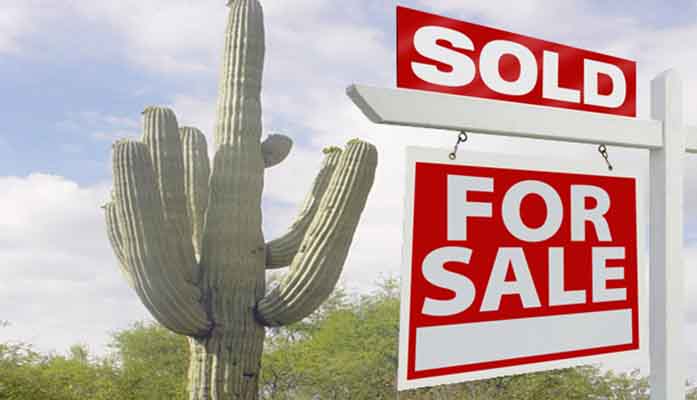
The Greater Phoenix housing market continued its gradual reset in June 2025, signaling a clear shift in momentum from sellers to buyers according to a report from The Ravenscroft Group. Home prices dipped modestly, builders ramped up incentives, and buyers found themselves in the strongest negotiating position in years—marking a pivotal moment for one of the nation’s hottest real estate regions.
While not a repeat of the 2008 housing crash, market data shows a softening across key indicators, as elevated mortgage rates, seasonal slowdowns, and affordability pressures weigh on demand.
According to the group, the median sales price in Phoenix edged down to $449,500, a 0.3% dip from May’s $451,000. Phoenix’s Market Index—a measure of supply vs. demand—fell to 71, further cementing the area’s tilt toward a buyer’s market.
With 30-year fixed mortgage rates hovering around 6.89%, homebuilders are stepping in to maintain momentum. Many are offering interest rate buydowns into the mid-3% range, along with generous closing cost credits, appliance packages, and landscaping perks. This reality has made new construction homes particularly appealing to buyers, many of whom are priced out of the resale market due to borrowing costs.
Real estate trends varied across the Valley in June. Buckeye saw the steepest price shift at -8% while Fountain Hills and Phoenix proper each declined by -6%. Cave Creek transitioned into buyer’s market territory, and Avondale moved from a seller’s to a balanced market.
As of June, the groups says 2 cities are in seller’s markets, 7 cities are considered balanced, and 9 cities have shifted into buyer’s market territory. Outlying cities like Arizona City, Casa Grande, and Gold Canyon lean even more heavily toward buyers.
High recurring costs—such as HOA dues and special assessments—are driving buyers away from attached housing. The listing success rate for condos and townhomes dropped to 58% in May, the lowest since 2011. Manufactured homes fared worse, with fewer than half of listings resulting in a sale.
The Phoenix housing market isn’t collapsing—it’s correcting. Buyers are better positioned than they’ve been in years, and sellers are being forced to recalibrate.
This moment offers unique opportunities for those ready to act—especially in a region still driven by long-term population growth and economic expansion. But navigating it successfully will take strategy, patience, and flexibility on both sides of the deal.
Jonathan Eberle is a reporter for AZ Free News. You can send him news tips using this link.
While the White House touts the success of “Bidenomics,” American families are drowning in debt, especially on credit cards. The latest data from the Federal Reserve Bank of New York show Americans ended the first half of this year with over a trillion dollars of credit card debt for the first time ever. At the same time, credit card interest rates are at record highs, pushing many Americans to the financial brink.
How we got here is a lesson in basic economics, something the Biden administration has willfully ignored.
Contrary to the White House talking points, President Joe Biden did not inherit a “reeling” economy and inflation was not “already there.” When he entered the Oval Office, the economy was growing at a $1.5 trillion annualized rate and inflation was 1.4 percent, comfortably below the Federal Reserve’s target inflation rate. But Bidenomics changed all that.
In just a year and a half, Mr. Biden managed to deliver two consecutive quarters of negative economic growth (a recession). Moreover, inflation reached 40-year highs, with prices rising in a single month about as fast as they rose in the entire year before Biden took office.
This is the bitter fruit of the Bidenomics tree. The seed was trillions of dollars in excessive government spending; it was watered with trillions of borrowed dollars and fertilized by the Fed’s printing trillions of dollars. The results are fast-growing prices, a sluggish economy, and family budgets getting squeezed.
Since Mr. Biden took office, prices have risen about 16 percent, but average hourly wages have risen less than 13 percent, and average weekly hours have been cut back. That has left the average American with an effective pay cut of about 5 percent, and families have been using credit cards to make up for that lost purchasing power.
In just two and a half years, outstanding credit card balances have exploded 34 percent, but it gets worse—much worse. The Fed has been steadily raising interest rates to combat the very inflation which it helped cause. That has pushed up borrowing costs, especially on credit cards; their average interest rate is now at an all-time high.
The combination of large balances and high interest rates is a financial death spiral for many American families. When the financing charges on your credit card bill are equal to or greater than what you can afford to pay each month, it becomes impossible to pay down your balance. You are effectively trapped in debt. On top of the higher cost of living, you’re now paying higher financing charges too.
And it’s not just credit card debt that has exploded during Bidenomics. Consumer spending during the last two years has been partly fueled by higher balances for auto loans and mortgages, the latter of which has grown almost $2 trillion in just two and a half years.
Mr. Biden’s false promises of a student loan bailout along with a moratorium on student loan payments have also encouraged young people to take on additional debt for schooling and not pay those loans back. In fact, instead of using the savings from the moratorium to responsibly pay down their debt, most borrowers have been further increasing consumer spending.
American families going deeper into debt is a hallmark of Bidenomics, so much so that even members of Mr. Biden’s administration are beginning to say the quiet part out loud. Vice President Kamala Harris recently claimed that most Americans would go “bankrupt” if they had a $400 emergency expense.
While there is no evidence to support Ms. Harris’ claim, her statement is an indictment of the administration’s economic agenda. For most Americans, a much more likely scenario than bankruptcy is that they would have to put that emergency expense on a credit card—which many families have already had to do.
The squeeze on Americans’ family budgets will continue until we clean up the federal budget. If Washington doesn’t cut trillions of dollars in spending, the bills will keep piling up, both at the Treasury, and in your mailbox.
E.J. Antoni is a contributor to The Daily Caller News Foundation, a public finance economist at The Heritage Foundation, and a senior fellow at Committee to Unleash Prosperity.