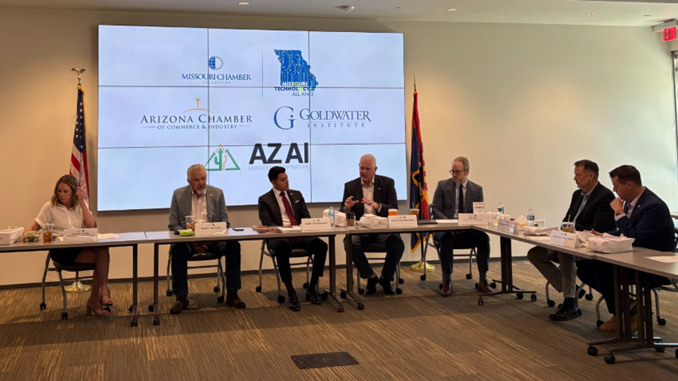
The Arizona Chamber of Commerce & Industry and the Goldwater Institute hosted a delegation of Missouri policymakers in Phoenix to discuss economic competitiveness, innovation, and pro-growth policy, according to a joint release.
The meeting focused on Arizona’s approach to building a competitive environment for emerging industries and long-term economic growth.
The discussion followed the Chamber’s recent launch of its AZ AI Leadership Initiative, which aims to strengthen Arizona’s position in emerging technologies and the broader digital economy.
Arizona has seen rapid expansion in AI and data center infrastructure, driven by growing demand for computing power and cloud services. Major investments from companies such as Taiwan Semiconductor Manufacturing Company (TSMC), which is constructing advanced semiconductor fabrication facilities in Phoenix, along with large-scale data center developments by Google and Meta Platforms in Mesa, and Amazon Web Services in Goodyear, have helped position the state as an emerging hub for both semiconductor production and AI-related computing capacity.
Participants included legislative leaders, policy experts, and representatives from the Arizona Commerce Authority, who shared insights into the state’s policy framework and economic development strategies.
A big part of the conversation: how states are thinking about AI and the broader digital economy.
“Arizona’s growth didn’t happen by accident,” said Courtney Coolidge, executive vice president of the Arizona Chamber of Commerce & Industry. “It reflects deliberate policy choices that prioritize certainty, competitiveness, and a regulatory environment where businesses can invest, innovate, and scale.”
Arizona lawmakers participating in the meeting included House Speaker Steve Montenegro (R-LD29), Majority Leader Michael Carbone (R-LD25), Rep. Jeff Weninger (R-LD13), Rep. Justin Wilmeth (R-LD2), chair of the House Artificial Intelligence and Innovation Committee, Senate President Pro Tempore T.J. Shope (R-LD16), and Senate Majority Whip Frank Carroll (R-LD28).
“Arizona has made a conscious decision to lead on innovation rather than wait for other states to set the pace,” Montenegro said. “That kind of alignment and forward-looking policy environment allows industries to grow and scale here.”
Lawmakers and policy leaders highlighted sectors including advanced manufacturing, semiconductors, aerospace, autonomous systems, and emerging technologies as areas where Arizona has seen sustained growth.
“Arizona’s success in attracting major investment is tied directly to our focus on advanced manufacturing, infrastructure, and supply chain strength,” Carbone said.
Weninger pointed to Arizona’s regulatory and tax structure as a factor in business investment.
“Companies are looking for certainty,” Weninger said. “Arizona’s predictable regulatory environment and competitive tax structure give businesses the confidence to invest and expand.”
Participants also discussed the role of infrastructure, water policy, and land use in supporting statewide growth. “We’ve been intentional about making sure economic development isn’t concentrated in one region,” Shope said.
Carroll said Arizona’s approach to economic development has positioned the state for continued expansion, particularly in emerging industries.
Wilmeth emphasized the importance of flexibility in regulating new technologies. “We’ve taken a thoughtful approach to emerging technologies by avoiding premature regulation,” he said.
Victor Riches, president and CEO of the Goldwater Institute, said policy certainty and deregulation remain key factors in supporting innovation.
“As emerging technologies continue to reshape industries, policy certainty and deregulation matter more than ever,” Riches said. “Arizona needs to ensure an environment where innovation can move forward.”
The Missouri delegation included state senators and policy advisors, including Sen. Travis Fitzwater, Sen. Maggie Nurrenbern, Sen. Karla May, Sen. Barbara Anne Washington, Sen. Jamie Burger, policy advisor to Gov. Mike Kehoe, Johnathan Shifflett, and representatives from the Missouri Chamber of Commerce, Karen Buschmann, and Jared Hankinson.
The meeting explored how elements of Arizona’s economic policy framework could be adapted in other states and how interstate collaboration could support broader economic growth.
Nothing undermines confidence in elections quite like discovering they can be compromised by foreign billionaires or botched altogether through complex schemes like ranked-choice voting.
This year, legislatures across the country took aim at both of these urgent threats to election integrity, as outlined by a recent report from Honest Elections Project. Altogether, eight states closed a critical legal loophole allowing foreign billionaires to flood ballot measure campaigns with foreign dark money. Meanwhile, six more states banned ranked-choice voting, the most legislative bans in a single year. In other words, conservative states have made 2025 a banner year for election reform.
Most Americans would be shocked to learn how vulnerable our elections are to foreign influence. Federal law forbids foreign nationals from donating to candidates or political parties yet offers no such protection for state or local ballot measures. This means that a foreign billionaire cannot influence a particular race, but he can spend millions to pass a constitutional amendment that rewrites the rules of the entire election system.
That loophole has been a gift to Swiss billionaire Hansjörg Wyss. According to the watchdog group Americans for Public Trust, Wyss has directed roughly $280 million into the Sixteen Thirty Fund, which has simultaneously spent more than $130 million in foreign-tied funds into ballot campaigns in 26 states. As shocking as these figures are, they likely represent the tip of the iceberg. After all, the same loophole can just as easily be abused by foreign nationals doing the bidding of China and Russia.
Fortunately, conservative states are taking action to ensure that ballot measures are no longer a Trojan Horse for foreign interference. After Ohio led the way in 2024, eight states this year—Arkansas, Indiana, Kansas, Kentucky, Louisiana, Missouri, Tennessee, and Wyoming—enacted new laws to ban foreign nationals and the groups they finance from funding ballot measure campaigns. Even Kentucky’s Democratic governor signed the bill into law, proof that defending elections from foreign influence should not be a partisan proposition.
That hasn’t stopped many on the left from fighting to keep these loopholes open for purely partisan gain. Marc Elias, Democrats’ top election lawyer, went to court in Ohio in 2024 and again in Kansas this year to block these bans. He lost both times, once in front of an Obama-appointed judge. States clearly have the authority to ban foreign funding, and every state should.
The same is true of ranked-choice voting, and 2025 was an incredible year in the ongoing fight to stop its spread.
Under ranked-choice voting, voters are asked to rank multiple candidates. Ballots are counted in rounds as losing candidates are eliminated and votes are redistributed. If a voter fails to rank enough candidates, the ballot is “exhausted” and thrown out. Candidates can win the most first-place votes but lose the election. Delays are inevitable; Alaska’s ranked-choice voting tabulation does not even begin until 15 days after Election Day. In California, a tabulation error once led to the wrong candidate being certified. Ranked-choice voting turns what should be a straightforward election into a complicated black box.
Fortunately, the public has seen the problems with this system from the start. In 2024, ranked-choice voting advocates spent nearly $100 million dollars on ballot measures promoting the scheme in six states. All failed. Only the District of Columbia adopted it, which is hardly a ringing endorsement.
Between 2022 and 2024, 11 states banned ranked-choice voting. And this year, six more – Arkansas, Iowa, Kansas, North Dakota, West Virginia, and Wyoming – acted to make the scheme illegal. And in Utah, lawmakers allowed a failed pilot program to expire, meaning ranked-choice voting will come to an end there, too.
As extraordinary as this progress is, conservatives must not become complacent. States like Michigan, Florida, Nebraska, North Carolina, Montana, and Arizona have all seen significant amounts of foreign-tied money pumped into ballot issue campaigns, but so far have not acted. And progressives remain committed to pushing ranked-choice voting, especially after witnessing the scheme elevate a Democratic Socialist in New York. Ranked-choice voting lobbyists are working legislatures nationwide, and activists are already gathering signatures for another ballot measure in the presidential battleground of Michigan.
That should serve as a warning. When it comes to securing our elections, the job is never done. This was a banner year for election integrity. Conservative leaders must keep the momentum going in 2026 and beyond.
A partisan effort to make it harder for fossil fuel-based energy companies to obtain bank financing and banking services prompted a warning letter to the U.S. banking industry on Nov. 22 from the top financial officers of several states, including Arizona.
“Denying banking services to traditional, reliable energy production industries simply to advance radical, socialist policies from the White House, is both immoral and goes against the very free market principles that our country was founded upon,” said Arizona Treasurer Kimberly Yee in announcing the letter. “In this case, they are picking the energy industry as the losers and that goes against the free marketplace in America.”
Yee joined the financial officers of Alabama, Arkansas, Idaho, Kentucky, Louisiana, Missouri, Nebraska, North Dakota, South Carolina, South Dakota, Texas, Utah, West Virginia, and Wyoming in signing the letter, cautioning the banking industry of potential consequences for allowing itself to be used as a political pawn against law-abiding companies in the coal, oil, and natural gas industries.
According to the letter, the Biden Administration is “pressuring U.S. banks and financial institutions to limit, encumber, or outright refuse financing for traditional energy production companies.” The White House is also supporting an end to American financial support for traditional energy production projects in developing countries around the world, “likely ceding future development and exploration to Chinese interests,” the letter states.
“We believe, as almost all Americans do, that the free market should remain free and not be manipulated to advance social agendas,” the letter states. “We are not asking for special treatment of the fossil fuel industries. To the contrary, we simply want financial institutions to assess fossil fuel businesses as other legal businesses – without prejudice or preference.”
The letter also says the states have a compelling government interest “to select financial institutions that are not engaged in tactics to harm the very people whose money they are handling.”
Each state will undertake its own actions to counter the “undue pressure” being placed on the banking industry, according to the letter. Yee has not outlined what steps her office might take if financial institutions which do business with the state engage in efforts to deny services to the energy industry.