by Elizabeth Troutman | Jan 11, 2024 | News
By Elizabeth Troutman |
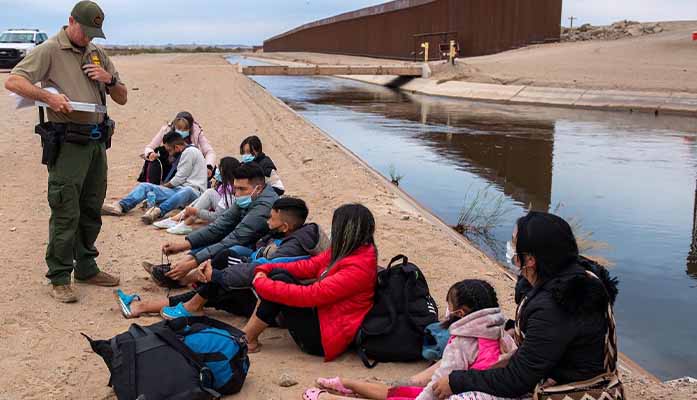
America should deny demands from Mexico for billions of dollars in order to stop the flow of illegal immigration, according to U.S. Senate candidate Mark Lamb on Tuesday.
Lamb, a Republican and the current sheriff of Pinal County, Arizona, criticized Mexican President Lopez Obrador’s list of demands which the United States would need to meet in exchange for Mexico to help slow illegal immigration across the southern border.
“I consider the demands made by Mexico as DOA – dead on arrival,” Lamb said. “The last time I looked, the Mexican President doesn’t get to set U.S. domestic and foreign policy. I call upon the entire Arizona Congressional delegation to unite and publicly reject these conditions imposed by Mexico.”
Obrador demanded the U.S. give $20 billion to Latin American and Caribbean countries; grant work visas to 10 million Hispanics who have worked in the U.S. for at least 10 years; and end sanctions against Venezuela and halt the blockade of Cuba.
Mexico is responsible for slowing illegal immigration into America, according to Lamb.
“As our southern neighbor, the responsibility is on them to do everything they can to work with us – without preconditions – to stop the hundreds of thousands of illegals crossing our mutual border,” Lamb said. “We shouldn’t take kindly to having a gun put to our head just to have Mexico do what’s right.”
Lamb said the Mexican president’s demands are an example of President Joe Biden’s “lost control of the border.”
Border Patrol encountered 2.5 million migrants on the U.S.-Mexico border in fiscal year 2023, topping the previous year’s record, according to the Migration Policy Institute.
“It’s bad enough that Biden doesn’t have a plan to stop the hundreds of thousands of illegals crossing the border and the fentanyl that comes with them, now Biden is allowing our nation to be held hostage by the President of Mexico,” Lamb continued.
Lamb is running for Sen. Kyrsten Sinema’s seat. He has said that if elected, he will work to secure the border with Trump-era policies.
“We’ve got to shut the border down, secure the border and we’ve got to restore the ‘Remain in Mexico’ program,” Lamb told Fox News.
“We’re gonna have a mass deportation situation on our hands and so we’ve got to get back to securing the border – first and foremost – which would stop the fentanyl,” Lamb continued to Fox News. “It would weaken the cartels and allow border patrol to get back to doing their jobs because right now they are completely handcuffed.”
Elizabeth Troutman is a reporter for AZ Free News. You can send her news tips using this link.
by Daniel Stefanski | Dec 27, 2023 | News
By Daniel Stefanski |
Arizona’s top business organization is speaking out against a closure of two significant border crossings in Texas.
Last week week, the Arizona Chamber of Commerce and Industry issued a statement on “X” after the U.S. Customs and Border Protection (CBP) announced its suspension of rail operations in Eagle Pass and El Paso, Texas, due to the massive influx of illegal immigration all along the southern border. In the press release sharing the news, CBP stated that it was “taking additional actions to surge personnel and address (the) concerning development (of) a recent resurgence of smuggling organizations moving migrants through Mexico via freight trains.”
The Chamber’s “X” account said, “Rail crossing closures in Texas affect commerce border-wide, including here in AZ. We’re in a busy shipping/shopping season. We’ve already seen how Lukeville’s closure has affected cross-border commerce. The U.S. Department of Homeland Security should protect our supply chains and reverse these closures.”
In an opinion piece published in the Chamber Business News, AZ Chamber President and CEO Danny Seiden, along with the President and CEO of the Texas Association of Business, Glen Hamer, warned of the negative business and economic consequences of the increasing number of closures at the border, calling these actions “unacceptable.” The two men wrote that these closures “damage cross-border trade….cause shipping delays and cost increases, which get passed along to consumers in the form of higher prices on store shelves….make travel more difficult for folks who want to visit friends and family or simply run errands, and … cut off small businesses from their customers.”
Seiden and Hamer gave four recommendations at the end of their piece, including one for the government to prioritize “processing of legitimate trade and travel over migrants with dubious amnesty claims.”
Over the past few months, the border crisis has deteriorated considerably, forcing the Biden Administration to take rather unprecedented measures in a frenzied attempt to mitigate public perception of the massive influx of illegal immigrants into the country. One of those actions was the closure of the Lukeville Port of Entry, which is the main thoroughfare to the popular tourist destination of Rocky Point, forcing families or commerce operators to detour hours to the east or west. A local business owner recently told an Arizona outlet that, in the aftermath of the closure, Rocky Point “was like a little ghost town,” noting that “local business, restaurants, hotels, rentals, everything has declined.”
With no end in sight to the historic wave of illegal immigration, and no word on whether the Lukeville, Eagle Pass, and El Paso border operations will be reopened for business, many are wondering when and where the next major economic disruption will take place as the government searches for answers to solve this crisis.
Daniel Stefanski is a reporter for AZ Free News. You can send him news tips using this link.
by Corinne Murdock | Aug 13, 2023 | News
By Corinne Murdock |
Come February 2024, travelers can book a direct flight from Phoenix to the one of the world’s deadliest cities: Tijuana, Mexico.
Phoenix Sky Harbor Airport announced late last month that American Airlines will begin offering the direct flights to Tijuana.
Phoenix Mayor Kate Gallego hailed the move as an economic boost.
“This new connection will ultimately strengthen our tourism industry, support business, and create more job opportunities for Phoenicians,” said Gallego.
The Citizens Council for Public Security and Criminal Justice, a Mexican organization, reported that Tijuana had the fifth-highest murder rate of 105 for every 100,000 residents in 2022 (there were nearly 2,200 homicides in one year per two million residents). Nine of the ten deadliest cities worldwide were located in Mexico.
In May, the Baja California’s State Attorney General’s Office reported over 600 murders from this January to April.
The one city to make the top-ten ranking that wasn’t located in Mexico was New Orleans, Louisiana at eighth. Baltimore, Maryland ranked 17th; Detroit, Michigan ranked 23rd; Memphis, Tennessee ranked 25th; Cleveland, Ohio ranked 27th; Milwaukee, Wisconsin ranked 39th; and Philadelphia, Pennsylvania ranked 46th.
Located in Tijuana is the New Generation Tijuana Cartel, or Tijuana Cartel, formerly the Arellano-Félix Organization (AFO), allied with the Jalisco New Generation Cartel: one of the two leading cartels responsible for the deadly drug epidemic in the U.S. The other is their rival, the Sinaloa Cartel.
Drug smuggling has become an issue on passenger flights; reports identified American Airlines flights among those used to traffic drugs. In May, the American Airlines mechanic was convicted for drug smuggling.
Customs and Border Protection (CBP) stated in a report last year that cartels have internal conspirators within airlines that assist in smuggling the drugs. Ramon Santaliz, a CBP Aircraft Search Team officer, said he’s seen traffickers posing as all sorts of figures. They store the drugs anywhere imaginable: checked luggage, life vests, bathroom waste tanks, galley carts, garbage cans, toilet paper rolls, aircraft computer cabinets, pilot seats, wing spars, even first class armrests.
“It could be the caterers, cleaners, mechanics, baggage handlers, flight crew, or even the security guards. Money moves a lot of people,” said Santaliz. “The aircraft is its own contained world. [Drugs] could be anywhere on the aircraft — from the tip of the nose all the way to the tail because there are hidden spaces everywhere.”
CBP conducts its drug seizure tactics using a mix of trends and chance. Officers review flight schedules and will “randomly” select flights to search. Airlines pay fines of $1,000 an ounce for any drugs discovered during CBP searches.
Last August, the U.S. Consulate issued a “shelter in place” advisory for Americans residing in Tijuana after dozens of people were killed amid a fight between the Jalisco and Sinaloa Cartels. The advisory succeeded former Gov. Doug Ducey’s executive order to finish the border wall by several hours. The violence prompted the descent of military reinforcements to the area.
In recent months, local cartels have engaged in violent public conflict over control of strip clubs, brothels, and bars within Tijuana’s Zona Norte. One confrontation earlier this month resulted in a deadly shootout, with two dead.
In addition to Tijuana, American Airlines will also offer daily flights to Guadalajara, Mexico.
Corinne Murdock is a reporter for AZ Free News. Follow her latest on Twitter, or email tips to corinne@azfreenews.com.
by Corinne Murdock | Jun 21, 2023 | News
By Corinne Murdock |
Over the weekend, the Arizona Republic featured an opinion article from an illegal immigrant activist advocating for citizenship rights for himself and others.
The illegal immigrant activist, Arizona State University (ASU) college student Angel Palazuelos, interns with the illegal immigrant activist group Aliento. Palazuelos refers to himself as “undocumented,” a euphemism for those who remain illegally in America after immigrating illegally.
“I belong here. This is my home, and I have done more than enough to prove it,” wrote Palazuelos. “The struggles of undocumented individuals like me are often overlooked in the broader conversation.”
Palazuelos is a rising senior at ASU, where he studies biomedical engineering. He receives in-state tuition rates due to the recent passage of Proposition 308, a leftist dark money-backed ballot initiative which conferred the benefits of reduced tuition rates to illegal immigrants.
Palazuelos has also served as the face for advancing illegal immigration reform for years. Prior to joining up with Aliento, Palazuelos said his dream was to become a mechanical engineer. Now, he hopes his activist efforts will enable him to become an immigration lawyer.
In 2020, the New York Times featured Palazuelos following his high school graduation, depicting him as a youth whose “life has been punctuated with uncertainty, anxiety, and fear.”
The author of the Palazuelos feature, Fernanda Santos, writes currently for The Washington Post, teaches at ASU’s Walter Cronkite School of Journalism, and serves as the editorial director for the Futuro Media Group.
In a 2021 interview with ASU’s student newspaper, Palazuelos complained that he had to find outside scholarships to afford college since he didn’t qualify for in-state tuition rates. Four months later, Palazuelos received financial aid from the governments of both his home country and the U.S.: he received $5,500 as one of the 30 recipients of the Empowering Diversity Scholarship issued by the Blue Cross Blue Shield of Arizona and Fiesta Bowl. Palazuelos also received $2,000 from the Mexican Consulate in Phoenix and the nonprofit Friendly House. The Mexican Consulate funding comes from the Mexican government’s Institute for Mexicans Abroad, which is then applied by individual, U.S.-based consulates.
Earlier in 2021, Palazuelos claimed in an Aliento video feature that his dreams of studying engineering were “crushed” because of his immigration status.
Now, in anticipation of soon graduating with his engineering degree, Palazuelos said he plans on attending law school to become an immigration attorney. However, Palazuelos claimed that current employment laws prevent him from working, or even receiving an internship. Palazuelos has been admitted to multiple internships and programs throughout his life.
Palazuelos met with Gov. Katie Hobbs in February to lobby for the “Promise for Dreamers” program. Hobbs’ plan would set aside $40 million for college scholarships for illegal immigrants. On average, over 3,600 illegal immigrant youth graduate from Arizona high schools annually.
READ: GOV. HOBBS WANTS TO COVER ILLEGAL IMMIGRANTS’ TUITION
According to Palazuelos’ most recent testimony, when he was five years old his family immigrated illegally from Culiacán Sinaloa, Mexico into the country exactly three days after the deadline to qualify for the Deferred Action for Childhood Arrivals (DACA) program instituted by former President Barack Obama. He claimed to not be a DACA recipient, though on social media and in interviews he refers to himself as a “dreamer” — the descriptor used to identify DACA recipients. Palazuelos also identified himself as a DACA recipient for a feature article by ASU’s marketing team in 2020.
That’s not the only inconsistency: elsewhere, Palazuelos claims he immigrated when he was four, then five, then six years old. His timeline for missing DACA eligibility has also shifted: in a 2021 article, Palazuelos told the Arizona Republic that his family missed the deadline by two days, not three. Yet in 2020, Palazuelos told the New York Times that he qualified for the program and intended to apply, but was unable to because the Trump administration rescinded DACA.
Aliento, the organization where Palazuelo served as both an intern and a fellow, was co-founded by a DACA recipient: Reyna Montoya. Like Palazuelo, Montoya also attended ASU; she graduated with political science and transborder studies degrees, then a master’s degree in secondary education.
Also like Palazuelo, Montoya lamented the consequences of illegal immigration. Montoya founded Aliento in 2016, claiming “compounded trauma and education barriers” from growing up as a DACA recipient. Montoya was 10 years old when her mother smuggled her from Tijuana, Mexico to Arizona.
In the summer of 2021, the Arizona House awarded Aliento for advocating for in-state tuition for illegal immigrants. Aliento leadership also has ties to the liberal think tank behind the cover-up of Hunter Biden’s corruption.
In his opinion article over the weekend, Palazuelos petitioned Congress to confer permanent citizenship to himself, his family, and other illegal immigrants like them.
The taxpayer-borne cost of educating illegal immigrants is nearing the billions annually. In 2020, the most recent data available, illegal immigrant children cost Arizona public schools over $748 million. 99 percent of those funds came from local and state taxes, not the federal government.
Palazuelos’ mother, Daisy, claimed in an interview with Aliento that her children have “suffered” because of immigration law. Daisy issued her remarks in Spanish.
“[M]y children and our, as a whole community, has already suffered enough,” said Daisy. “This is not just. This is an opportunity we cannot wait for. We need it now.”
It’s unclear what suffering Palazuelos endured.
He revealed across his many media interviews over the years that his high school experience lacked for nothing. All while reportedly maintaining a 4.7 GPA, Palazuelos was able to take honors and Advanced Placement (AP) classes, as well as enjoy a wide variety of extracurriculars in high school. Palazuelos also delivered a speech to his graduating class.
Palazuelos played volleyball, baseball, and cross-country; he participated in an engineering CTE program where he was certified through programs like SolidWorks and AutoCAD; he served as president for his school’s Spanish Honor Society; he was a member of the National Honor Society, Science National Honor Society, Mathematics Honor Society, Movimiento Estudiantil Chicanx de Aztlan (MEChA), the ACLU of Arizona; and he served as a student strategist for the Presidents’ Alliance on Higher Education and Immigration.
Palazuelos also interned for Puente Human Rights Movement, and participated in a Harvard University summer program, Summer Business Academy. Palazuelos successfully crowdfunded the $2,000 to pay for the program.
Puente Human Rights Movement allegedly assisted Palazuelos in a petition to remove school resource officers off Phoenix Union High School District campuses, for which Palazuelos alleged to The New York Times that he was threatened with deportation. Palazuelos also led demonstrations at the Phoenix Police Department and the ICE detention center.
“The system is the one we need to dismantle,” said Palazuelos in a 2020 ASU feature interview.
“Being undocumented is knowing that despite doing everything right, you will never be ‘qualified,’” stated Palazuelos.
Corinne Murdock is a reporter for AZ Free News. Follow her latest on Twitter, or email tips to corinne@azfreenews.com.
by Terri Jo Neff | Apr 1, 2023 | Economy, News
By Terri Jo Neff |
An Arizona company has announced plans to ship African-mined cobalt to Mexico, then truck it north to be processed at a new, state-of-the-art facility in Yuma County so it can be sold to companies that make batteries for Electric Vehicles (EVs).
EVelution Energy is expected to start construction of its Yuma cobalt processing facility next year, with a goal of being operational no later than early 2026. It forecasts more than 1,000 construction phase jobs, along with 60 direct and 300 indirect jobs once the facility is fully functional.
Cobalt is a rare, ferromagnetic metal primarily used in lithium-ion batteries and in the manufacture of magnetic, high-strength alloys. Dating back to 3000 BC, cobalt was mostly used for its blue coloring in the making of ceramics and glass.
Other uses were limited due to the fact arsenic fumes are a by-product of smelting. But new processing methods in the last few decades changed all of that.
In March, the Yuma County Board of Supervisors unanimously approved a special-use permit allowing EVelution to move forward with construction on 139 acres just east of the City of Yuma and south of the Kofa National Wildlife Refuge.
The property, which spans Union Pacific Railroad tracks and U.S. Interstate 8, is located within one of Arizona’s Qualified Opportunity Zones which provide a wide range of tax incentives for private, long-term investments in economically distressed communities.
There are also various federal economic development incentives currently available for EVelution Energy’s project, such as the Inflation Reduction Act and the Infrastructure Investment and Jobs Act.
According to the U.S. Geological Survey, nearly two-thirds of all mined cobalt (150,000 tonnes in 2019) comes from the Democratic Republic of the Congo (100,000 tonnes in 2019). The USGS also estimates there is about 4 million tonnes of cobalt reserves on the African continent, and another 3 million tonnes globally.
EVelution plans to transport cobalt hydroxide feedstock sourced from the Democratic Republic of the Congo to a port in Ensenada, Mexico, a roughly four hour trip by truck to the Yuma processing facility. And the company knows there is domestic market for its product.
Currently, more than 70 percent of the world’s battery grade cobalt is processed in China. That puts U.S.-based Electric Vehicle manufacturers overly reliant on imports.
The Yuma cobalt facility’s expected annual 7,000 tonnes capacity could meet 40 percent of the expected demand for U.S.-produced EVs in 2027.
The forecasted $55 million economic benefit from EVelution Energy’s project is very much needed, particularly in southwestern Arizona. However, two environmental concerns will be closely monitored even though Yuma County approved the company’s special use permit.
First is the sourcing and disposal of water. EVelution expects to use 74 million gallons of water per month. The water will be sourced from aquifers running under the property, likely via wells which will run more than 1,000 feet deep.
“Our water usage is therefore not expected to impact the surrounding area’s water table/groundwater,” the company says, adding that a water treatment plant will allow for about 70 percent of its used water to be recycled.
The second concern is the disposal of “tailings,” which are the unused materials which remain after processing. EVelution intends to minimize risks of potential contamination to its or surrounding land by foregoing on-site tailing ponds.
“Tailings will be collected, transported and safely disposed of at a licensed local landfill located less than 20 miles away,” the company says.
EVelution Energy is also focused on transitioning to a net zero carbon future. Getting there will mean building a 38.4 MW (peak) solar power array to power the processing plant. The company expects to use excess power from the day to recharge its battery storage.
There is also the possibility some of the excess electricity can be sold to a local power utility to service nearby agricultural companies.
“Solar power will heat the water and process solutions for hydrometallurgical cobalt processing,” according to the company’s website. ‘This heated solution will be stored at temperature in large storage tanks overnight. Using solar power rather than propane or natural gas will further reduce our carbon-footprint.”
As with most mining operations in Africa, there are concerns with the health impacts to workers and with the use of child labor. EVelution’s website shows the company is aware of those issues.
“We are committed to sourcing cobalt in a socially responsible manner, preventing child labor and to promoting respect for human rights of people employed in or affected by our cobalt supply chain,” the website states. “We plan to source our cobalt only from companies that comply with the guidelines of the Responsible Cobalt Initiative.”
EVelution’s proximity to California could lead to further revenue streams, given that state’s early acceptance of EVs.
With EV batteries being quite heavy, and thus expensive to transport, the company is “well positioned to potentially recycle EV batteries from electric vehicles that reach the end of their product lifespan,” its website notes. “The oldest electric vehicles are predominantly located in California and therefore their batteries will be in need of recycling the soonest.”
Terri Jo Neff is a reporter for AZ Free News. Follow her latest on Twitter, or send her news tips here.