Data centers are coming to Pima County, whether residents like it or not.
The Pima County Board of Supervisors has approved a new data center despite major community opposition and no end user formally lined up.
Amazon was outed earlier this summer as the longtime, unofficial end user lined up for the 290-acre data center, Project Blue, but the e-commerce giant reportedly backed out around the beginning of this month after the developer, Beale Infrastructure, nixed water cooling in favor of the more electricity-dependent air cooling process.
Amazon’s departure was uncovered during the Arizona Corporation Commission (ACC) hearing earlier this month by sources first reported on by the Arizona Daily Star. ACC approved, 4-1, a decade-long Energy Supply Agreement between Tucson Electric Power (TEP) and the developer to power Project Blue.
Beale Infrastructure made the cooling process switch after the Tucson City Council voted unanimously to deny access to their reclaimed water system back in August. Tucson Mayor Regina Romero also pledged to place limits on future data centers.
The days leading up to the council vote were filled with contentious community information meetings on the project.
Per 13 News, multiple unnamed sources told Pima County Supervisor and Tucson City Councilman Paul Cunningham that up to eight other companies expressed interest in taking Amazon’s place. Sources conflicted on whether one of the companies is Meta, or whether Meta had already backed out as Amazon had.
Project Blue’s developer, Beale Infrastructure, presented the proposed data center as both an economic driver and environmentally friendly operator: “no risks or financial burdens [will be] passed on to other customers,” their representatives promised in their presentations during the community information meetings.
Opponents argue these data centers will further strain an already stressed water supply and electric grid, ultimately leading to scarcity as well as higher fiscal and health costs for the consumer.
It was the promised economic benefits that won over the 3-2 majority of Pima County supervisors. The two supervisors against the data center, Andres Cano and Jen Allen, expressed concerns over the long-term unknown impacts on the environment and community health.
Pima County’s vote came several weeks after ACC approved Beale Infrastructure’s application for Project Blue.
Data centers are the powerhouse for platforms covering virtually every aspect of modern life online: government, streaming, remote work, cloud storage, e-commerce, education, finance, and healthcare.
An independent Economic Impact Study on Project Blue projects a $3.6 billion total capital investment, $250 million in tax revenues, 180 new jobs by 2029, and over 3,000 direct construction jobs during the building phase.
The project will be located north of Pima County Fairgrounds, at the I-10 and Houghton interchange. The development site is over a mile away from the nearest resident, located within an unincorporated area that’s part of the Southeast Employment & Logistics Center.
Beale Infrastructure is also moving on another, equally controversial data center development in Marana totaling 600 acres. Two rezoning applications were filed recently for potential data center development: Luckett North and Luckett South. Earlier this month, the town’s planning commission recommended rezoning for development.
As with Project Blue, the closest resident lives about a mile away from the proposed data center campus. It will also be an air-cooled facility.
In preparation for consideration of the data center, town officials produced two podcast episodes on the town’s data center ordinance and potential for development.
Marana Town Council is scheduled to consider the data center project on Jan. 6, 2026. Progress on the project is available for viewing on the town’s development projects and activity portal.
AZ Free News is your #1 source for Arizona news and politics. You can send us news tips using this link.
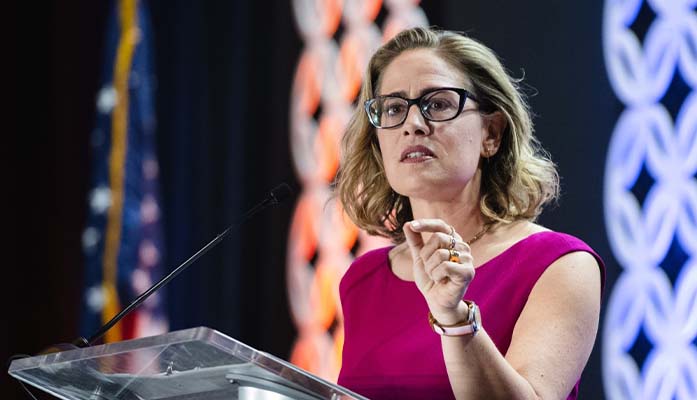
Former Senator Kyrsten Sinema claims she’s not a lobbyist, but her emails tell a different story.
Emails uncovered by FOIAzona revealed Sinema’s lobbying for a major new AI data center in Chandler.
When Sinema joined Hogan Lovells, global law and lobbying firm, as senior counsel back in March, she told reporters she wasn’t registering as a lobbyist. Sinema is also an advisory council member for Coinbase Global, a cryptocurrency company; and president and CEO of Arizona Business Roundtable.
Federal law requiring a “cooling off” period for former representatives and senators doesn’t apply to lobbying at local levels — only lobbying in Congress.
The federal lobbyist system doesn’t have Sinema registered. However it does have the registration of Hogan Lovell’s policy advisor: her former congressional aide, Daniel Winkler.
Emails revealed that Sinema met with Chandler council members in mid-June to discuss the data center. Following that meeting, Sinema used her Hogan Lovells email to push plan proposals for the data center to six city officials: a development agreement and a white paper advocating for AI data centers as an economic boon. Her emails to city officials were consistent thereafter.
“Single User – We demo the property and leave the front part open to attract the single use that [City Manager] Micah [Miranda] envisions. We build only the data center and the north building at the same time. R&D buildings along Dobson – We commence construction of these two eastern buildings within 18 months of C of O of data center. This gives Micah the time to attract a single user, but we still will process plans for these two buildings in the meantime to hit the 18 month mark. This leave the middle portion open to still attract a single user and build to suit. Full buildout – We commence spec construction of the middle building within 36 months of C of O of data center. This gives Micah the time to attract a single user, or a middle user but we still will process plans for all the buildings to hit the 36 month mark.”
Councilmember Matt Orlando then met with Sinema and Winkler in early August.
About a week later, Sinema was attempting to get the ear of another member of the council, Jennifer Hawkins.
In the days that followed, Orlando advised the city manager and economic development director that councilmembers were receiving constant communications about AI, and directed the pair to reach out to Sinema for possible development sites.
“We should not only look at the old Northrop Grumman site, but at the airport and other areas of our community for many AI clusters,” said Orlando. “We need to look at the economic model of such complexes. Please get with Kirsten [sic] Sinema, our existing companies and others in the industry and get us some ideas for a truly strategic plan to position our city for the future.”
The city’s economic development director advised in September that there wasn’t “any definitive cause relationship” between AI data centers and the desired location site for companies.
Then came the widely reported day in mid-October when Sinema argued for the data center at the Chandler Planning and Zoning Commission meeting.
It was there that Sinema threatened to use the power of the Trump administration against the city should they not approve the data center.
“[My coalition] works hand-in-glove with the Trump administration as we prepare for AI American dominance,” said Sinema. “We all know that the innovation campus has been vacant for over seven years. What I’d like you to know today is this: if we choose not to move forward with this development, the land will continue to sit vacant until federal preemption occurs.”
Sinema argued on behalf of the data center developer Active Infrastructure. She presented herself as the founder and co-chair of the AI Infrastructure Coalition (AIC), which formally launched with a swanky D.C. party last month.
AIC members include Andreeseen Horowitz, Cisco, ExxonMobil, Google, Lumen, Meta, Microsoft, and Pinnacle West. AIC’s executive director, Brian Walsh, formerly led the Congressional Leadership Fund and America First Action.
NEW – 🚨@KyrstenSinema claimed she's "not a lobbyist" … but I obtained internal emails from @CityOfChandler suggesting otherwise
For months, Sinema & her DC lobbying firm have been strong-arming the City to approve a massive AI data center
A dark money, globalist climate group poised to obtain power over U.S. defense contracts has Arizona roots.
Last November, the Biden administration proposed granting decision-making power on defense contracts to the Science Based Targets initiative (SBTi): a London, England-based environmentalist group. In mid-February, a key initiative to SBTi called the Advanced and Indirect Mitigation (AIM) Platform launched at GreenBiz 23 in Scottsdale.
According to a press release, the AIM Platform will provide net-zero carbon value chain mitigation for SBTi and the GHG Protocol. Value chain mitigation determines the greenhouse gas emissions of each aspect of a company in an effort to reduce it; SBTi is also advancing a successor of the concept, called “beyond value chain mitigation,” or BVCM.
AIM Governing Committee members are Alexia Kelly, High Tide Foundation; Devon Lake, META; Kelley Kizzier, Bezos Earth Fund (Amazon founder, executive chairman, and former CEO Jeff Bezos); Mandy Rambharos, EDF; Tim Juliani, World Wildlife Fund (WWF); Derik Broekhoff, Stockholm Environment Institute (SEI); Graham Winkelman, BHP; Dan Smith, Smart Freight Center; Elena Schmidt, Roundtable on Sustainable Biomaterials (RSB); Lisa Spetz, H&M Group; Meinrad Bürer, Louis Dreyfus Company; Peter Skovly, MAERSK; and Pierre Bloch, Sustaincert.
SBTi funders include the Bezos Earth Fund, Bloomberg Philanthropies, Rockefeller Philanthropy Advisors, IKEA Foundation, and Laudes Foundation. The initiative is a collaboration by the Carbon Disclosure Project, World Resources Institute, and WWF, an outgrowth of the leftist dark money initiative called “We Mean Business Coalition” fronting the New Venture Fund: an arm of one of the leading leftist dark money networks, Arabella Advisors.
Washington Free Beaconreported that SBTi didn’t officially incorporate until June, though it launched in 2015. SBTi could receive around $1.2 million in annual estimated fees for their services.
The AIM Platform creators were the Gold Standard, a Switzerland-based, climate-focused finance group; Center for Climate and Energy Solutions (C2ES), a Virginia-based climate policy think tank; and Neoteric Energy & Climate, a D.C.-based climate advisory firm.
The few Americans on Gold Standard’s leadership include Scott Harder, a California native and founder of the Environmental Financial Group; Kerry Constabile, a New Yorker who formerly served as a sustainability executive for Google as well as a senior officer and lead advisor for the United Nations, and also a technical advisor for SBTi; Sue Ellen Johnson, a North Carolina agriculturalist and advisor for a number of climate groups including Gold Standard; and Lawson Henderson, a Vermont-based manager of Wildlife Works Carbon and formerly a coordinator for Rainforest Alliance.
C2ES is the successor of the Pew Center on Global Climate Change, led currently by Nathaniel Keohane: former President Barack Obama’s special assistant on energy and environment and formerly a senior vice president for the Environmental Defense Fund (EDF). The former president for C2ES was the deputy administrator for the Environmental Protection Agency under the Obama administration. C2ES and its predecessor were founded and presided over initially by Eileen Claussen, the special advisor to the president on global environmental affairs at the National Security Council and assistant secretary of state for oceans and international environmental and scientific affairs to former President Bill Clinton.
Neoteric Energy & Climate was founded in January by Kim Carnahan, the current CEO, who helped lead the State Department under both Obama and Trump on finalizing the Paris Agreement and other major emissions reductions policies with the International Maritime Organization and International Civil Aviation Organization. Carnahan also worked as the senior director for ENGIE Impact, a Washington-based sustainability consultancy company.
GreenBiz 23 was the latest in a series of annual events that have taken place in Arizona since at least 2014. Next year’s event, GreenBiz 24, will take place in Phoenix.
Featured speakers for this year’s event included Arizona State University (ASU) Morrison Institute Kyl Center for Water Policy directors Kathryn Sorensen and Sarah Porter.
Most of the other speakers over the years have represented the biggest companies worldwide. This year included representatives from 3M, Anheuser-Busch, Associated Press (AP News), BASF Chemicals, CEMEX, Coca-Cola, Cox Enterprises, Clif Bar, Deloitte Tax, Delta Airlines, Dollar Tree, eBay, Estée Lauder, Ford, General Mills, General Motors, Henkel, IBM, Intuit, Johnson & Johnson, Levi Strauss, Mars, McDonald’s, Meta (Facebook and Instagram), Microsoft, Morgan Stanley, Nasdaq, National Public Radio (NPR), NCX, NextEra Energy Resources, Nike, Paramount, Procter & Gamble, Salesforce, Seventh Generation, S&P Global, Starbucks, Under Armour, United Airlines, UPS, U.S. Steel, and Wells Fargo.
The Biden administration also sent speakers: Betty Cremmins and Katy Newhouse, directors for sustainable supply chains with the White House Council on Environmental Quality.
Corinne Murdock is a reporter for AZ Free News. Follow her latest on Twitter, or email tips to corinne@azfreenews.com.