by Matthew Holloway | Jul 26, 2025 | Education, News
By Matthew Holloway |
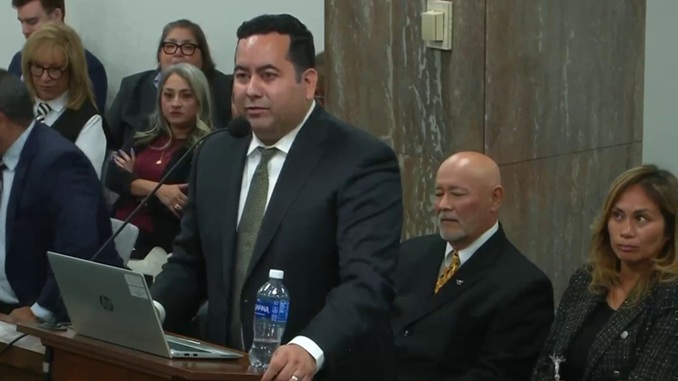
Tolleson Union High School District Superintendent Jeremy Calles found himself the subject of intense grilling at the hands of Joint Legislative Audit Committee (JLAC) Co-Chairmen Matt Gress and Mark Finchem during a three-hour hearing this week. Following the exchange, Gress told reporters that he and Finchem “will be reviewing our options with the Auditor General.”
The fiery hearing came about in response to concerns over a Tolleson Union High School District (TUHSD) leaseback deal with the Isaac Elementary School District that would see TUHSD purchase Isaac Middle School for $25 million with the elementary district then leasing the building at an interest rate of 6%.
Calles revealed in the hearing that he holds two professional roles, one as a consultant and the second as Superintendent, and he confirmed to the committee that initial conversations on the deal began in his role as a consultant.
He told the JLAC, “The first conversation I had came from a text message from, yes, the prior superintendent, Mr. Mario Ventura, who texted me and asked if I could take a look at his finances.”
Calles explained that when his district became involved, his role in the deal changed, although he claimed to have never billed for the conversation and never contracted with Isaac Elementary School District as a consultation client.
“This is not a new concept; the only thing novel on this idea is that both sides of the transaction, you have a school district. Everything else about this transaction, both sides of the transaction are not unseen,” he told lawmakers.
The Superintendent said that the agreement between the districts lacked a prepayment penalty, had no lock-in requirement, and aided the district in a financial crisis. He suggested that the benefit for TUHSD students was in generating up to $7 million in funding for the district. However, committee members balked at this suggestion, noting that although the district holds a “B” letter grade from the Arizona State Board of Education, only 30% of its students are proficient in Mathematics, English, and Language Arts.
Gress challenged him, “Here, you have not been able to demonstrate the $25 million financial transaction benefiting Tolleson Union students directly, given that you have no square footage, you’re not providing any learning services. It’s not even in your district so this is far beyond novel. I think you’ve made a mockery of our state law.”
He added, “I think you should be ashamed of yourself for the way you’ve mistreated taxpayers of Tolleson Union.”
The Superintendent was later asked by Rep. Carbone, “Why doesn’t every school district now just follow your lead and start making money and become a bank?”
In a reponse that appeared to show defiance, he said, “I don’t think every school district has a superintendent willing to stand in front of you like this.”
As reported by State 48 News, Calles confirmed that he utilizes his district office to conduct personal business during working hours. The outlet noted that under questioning it was further revealed that two members of the school district are also employed by the Superintendent through his consultancy.
When pressed to answer questions from Tolleson City Manager Reyes Medrano Jr., along with Police Chief Rudy Mendoza and former Superintendent Kino Flores regarding his conduct, including an alleged request for Tolleson to pay Calles’ real estate broker an $85,000 fee related to the district’s purchase of city land, Medrano suggested this violated state procurement laws.
“The 85 was going to be on top of the purchase price, and then we were supposed to pay the broker with it,” he told the committee. According to Medrano, Calles told him “it would be cleaner” to do so.
Calles lashed out in response, claiming the allegation “borderlines defamation.” He said in full: “I believe that borderlines defamation, the way he made that implication as if something nefarious was happening.”
Speaking with a reporter, Calles rejected the allegations saying that “they’re all lies. Do you see our improvement on the letter grade system? You see that our schools are moving up on their performance?”
The Superintendent told 12News that he expected the committee to request review of his conduct by the Arizona Auditor General and said, “When the Auditor General’s Office finally sends me someone, I’ll give them the full story.”
In a statement following the hearing, Gress said, “The hearing today revealed deeply troubling information that shows a pattern of disregard for public transparency. Combining public service with private consulting work, including using Tolleson District facilities and employees to support superintendent Calles’s consulting company reeks of corruption. Chairman Finchem and I will be reviewing our options with the auditor general.”
Matthew Holloway is a senior reporter for AZ Free News. Follow him on X for his latest stories, or email tips to Matthew@azfreenews.com.
by Jonathan Eberle | Jun 13, 2025 | News
By Jonathan Eberle |
With increasing public concern surrounding Arizona’s family court system, state lawmakers will continue their deep dive into the issue Monday, June 16, when the Joint Legislative Ad Hoc Committee on Family Court Orders reconvenes for its third hearing.
Committee Chairman Mark Finchem is inviting parents and community members who say they’ve been harmed or ignored by the family court system to testify before the panel at the Arizona State Senate. The hearing is scheduled from 9 a.m. to 5 p.m. in Senate Hearing Room 2.
“While we cannot resolve current individual cases, we must learn from them,” Finchem said in a statement. “Every story shared contributes to a clearer picture of where the system is falling short and how we can build something better for Arizona families.”
The committee is not empowered to provide legal advice, intervene in active litigation, or weigh in on ongoing cases. Instead, it is tasked with collecting public testimony to identify weaknesses and inform potential legislation for the 2026 session.
Finchem emphasized that all testimony will become part of the public record and may be subject to future public records requests. Despite these limitations, he says the hearings have already brought to light “horrific stories” that underscore the need for reform.
“Too many parents and children feel they have been silenced or dismissed by a system that’s supposed to protect them,” he said. “This is an opportunity for those voices to finally be heard and to drive real, lasting change.”
The committee will recess at noon on Monday and is tentatively scheduled to reconvene at 2 p.m., depending on the adjournment of the Senate and House floor sessions.
This session marks the third in a five-part series of public hearings focused on Arizona’s family court system. Lawmakers are expected to introduce reform proposals based on the testimony and findings from this ad hoc committee during the next legislative cycle.
Jonathan Eberle is a reporter for AZ Free News. You can send him news tips using this link.
by Jonathan Eberle | May 11, 2025 | News
By Jonathan Eberle |
A special legislative committee examining Arizona’s family court system will convene again Monday, May 12, as allegations of widespread abuse and violations of children’s civil rights take center stage.
State Senator Mark Finchem, chair of the Joint Legislative Ad Hoc Committee on Family Court Orders, is encouraging parents who have been negatively affected by the state’s family courts to testify during the second of five planned hearings.
According to Finchem, the committee has been inundated with stories from parents and children who say they have been mistreated or silenced by the court system. In a statement, he described the issue as not just a statewide concern, but a “nationwide crisis.”
“We expect to see over 400 people at the upcoming hearing after the traumatic stories we’ve heard and evidence we’ve seen,” Finchem said. “At this committee, we will address concerns over children’s civil rights being violated, unlicensed court-appointed medical ‘professionals’ infiltrating the system, and we will allow every voice to be heard.”
The committee’s investigation was launched following mounting complaints about Arizona’s family courts, which handle custody, divorce, and parental rights cases. Critics say the system too often fails to protect the best interests of children and allows unqualified professionals—such as court-appointed therapists or evaluators without proper licenses—to influence life-altering decisions.
The committee’s first hearing, held earlier this year, drew emotional testimony from parents alleging coercion, judicial overreach, and lack of due process. Lawmakers are using the hearings to gather testimony and evidence that could inform future legislation aimed at reforming family court procedures.
Arizona is not alone in facing scrutiny over its family courts. In recent years, states like California, Connecticut, and Georgia have also seen public outcries over custody rulings, allegations of judicial misconduct, and concerns about the lack of oversight of court-appointed professionals.
The committee will recess at noon and reconvene after the Senate and House floor sessions adjourn. Hearings are expected to continue through the summer, with three additional sessions scheduled before the end of the year.
Jonathan Eberle is a reporter for AZ Free News. You can send him news tips using this link.
by Jonathan Eberle | Apr 15, 2025 | News
By Jonathan Eberle |
Arizona State Senator Mark Finchem (R-LD1) has announced the formation of a Joint Legislative Ad Hoc Committee on Family Court Orders. The committee is aimed at evaluating the state’s family court system and potential reforms. The first hearing took place on Monday, April 14.
The committee, which will include both lawmakers and subject matter experts, is inviting parents and advocates to share personal stories and concerns about their experiences with family court proceedings. According to Finchem, the hearings were prompted by a growing number of complaints from families alleging that court-ordered interventions and custody decisions are inconsistent or harmful.
“I am urging those who have been impacted by the family court system to come to the Senate and make their voices heard,” said Chairman Finchem. “We want to evaluate potential legislative solutions to safeguard families and hold government and non-government agencies accountable for potentially unreasonable practices.”
The ad hoc committee will focus on a range of issues related to family court, including but not limited to custody arrangements and their long-term impact on children; the use and oversight of court-ordered therapeutic interventions; transparency and accountability of family court judges and court-appointed professionals; and the influence of external agencies and third-party service providers in custody and visitation decisions.
Finchem’s office confirmed that this will be the first in a series of five public hearings intended to gather testimony and explore whether legislative reforms are needed.
Arizona’s family court system, like those in many other states, has faced scrutiny in recent years over concerns ranging from judicial discretion in custody rulings to allegations of bias and lack of oversight for court-appointed evaluators. Critics have raised questions about the role of court-ordered therapists, parenting coordinators, and other third-party providers—especially when their involvement results in costly or extended legal battles.
Some people have also suggested that existing processes fail to properly address issues of domestic abuse, parental alienation, and financial inequities. While many of these claims are complex and deeply personal, they have prompted a broader discussion about balancing judicial discretion with accountability and protecting the well-being of children caught in contentious disputes.
Additional hearings are expected to be scheduled over the coming months as the committee works to develop findings and potential legislative recommendations.
Arizona joins a number of states nationwide that are reconsidering how family courts operate in light of evolving societal and legal expectations. Whether this effort leads to concrete policy change remains to be seen, but it represents a significant moment of public engagement with the legal system’s handling of family matters.
Jonathan Eberle is a reporter for AZ Free News. You can send him news tips using this link.
by Jonathan Eberle | Mar 8, 2025 | News
By Jonathan Eberle |
On Monday, the Arizona State Senate passed two key pieces of legislation aimed at improving the security and integrity of the state’s election system. These bills, which will now move to the House of Representatives for further consideration, seek to bolster Arizona’s efforts to prevent election fraud and increase voter confidence in the electoral process.
The two bills, SB 1123 and SB 1063, were sponsored by State Senator Mark Finchem, a vocal advocate for election reform. SB 1123 proposes a series of enhanced security measures to protect ballots from fraud and tampering, while SB 1063 focuses on expanding civic participation in the election process.
SB 1123 is a comprehensive measure that aims to implement a variety of advanced security features on Arizona’s ballots. Under the proposed legislation, election officials would be required to use at least three fraud countermeasures including watermarked security paper, secure holographic foil, and forensic fraud detection security inks, among other possible countermeasures.
According to Senator Finchem, these measures are designed to ensure that every ballot is both secure and verifiable. “Arizonans deserve fair and accurate elections, free from fraud and illegal influence,” said Finchem. “This bill was carefully crafted and is a commonsense solution that will increase voter confidence. By adding these countermeasures to our ballots, we can ensure that every vote is accurately counted, verified, and speaks to citizens and the right to exercise their franchise.”
The proposed security features are intended to make it more difficult for bad actors to manipulate or counterfeit ballots. Proponents of the bill argue that these enhancements are essential for safeguarding Arizona’s elections.
SB 1063, also sponsored by Finchem, offers a unique solution to encourage greater civic engagement. This bill allows jury commissioners to offer qualified jurors, who receive a jury summons between 120 and 90 days before a general election, the option to serve as temporary election workers instead of fulfilling their jury duty obligations.
The idea behind this measure is to increase the number of available election workers during election season, which can often be a logistical challenge. By providing citizens with the choice to participate in either jury duty or election work, the bill aims to create greater oversight during elections and reduce the risk of fraudulent activity.
“Extending civic duty services to allow citizens the choice to participate in jury duty or elections will ensure greater oversight in an effort to deter the schemes pulled by fraudsters,” said Senator Finchem. “Senate Republicans will continue to work in good-faith to provide Arizonans with much-needed reforms to uphold the integrity of our election process.”
Jonathan Eberle is a reporter for AZ Free News. You can send him news tips using this link.