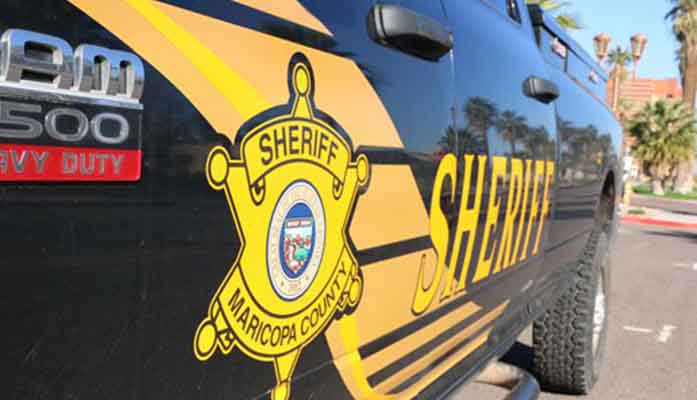
The federal government has watched over the Maricopa County Sheriff’s Office (MCSO) for well over a decade.
The Maricopa County Board of Supervisors says it’s no longer warranted.
The board filed a motion with the U.S. District Court for the District of Arizona to cease federal oversight of MCSO.
Chairman Thomas Galvin explained in a video announcing the court filing that the MCSO has not had an issue with racial profiling for years — the allegation at the heart of Melendres v. Arpaio which resulted in a federal court ruling against MCSO.
“After 14 years, four sheriffs, and hundreds of millions of spent tax dollars, it is essential to defend taxpayer money if federal oversight is no longer warranted,” said Galvin.
The county has spent over $300 million to comply with federal court orders; over $30 million in fees on a court-appointed monitor. That means every year, the county has spent around $25 million for federal oversight.
The Melendres case was a class action complaint alleging racially motivated detentions under former MCSO Sheriff Joe Arpaio. Under Arpaio, law enforcement would conduct sweeps targeting individuals suspected of being illegal immigrants, often in areas where day laborers abounded. The lead plaintiff in the class action complaint, Ortega Melendres, was detained despite having lawful presence. Other plaintiffs alleged they were stopped and questioned by law enforcement because they were Latino.
Galvin said the MCSO is “100 percent in compliance” with court-ordered policy changes, and has no evidence of ongoing civil rights violations.
The motion cited results from multiple periodic reviews, such as the Traffic Study Annual Reports from the last two years which found “no statistically significant differences between white drivers and [Hispanic drivers].”
The motion argued that MCSO hasn’t been able to devote full energy to public safety and “countless” other priorities due to the significant diversion of resources required to fund federal oversight.
“MCSO’s current practices do not violate federal law. But continued federal oversight diverts resources that could be used to serve the people of Maricopa County,” stated the motion. “It also upsets the democratic process and America’s federalist structure by making local officials accountable to a federal court — based on the conduct of a former Sheriff who has been out of office for eight years.”
Chairman Galvin characterized the county’s petition as a defense of federalism by restoring the power of accountability to voters.
“All that’s left to enforce are matters unrelated to discriminatory policing which should be left to the sheriff who was elected by you: the Maricopa County residents,” said Galvin. “In our federalist system, elected officials are accountable to voters.”
In a separate statement, Galvin said the MCSO was a “completely different agency” than when the Melendres ruling was handed down nearly 15 years ago.
“The voters held the responsible parties accountable and voted them out. Since then, MCSO disbanded immigration-related units, implemented new policies and anti-bias trainings, and is a law enforcement agency we can be proud of. Further federal oversight is unnecessary and only serves to divert taxpayer dollars away from true public safety needs,” said Galvin.
AZ Free News is your #1 source for Arizona news and politics. You can send us news tips using this link.
Maricopa County officials are asking a federal judge to rein in what they describe as years of mission creep by the court-appointed monitor overseeing reforms within the Maricopa County Sheriff’s Office (MCSO), arguing that the agency has fully complied with the policy changes required under a landmark racial-profiling case.
In a new legal filing submitted last week in Sheridan v. Melendres—a case that began nearly two decades ago over civil-rights violations during traffic stops—Board of Supervisors Chairman Thomas Galvin and Vice Chair Kate Brophy McGee contend that the county has long met the terms of the court’s orders and that continued federal intervention is no longer justified.
The filing points to a central argument: since the court issued its first injunctive order, MCSO has undergone sweeping reforms, leadership changes, and years of federal scrutiny. “Since the issuance of the Court’s first injunctive order, fourteen years have passed, three new Sheriffs have taken office (from both political parties), MCSO has achieved 100% compliance with required policy changes, and there have been zero new allegations of targeted immigration enforcement by MCSO,” the document states.
At the heart of the county’s challenge is the work of federal monitor Robert Warshaw, who has overseen MCSO’s compliance efforts for nearly 15 years. According to the filing, Warshaw and his team have collected more than $30 million in fees during that time. County leaders say they have been increasingly frustrated with what they describe as an expansion of Warshaw’s role—particularly his recent “audit” of county spending related to the case. They argue that federal oversight was intended to ensure constitutional policing practices, not to scrutinize local budgeting decisions.
“In today’s legal filing, we highlight how far the federal monitor has strayed from his original charge,” Galvin and Brophy McGee wrote in a joint statement. “Digging into county finances and trying to minimize the cost of Melendres compliance is not just an insult to taxpayers, it’s beyond the federal court’s jurisdiction.”
County attorneys note that nothing in the county’s budgeting practices violates state or federal law. For that reason, the Board says it will not participate in further disputes over compliance-related costs. The county’s brief argues that questions about staffing, budgets, and administrative costs fall squarely within local authority. Citing Supreme Court precedent, the filing asserts that “federal-court decrees must directly address and relate to the constitutional violation itself.”
The county maintains that because MCSO has reached full compliance with all policy reforms stemming from the Melendres orders—including the creation of 209 positions tied directly to those requirements—the original purpose of the decree has been fulfilled. “It would be a complete waste of taxpayer money to engage the federal courts in a back-and-forth over what is clearly an issue of local jurisdiction,” the statement reads.
Galvin and Brophy McGee say the Board’s priority is protecting taxpayers and ensuring resources are directed toward public safety needs determined at the local level. The Board of Supervisors represents roughly 4.5 million residents. “We’ll keep standing up for transparency, common sense, and your right to self-govern,” they wrote.
The federal court will now determine whether the county’s arguments warrant narrowing or ending the monitor’s authority—a decision that could significantly reshape the long-running oversight of one of the nation’s most closely watched law-enforcement reform cases.
Jonathan Eberle is a reporter for AZ Free News. You can send him news tips using this link.
On Wednesday, July 16th, I attended the quarterly public meeting held by the federal monitor overseeing the Maricopa County Sheriff’s Office, alongside Sheriff Jerry Sheridan. These meetings are intended to gather community input regarding the continued federal oversight. Historically, these sessions have been dominated by voices calling for the oversight to continue — but not anymore.
The people of Maricopa County are fed up. We’re tired of the federal government wasting taxpayer dollars, constantly shifting the goalposts, and interfering with our local law enforcement. Last week, hundreds of concerned citizens showed up to support Sheriff Sheridan and his dedicated team. And we’re not done. We will continue to make our voices heard every quarter until Judge Snow hears us loud and clear: enough is enough.
Out of thirteen mandated benchmarks from Judge Snow, the Sheriff’s Office has met twelve. The only remaining issue? Hispanic individuals, on average, experience encounters that are 17 seconds longer than individuals of other races. Seventeen seconds. That is the justification being used to prolong this multimillion-dollar oversight?
As someone who has worked in customer service, I can tell you that when a language barrier is involved, conversations naturally take longer. It’s not discrimination — it’s respect. It’s a commitment to ensuring clarity, understanding, and fairness. I would often take several minutes longer, not just seconds, to ensure someone understood important documents or procedures. That’s called good service — not racism.
Yet the ACLU and federal monitors insist this slight timing difference is grounds for continued federal control. They are actively seeking racism in places where it does not exist, undermining the professionalism and integrity of our Sheriff’s Office.
It’s time to end this charade. The citizens of Maricopa County demand the immediate termination of this federal monitoring. Let our sheriff do his job without unnecessary interference and outrageous costs.
Stop the federal monitoring of our Maricopa County Sheriff’s Office.
Lisa Everett serves as the Legislative District 29 Chair. You can follow her on X here.
Robert Warshaw, the court-appointed monitor over the Maricopa County Sheriff’s Office (MCSO), found himself challenged by Republican state and county-elected officials and over 100 attendees at a community forum with Sheriff Jerry Sheridan on Wednesday night.
GOP leaders, including Maricopa County Board of Supervisors Chairman Thomas Galvin, Supervisor Debbie Lesko, gubernatorial candidate Karrin Taylor Robson, and Maricopa County Republican Committee First Vice Chair Shelby Busch, joined the meeting with a large group of supporters of the Sheriff’s Office. The group demanded an accounting from Warshaw for the $311 million in taxpayer dollars spent over the past 11 years on the court-mandated monitoring in the racial profiling case Melendres v. Arpaio.
Supervisor Galvin shared a series of posts to X, laying out the case presented by Lesko and himself. He wrote, “Last night Supervisor @DebbieLesko gave eloquent speech at Maricopa County’s west valley meeting on federal oversight of MCSO[:] *$350 million in costs since 2007[,] *Compliance goalposts keep moving[,] *Monitor paid $2.9M last year[,] *4 sheriffs have served since lawsuit filed[.]”
“Maricopa County pays for these meetings, with taxpayer dollars, and thanks to all who showed up to participate in the public process. High turnout at any public meeting is always a good thing!”
Supervisor Mark Stewart shared video of Galvin’s remarks, initially posted by Maricopa County Attorney Rachel Mitchell, suggesting a concerted effort by the Board of Supervisors and County Attorney’s Office to pushback against the Melendres ruling.
Stewart wrote, “The time to end this decade long oversight. The men and women of the @mcsoaz Sheriffs office deserve recognition as a top tier law enforcement organization. The taxpayers expect their hard earned tax dollars to be invested in their safety. Thank you @Rachel1Mitchell for speaking out and to Chairman @ThomasGalvin for leading this effort.”
The time to end this decade long oversight.
The men and women of the @mcsoaz Sheriffs office deserve recognition as a top tier law enforcement organization.
— Mark Stewart Maricopa County Supervisor District 1 (@MarkStewart_AZ) July 17, 2025
During his remarks Galvin quipped, “Mr. Warshaw, you’re a tough man to find! In fact, this is the first time we’ve met.”
Mitchell described the scene in a post writing, “@ThomasGalvin speaking truth to the federal monitor—oversight of our elected sheriff has cost Maricopa taxpayers hundreds of millions of dollars.”
Brandon Hiller, Chief of Staff to the Maricopa County Attorney, shared an image of Warshaw resting his head on his hand during the proceedings, which reportedly became raucous at times. He wrote, “The federal monitor was not pleased with all the support for @JerrySheridan24 and @mcsoaz. Time to end the court orders. 350 million dollars later… 30 million to the federal monitor alone…”
According to KJZZ, the overall cost to the Maricopa County taxpayers to meet the ruling’s 360 requirements for the agency, related to traffic stops and internal affairs, is projected to reach $350 million this year. Warshaw told the audience that the reforms ordered by Judge Snow are not complete yet.
“This agency has made a lot of progress. A lot of progress. We’ll get to the money in a second,” Warshaw told the forum. “Is this thing going to go on forever? No, no, no.”
The monitor told attendees that an independent firm recently did a traffic-stop study of the Sheriff’s Office and found that the bias alleged in Melandres has continued and that oversight will only end after the Sheriff’s Office complies. Warshaw said that the MCSO is still facing a major backlog of internal misconduct investigations, required to be resolved within 180 days with many exceeding that timeline. Warshaw’s most recent report indicated that the department is in “full and effective compliance” with 92% of the 360 requirements in Judge Snow’s order while the misconduct investigation backlog “remains one of the biggest hurdles affecting MCSO’s ability to reach overall completion.”
Lesko was unconvinced however, and said, “I ask the judge, the federal monitor, (and) all the stakeholders to please end this madness.”
Many critics cited the cost of the federal monitoring as their chief concern. Court records show that of the $311 million cost of the lawsuit to date, $31 million has covered the monitoring fees. Warshaw defended the cost, stating that he has 13 full-time staffers monitoring the department.
Galvin was incredulous, referring to the monitoring effort’s 2025 year to date cost of $2.9 million. “We have to spend $2.9 million—you have to spend $2.9 million on Mr. Warshaw. You have to pay for this meeting tonight,” Galvin said. “Debbie and I cut the check, but you, the taxpayers, are paying for this meeting.”
In a critical move to combat the growing threat of drugs and contraband entering county jails, the Maricopa County Sheriff’s Office has deployed advanced LineV X-ray body scanners at its Intake, Transfer, and Release (ITR) Facility.
A total of 10 scanners have been acquired and will be installed across six active jail facilities. This will significantly enhance safety for staff, inmates, and the public.
Chief Mike Dawson of the Maricopa County Sheriff’s Office emphasized the scanners’ importance.
“This technology gives our detention deputies another tool in their arsenal to keep contraband out of our jails. Our mission is the care, custody, and control of inmates, which includes keeping them and our staff safe,” said Dawson.
The new LineV scanners are full-body imaging systems that emit less than 0.25 microsieverts of radiation, roughly 1/100th of the exposure of a typical chest X-ray.
Within just 90 minutes of these scanners being live at the ITR Facility, one scanner successfully detected drugs concealed in an inmate’s body cavity, an item that may have gone unnoticed.
The new scanning technology eliminates the need for most manual searches, helping to reduce contraband entry while improving the intake process.
There are three models of LineV scanner being utilized:
Conpass Smart DV, which is a dual-angle, full-body X-ray system designed specifically for correctional environments. It features radiation shutters, real-time dose metering, and strict beam containment for maximum safety.
ClearPass, a high-resolution, rapid-scanning system that produces a full body image in just three seconds, allowing for efficient and effective screening.
Clearpass Ci, a compact, mobile scanner designed for targeted inspections for specific areas such as the torso or groin.
“My goal is to stop contraband from entering the jail system altogether,” said Maricopa County Sheriff Jerry Sheridan. “So let this serve as a warning: if you are caught smuggling drugs into or within our facilities, we will be watching closely, and you will be charged. Possession of contraband drugs will result in a class two felony charge.”
Ethan Faverino is a reporter for AZ Free News. You can send him news tips using this link.