Arizona’s Legislature is about to have a new member within its ranks.
This week, Arizona Republican Party Chairman Jeff DeWit sent a letter to the Maricopa County Board of Supervisors, informing them that “on Monday, June 26, 2023, the elected Precinct Committeemen of Legislative District 2 convened a meeting to nominate three qualified electors to fill a vacancy in the legislature.”
DeWit revealed that the nominees were Shawnna Bolick, Josh Barnett, and Paul Carver.
Carver, the chairman of the Legislative District 2 Republicans, posted on his Facebook account that he is “honored to be among those chosen,” adding that “the meeting ran smooth and our LD did not disappoint with the Nominees. We are blessed in our LD to have so many amazing Patriots.”
Bolick, who served in the Arizona House before an unsuccessful run for the Republican nomination for Secretary of State in 2022, thanked the precinct committeemen who nominated her as one of the individuals for this vacancy, writing, “I honorably served my constituents at the Capitol for four years. I know what it takes to win. I am the only candidate who can hit the ground running on day one. While I was at the Capitol, I led the charge in so many policy areas with many of my bills earning bipartisan support and becoming law making me the best nominee to effectively represent LD2. I look forward to meeting with the Board of Supervisors to discuss with them why I would be the best replacement to represent Legislative District 2.”
Last night the elected Precinct Committeemen of Legislative District 2 voted to include me on a list of three names being sent to the Maricopa County Board of Supervisors to fill Senator Kaiser’s vacancy. Thank you to the PCs who recruited me and supported me in this endeavor…
— Shawnna LM Bolick (@ShawnnaLMBolick) June 27, 2023
Before he earned a coveted nomination, Barnett, who had previously run for U.S. Congress in the 2022 Republican Primary, tweeted, “I’m the one that can win in 2024 and defeat Judy Schweibert. I have the knowledge, wherewithal, & grit to get things done for the People. Some have already lost to Schweibert in past races and some have no real understanding of our 51 Constitutions. I am asking for your vote tonight to let me show you what can happen when someone is actually standing up against corruption and unapologetically using the Constitution to its fullest extent to our advantage.”
1/2 I'm the one that can win in 2024 and defeat Judy Schweibert. I have the knowledge, wherewithal, & grit to get things done for the People. Some have already lost to Schweibert in past races and some have no real understanding of our 51 Constitutions. I am asking for your vote
The legislative vacancy came about due to the sudden resignation of former Senator Steve Kaiser, who announced his plans to step down from his seat earlier this month. Kaiser’s resignation was official on June 22, giving Republican precinct committeemen in Arizona Legislative District 2 the opportunity to handpick nominees for consideration by the Maricopa County Board of Supervisors.
Legislative District 2 is expected to be very competitive in November 2024, and at least one Democrat is already eyeing the Senate seat in the next General Election. Representative Judy Schwiebert wasted little time in staking a claim to a run for the Arizona Senate, tweeting on June 16 that she would be throwing her name into the Democrat primary for this district.
Today, I am announcing my candidacy for the AZ State Senate in Legislative District 2. Now is the time to make real progress for Arizona families, so everyone gets their chance to thrive. Join our team and chip in now —> https://t.co/eqlsLuWVeRpic.twitter.com/TKI1imW0I7
— Representative Judy Schwiebert, LD2 (@JudyForAZ) June 16, 2023
The Arizona Republican Party’s Chairman thanked Carver and the precinct committeemen “for their professionalism, hard work, and dedication to ensuring a smooth, fair, and transparent process.” DeWit stated that “we anticipate a prompt appointment by the Maricopa County Board of Supervisors so that the work of the Legislature can continue.”
The Maricopa County Board of Supervisors’ role in selecting replacements for legislative vacancies has been a point of contention between them and some Republicans in the state legislature. Earlier this year, Senator J.D. Mesnard took to the floor of his chamber to address the Maricopa County Supervisors’ ongoing consideration of two legislative vacancies in both the House and the Senate. Mesnard’s frustrations boiled over on the Senate floor as he laid out his charge against the Supervisors’ alleged delay in filling the two vacancies for 19 (Senate vacancy) and 20 (House vacancy) days. He informed his colleagues that “the length of these vacancies is the longest, while we’ve been in session, in half a century – 56 years!” The East Valley lawmaker also said that 8.76 days is the historical average to fill the vacancy.
Senator Mesnard hinted that maybe his colleagues should take future action to change the statute to force the county board of supervisors to act with more urgency when filling vacancies during a legislative session.
The hint of legislation from Mesnard may be a reality in short order. On June 25, Arizona Senator Justine Wadsack tweeted, “I plan to introduce legislation that removes the power of the County BOS from choosing people to replace legislators who are Expelled or Resign. We must put the power in the hands of the PCs, who’s authority currently ends at presenting (3) candidates for the BOS to choose from.”
I plan to introduce legislation that removes the power of the County BOS from choosing people to replace legislators who are Expelled or Resign.
We must put the power in the hands of the PCs, who's authority currently ends at presenting (3) candidates for the BOS to choose from.
— AZ Senator Justine Wadsack (@Wadsack4Arizona) June 25, 2023
Freshman Representative Austin Smith suggested that this proposal could be presented to Arizona voters as a constitutional amendment – especially due to a Democrat governor who could be hostile to this idea from Republican legislators.
Likely won’t need to the governor, may need to send this to the ballot as a constitutional amendment.
After a state senator aired his frustrations with the Maricopa County Board of Supervisors, two legislative vacancies have been filled.
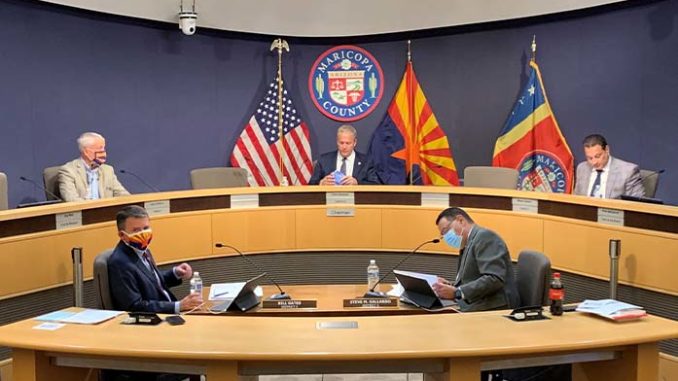
On Friday and Monday, respectively, the Maricopa County Board of Supervisors filled a vacant seat in the Arizona House of Representatives for Legislative District 13 and a vacant seat in the Senate for Legislative District 26.
Julie Willoughby was appointed for Legislative District 13. The newest House Republican fell short of victory in the 2022 election but found her way into the chamber in 2023 thanks to the expulsion of former Representative Liz Harris.
NEW: The Board of Supervisors has appointed Julie Willoughby to fill the Arizona House vacancy in Legislative District 13. Follow this link to read more: https://t.co/isQslfgZ3z
In announcing the selection of Willoughby, Maricopa Board of Supervisors Vice Chairman Jack Sellers issued the following statement: “I would like to thank the PC’s from District 13 for selecting three qualified candidates for our consideration. I interviewed all of them about important issues such as Prop 400, homelessness, water, and elections. We take this duty seriously and follow a process that includes background checks and interviews so residents can be confident in the person chosen to fill the vacant seat.”
House Speaker Ben Toma told AZ Free News, “We’re proud to welcome Representative Willoughby to the House and to be a part of our majority Republican Caucus. There is still a lot of important work for us to accomplish this session for the people of Arizona and we can’t wait to get it done.”
— Arizona House Republicans (@AZHouseGOP) May 5, 2023
Representative Flavio Bravo was appointed for Legislative District 26, opening up another vacancy to be filled in the state house. Bravo was selected after the resignation of former Senator Raquel Terán.
NEW: The Board of Supervisors has appointed Rep. Flavio Bravo to fill the Senate vacancy in Legislative District 26. Follow this link to read more: https://t.co/DOJpHFvV3i
Bravo’s appointment was also heralded by another Maricopa County Supervisor, Steve Gallardo, who stated: “I would like to thank the PC’s from District 26 for selecting three qualified candidates for our consideration. It was a difficult decision because I respect all three of these community leaders. Flavio Bravo knows this district well and will represent it vigorously in the Senate.”
— Arizona House Democrats (@AZHouseDems) May 8, 2023
The Maricopa County Board of Supervisors’ appointments came after Arizona Senator J.D. Mesnard took to the floor of his chamber to address the Board’s ongoing consideration of two legislative vacancies.
Senator Mesnard’s frustrations boiled over on the Senate floor as he laid out his charge against the Supervisors’ alleged delay in filling the two vacancies for 19 (Senate) and 20 (House) days. He informed his colleagues “the length of these vacancies is the longest, while we’ve been in session, in a half a century – 56 years!” Mesnard also said that 8.76 days is the historical average to fill the vacancy.
The East Valley lawmaker indicated that due to this historic delay, changes in statute could be on the horizon to ensure a more expedient selection by a county board of supervisors during an ongoing legislative session.
Daniel Stefanski is a reporter for AZ Free News. You can send him news tips using this link.
The animosity and distrust between the Maricopa Board of Supervisors and the Republican-led Arizona Legislature continues to deepen with a new issue finding a wedge between the two sides.
On Wednesday, Arizona Senator J.D. Mesnard took to the floor of his chamber to address the Maricopa County Supervisors’ ongoing consideration of two legislative vacancies in both the House and the Senate.
"The length of time of these vacancies is the longest, while we've been in session, in a half a century! 56 years!"
One of the vacancies is due to an expulsion of a Republican member of the Arizona House of Representatives. The other for a resignation of a Democrat member of the State Senate.
The Maricopa County Board of Supervisors is statutorily required by law to select the replacement for the vacancy from a pool of three same-party nominees chosen by their party. Republican precinct committeemen transmitted three names for the open House seat (Liz Harris, Julie Willoughby, and Steve Steele) as did the Democrats for the Senate seat (Representatives Cesar Aguilar and Flavio Bravio in addition to Quant’a Crews).
Mesnard’s frustrations boiled over on the Senate floor as he laid out his charge against the Supervisors’ alleged delay in filling the two vacancies for 19 (Senate) and 20 (House) days. He informed his colleagues “the length of these vacancies is the longest, while we’ve been in session, in a half a century – 56 years!” The East Valley lawmaker also said that 8.76 days is the historical average to fill the vacancy.
What seemed to bring Senator Mesnard to this point were some of the rumors he recounted hearing about for the reasons in the delay to fulfill the vacancies. According to the senator, “one of the rumors is there may be a belief that the county can reject all three of the nominees put forward.” The other rumor “is that (the supervisors) just want to sit on this for a while and hold out for some piece of legislation that they want to see passed” – in other words, “leverage” on the Arizona Legislature.
Senator Mesnard spoke on behalf of the 120 Republican precinct committeemen who rearranged their schedule back in April to nominate the three individuals to fill the open House seat. He bemoaned the fact that such a lengthy delay was not previously an issue, and he hinted that maybe his colleagues should take future action to change the statute to force the county board of supervisors to act with more urgency when filling vacancies during a legislative session. He stated that the “Board of Supervisors should have held a special meeting to hasten what should be an important priority for them.”
The members of the Maricopa County Board of Supervisors were definitely paying attention to Senator Mesnard’s words. Supervisor Steve Gallardo quickly responded on Twitter, writing, “Thanks for taking us all the way back to the 70s Senator. We didn’t receive nominees until the 4/18. Some didn’t respond right away to request for background info. Board is performing due diligence. As always, Arizona Senate Republicans are ignoring the facts.”
Thanks for taking us all the way back to the 70s Senator. We didn’t receive nominees until the 4/18. Some didn’t respond right away to request for background info. Board is performing due diligence. As always @AZSenateGOP are ignoring the facts. 🤣 https://t.co/JiRXnWLj0C
— Supervisor Steve Gallardo (@Steve_Gallardo) May 3, 2023
Daniel Stefanski is a reporter for AZ Free News. You can send him news tips using this link.
Downtown Phoenix’s residents experienced a glimmer of hope in the ongoing homeless crisis last month after a court declared the city to blame. If the city doesn’t appeal the court’s order, it may be the end of the massive encampment known as “The Zone.”
The decision flies in the face of the precedent set by other cities: plans and spending that yield no favorable results, ultimately forcing the residents to learn to live with the crime and squalor. Yet, Phoenix may no longer be resigned to the same fate borne by most other major cities. Downtown property and business owners were vindicated in their belief: city officials’ plans, spending, and promises alone don’t qualify as results.
Requiring results of the city could mean The Zone may cease to exist in the near future — restoring a square mile of the current wasteland of city-sanctioned slums into a healthy business district — but only if the city of Phoenix decides to follow through on the court-ordered action to resolve the homeless crisis. Cleaning up The Zone would mean finding shelter and services for around 800 homeless residing in the area, according to a census conducted by the Human Services Campus late last month.
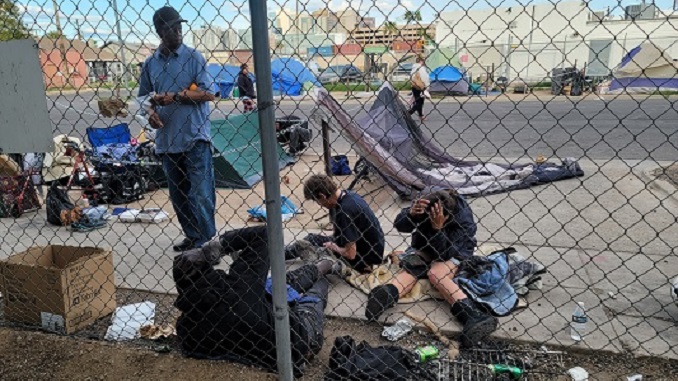
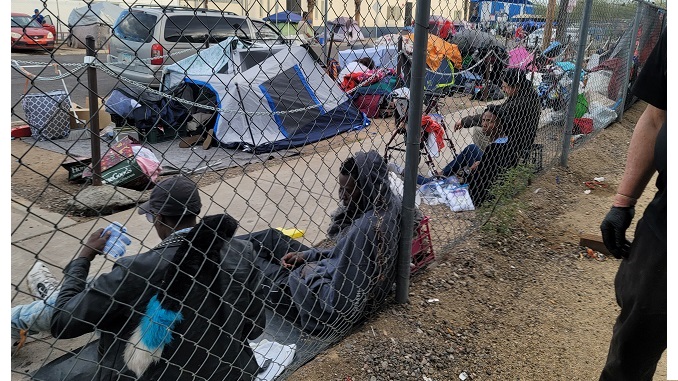
Homeless sit outside a business in The Zone.
The first bout of legal relief came for The Zone’s residents and business owners after the Maricopa County Superior Court ruled last month that the city of Phoenix was at fault for The Zone. The court ordered the city to show that it’s taking “meaningful steps” toward fixing The Zone. They have until July 10 to do so, with a trial date scheduled for June.
The ruling came days after the city of Phoenix promised to finally meet to fix The Zone, a promise prompted by back-to-back murders in the encampment.
Vice President for Legal Affairs at the Goldwater Institute, Timothy Sandefur, who submitted an amicus brief in the case, told AZ Free News that this ruling was a good first step toward remedying The Zone — but that the city has a ways to go.
“I think this is a first step and a very important one,” said Sandefur.
Sandefur said that the superior court indicated the best next steps for the city would be to build structured campgrounds and establish treatment programs, rather than continue with their current “housing first” approach.
However, notice of a settlement in a separate, federal case issued recently may complicate matters in finally getting the city of Phoenix to fix The Zone.
In the Arizona District Court case, the ACLU and the city held mediation about three weeks ago.
Details of the settlement weren’t made public. The Phoenix City Council plans to convene April 18 in an executive session — a meeting not open to the public — to discuss the terms of the settlement. At some point after, the Phoenix City Council will announce the settlement terms during a public meeting.
Of note, the city attempted to dismiss the superior court case — but not the federal case. The city also spent just shy of $100,000 fighting the superior court case.
Ilan Wurman, another lawyer on the lawsuit against the city, told AZ Free News that the court’s order to fix The Zone was thorough to the point where he imagined it would be difficult for the city to fight it.
“The court’s ruling is such a thorough victory for the business and property owners that it will be very hard for the city to overcome it at a full trial on the merits,” said Wurman. “We hope the city does the right thing and considers a settlement or simply follows through on the court’s instructions — that will save a lot of expense to taxpayers and it will be better for the unsheltered community as well.”
In remarks to the press, the city stresses that it has allocated around $140 million to solve the homeless crisis. However, there’s a difference between commitment and spending. Of the $120 million in COVID-19 relief funds received to address the homeless crisis, the city has only spent about 10 percent.
Of what little the city has spent for the homeless crisis, the Maricopa County Superior Court assessed that none of this spending has actually mitigated the crisis.
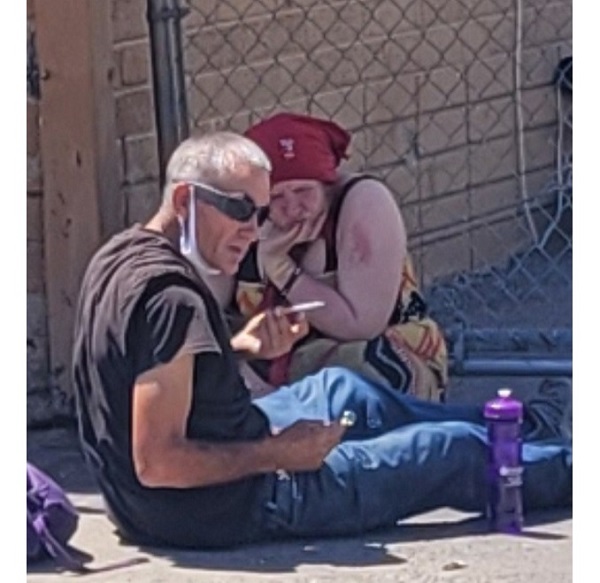
Homeless use drugs inside Phoenix’s sprawling encampment known as The Zone.
“With few exceptions, the action items about which city representatives testified centered around the creation of more bureaucracy, additional staff positions, and obtaining additional funding for programs to vaguely address homelessness in general,” stated Judge Scott Blaney. “The Court received very little evidence — if any — that the City intends to take immediate, meaningful action to protect its constituent business owners, their employees, and residents from the lawlessness and chaos in the Zone.”
However, in a recent interview, Mayor Kate Gallego indicated that the city was attempting to follow through on a “housing first” approach, and claimed that the city was “working very hard” to fix the homeless crisis.
As AZ Free News previously reported, “housing first” — also referred to as “permanent supportive” or “affordable” housing — holds the theory that the homeless will choose to seek employment, become financially responsible, and receive mental health care and/or substance abuse treatment if food and housing are provided. The theory also posits that enabling the homeless to choose their housing and support services will make them more likely to remain in that housing and stick with self-improvement initiatives.
Gallego shared that the city was working on launching seven new shelter options in partnership with various organizations, and that the city is hoping to receive additional help from both the state and federal government. She mentioned that she would meet with the Maricopa County Board of Supervisors.
Gallego disclosed that she recently spoke with Gov. Katie Hobbs about the homeless crisis — a conversation that had last occurred during Hobbs’ inauguration week in January. The mayor said that Hobbs was looking for additional resources to provide the city.
“Residents should feel confident that they’re going to see changes,” said Gallego. “The message we want to send to the public is that we recognize it’s a problem and we want to solve it.”
When questioned, Gallego didn’t directly deny that the city wouldn’t appeal the superior court’s decision.
In another interview, Gallego claimed that adequate law enforcement was taking place in The Zone. Gallego’s claim conflicted with the various investigative reports and witness accounts that depicted minimal law enforcement in The Zone.
“We treat every member of our community the same when they commit a crime. We want to be consistent and to enforce breaking the law,” said Gallego. “If you commit a crime, it is the same regardless of your housing status.”
However, the “Gaydos and Chad Show” testified to witnessing a myriad of criminal activity during a recent excursion in The Zone — including drug use, public defecation and urination, and prostitution — but not seeing any police presence. In response, Gallego claimed the city’s police were “too aggressive” when handling the homeless. The mayor cited the Arizona District Court case against the city as justification for her claim. However, that lawsuit concerned whether the city could enforce camping and sleeping bans, as well as whether the city had a right to seize or throw away items from homeless encampments as part of cleanup efforts. The lawsuit does not address police response to criminal activity.
Watch: The Zone – Homelessness and Crime Rampant in Phoenix
Corinne Murdock is a reporter for AZ Free News. Follow her latest on Twitter, or email tips to corinne@azfreenews.com.
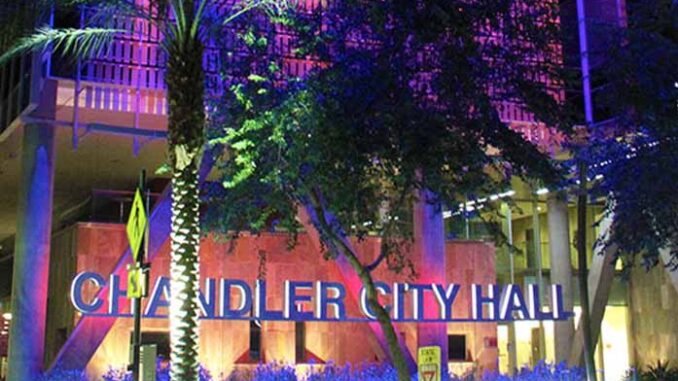
Last month, the City of Chandler unanimously passed Resolution 5656 to reject the proposed ‘Landings on Ocotillo’ high-density housing project. From the start, the developer has been smearing our neighbors for no other reason than we support the plans that have been voted on and approved for our community.
Along with the city, we support additional affordable housing for the community. But the fact is, this isn’t about affordable housing. If it were, then the developer—and their high-paid zoning lawyers, PR firms, and nonprofits—would have found a way to make the project work at one (or more) of the 14 other sites that fit within existing planning.
This is about profit. And to make matter worse, in just 15 years, this housing can (and probably will) convert to regular market rate housing. This means that the subsidies will go away, and the tenants who need the subsidies will get kicked out.
The reality is that the City of Chandler has already approved multiple affordable housing projects in line with the voter-approved City Master Plan. In October, the City of Chandler approved a large public housing development for seniors. In November, the City approved hundreds of affordable housing units in its Downtown District. Resident and neighborhood opposition groups have been unanimous in their support for affordable housing, which can be further evidenced by their 85% affirmative vote on the Chandler General Plan.
The problem is that the high-density housing project (Landings) proposed by the Developer (Dominium) is on an unsuitable county island site. Development as a multifamily living site is incompatible with the voter-approved General Plan, the Chandler Water Master Plan, and the Chandler Airpark Area Plan, as noted by the City Council in Resolution 5656.
Given that Arizona is a desert, the largest issue is the incompatibility with the Chandler Water Master Plan—the site in question does not have the water capacity to support any form of housing. The City allocates water in accordance with the Chandler Water plan depending on intended use and zoning. The site in question is currently zoned for farming with the plan to rezone it to light industry or employment under the Chandler General Plan and Chandler Airpark Plan. Light industrial/employment is allocated 121 gpd per 1,000 ft, whereas the proposed multifamily housing requires over twice that amount at 253 gpd per 1,000 ft. If this project were approved, the site would have grossly insufficient water. Neither Dominium nor its representatives have addressed in the media or to government officials how they will supply the 102 gpd shortfall. With existing drought conditions, Chandler is currently under Tier 2 water shortage restrictions. There is simply not enough water to support this proposed development at this location.
The assumption that this land would be used for light industrial uses has been the basis for other plans like traffic planning. Using this land for housing instead of light industrial would increase the number of cars on the road in an area that already has the highest traffic incidents with a record injury rate when compared to the rest of southern Chandler. The full impact on traffic from current construction projects is yet to be felt in this already congested area, and this unplanned project would only make it worse.
The City of Chandler offered Dominium fourteen other locations for consideration that are in line with existing plans. Dominium refused to consider these other locations. Instead, it is focused on this specific parcel of land. The alternate locations are smaller, but they have the requisite water allocation and would fit within the parameters of the voter-approved Chandler Master Plan.
The everyday residents who live and work in this neighborhood were all universally opposed to the project at the City Council meeting. Those who spoke in favor were from other cities and organizations. Should special interest groups and outside actors determine what is best for a city? Is the voice and concern of the neighbors and residents inferior to that of a deep-pocketed developer with the right political connections?
Enough is enough. Where a voter-approved plan exists, we the people should always have final say—not some multi-million-dollar corporation. And when this case is brought before the Maricopa County Board of Supervisors this year, they must affirm this important principle.
The Voice of Chandler is a group of concerned Chandler residents fighting for the rights of We The People. You can find out more about their work here.