by Matthew Holloway | Apr 1, 2026 | Economy, News
By Matthew Holloway |
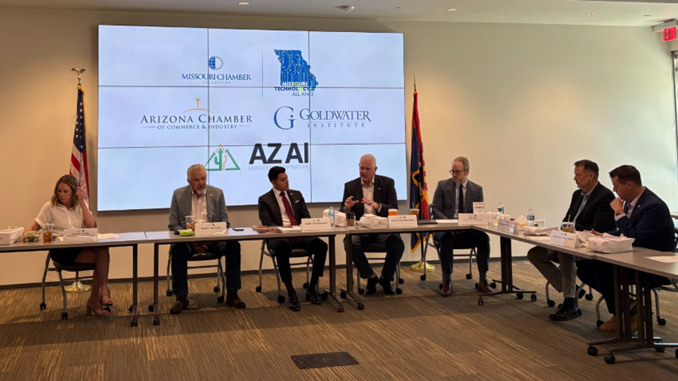
The Arizona Chamber of Commerce & Industry and the Goldwater Institute hosted a delegation of Missouri policymakers in Phoenix to discuss economic competitiveness, innovation, and pro-growth policy, according to a joint release.
The meeting focused on Arizona’s approach to building a competitive environment for emerging industries and long-term economic growth.
The discussion followed the Chamber’s recent launch of its AZ AI Leadership Initiative, which aims to strengthen Arizona’s position in emerging technologies and the broader digital economy.
Arizona has seen rapid expansion in AI and data center infrastructure, driven by growing demand for computing power and cloud services. Major investments from companies such as Taiwan Semiconductor Manufacturing Company (TSMC), which is constructing advanced semiconductor fabrication facilities in Phoenix, along with large-scale data center developments by Google and Meta Platforms in Mesa, and Amazon Web Services in Goodyear, have helped position the state as an emerging hub for both semiconductor production and AI-related computing capacity.
Participants included legislative leaders, policy experts, and representatives from the Arizona Commerce Authority, who shared insights into the state’s policy framework and economic development strategies.
“Arizona’s growth didn’t happen by accident,” said Courtney Coolidge, executive vice president of the Arizona Chamber of Commerce & Industry. “It reflects deliberate policy choices that prioritize certainty, competitiveness, and a regulatory environment where businesses can invest, innovate, and scale.”
Arizona lawmakers participating in the meeting included House Speaker Steve Montenegro (R-LD29), Majority Leader Michael Carbone (R-LD25), Rep. Jeff Weninger (R-LD13), Rep. Justin Wilmeth (R-LD2), chair of the House Artificial Intelligence and Innovation Committee, Senate President Pro Tempore T.J. Shope (R-LD16), and Senate Majority Whip Frank Carroll (R-LD28).
“Arizona has made a conscious decision to lead on innovation rather than wait for other states to set the pace,” Montenegro said. “That kind of alignment and forward-looking policy environment allows industries to grow and scale here.”
Lawmakers and policy leaders highlighted sectors including advanced manufacturing, semiconductors, aerospace, autonomous systems, and emerging technologies as areas where Arizona has seen sustained growth.
“Arizona’s success in attracting major investment is tied directly to our focus on advanced manufacturing, infrastructure, and supply chain strength,” Carbone said.
Weninger pointed to Arizona’s regulatory and tax structure as a factor in business investment.
“Companies are looking for certainty,” Weninger said. “Arizona’s predictable regulatory environment and competitive tax structure give businesses the confidence to invest and expand.”
Participants also discussed the role of infrastructure, water policy, and land use in supporting statewide growth. “We’ve been intentional about making sure economic development isn’t concentrated in one region,” Shope said.
Carroll said Arizona’s approach to economic development has positioned the state for continued expansion, particularly in emerging industries.
Wilmeth emphasized the importance of flexibility in regulating new technologies. “We’ve taken a thoughtful approach to emerging technologies by avoiding premature regulation,” he said.
Victor Riches, president and CEO of the Goldwater Institute, said policy certainty and deregulation remain key factors in supporting innovation.
“As emerging technologies continue to reshape industries, policy certainty and deregulation matter more than ever,” Riches said. “Arizona needs to ensure an environment where innovation can move forward.”
The Missouri delegation included state senators and policy advisors, including Sen. Travis Fitzwater, Sen. Maggie Nurrenbern, Sen. Karla May, Sen. Barbara Anne Washington, Sen. Jamie Burger, policy advisor to Gov. Mike Kehoe, Johnathan Shifflett, and representatives from the Missouri Chamber of Commerce, Karen Buschmann, and Jared Hankinson.
The meeting explored how elements of Arizona’s economic policy framework could be adapted in other states and how interstate collaboration could support broader economic growth.
Matthew Holloway is a senior reporter for AZ Free News. Follow him on X for his latest stories, or email tips to Matthew@azfreenews.com.
by Matthew Holloway | Mar 8, 2026 | News
By Matthew Holloway |
In a 42–14 bipartisan vote on Monday, the Arizona House approved House Concurrent Resolution 2005 (HCR 2005), a proposed constitutional amendment requiring the Legislature to adjourn its regular session no later than April 30 each year.
HCR 2005, was sponsored by State Representative Justin Wilmeth (R-LD2) and proposes amending Article IV, Part 2, Section 3 of the Arizona Constitution to establish a firm adjournment deadline for legislative sessions. Under the measure, the Legislature would continue to convene annually on the second Monday of January but would be required to adjourn sine die by April 30.
The resolution was passed by the Arizona House and transmitted to the Arizona State Senate for consideration.
Under current practice, Arizona’s regular legislative sessions traditionally begin in January and are expected to conclude within approximately 100 days. However, sessions have frequently extended well beyond that timeframe in recent years, often continuing into late spring or summer.
According to the sponsor, the proposal is intended to restore a predictable schedule consistent with Arizona’s model of a citizen legislature.
“A part-time Legislature should act like one,” Wilmeth said in a statement. “When sessions drag into June, priorities are delayed, and decisions are delayed. Arizonans expect us to pass a budget on time and finish our work. The House vote shows bipartisan support for a firm deadline. April 30 is reasonable, and we should meet it.”
The measure preserves the governor’s authority to call special sessions when necessary. Under Arizona law, special sessions must be limited to the subjects specified in the governor’s call.
If approved by the Senate, the proposed constitutional amendment would be placed on the ballot at the next general election, allowing Arizona voters to decide whether to adopt the April 30 adjournment deadline.
Matthew Holloway is a senior reporter for AZ Free News. Follow him on X for his latest stories, or email tips to Matthew@azfreenews.com.
by Matthew Holloway | Feb 26, 2026 | News
By Matthew Holloway |
Arizona House Concurrent Resolution 2048, sponsored by State Representative Michael Way (R-LD15), passed the Arizona House Government Committee last week in a party-line vote and now heads to the full Arizona House of Representatives.
HCR 2048 is a proposed constitutional amendment that would prohibit salary increases for elected state officers from taking effect during their current term. It would also require legislators, the Governor, and other statewide executive officers to forgo regular salaries and subsistence payments if the general appropriation bill is not signed into law by April 30.
The measure states that compensation withheld during a budget delay would not be paid retroactively. Salaries would resume with the first full pay period after the budget becomes law.
“If we do not pass a budget on time, we should not get paid. It is that simple,” Way said in a statement. “Arizonans are expected to meet deadlines in their jobs. Lawmakers should be held to that same standard. If we fail to finish the budget by April 30, there should be consequences.”
The resolution is described as complementing House Concurrent Resolution 2005, introduced by Rep. Justin Wilmeth (R-LD2), which would require the Legislature to adjourn its regular session by April 30.
“Deadlines matter,” Way said. “Families and businesses across Arizona operate on them every day. State government should do the same.”
If approved by the full Legislature, HCR 2048 would be referred to Arizona voters at the next general election.
Way represents Legislative District 15, which includes Mesa and Queen Creek in Maricopa County and San Tan Valley in Pinal County.
Matthew Holloway is a senior reporter for AZ Free News. Follow him on X for his latest stories, or email tips to Matthew@azfreenews.com.
by Matthew Holloway | Feb 11, 2026 | News
By Matthew Holloway |
Arizona lawmakers advanced a constitutional proposal last week that would set a firm deadline for ending the Legislature’s regular session, a major procedural change supporters say would provide a clearer structure for what is currently an open-ended calendar.
Under the state’s current system, the Arizona Constitution requires lawmakers to convene the regular session on the second Monday in January each year, but does not set a deadline for when that session must end. Regular sessions in recent years have stretched into late spring or early summer, with the 2025 session adjourned on June 27 after roughly 169 days in session.
The absence of a constitutional adjournment deadline means lawmakers can continue legislative work beyond traditional spring months, even though state law governs per diem reimbursements for extended sessions.
By contrast, other states employ more rigid schedules. Texas lawmakers meet in regular session once every two years for a constitutionally limited period, and adjourn by a set date unless a special session is called. In 2025, for example, the Texas Legislature concluded its most recent regular session in early June as the statutory timeline expired.
The House Government Committee on Wednesday passed House Concurrent Resolution 2005 (HCR 2005), sponsored by State Representative Justin Wilmeth (R-LD2) of North Phoenix. The resolution would amend the Arizona Constitution to mandate that the Legislature adjourn its regular session sine die no later than April 30 each year.
Under the proposal, lawmakers could still convene special sessions after April 30, but those would be subject to the subjects specified in the Governor’s call. If HCR 2005 clears both chambers of the Legislature, it would be placed on the ballot at the next general election for voter approval.
Wilmeth said the measure is aimed at restoring discipline and accountability to the legislative calendar. “I appreciate the committee moving this measure forward, allowing the discussion to continue,” he said in a statement.
“This proposal is about accountability and discipline. Arizonans expect the Legislature to do its job, pass a budget, and finish its work on time. President Ronald Reagan kept a sign on his desk in the Oval Office that said, ‘It CAN be done.’ I agree with that. Finishing our work by April 30 is achievable, and it should be the standard.”
Wilmeth, a Republican member of the Arizona House of Representatives and Chairman of the House Committee on Artificial Intelligence & Innovation, introduced the constitutional adjournment proposal earlier this year.
Supporters of the resolution have pointed to frequently extended sessions, which in recent years have stretched deep into spring and summer, as justification for a defined end date. In several recent cycles, lawmakers did not adjourn until June, well past traditional deadlines for bill passage and budget agreement.
In a post to X on January 23, Wilmeth wrote, “Decades ago, we told the people we’d have a part-time legislature conducted by citizen-legislators. Nowadays, the legislative session basically goes seven months! That’s unacceptable to me. It’s just responsible government to stick to our part-time commitment.”
If voters approve a constitutional amendment, Arizona would become one of the states with a fixed legislative deadline, rather than relying on internal legislative rules and per diem incentives to guide the calendar. That model differs from states like Texas, where sessions are inherently limited by statute or constitution and extend only through specified time windows.
HCR 2005 now moves to further consideration in the Arizona House as it continues through the legislative process.
Matthew Holloway is a senior reporter for AZ Free News. Follow him on X for his latest stories, or email tips to Matthew@azfreenews.com.
by Ethan Faverino | Jan 26, 2026 | News
By Ethan Faverino |
State Representative Justin Wilmeth (R-LD2) has introduced House Concurrent Resolution 2005 (HCR 2005), a proposed constitutional amendment that would mandate the Arizona Legislature to conclude its regular session no later than April 30 each year.
Arizona’s citizen Legislature was designed to be part-time, not full-time, reflecting the intent of the state’s founders for lawmakers, many of whom maintain outside careers.
Despite an expectation that the Legislature conclude its work within approximately 100 days of convening in January, routine extensions have become common, regularly stretching sessions into late spring and early summer.
“Arizona does not have a full-time Legislature, and it was never meant to operate like one,” said Rep. Wilmeth. “A firm April 30 adjournment restores discipline to the process, forces timely budget decisions, and respects the part-time nature of legislative service. We should be able to do the people’s work without dragging regular sessions into June.”
Prolonged sessions create unnecessary uncertainty for taxpayers, school districts, and state agencies that rely on timely budget approvals. By establishing a hard deadline of April 30, HCR 2005 aims to instill greater accountability, expedite essential decisions like the state budget, and align legislative operations with Arizona’s constitutional vision of a citizen-led government.
The measure preserves the Governor’s existing authority to convene special sessions whenever deemed necessary. Any special session would remain limited to only the subjects specified in the Governor’s call.
If approved by the Legislature, HCR 2005 would be placed on the ballot for the next general election, allowing the people of Arizona to vote on the proposed amendment.
The resolution explicitly amends the constitutional language to state that legislative sessions “shall commence on the second Monday of January of each year and shall adjourn sine die not later than April 30 of each year.”
Ethan Faverino is a reporter for AZ Free News. You can send him news tips using this link.