Arizona’s Attorney General is standing with the state’s Senate President to protect the financial interests of families.
Last week, Attorney General Kris Mayes sent a letter to the IRS Commissioner, requesting the agency “reconsider its decision to tax the 2023 Arizona Families Tax Rebate.”
The IRS should reverse its stance on the Arizona Families Tax Rebate. Otherwise, my office will explore every legal option to keep these dollars in the pockets of Arizona taxpayers. My full letter to the IRS: https://t.co/izQoX66NqT
In a statement that accompanied her announcement, Mayes said, “The IRS should act promptly to reverse this decision and provide clear guidance to Arizona taxpayers as tax season nears. If they do not, my office is prepared to examine all legal avenues to ensure these dollars stay in the pockets of Arizona taxpayers.”
The news from the state Attorney General’s Office follows communication from Arizona Senate President Warren Petersen over this matter. Earlier this month, Petersen issued a press release to share that he was “working diligently to come to a resolution that will protect the more than 700,000 recipients from having to give the federal government a portion of [the rebate] this tax season.”
🚨 FOR IMMEDIATE RELEASE: Senate President @votewarren Works to Prevent Biden's IRS from Taking Advantage of "Arizona Families Tax Rebate" Recipients ⬇️ pic.twitter.com/Y2B2JisOvy
Petersen also thanked Mayes’ office for “reaching out to us on this matter,” though he cautioned that “litigation likely isn’t the best approach.”
In her letter to the IRS Commissioner, Mayes argued that “the full Tax Rebate should be excludable from federal tax under the general welfare exclusion,” and that “at a minimum, the Tax Rebate should be excluded from federal tax to the extent it does not exceed state taxes that were actually paid and that were not deducted from federal income.”
The state’s top cop pointed to past IRS guidance and states where the agency “determined to be excludable from federal tax in February 2023,” such as Alaska, California, Colorado, Delaware, Idaho, and Indiana. She added that different guidance from the IRS established other exclusions that benefited four states – Georgia, Massachusetts, South Carolina, and Virginia. In closing, Mayes wrote that “it would…be fundamentally arbitrary and inequitable to preclude Arizona and its taxpayers from relying on that guidance, particularly given the materially similar (and less restrictive) state programs that the IRS found to be nontaxable in whole or in part last year.”
Mayes asked for the IRS to reply to her letter “by return letter or through amended published guidance no later than February 6.”
Daniel Stefanski is a reporter for AZ Free News. You can send him news tips using this link.
Gov. Katie Hobbs announced Tuesday that Arizona will participate in the Internal Revenue Service (IRS) free tax filing pilot program.
Under the IRS Direct File Pilot Program, certain Arizonans may file their state and federal returns directly to the IRS for free. While the program would come at no direct cost to those eligible, taxpayers ultimately subsidize this additional service.
In a press release, Hobbs said that the program would make filing taxes “convenient and easy.” Although Hobbs said that taxpayers could file both their state and federal tax returns through the pilot program, the IRS noted that its program would not prepare state returns but would instead guide taxpayers to a state-supported tool to file a stand-alone state tax return.
Today, I am putting money back into taxpayers' pockets by announcing a new & easy way to file taxes for free.
Starting in 2024, Arizonans can file their state & federal returns in one seamless experience.
It’s unclear which Arizona taxpayers may participate: the IRS disclosed that it hasn’t finalized its determinations of who would qualify. Expected, but not finalized, eligibility includes: W-2 wage income, Social Security and railroad retirement income, unemployment compensation, interest of $1,500 or less, Earned Income Tax Credit, Child Tax Credit, Credit for Other Dependents, standard deduction, student loan interest, and educator expenses.
IRS Commissioner Danny Werfel promised to reporters in a call on Tuesday that this program wouldn’t replace popular private tax preparation companies like H&R Block or Intuit’s TurboTax.
“I can’t stress enough that Direct File, if pursued further after the pilot, would be just another choice taxpayers have to help them prepare their tax returns,” said Werfel.
Intuit spokesman Derrick Plummer claimed in a statement to PBS that the direct file program would cost billions of dollars.
“An IRS direct-to-e-file system is redundant and will not be free — not free to build, not free to operate, and not free for taxpayers,” said Plummer.
California, Massachusetts, and New York are the three other states that signed onto the pilot program for the 2024 filing season. The IRS noted that taxpayers in states without an income tax may be eligible to participate as well: Alaska, Florida, New Hampshire, Nevada, South Dakota, Tennessee, Texas, Washington, and Wyoming.
The direct file pilot doesn’t replace another existing free direct filing service by the IRS, Free File Program (FFP): a public-private partnership between the IRS and Free File, Inc., or Free File Alliance (FFA), a consortium of tax preparation and filing software industry companies. Those with an income of $73,000 or less qualify for a free federal tax return under that existing program.
The FFP was created in 2002 with the agreement that the IRS wouldn’t create its own free tax-filing software. However, the IRS removed that provision from the FFP memorandum in late 2019 following ProPublica investigative reporting that then-members of the FFA, namely Intuit and H&R Block (who together served 70 percent of FFA users), were charging FFP-eligible taxpayers for tax return services. The Treasury Inspector General for Tax Administration (TIGTA) in a follow-up audit found that over 14 million FFP-eligible taxpayers ended up paying for a commercial service for tax returns.
H&R Block departed the FFP in 2020, then Intuit in 2021. Intuit settled last year for $141 million over the claims.
The Government Accountability Office (GAO) found last year that the FFP has been vastly underutilized by eligible taxpayers, and that the IRS faced risks by relying on the private industry to provide free tax filing. Of the 71 percent of taxpayers eligible for FFP, only about three percent participated in 2020. The GAO recommended the IRS develop other free tax e-filing options.
In 2020, TIGTA reported that not many taxpayers used the FFP because it was rife with “complexity and insufficient oversight.”
The IRS promised to publicly share the results of the direct file pilot program once completed. More information on the program may be discovered here.
Corinne Murdock is a reporter for AZ Free News. Follow her latest on Twitter, or email tips to corinne@azfreenews.com.
On Tuesday, Rep. Andy Biggs (R-AZ-05) and the House Freedom Caucus spoke in opposition to Congress’ plan to raise the debt ceiling: the Fiscal Responsibility Act (FRA).
Under the current plan, the debt ceiling would increase from $31.5 trillion to $36 trillion by 2025, with no cap in place. Without a raise in the debt limit by June 5, the government will be in default.
“Instead of estimating the actual debt ceiling that will be imposed by that date, January 1, 2025, they simply say that will be the date, there will be an unlimited cap,” said Biggs. “There won’t be a cap for 19 months of the Biden administration, and the Biden administration is probably the most profligate we’ve seen.”
Honored to stand with my colleagues in the @freedomcaucus today.
The national debt current growth rate is projected at over $4 trillion in new debt. Biggs forecasted an increase to $5 trillion by 2025.
Biggs claimed that the version of the FRA agreed to under House Speaker Kevin McCarthy (R-CA-20) would only delay, not prevent the IRS from hiring 87,000 new agents costing $71 billion. Biggs said these agents would not only be weaponized against taxpayers, but presented a significant financial burden.
Biggs further claimed that the FRA establishes Green New Deal tax credits and subsidies for the wealthy. He further criticized the PAYGO program, which would require government bureaucrats to justify how they would afford their expenditures; Biggs noted that a similar program already exists in Congress, yet that program hasn’t slowed spending. He added that Congress also already waives PAYGO provisions.
“How come it is Republican leaders always tell us ‘next year we’ll fight hard’?” asked Biggs.
Rep. Raúl Grijalva (D-AZ-07) also opposed the FRA, but for different reasons. Grijalva expressed opposition to the FRA in his capacity as Democratic ranking member of the Natural Resources Committee. He argued that the FRA would jeopardize the National Environmental Policy Act (NEPA).
Watch the full press conference here:
Rep. Thomas Massie (R-KY-04) criticized the Senate for attempting to corner the House into approving their version of the funding bill.
“[The Senate is] sending us a giant omnibus bill the day before the government funding runs out, and saying, ‘Pass the Senate version or the House will be responsible for the shutdown,” said Massie.
House Republican Conference leadership backs the FRA. The chairwoman, Rep. Elise Stefanik (R-NY-21) claimed the FRA would stop runaway inflationary spending, rescind executive overreach, and improve everyday Americans’ financial status.
With the Fiscal Responsibility Act, House Republicans will:
1. Stop out-of-control inflationary spending. 2. Rein in executive overreach. 3. Lift Americans out of poverty.
McCarthy also characterized the FRA as a win, adding that their version eliminates COVID-19 spending, prevents $5 trillion in new tax proposals, and enacts more work requirements for welfare recipients.
Treasury Secretary Janet Yellen warned Congress in January that the U.S. had reached its statutory debt limit and would run out of funding sometime in early June. In a follow-up letter last week, Yellen specified the expiration date as June 5.
She disclosed that her department would fulfill over $130 billion of scheduled payments in the first two days of June, including payments to veterans as well as Social Security and Medicare recipients. Yellen added that scheduled payouts would leave the Treasury unable to satisfy all its fiscal obligations.
Corinne Murdock is a reporter for AZ Free News. Follow her latest on Twitter, or email tips to corinne@azfreenews.com.
Benjamin Franklin once famously said, “[I]n this world, nothing is certain except death and taxes” — true, unless you’re a leftist political nonprofit. For many of them, taxation isn’t certain, even if they run afoul of tax-exempt status requirements.
Funding sources, expenditure recipients, and even those operating these nonprofits may remain secretive under the current state of lax federal enforcement. These tax-free and opacity perks are possible through two interrelated federal tax classifications: 501(c)(3), or “C3,” and 501(c)(4), or “C4.” There are over 27,000 C3s and just over 1,200C4s registered in Arizona. The big difference between the two classifications is that donations to IRS-recognized C3 organizations are deductible under our income tax code. And the Left has learned how to exploit this tax status for their political benefit.
In Arizona, many liberal C3 and C4 nonprofits work in tandem, each executing symbiotic duties while coordinating their activities and sharing data and resources. Sometimes, these C3 and C4 duos are “sister” organizations — meaning, they’re affiliated rather than independent entities allied over common goals.
These arrangements are legal so long as clear distinctions are made between charitable and non-charitable activities. Over the last several months, AZ Free News has conducted an extensive review of over a dozen different liberal nonprofits in the state, examining their websites, tax documents, and social media accounts. Our research has found that many of these organizations have blurred the lines on their political activities via various C3 and C4 groups. In some cases, there appeared to be no distinction at all, with some C3 organizations providing completely different accounts of their tax-deductible program activities to the IRS compared to what they shared publicly.
How the IRS Intended for C3 and C4 Organizations to Operate
C3s have two major qualifiers: they’re supposed to be nonpartisan and apolitical—meaning, they can’t expend funds or use resources to coordinate with political activity being conducted by C4s.
C3s must organize and operate exclusively for purposes that are one or more of the following: charitable, religious, educational, scientific, literary, testing for public safety, fostering national or international amateur sports competition, and preventing cruelty to children or animals.
The IRS defines “charitable” as relief of the poor, the distressed, or the underprivileged; advancement of religion; advancement of education or science; erecting or maintaining public buildings, monuments, or works; lessening the burdens of government; lessening neighborhood tensions; eliminating prejudice and discrimination; defending human and civil rights; and combating community deterioration and juvenile delinquency.
The IRS expressly prohibits C3s from being an “action organization”: those engaging in political or legislative activities. Political activities include the direct or indirect participation or intervention in any political campaign on behalf of or in opposition to any political candidate. The IRS also prohibits political campaign fund contributions or public statements of positions, either verbal or written, on behalf of the organization in favor of or opposing any candidate.
The IRS does condone voter education activities, such as get-out-the-vote (GOTV) efforts like voter registration. However, any evidence of political bias is forbidden: favoritism of a candidate, opposing a candidate in any way, or “hav[ing] the effect of favoring a candidate or group of candidates.” Lobbying is also largely forbidden.
Comparatively, the IRS classifies C4 organizations into one of two categories: social welfare organizations or local association of employees. The former concerns civic leagues or organizations organized exclusively for social welfare promotion, not profit. The IRS clarifies that social welfare promotion doesn’t include direct or indirect participation or intervention in political campaigns on behalf of or in opposition to any candidate. Those that do must not render that activity as their primary activity, and risk being subjected to taxation. The latter concerns membership-based organizations with net earnings devoted exclusively to charitable, educational, or recreational purposes.
How Leftist C3 and C4s Operate in Arizona
Our review of leftist C3s in Arizona appears to indicate that their activities are overtly partisan and political. They coordinate with politically active C4s to achieve shared, partisan goals, and receive political action committee (PAC) funding while doing so. Often, these leftist C4s have either direct or indirect participation or intervention in political campaigns on behalf of or in opposition to one or more candidates.
Progressive activists leading these C3s have effectively mastered the art of exploiting the IRS code for partisan advantage, helping to maximize liberal donor partisan impact with their dollars while still hiding their identity. The C3s will claim that their allowable vote (GOTV) efforts, such as voter registration, are nonpartisan. They will claim they’re reaching out to certain, “marginalized” demographic groups; however, these groups turn out to be known Democratic voter bases.
One example of this is Mi Familia Vota Education Fund, the C3 sister organization of Mi Familia Vota, the C4. The former admitted on their 2020 tax filing to coordinating political activity with the latter. The executive director of Mi Familia Vota Education Fund, Hector Sanchez Barba, has publicly advocated for the losses of Republican candidates.
“We will keep working to keep extremism, Trump and MAGA out of our democracy,” wrote Sanchez Barba. “@MiFamiliaVota.”
In response to a Politico article documenting the GOP’s underperformance in last year’s midterm elections, Sanchez Barba thanked Latino voters for having Democrats win.
Meanwhile, their partner C4s pay for media and partisan activities like ad campaigns for candidates. It’s uncertain whether the funding for these activities comes from their C3 partners since those grant or cost-sharing agreements aren’t public. The IRS requires that C3 funds given to C4s be restricted to charitable uses — not electioneering activity.
The C3-C4 duo targets certain voter demographics to achieve a partisan outcome. They contact Democrat-leaning voters to get their vote cast, convince newly registered voters to vote Democratic through mailers and ads supportive of Democratic candidates and causes, and publicly support certain partisan ballot initiatives.
The C3-C4 sister organizations thinly veil their efforts that a division exists between them. For example, Mi Familia Vota spent tens of thousands on TV advertising that advocated for the election of Reginald Bolding ahead of last year’s primary. However, they listed a staffer for their C3 sister organization, Mi Familia Vota Education, as the point-of-contact on that campaign filing.
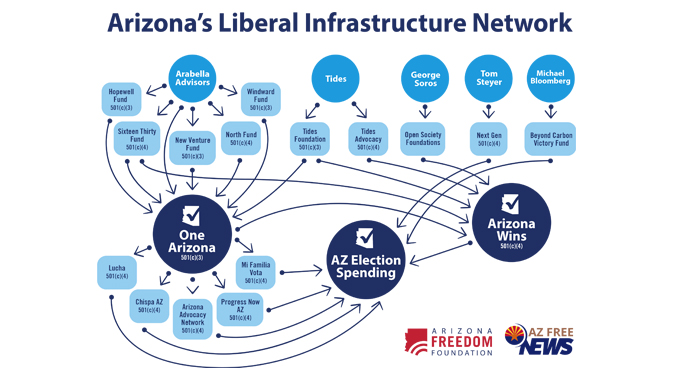
As AZ Free News reported in Part One of this series, Mi Familia Vota receives funding from One Arizona, a C3, which in turn receives its funding from the Tides Foundation, George Soros’ Open Societies Foundation, and several different organizations under Arabella Advisors.
.@RealMarkFinchem, a MAGAmigo, lies, & says that the 2020 election was fraudulent. If elected, he would use his position to help Trump. We are fighting for free and clear elections this cycle. Our democracy is at stake in Arizona, we must fight back. We say #BastaFinchempic.twitter.com/WPVSjflt2L
Ahead of the midterm election last June, One Arizona advertised a job opening for an independent expenditure (IE) campaign manager. The position appears to be one for a political staffer, which would constitute prohibited electioneering.
While not a complete pitcure, the above graphic illustrates some of the connections in the left’s secretive infrastructure and how they relate to Arizona elections.
Leftist C3s also hire for both the C3 and C4, resulting in shared jobs and salaries. One Arizona (C3) and Arizona Wins (C4) co-hired staff including a field director, field program coordinator, and finance and compliance director. That shared salary should not be used for political work. One recent example of this was a job listing by Arizona Coalition for Change (C3) and Our Voice Our Vote (C4) for a data manager that would work within the duo’s political and grassroots lobbying arms.
These blurred lines surrounding co-hires don’t just apply to staff. Arizona Center for Empowerment (ACE, a C3) and LUCHA (C4) share an executive director, Alejandra (Alex) Gomez, as well as staffers. This relationship is further complicated by the fact that ACE listed LUCHA as its “Employer of Record” on their latest tax return. Under Gomez, both organizations have expressed their partisanship.
Last year, LUCHA launched an initiative to get Democratic candidates elected: “LUCHA Blue.” The nonprofit pledged to prioritize certain races and voter bases in its GOTV efforts. On its hiring page for the initiative, LUCHA disclosed that it would staff between 70 and 105 people.
“We believe that not all candidates align with the mission of LUCHA, and this is why we created a campaign not only to flip Arizona Blue — but LUCHA Blue!” stated LUCHA. “Overall, the goal of the campaign is to win these targeted races, increase Latin/Hispanic voter turnout, and educate voters on the voting process.” (emphasis added)
In one post following Sen. Mark Kelly (D-AZ) winning re-election last November, LUCHA appeared to affirm that both it and ACE assisted in organizational efforts to assure Kelly’s victory.
Wealthy dark money donors have a greater financial incentive to back C3s. 75 percent of their donations can go to politics and qualify as tax deductible — effectively maximizing their gift-giving while affording them a tax break. C4 donations aren’t tax deductible.
The IRS has long been aware of the disparity between the lawful intent for C3 and C4 entities, and the current reality of C3-C4 relationships. As ProPublica revealed in 2019, the IRS essentially gave up on holding nonprofits accountable.
The following are some of Arizona’s liberal C3-C4 nonprofit duos: One Arizona and Arizona Wins, Arizona Center for Empowerment and Living United for Change in Arizona, Mi Familia Vota Education Fund and Mi Familia Vota Victory, Chispa AZ/League of Conservation Voters Education Fund and League of Conservation Voters, Arizona Coalition for Change and Our Voice Our Vote, Instituto Lab and Instituto Power, Rural Arizona Engagement and Rural Arizona Action, and Voto Latino Foundation and Voto Latino.
The relationships between these nonprofits and the awareness of their straining tax law will be further explained in the next installment of this series.
This is Part Two in a series on the Left’s secret infrastructure to turn Arizona blue. Be sure to sign up for our newsletter to be notified of Part Three in the series.
Corinne Murdock is a reporter for AZ Free News. Follow her latest on Twitter, or email tips to corinne@azfreenews.com.
During her last year in the State Senate in 2018, Democratic gubernatorial candidate Katie Hobbs backed a bill to add 131 new tax auditors, managers, and staff to the Arizona Department of Revenue (ADOR) using $8.3 million in state funds. At the time, Hobbs was the State Senate’s minority leader.
Throughout her gubernatorial campaign, Hobbs said she would lighten the tax process burden for the working class if elected. Hobbs also pledged to cut income taxes for 800,000 families if elected governor.
We need a governor with a plan to tackle rising costs. I’ll cut taxes for Arizona’s working families and lower costs on things like school supplies and diapers. Because these solutions can’t wait. pic.twitter.com/FMzHcbv0UH
Additionally, Hobbs promised that working-class Arizonans wouldn’t pay “a center higher” for her economic plan, nor would they face unnecessary tax burdens.
My plan for a more Affordable Arizona keeps hard-earned dollars in your pockets, helps Arizonans get back to work, and ensures families statewide can access necessities without unnecessary tax burdens.
Hobbs’ proposed plan to increase ADOR was similar to the Biden administration’s recent accomplishment: expanding the IRS. In August, Congress voted to increase the size of the IRS by about 87,000 agents through the Inflation Reduction Act (IRA), a repackaged version of President Joe Biden’s Build Back Better (BBB) Act. Republicans decried the provision as a weaponization of the IRS that would cause disproportionate harm to the working class. Democrats dismissed those concerns, insisting that the IRS would only target the wealthy not paying their fair share of taxes, and that the IRA would mitigate inflation.
Last year, over 50 percent of all IRS audits targeted taxpayers making under $75,000 a year, which applies to about 171.6 million Americans (52 percent). About 25 percent of IRS audits applied to taxpayers making between $75,000 to $200,000, which applies to about 118.8 million Americans (36 percent).
In all, 75 percent of audits may apply to the 290.4 million Americans that comprise 88 percent of the population (about 330 million).
Over 75% of IRS audits targeted Americans making under $200,000 per year.
Democrats want to hire 87,000 new IRS enforcers to target the middle class even more. pic.twitter.com/cxmCqE4eBN
The bill that Hobbs cosponsored in 2018, SB1324, proposed the addition of two corporate income tax audit managers, 28 corporate income tax auditors, two transaction privilege tax managers, 28 transaction privilege tax auditors, two transaction privilege tax license compliance staff managers, 18 transaction privilege tax license compliance staff members, 40 tax collectors, and 11 support staff members.
The bill died quietly, having never received a vote in any committee. Its House companion, HB2137, experienced the same fate.
At the time, Governor Doug Ducey expressed a desire to expand ADOR — but by 25 tax collector positions that had been eliminated several years prior, about 80 percent less than what HB2137/SB1324 proposed. Ducey was looking for ways to make up about $83 million in lost audit revenue.
Corinne Murdock is a reporter for AZ Free News. Follow her latest on Twitter, or email tips to corinne@azfreenews.com.