by Ethan Faverino | Feb 8, 2026 | Economy, News
By Ethan Faverino |
Arizona House Republicans on the Natural Resources, Energy, and Water Committee have taken action to address skyrocketing gas prices and utility bills, passing a sweeping package of bills designed to lower fuel costs, enhance energy reliability, and defend ratepayers.
Under the leadership of Chairman Gail Griffin (R-LD19), the measures align with the House Republican Majority Plan’s core priorities of unleashing economic prosperity, promoting government efficiency, and protecting individual rights and liberties.
The legislation, which advanced on a party-line vote with Democrats in opposition, targets the challenges faced by Arizona families, particularly in Maricopa and Pinal Counties, where severe summer fuel blend requirements have driven up prices at the pump. By prioritizing affordability and reliable power, these bills aim to ease the financial burden on households amid rising energy demand.
“The cost of living for Arizona families, including gas and electricity, continues to increase, and Republicans are acting,” stated Chairman Griffin. “This package puts affordability first by lowering fuel costs, protecting ratepayers from higher utility bills, and making sure Arizona has dependable power as demand grows. The Majority Plan is clear: government should work to ease the cost burden on families, not make them worse.”
Bills Tackling High Gas Prices
- HB 2145 (Rep. Griffin): Amends motor fuel statutes to empower the President of the Senate and Speaker of the House to jointly request EPA fuel waivers during shortages if the Governor does not act, providing a defense against price surges.
- HB 2400 (Reps. Willoughby, R-LD13, and Biasiucci, R-LD30): Implements a seasonal suspension of the state’s 18-cent gas tax from May through September in Maricopa and Pinal Counties. The bill ensures local governments are reimbursed for lost highway revenue through allocations from the Arizona Highway User Revenue Fund, including $27.588 million to counties, $39.93 million to cities and towns, and $5.082 million to larger municipalities. It also includes an emergency clause for immediate implementation and exempts the Department of Transportation from rulemaking for one year.
- HB 2696 (Rep. Willoughby): Directs the Arizona Commerce Authority to prioritize reducing fuel and gas prices as its primary objective for two years, expiring December 31, 2029. The authority must collaborate with the oil and gas industry to study repealing the cleaner-burning gasoline blend, building new pipelines, establishing a strategic reserve, and exploring in-state refineries, including reviving a proposed facility in Yuma County. Status updates will be provided to legislative committees, with a final report due by October 1, 2026.
- HB 2955 (Rep. Willoughby): Amends motor fuel standards to end the expensive summer fuel blend in populous counties, subject to EPA waiver under the Clean Air Act. It allows for gasoline compliant with ASTM D4814 and vapor pressure limits, addressing supply shortages and enabling lower-cost alternatives.
- HCM 2008 (Rep. Willoughby): A concurrent memorial urging Congress and the EPA to eliminate the federal gas tax on Arizona’s cleaner-burning gasoline in Maricopa and Pinal Counties from May to September or grant the EPA administrator emergency waiver authority for costlier blends. This recognizes Arizona’s progress toward National Ambient Air Quality Standards while highlighting the undue tax burden on specialized fuels.
Supporting these efforts are additional bills to promote long-term solutions:
- HB 2014 (Rep. Fink, R-LD27): Requires the Department of Environmental Quality (ADEQ) and Arizona Department of Agriculture to conduct air emissions modeling and feasibility studies on alternative gasoline blends, including federal reformulated, California phase 3, and conventional options. Reports must be published by September 30, 2027, with $100,000 appropriations each for modeling and studies.
- HB 2401 (Willoughby and Biasiucci): Mandates biennial reviews by ADEQ of fuel formulations available under federal standards, assessing air quality impacts in regulated areas, and submitting recommendations to the Department of Agriculture, the Governor, the President of the Senate, the Speaker of the House, and the Secretary of State by December 31 of each review year.
- HB 2428 (Griffin): Authorizes voluntary mobile emissions reduction credit programs, permitting emissions credits for nonroad engines under Clean Air Act guidelines, with permits issued by ADEQ for up to 20 years, supported by chambers of commerce, utilities, and Maricopa County.
“Today we heard from organizations with the time and resources to lobby against affordable prices for Arizona families, but not from the families paying more at the pump,” explained Majority Whip Julie Willoughby. “Working families cannot take time off to come to the Capitol and ask for relief; that is why we are here to help be their voices.”
“Eighteen cents a gallon may sound small to some, but it matters to families trying to make ends meet,” Willoughby added. “I will do everything in my power to deliver relief now while we continue working to fix the fuel blend and supply problems. Families need lower prices, not excuses.”
Bills Ensuring Energy Reliability and Ratepayer Protections
- HB 2331 (Reps. Marshall, R-LD7 and Heap, R-LD10): Renames and expands energy reliability statutes to require public power entities and service corporations to prioritize domestically produced fuels, minimize foreign reliance, and evaluate resources for affordability, reliability, and cleanliness. Defines “clean energy” to include low-emission sources like nuclear and natural gas, with reliable sources needing at least 50% capacity factor and rapid ramp-up capabilities. The bill emphasizes hydrocarbons and finds domestic sourcing essential for public health and safety.
- HB 2756 (Reps. Griffin and Blackman, R-LD7): Adds provisions for public power entities and electric corporations to report quarterly on new extra-high load factor customers, including interconnection requests and completions. These customers must be factored into load growth projections. The Arizona Corporation Commission (ACC) is directed to adopt rules on contracts, minimum billing, and pre-execution reviews to protect other ratepayers, excluding member-owned cooperatives. Requires cost-of-service studies within 180 days and an ACC workshop within 90 days to assess impacts on residential bills and potential new customer classes.
These bills now advance for further legislative consideration.
Ethan Faverino is a reporter for AZ Free News. You can send him news tips using this link.
by Corinne Murdock | Jun 19, 2022 | News
By Corinne Murdock |
Arizona House Republicans took a novel approach to informing constituents with a new short video series, “Under the Copper Dome,” delivering information in an entertaining fashion.
The GOP caucus’ debut two-minute clip followed Majority Whip Leo Biasiucci (R-Lake Havasu City) as he reenacted discussions of HB2696, a bill increasing prison time for those who sexually abuse, smuggle, or traffic children.
The video depicted Biasiucci explaining his bill to several state representatives, including John Kavanagh (R-Fountain Hills), who gave enthusiastic support. A group of GOP legislators walked together with Biasiucci into the Arizona State Capitol, with upbeat music playing in the background. The video concluded with Biasiucci addressing the viewers directly to discuss HB2696. He thanked Arizona law enforcement for working to end crimes against children.
“[My bill] will bring the hammer down on these heinous crimes and ensure a safe Arizona for everyone,” said Biasiucci. “With this law, and another I sponsored last year toughening punishments for child sex traffickers, Arizona is leading the fight against trafficking and smuggling.”
The caucus’ efforts earned the approval of Congressman Paul Gosar (R-AZ-04). Gosar’s social media team puts out information with an entertainment edge, sometimes perceived by political opponents as controversial. Gosar was punished for a meme video parodying several Democratic members of Congress as villains in the intro from the cult classic anime “Attack on Titan,” with him parodied as the hero.
The caucus drew from Gosar’s short video series, the Gosar Minute, as inspiration. One of the principal creators behind the video series, State Representative Teresa Martinez (R-Oro Valley), has served as Gosar’s Hispanic Outreach and Coalitions Director.
Twitter shadowbanned the Gosar Minute hashtag for those with the “hide sensitive content” search filter turned on.
Corinne Murdock is a reporter for AZ Free News. Follow her latest on Twitter, or email tips to corinne@azfreenews.com.
by Terri Jo Neff | Apr 29, 2022 | News
By Terri Jo Neff |
The sentencing options for several felonies related to child sex abuse, human trafficking, and human smuggling will be significantly restricted in Arizona later this year when new legislation takes effect.
On Thursday, Rep. Leo Biasiucci celebrated the enactment of House Bill 2696 which reforms the state’s sentencing ranges for some of the most horrific crimes against children. It triples the length of prison sentences for some crimes against children under age 15 while prohibiting judges from placing someone on probation instead of in prison for other offenses, including human trafficking and human smuggling.
“I’m proud to have sponsored this important legislation to ensure that anyone convicted of these heinous crimes serves mandatory prison time with no chance of parole,”said Biasiucci, the House Republican Majority Whip. “Iappreciate the strong support of Governor Ducey and my fellow legislators. These new laws will combat these crimes and make Arizona safer for everyone.”
Under HB2696, the sentencing range for the continuous sexual abuse of a child under age 15 changes from 13 to 27 years to 39 to 81 years. And someone who has a prior felony involving various forms of child abuse would have a sentencing range of 69 to 111 years if later convicted of the continuous sexual abuse of someone under age 15.
Judges will also see new restrictions when sentencing a defendant convicted of luring a minor for sexual exploitation if the minor is under age 15, aggravated luring when the minor is under age 15, as well as sexual extortion. Such offenses will become prison mandatory and ineligible for probation, suspension of sentence, pardon, or most early releases from confinement.
Luring involves offering or soliciting sexual conduct with another person knowing or having reason to know that the other person is a minor, while aggravated luring involves the use of an electronic communication device “to transmit at least one visual depiction of material that is harmful to minors for the purpose of initiating or engaging in communication” which offers or solicits sexual conduct with a recipient the sender has reason to believe is a minor.
Although luring and aggravated luring often involve online predators, those crimes are also frequently committed by young adults and teens. In addition, the offense does not require an actual victim who is a minor. A conviction can be obtained on the basis of offers or communications with someone the person have reason to believe is under 15, even if that person is a peace officer.
But HB2696 also targets those involved in criminal activity involving human trafficking and human smuggling. Once effective, the new law will allow prosecutors in the state’s 15 counties as well as the Arizona Attorney General’s Office to charge someone who knowingly or intentionally gets involved in a human smuggling organization or operation.
The bill adds a provision to Arizona Revised Statute 13-2323A making it a crime for someone to knowingly assist a human smuggling organization or operation “by transporting a person, or procuring the transportation for a person” with the intent to conceal the person from a peace officer or to assist the person in fleeing from a peace officer “who is attempting to lawfully arrest or detain” that person.
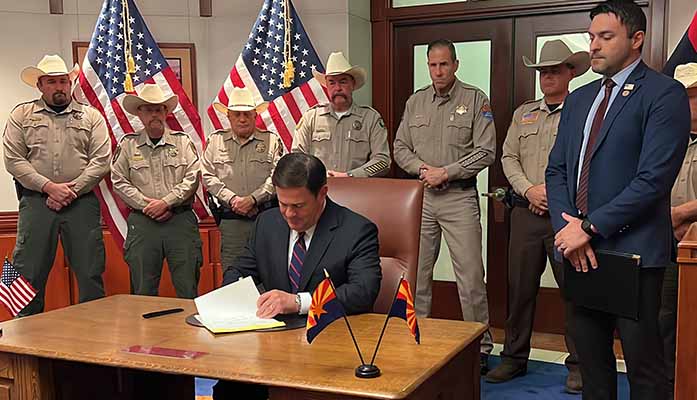
Several law enforcement officials from across the state attended Thursday’s bill signing by Ducey. During the event, the governor made pointed comments about ongoing border crisis, while praising Biasiucci and the bill’s 32 bipartisan co-sponsors for ensuring anyone who aids illegal human smuggling organizations or operations will be held accountable.
“We’re taking another critical step to fill the void in leadership left by the federal government’s unwillingness to secure the border,” Ducey said. “We have seen a dramatic increase in human smuggling at the border since President Biden took office. I’m hopeful this new law will help to save lives and deter more migrants from making the dangerous journey to our border.”
Biasiucci’s bill was opposed by the Arizona Justice Project, the William E Morris Institute for Justice, and Arizona Attorneys for Criminal Justice. The sentencing requirements do not take effect until later this year and are not retroactive.
Nothing in HB2696 restricts the ability of a governor to commute a sentence in accordance with existing state law.
by Corinne Murdock | Mar 13, 2022 | News
By Corinne Murdock |
On Thursday, three State Senate Democrats on the Senate Judiciary Committee voted against HB2696, a bill increasing sentencing for those who sexually abuse, smuggle, or traffic children. They argued that illegal immigrants or those transporting illegal immigrants around the state — not bringing them across the border — might be unfairly swept up under this bill.
The bill sponsor, State Representative Leo Biasucci (R-Lake Havasu City), explained during committee that the legislation would afford children with greater protections while creating disincentives for would-be perpetrators. Last month during the House Judiciary Committee consideration of the bill, Biasucci noted that current law allows criminals impacted by this bill to be released on probation after a few months. He described his bill as “put[ting] the hammer down.”
“It’s insane to think we continue to allow these people to walk our streets. And until we send a message that you’re going to go to prison for a very long time, it’ll never stop. It’s very simple and, in my opinion, not even debatable,” said Biasucci.
In opposition to the bill, State Senator Stephanie Stahl Hamilton (D-Tucson) said that human smuggling charges should be addressed in a separate bill.
Minority Whip Martin Quezada (D-Glendale) concurred with Stahl Hamilton, calling the broadness of the bill “troubling and scary.” Quezada added that those transporting illegal immigrant children to various day-to-day activities like doctor’s appointments shouldn’t fear a human smuggling charge.
“These are family members that people are going to be transporting, you know taking to school, taking to the doctor, visiting other family, taking to the park — and now they’re going to be charged as human smugglers?” said Quezada. “Is this making the anti-immigrant culture in our community, is it making it better or is it going to make it worse? Is it going to further divide our community, or is it going to bring us together more?”
On the side of the committee Democrats was the American Civil Liberties Union (ACLU) of Arizona. They didn’t speak on the bill during any committee consideration of the bill.
In the House, only State Representatives Morgan Abraham (D-Tucson), Melody Hernandez (D-Tempe), Pamela Powers Hannley (D-Tucson), and Minority Whip Domingo DeGrazia (D-Tucson) voted against the bill. They didn’t explain their votes.
Corinne Murdock is a reporter for AZ Free News. Follow her latest on Twitter, or email tips to corinne@azfreenews.com.
Page 1 of 11