by Ethan Faverino | Feb 15, 2026 | News
By Ethan Faverino |
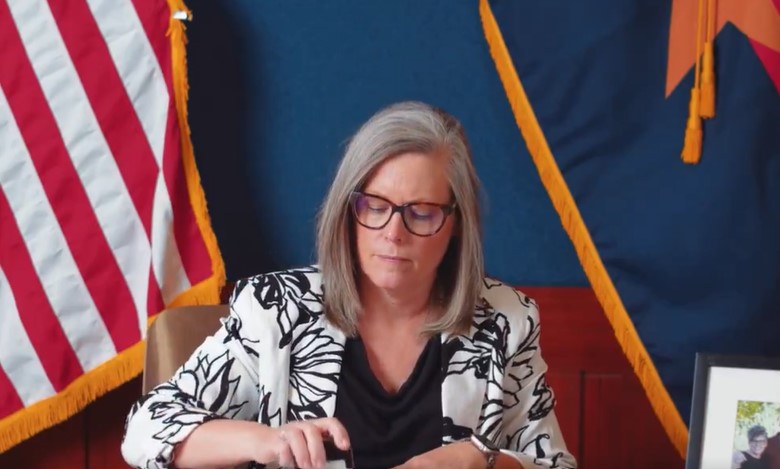
Governor Katie Hobbs has vetoed a Republican bill, HB 2785, which would have brought Arizona’s income tax law into full conformity with the federal Internal Revenue Code as reflected in the tax forms already issued by Hobbs’ Department of Revenue for the 2025 tax year.
The legislation, passed on February 11, 2026, aimed to protect Arizona taxpayers from uncertainty, the need for amended returns, potential penalties, and mid-season rule changes during the ongoing filing season.
By aligning state statute with the guidance taxpayers are currently following, HB 2785 would have prevented widespread disruption and costly refiles for Arizonans.
The action comes after Governor Hobbs vetoed an earlier Republican tax conformity package that included targeted relief measures—such as no tax on tips or overtime, deductions for seniors, and replacements for the federal SALT deduction with expanded child tax credits and childcare expense deductions.
Following the first veto, the Governor’s administration issued tax forms assuming full federal conformity (including provisions like deductions for qualified tips, overtime pay, certain vehicle loan interest, and additional charitable contributions for standard deduction filers), while repeatedly declining to clarify her position or support changes.
Department of Revenue testimony highlighted the risks of reversing course now, potentially forcing up to one-third of filers to submit paper-only amended returns, incur additional filing costs, and face unexpected tax liabilities months later.
In a press release, House Speaker Steve Montenegro stated, “Arizona taxpayers did exactly what the government told them to do, and the Governor left them exposed. Her Department of Revenue issued tax forms, told people not to delay filing, and testified that changing course would cause massive disruption. Then the Governor vetoed the Legislature’s solution and refused to explain what comes next.”
“That is the opposite of leadership,” added Montenegro. “The House and Senate acted because families, seniors, and small businesses should not be forced to pay penalties, refile returns, or owe unexpected taxes because the executive branch could not get its act together.”
Ethan Faverino is a reporter for AZ Free News. You can send him news tips using this link.
by Staff Reporter | Feb 2, 2026 | News
By Staff Reporter |
The Republican majority at the Arizona House and Senate are advancing legislation to ensure full income tax conformity.
The state remains without conformity since Gov. Katie Hobbs rejected a solution by the Republican-led legislature amounting to $1.1 billion. Republicans are trying to bring another solution to the table with HB 2785. It’s unclear if Hobbs will pull up a seat for it.
Earlier this month, Hobbs vetoed legislation that would have aligned Arizona tax code with many of the congressional changes passed last summer under the One Big Beautiful Bill Act.
The governor accused Republicans of giving tax breaks to special interests and increasing taxes on working senior citizens. Hobbs said she would only agree to the Democratic minority’s Middle Class Tax Cuts Package.
“I urge you to rethink your partisan political theater and send the Middle Class Tax Cuts Package to my desk,” said Hobbs. “We should not hold tax cuts for over 88 percent of Arizonans hostage in order to force through tax breaks for special interests. Other questions of tax conformity must be decided through budget negotiations, following the precedent set by Governor Ducey.”
Unfortunately for the governor, the Arizona Department of Revenue (ADOR) had already advised Arizonans on how to file under federal tax law changes.
Several days before the governor issued her veto, ADOR notified lawmakers of the impossibility of altering their forms during the filing season. This latest bill from Republicans would codify ADOR’s instructions to taxpayers. Senate Finance Committee Chairman J.D. Mesnard (R-LD13) said the bill wasn’t the preferred approach since it wouldn’t provide as much relief to working families.
“The Department of Revenue has already told taxpayers how to file, and we are compelled to make sure the law and that guidance align, especially since the Department has publicly advised taxpayers not to wait to file,” said Mesnard. “Doing nothing would only guarantee more confusion and force families and businesses to fix the government’s mistakes later. We will never support a plan that requires taxpayers to amend their returns because state leaders failed to act when it mattered. It would be completely unjust.”
Without conformity, Arizonans have no way of knowing the accuracy of their filings. It’s likely taxpayers will need to refile, and even possibly pay more than they are prepared to pay.
House Speaker Steve Montenegro (R-LD29) said Hobbs was to blame for the present burden of impossible compliance facing Arizona taxpayers. The speaker said the governor has refused to communicate further with Republican leadership on conformity.
“Arizona taxpayers are being asked to file on forms that do not clearly match state law, while the Governor offers no answers and no alternative plan,” said Montenegro. “We asked for clarification privately. We asked publicly. We sent a detailed letter. We received silence. With tax season underway, waiting is not an option. This legislation exists because executive inaction left taxpayers exposed, and the Legislature has a responsibility to step in and restore clarity.”
Senate President Warren Petersen (R-LD14) said it was Hobbs’ agency that introduced the deductive provisions for wealthier filers to which she objected.
“It’s unfortunate the Governor has chosen not to work with us. The Legislature is stepping in to provide certainty by conforming state law to the tax forms her DOR has already released, including the State and Local Tax Deduction,” said Petersen. “The Governor would call that provision a tax break for the rich. We do not support the SALT deduction, but her agency has already included it on the forms, leaving the Legislature no choice but to address it. Tax reform was meant to make filing simpler and more predictable, not create confusion, anger, and frustration for Arizona taxpayers.”
AZ Free News is your #1 source for Arizona news and politics. You can send us news tips using this link.
by Staff Reporter | Feb 5, 2025 | News
By Staff Reporter |
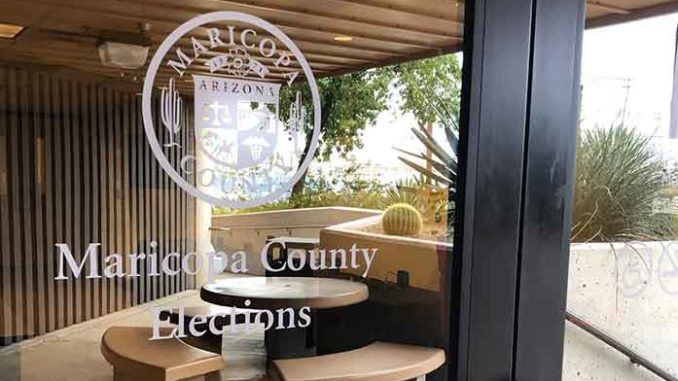
Election volunteers will be allowed to observe signature verification processes in Maricopa County up close for the first time.
Maricopa County Recorder Justin Heap announced the “common-sense” policy change on Monday. The recorder said the observers won’t have access to the party affiliation of voters.
“This change allows bipartisan election observers into the Signature Verification room to more directly observe the Signature Verification process,” said Heap. “This is one of the first of many commonsense improvements to make Maricopa’s election processes more trustworthy and transparent.”
In order to protect the party affiliation of voters, Maricopa County won’t display political parties or any “personally identifying data” on the signature verification screen. This change will take effect with the May 2025 elections, per the recorder’s office.
Heap revealed in Monday’s press release containing the policy change announcement that previous recorder administrations hadn’t been fully honest about election workers’ abilities to access voters’ party affiliations and personal identifying information. Per Heap, all election workers had to do to access that information was scroll down on their screens during signature verification processes.
“Previously, voters were assured by election officials that no party or personally identifying data was available to signature verifiers,” said Heap. “In my review of our election processes I have discovered this was not the case. Signature verification workers who scrolled down the page would still see this information on the scans of older ballots.”
Prior to Heap’s administration, election volunteers weren’t permitted to observe signature verification processes. In the accompanying press release issued on Monday, the recorder’s office claimed that the previous policies requiring signature verification observation to take place from an adjacent hallway some distance from the work “made meaningful observation of the process impossible.”
“Removing that data will accomplish two important things: it brings bi-partisan observers back into the room to scrutinize the process and ensures that verifiers do not know the party affiliation of the voters whose signatures they are verifying. This will be the first of many commonsense improvements we will be making to ensure that future elections in Maricopa County are run in a trustworthy, transparent, and efficient manner,” concluded Heap.
Ahead of the presidential election last year, the state established the first legally binding signature verification rules as part of necessary modifications to election dates made to comply with the shortened electoral count deadline.
Those signature verification rules (contained within HB 2785) require the rejection of early ballot envelopes bearing signatures that don’t match the voter’s registration or records. Beginning next year, voters may bypass the signature verification requirement by showing their ID while returning their early ballot in person. Other Republican-led aspects ensuring stricter signature verification were stripped from the bill following negotiations with Democratic lawmakers and Governor Katie Hobbs.
Improving signature verification processes was a top priority for Heap during his campaign to oust then-incumbent Stephen Richer. Heap attested during his campaign that the county’s standards for signature verification were too lax based on his personal experiment with the process.
AZ Free News is your #1 source for Arizona news and politics. You can send us news tips using this link.
by Staff Reporter | Jul 5, 2024 | News
By Staff Reporter |
Governor Katie Hobbs’ high rate of vetoes in election-related legislation was featured in a new Ballotpedia report released this week.
That report also detailed the thousands of election-related bills considered nationwide, highlighting those passed and vetoed in Arizona specifically.
Arizona with its divided government saw the passage of three key election bills, and the veto of seven.
The digital nonprofit featured several key bills passed by the Arizona legislature this year: HB 2785, which modified the statewide primary date by one week; SB 1342, which provided compensation to political party designees for post-election audit hand counts, with a limit of 75 percent of those conducting the hand count from being members of the same political party; and HB 2482, which required county election officials to notify voters of registration record changes within 24 hours.
Ballotpedia also highlighted the seven bills vetoed by Governor Katie Hobbs: SB 1060, allowing federal candidates to choose observers at polling centers; SB 1330, replacing the term “drop box” with “ballot box” or “container”; SB 1097, making school board races partisan; HB 2393, allowing for an alternative presidential preference election for overseas military voters; HB 2404, prohibiting county recorders from issuing voter registration cards to out-of-state addresses; HB 2612, prohibiting individuals convicted of ballot abuse offenses from holding elected public office; and HB 2031, reducing the threshold for asking voters to expand the board of supervisors from 150,000 to 125,000.
Hobbs’ vetoes pushed Arizona to the top in terms of highest vetoes nationwide.
Although Arizona was featured as one of the key states reviewed, the state didn’t make the top 10 for most active overall in passing bills. With the exception of Maryland and Virginia, all of these states had Republican trifectas. In order from most activity to least: Tennessee, Georgia, Virginia, Louisiana, Idaho, South Carolina, Utah, West Virginia, South Dakota, and Maryland.
Arizona was, however, most active among the 10 states with divided governments.
In its report, Ballotpedia tallied the total of election-related legislation considered across Arizona and the rest of the nation: over 3,700 bills.
The nonprofit also noted that legislation topic or type was often determined by the political party leading the state. In Republican-led states, the election-related bills focused on ballot harvesting or collection, voter registration drives, noncitizen voting, or ranked-choice voting. In Democrat-led states, the bills focused on ballot curing for absentee or mail-in voting, voter suppression, and election disinformation or misinformation.
Bipartisan support existed for about eight percent of bills on topics such as voter list maintenance, protections for elections officials and workers, presidential electors, and voting by eligible but incarcerated individuals or felons.
States with a Republican trifecta and Republican or other sponsorship of the bills enacted the greatest majority of election-related legislation: 64 percent (196 bills). Democratic trifecta and Democratic or other sponsorship of the bills enacted 19 percent of the legislation (57 bills). “All other” totaled 17 percent (52 bills).
However, states with Democratic trifectas considered more changes to election laws than those states with Republican trifectas or divided governments. Ballotpedia noted that this was true for the third year in a row of their tracking history.
AZ Free News is your #1 source for Arizona news and politics. You can send us news tips using this link.
by Daniel Stefanski | Feb 14, 2024 | News
By Daniel Stefanski |
A bipartisan effort to pass election reforms in Arizona succeeded last week.
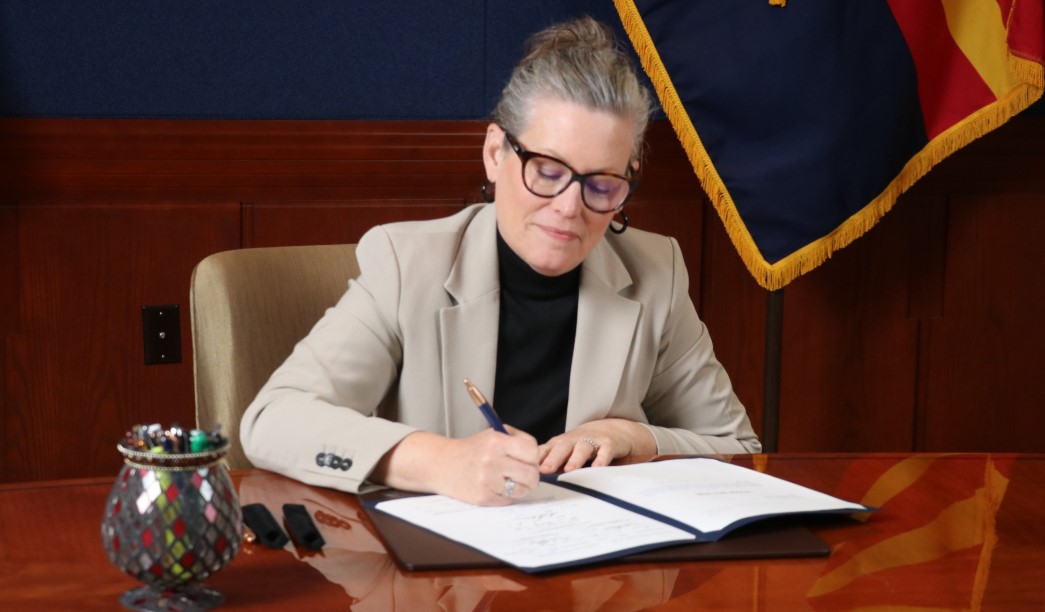
After many failed times of attempting to approve election reform measures in Arizona under a divided government since the start of 2023, the Republican-led legislature and Democrat Governor Katie Hobbs came to an agreement on a crucial package. Late last week, the state house and senate passed HB 2785, and then the governor signed the legislation.
According to an overview provided by the Arizona House of Representatives, the bill is “an emergency measure that modifies certain procedures and deadlines related to the conduct of elections.” The significant provisions of the legislation, per the press release from the Arizona House, are as follows:
- Robust legally binding signature verification standards in law for first time in Arizona.
- Puts political parties on an equal playing field when curing ballots.
- Promotes greater use of ID when voting early.
- Ensures that Arizona’s overseas military will be able to vote, and Arizona’s electors will be delivered on time.
With the bipartisan agreement, Arizona’s primary election date will be moved up to July 30.
“Politics is the art of the possible, and when Republicans stick together, we can achieve the impossible, like getting Katie Hobbs to sign real election reforms into law,” said Representative Alexander Kolodin, sponsor of HB 2785. “Arizona’s voters can rest assured that the 2024 election will be more secure, free, and fair than those that have gone before.”
The Senate Elections Committee Chair, Senator Wendy Rogers, added, “”This legislation is a major win for Arizona voters and important in restoring voter confidence in election Integrity. After months of painstaking discussions among lawmakers, election experts, administrators, county officials, and the executive branch, I’m proud we were able to craft a commonsense solution that all 15 Arizona counties support. It will ensure our service members abroad will have their votes counted on election day, and moreover, it will enable us to accurately determine the winner sooner rather than later.”
Governor Hobbs also struck a triumphant tone in her statement when she signed the bill, saying, “With this bill, we are making sure every eligible Arizonan can have their voice heard at the ballot box. We protected voters’ rights, we kept the partisan priorities out, and we demonstrated to the country that democracy in our state is strong. Thank you to Republicans and Democrats in the legislature who put partisan politics aside to deliver this important victory for the people of Arizona.”
Arizona Secretary of State Adrian Fontes, also a Democrat, chimed in with his support of the package. Fontes said, “I am pleased to see Arizona’s bipartisan effort to pass House Bill 2785, keeping on-time ballot delivery for military and overseas voters and securing the state’s electoral votes for the 2024 presidential election. This legislation received overwhelming support across party lines and demonstrates Arizona’s commitment to fair and secure elections.”
The bill passed the state house with a 56-2 vote (with two vacant seats), and the senate with a 24-2 vote (with four members not voting).
Ironically, the consensus on these election reforms between legislative Republicans and statewide Democrats comes as both parties prepare to wage a legal fight in the courts over the Elections Procedures Manual that was produced by Secretary Fontes and greenlighted by Governor Hobbs and Attorney General Kris Mayes.
Daniel Stefanski is a reporter for AZ Free News. You can send him news tips using this link.