by Matthew Holloway | Jan 22, 2026 | News
By Matthew Holloway |
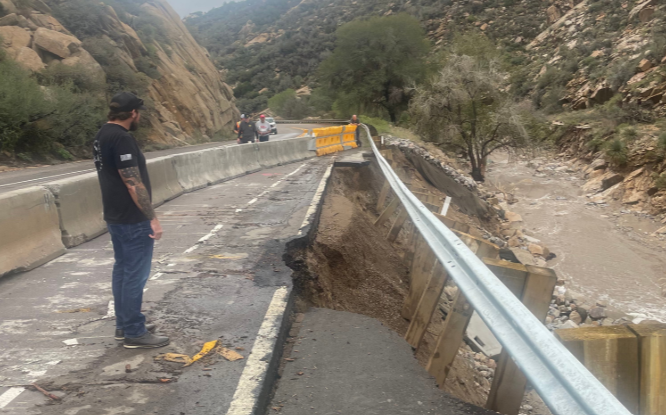
In the aftermath of historic flooding across Gila County in September 2025, Arizona communities are still wrestling with the long road toward recovery, and the federal government’s initial refusal to provide disaster relief has only added to the frustration.
On Thursday, U.S. Rep. Eli Crane (R-AZ02) took action, sending a letter to President Donald Trump and FEMA Region IX Administrator Robert Fenton uring them to intervene in Arizona’s appeal of FEMA’s denial of a Major Disaster Declaration. He was joined by Reps. Andy Biggs (R-AZ05), Juan Ciscomani (R-AZ06), and David Schweikert (R-AZ01).
The disaster declaration, would unlock vital federal funds and resources under the Robert T. Stafford Disaster Relief and Emergency Assistance Act to help communities like Globe, Miami, and other rural areas rebuild infrastructure, support residents, and mitigate future flood risks.
The appeal follows FEMA’s December 20, 2025, denial, a decision that came despite the state and local officials’ reassessment estimating damages well above $100 million.
“The new figures reflect substantial and unanticipated financial burdens placed on local jurisdictions, which were required to undertake immediate emergency protective measures, restore essential services, and address damage to roads, utilities, and public facilities,” Crane wrote in the letter.
He added, “When viewed in the aggregate, these impacts demonstrate a level of strain that exceeds the reasonable capacity of affected communities to manage without federal support.” Crane has engaged directly with FEMA officials in Washington, D.C., and invited them to visit Gila County to see conditions firsthand.
“With this more accurate assessment,” Crane said, “FEMA will now have a better sense of the damage to these storied communities. While many democrat elected officials were quick to point fingers and score cheap points, we worked behind the scenes to strengthen our efforts and believe the State of Arizona’s updated figures present a far stronger case for federal assistance. We applaud President Trump’s ongoing commitment to Arizona and look forward to continuing our work with his team at FEMA as they consider this appeal, which would deliver much-needed assistance to residents in rural Arizona.”
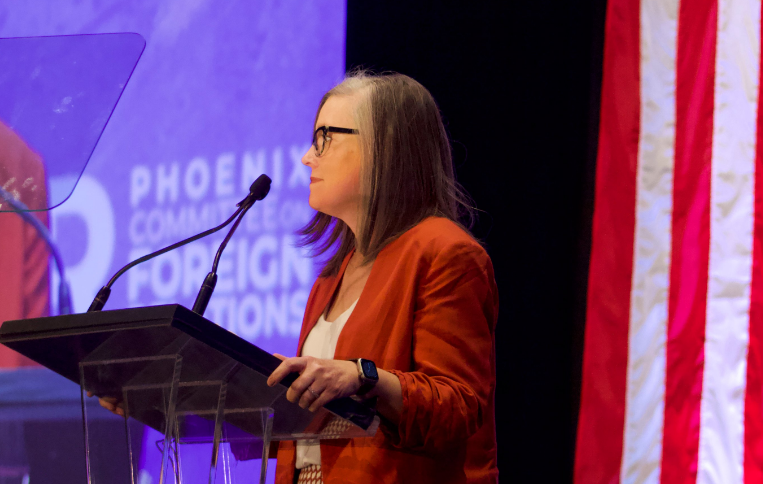
The original denial has drawn bipartisan criticism, including from Democrat Gov. Katie Hobbs, who argued the decision left families and local governments to shoulder rebuilding without critical federal support.
As federal officials weigh the appeal, residents and local leaders in Gila County continue working to recover from floods that overwhelmed watersheds, washed out infrastructure, and left lasting damage to homes and businesses.
Matthew Holloway is a senior reporter for AZ Free News. Follow him on X for his latest stories, or email tips to Matthew@azfreenews.com.
by Ethan Faverino | Dec 30, 2025 | News
By Ethan Faverino |
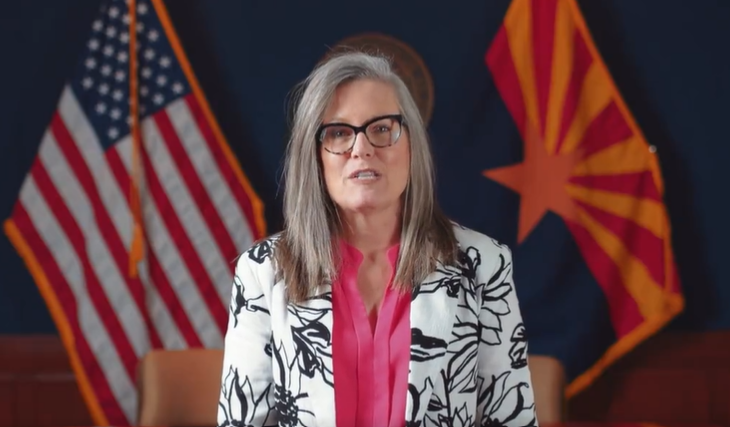
Arizona Governor Katie Hobbs strongly condemned the Federal Emergency Management Agency’s (FEMA) decision to deny the state’s request for a Major Disaster Declaration following the devastating floods that struck Gila and Mohave Counties from September 25-27, 2025.
Governor Hobbs announced plans to appeal the decision, emphasizing the urgent need for federal support to rebuild infrastructure, homes, and lives in these rural areas.
“The people of Gila and Mohave County were devastated by flooding from severe monsoon storms this September,” said Governor Katie Hobbs. “Now, they’ve been denied support from the federal government with little explanation. By denying much-needed relief, this administration is leaving Arizonans out on their own after their homes, businesses, roads, and bridges were decimated by historic storms. I will appeal this reckless decision and continue doing everything in my power to ensure Arizona communities don’t pay the price for the federal government’s senseless policies.”
The floods, triggered by a stalled monsoonal moisture system that dumped six to ten inches of rain in just 48 hours, overwhelmed local watersheds, including Pinal Creek, Miami Wash, Russell Gulch, and Keller Canyon.
Rapid runoff led to flash floods, debris flows, and widespread destruction across Globe, Miami, Claypool, Hayden, Winkelman, and other communities, including nearby Tribal nations.
Preliminary damage assessments revealed severe impacts: 312 homes were affected, with 64 destroyed, 89 suffering major damage, and 159 with minor to affected-level damage. More than 180 residents required emergency sheltering, and approximately 74 households lacked flood insurance.
Public infrastructure bore the brunt of the disaster with major damage to roads, bridges, utilities, and wastewater systems, including the loss of Globe’s city-owned wastewater system.
Total estimated losses stand at $33,579,081, broken down as follows:
- Residential: $4,100,000 for 312 damaged homes.
- Public Infrastructure: $23,306,284 for roads, bridges, and utilities in Globe, Miami, and rural areas of Gila and Mohave Counties.
- Emergency Protective Measures: $4,721,112 for search and rescue, debris clearance, sheltering, and Emergency Operations Center (EOC) activities.
- Debris Removal: $1,451,685 for 175,000 tons of mixed debris.
Hobbs was slow to declare a State of Emergency following the catastrophic flooding, eventually doing so on September 27, 2025, prompted by local declarations from Gila County, Mohave County, the San Carlos Apache Tribe, the Town of Miami, the City of Globe, and others.
State resources, including the Arizona Division of Emergency Management (DEMA), were fully mobilized, activating the EOC, deploying the incident management team, and coordinating evacuations, shelters, and rescues.
Local leaders echoed the Governor’s call for reversal:
Gila County Board of Supervisors District One Supervisor and Chairman Steve Christensen: “Devastation from our recent and profound flooding in southern Gila County has left many in financial ruin, homes destroyed, infrastructure destroyed or badly damaged, as well as loss of life. Gila County is left with significant challenges that we can never meet standing alone. Assistance from FEMA is vital, without which we will not recover to any level of the restoration needed. Please approve funding immediately for the work we MUST do in Gila County.”
Globe Mayor Al Gameros: “I want to thank Governor Hobbs, as well as the strong bipartisan support from our congressional delegation, for requesting a FEMA Major Disaster Declaration in response to the devastating floods that resulted in the death of three residents, and destroyed parts of our historic downtown, critical infrastructure such as bridges and roads, as well as numerous community assets. These floods caused historic and unprecedented damage and have forever transformed our small, tight-knit rural communities. Our community is extremely disappointed by FEMA’s short-sighted decision to deny the State’s Major Disaster Declaration, and we respectfully request that it reexamines its methodology and determines that this devastating flood event meets the critical criteria. I strongly urge FEMA to reverse course and immediately issue an approved Major Disaster Declaration.”
Miami Mayor Gil Madrid: “Miami is a strong and resilient community, and I know we can build back from this devastation, but this is a frustrating setback that will have a real impact on our families and businesses. I will continue working with state and local partners to ensure we get the support we need from the federal government to support our community. I urge the U.S. Department of Homeland Security to reconsider their decision and deliver this important relief to my city after we were struck by historic flooding.”
Ethan Faverino is a reporter for AZ Free News. You can send him news tips using this link.
by Matthew Holloway | Oct 14, 2025 | News
By Matthew Holloway |
With tropical storm-fueled rains hammering various parts of Arizona and flood losses mounting, the U.S. Small Business Administration (SBA) announced that low-interest loans are now available for the victims of severe flooding in Coconino, Gila, Graham, Maricopa, Navajo, Pinal, and Yavapai Counties, as well as tribal nations.
The SBA is offering low-interest federal disaster loans to eligible businesses, nonprofits, residents, and tribal nations—similar to those provided for the Dragon Bravo Fire victims in September.
In a post to X announcing the relief for Gila County, Congressman Eli Crane (R-AZ02) called for continued prayers for those hit by the massive flooding. Remnants of Hurricane Priscilla hammered the area over the weekend, adding to late September’s monsoon deluge that devastated Globe-Miami.
Crane wrote: “@SBAgov has declared an economic disaster due to the severe flooding in Gila County. Through this declaration, SBA’s Economic Injury Disaster Loan (EIDL) program is available to eligible businesses, private nonprofits, and residents,” providing a link to resources.
He followed up: “Please continue to keep those impacted by the devastating floods in Gila County in your prayers. For those affected, @SBAgov is offering Business Physical Disaster Loans, Home and Personal Property Loans, and Economic Injury Disaster Loans.”
According to the SBA:
“Businesses and nonprofits are eligible to apply for business physical disaster loans and may borrow up to $2 million to repair or replace disaster-damaged or destroyed real estate, machinery and equipment, inventory, and other business assets.
“Homeowners and renters are eligible to apply for home and personal property loans and may borrow up to $100,000 to replace or repair personal property, such as clothing, furniture, cars, and appliances. Homeowners may apply for up to $500,000 to replace or repair their primary residence.
“Applicants may be eligible for a loan increase of up to 20% of their physical damage, as verified by the SBA, for mitigation purposes. Eligible mitigation improvements include insulating pipes, walls and attics, weather stripping doors and windows, and installing storm windows to help protect property and occupants from future disasters.”
The Economic Injury Disaster Loan (EIDL) program is also available to help small businesses, nurseries, and non-profit organizations with financial losses directly related to this disaster.
For more information, the SBA directs victims to visit this website. They can apply online, call SBA’s Customer Service Center at (800) 659-2955, or email disastercustomerservice@sba.gov.
“When disasters strike, SBA’s Disaster Loan Outreach Centers play a vital role in helping small businesses and their communities recover,” Chris Stallings, associate administrator of the Office of Disaster Recovery and Resilience at the SBA, said in a press release. “At these centers, SBA specialists assist business owners and residents with disaster loan applications and provide information on the full range of recovery programs available.”
Matthew Holloway is a senior reporter for AZ Free News. Follow him on X for his latest stories, or email tips to Matthew@azfreenews.com.
by Ethan Faverino | Oct 1, 2025 | News
By Ethan Faverino |
Arizona State Representative Walt Blackman, Chairman of the House Government Committee, urged Governor Hobbs to declare a State of Emergency in Gila County following catastrophic flooding. The flooding that began on Thursday, September 25, 2025, has already claimed at least three lives, with one still missing.
Hobbs waited days before declaring an emergency, finally declaring one on Saturday, September 27.
The floods have washed away vehicles, damaged historic buildings, and scattered hazardous debris, leaving the communities in a state of disaster.
Search and rescue operations, supported by the Arizona Department of Forestry and Fire Management, Arizona Department of Public Safety (AZDPS), and cadaver dogs, continue across Globe and Gila County.
“The people of Gila County are facing a disaster that has taken lives, destroyed homes and businesses, and left our communities in crisis,” said Representative Blackman. “I am in constant contact with local and state officials and working around the clock to make sure families get the help they need. I urge Governor Hobbs to act immediately so state resources can be mobilized for rescue, recovery, and rebuilding.
He added, “Gila County residents need help now. I am calling on the Governor to issue this declaration without delay. Every hour counts when lives and property are at risk.”
The state’s emergency operation center is operating at level 1 with 24-hour staffing from 20 agencies and over 45 personnel.
Globe Mayor Al Gameros confirmed three deaths and one missing as of Monday, September 29, 2025.
“This morning (Sunday), we brought in an incident command team, type 3 team from the state, and they bring in so many resources,” said Mayor Gameros. “They bring in over 150 team members … We also have helicopters on standby.”
Ethan Faverino is a reporter for AZ Free News. You can send him news tips using this link.
by Ethan Faverino | Aug 28, 2025 | News
By Ethan Faverino |
Through the One Big Beautiful Bill Act, the U.S. House of Representatives reauthorized the Radiation Exposure Compensation Act (RECA) through December 31, 2028, and enacted its largest-ever expansion.
This act broadens eligibility to include new populations, such as Northern Arizona counties and additional uranium workers, while continuing support for those affected by the U.S. nuclear weapons program.
The expanded RECA provides a one-time, lump-sum payment of up to $100,000 to qualifying individuals or their survivors, offering critical restitution for those who developed serious illnesses due to radiation exposure.
Representative Eli Crane (AZ-02) announced that the reauthorized act now covers individuals in Coconino, Yavapai, Navajo, Apache, Gila, and Mohave counties in Arizona affected between January 1951 and November 1962, as well as uranium workers employed in covered occupations from January 1, 1942, to December 31, 1990.
The program also extends to onsite participants of nuclear tests and those impacted by the Manhattan Project waste.
RECA provides a non-adversarial alternative to litigation, requiring no proof of causation. Claimants qualify by demonstrating a compensable disease and presence in a designated area or occupation during specified periods.
The program, administered by the Department of Justice, is designed to resolve claims efficiently, using existing records to minimize administrative costs for both claimants and the government.
The four qualifying categories are Downwinders, onsite participants, uranium workers, and Manhattan Project waste victims.
Downwinders are individuals who developed certain cancers after radiation exposure from U.S. nuclear tests between 1944 and 1962.
The program now includes several Arizona counties along with eligible areas in Idaho, New Mexico, Utah, and Nevada.
To qualify, individuals must have lived in one of the areas during a specific time period and have been diagnosed with a compensable disease such as leukemia, multiple myeloma, lymphoma, or certain primary cancers.
On-site participants were individuals present at U.S. atmospheric nuclear tests before January 1, 1963, and later developed a compensable disease.
Uranium workers also receive compensation for individuals employed in uranium mining, milling, core drilling, ore transport, or remediation efforts in mines or mills located in Colorado, New Mexico, Arizona, Wyoming, South Dakota, Washington, Utah, Idaho, North Dakota, Oregon, or Texas between January 1, 1942, and December 31, 1990.
To qualify, uranium workers must have been employed for at least one year during the time period and been diagnosed with a compensable disease such as lung cancer, pulmonary fibrosis, silicosis, pneumoconiosis, cor pulmonale related to lung fibrosis, or renal cancers.
Lastly, Manhattan Project waste victims get compensation for individuals exposed to Manhattan Project waste in designated areas of Missouri, Tennessee, Alaska, and Kentucky.
To qualify, individuals must have lived, worked, or attended school for at least two years after January 1, 1949, in designated zip codes and have a compensable disease.
The expanded Radiation Exposure Compensation Act delivers long-overdue justice, honoring those whose lives were forever changed by radiation exposure.
Ethan Faverino is a reporter for AZ Free News. You can send him news tips using this link.