by Tamra Farah | Jul 1, 2025 | Opinion
By Tamra Farah |
Arizona’s Empowerment Scholarship Account (ESA) program, launched in 2011, empowers families to tailor their children’s education with state funds. The 2025-2026 school year covers private school tuition, tutoring, and therapies, averaging $7,000 – $8,000 per student.
While the program serves over 93,000 students, that number is only a fraction of its possible reach. Bureaucratic inefficiencies and government red tape currently hinder broader access and limit the benefits of ESAs. The approval of the 2025-26 ESA Parent Handbook could have fixed this, but as critics pointed out, the handbook’s restrictive guidelines and manual review processes create more bureaucratic obstacles.
Now, it’s time to examine some of the key aspects of the ESA Program. We need real change, including adopting best practices from other states to streamline operations, better serve families, and extend this opportunity to more Arizona children.
ESA Application Process
The ESA program provides eligibility to any Arizona child from kindergarten through 12th grade, including preschoolers with disabilities, as outlined in the 2025-26 ESA Parent Handbook and A.R.S. §15-240. Families apply via the Arizona Department of Education’s (ADE) online portal, submitting proof of residency and, for students with disabilities, an IEP or 504 Plan.
Approvals are typically granted within 30 days. Approved families sign a contract to use funds for educational expenses and to forgo public school enrollment. Quarterly tuition deposits are managed through ClassWallet, requiring allocation to core subjects like reading and math, with receipt submission to ensure compliance. Non-compliance risks account suspension, balancing flexibility with accountability.
ClassWallet and Financial Management
ClassWallet simplifies ESA fund management through the ESA Applicant Portal, allowing parents to monitor balances and make transactions. It offers four spending options: the Marketplace, with pre-approved items like textbooks; Pay Vendor, for payments to providers such as private schools; the Debit Card, which requires receipt validation for purchases like school supplies; and Reimbursement, for out-of-pocket costs after review.
Marketplace purchases are automatically deducted, like a math workbook, are automatically deducted, streamlining routine expenses. However, non-Marketplace transactions require manual review as mandated by the 2025-26 handbook, which causes inefficiencies and frustrates parents.
Manual Review Staffing Strain
The 2025-26 handbook requires a manual review for non-Marketplace items, a detailed and staff-intensive process. Items like custom curricula, tutoring from unregistered providers, computer hardware, therapies for students with disabilities, debit card purchases, public school fees, and expensive items such as a $500 musical instrument must be verified for educational relevance. This includes providing specific documentation for IEP students and detailed invoices.
With more than 93,000 students, that could mean up to 186,000 reviews annually taking 46,608 staff hours. That would require at least 23 full-time ADE employees, thereby straining resources. These reviews, mandated by A.R.S. §15-2403(B), caused delays for 77% of parents, according to a 2024 Heritage Foundation report, which fuels perceptions of bureaucratic inefficiency.
The 2025-26 Handbook Controversy
The latest handbook’s approval by the Arizona State Board of Education (SBE) with an 8-1 vote sparked controversy over its compliance with state law. Critics, including parent Angela Faber, argued that its restrictive approval process, requiring additional documentation for disability-related expenses, violates A.R.S. §15-2402(B)(4), which permits funds for therapies and assistive technology.
Republican lawmakers criticized “overly restrictive cost guidelines,” such as a removed $16,000 cap on items like cellos, claiming the handbook defied a legislative warning. Still, no formal directive is documented, making the accusation speculative. The ADE asserts compliance with A.A.C. R7-2-1503 and A.R.S. §15-231(B), with a 30-day appeal period for denied expenses to ensure recourse. Despite revisions, late draft postings limited public review and increased debate. A 2023 report showed 96% of ESA funds supported academic goals, highlighting the program’s potential when managed effectively.
Lessons from Other States
Expanding ClassWallet’s Marketplace to include more pre-approved items could decrease manual reviews by 20–30% to improve the handbook’s inefficiencies. Implementing a machine-learning system for routine approvals, modeled on Florida’s Family Empowerment Scholarship or Tennessee’s Individualized Education Account, would simplify processing. Reinstating debit cards with Merchant Category Code restrictions and adopting risk-based audits could reduce review volume by 40%. Better parental education through tutorials could lower errors, easing administrative burdens.
Potential Leadership Change: Horne vs. Yee
Amid the handbook concerns, Superintendent Tom Horne may face Treasurer Kimberly Yee in the Republican primary for Arizona Superintendent of Public Instruction. During his tenure, Horne has advanced educational initiatives by eliminating the Kindergarten Entry Assessment to reduce teacher workload and expanded school safety with 565 new officers. As Arizona State Treasurer, Kimberly Yee has championed government transparency by pushing for easily accessible online budgets, with the Arizona Treasury website providing clear information on taxpayer spending, enhancing public accountability. Yee has also prioritized financial literacy for high school courses and a Financial Literacy Fund to educate students, seniors, and vulnerable populations. Voters are urged to select the leader in 2026 who is most qualified and prepared to improve upon the administratively challenged ESA program. Check out my previous column for more information about the Horne and Yee matchup.
Conclusion: Strengthening a National Model
The ESA program’s flexibility for over 93,000 students makes it a national leader, but the 2025-26 handbook’s manual reviews and controversial approval process show administrative challenges. Arizona can improve operations while keeping accountability by increasing transparency and adopting automation, learning from Florida and Tennessee.
For more details, visit https://www.azed.gov/esa or call (602) 364-1969. Be aware of potential staff availability constraints.
Tamra Farah leads AmericanStrategies.org. She brings twenty years of experience in public policy and politics as a journalist, focusing on protecting individual liberty and advocating for limited government. She has worked with ten local, state, and federal candidates and organizations, such as Americans for Prosperity, FreedomWorks, Moms for America, and Arizona Women of Action. Farah has regularly appeared on conservative radio, television, and print media.
by Daniel Stefanski | Nov 22, 2024 | News
By Daniel Stefanski |
Arizona Republican officials have met with the State of Florida’s chief of elections to ascertain necessary changes to their own systems of counting and reporting votes.
On Tuesday, Arizona Senate President Warren Petersen led a call with the Florida Secretary of State, Cord Byrd, for the purpose of gleaning information about the Sunshine State’s efficient ballot tabulation for Election Day.
In a post on his X account, Petersen marked the meeting, saying, “Just finished a great meeting with Florida Secretary of State Cord Byrd and his staff discussing what they do to get election results quickly. As expected a big difference is that we do not have a cutoff for early ballot drop-offs at polling places like they do. But we also learned of other ways to be more efficient. I look forward to passing legislation so that AZ will have election results night of.”
Petersen also thanked the Republicans who joined him on the call, including Representatives Steve Montenegro, John Gillette, Senators Shawna Bolick, John Kavanagh, JD Mesnard, incoming Senator Mark Finchem, Maricopa County Supervisor Thomas Galvin, incoming Supervisor Debbie Lesko, and Republican Party of Arizona Chair Gina Swoboda.
In an exclusive comment to AZ Free News, Petersen shared more of his thoughts about the meeting, stating, “What I came away with is that the biggest thing we can do to speed up results, that would be the easiest to implement, would be having a cutoff of 7 p.m. on the Friday before the election to drop off ballots.”
Secretary Byrd acknowledged the meeting on social media, posting, “Yesterday, I and my team at the Florida Secretary of State spoke with legislative leaders from Arizona including the Senate President and Speaker of the House about how Florida’s election code allows for the timely and accurate counting of ballots. We are happy to share the Florida blueprint.”
Senator Bolick, who was also on the call with the Florida Secretary of State, told AZ Free News that, “In the past, I have worked with folks who helped fix the Florida issues. We also have tried different solutions over the past few years only for bills to be vetoed or killed by fellow GOP legislators because they didn’t sponsor the bill. I believe late earlies are the biggest hinderance in getting results on election night. Our voters are tired of being the laughingstock of the country, especially voters in Maricopa County. We shouldn’t be waiting two weeks for results. Early voting ends the Friday before the election as should mail-in ballots.”
Bolick added, “Florida’s voters know they can’t walk their vote by mail ballot into a polling place on election day. They can only walk it into their supervisor’s (aka our recorder’s) office on election day. Voters I have spoken to would be okay modifying these changes if it means getting results on races on election night. I am certain the legislature would be interested in appropriating funds to ensure timely, accurate results.”
State Senator Wendy Rogers also indicated her presence on the call and cheered the opportunity “to learn from Florida’s successes!”
Lesko made sure to note the call on her X account, writing, “Today, I was privileged to join AZ Senate President Warren Petersen, House Speaker Steve Montenegro, Supervisor Thomas Galvin, and several state legislators, on a call with Florida Secretary of State Cord Byrd to discuss their policies for elections that have made Florida into an admirable model. Republicans and Democrats must unite to make necessary reforms to Arizona elections. I look forward to working with legislators to accomplish this worthy goal on the Maricopa County Board of Supervisors.”
Republicans in the Arizona Legislature have vowed to make these reforms their top priority in the next legislative session, which starts in January. However, they are expected to meet resistance from Democrats, especially Governor Katie Hobbs, who has vetoed other commonsense elections bills in her previous two years in office.
Daniel Stefanski is a reporter for AZ Free News. You can send him news tips using this link.
by Brian Anderson | Jun 16, 2023 | Opinion
By Brian Anderson |
A third Florida man has his eyes on the White House.
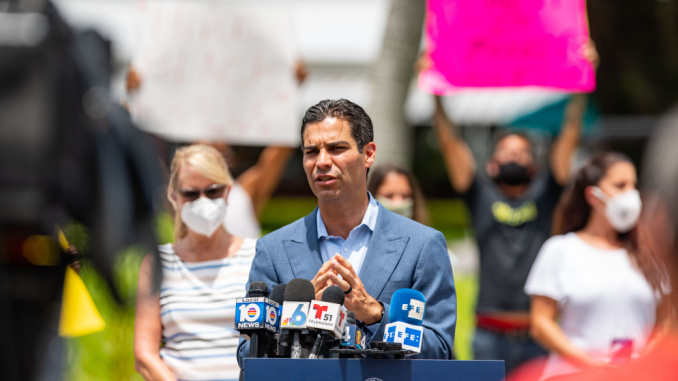
On Wednesday, after weeks of teasing an announcement, Miami Mayor Francis Suarez officially became the latest entry into the crowded Republican primary for president.
His speech at the Reagan Foundation the following day hit all the right notes—citing Miami’s “economic explosion” and “disciplined approach to spending” amid budget bloat in Washington—and there is little doubt that the mayor of Florida’s second-largest city will tout his role in the state’s booming economy.
Florida continues to stand out as a national model for conservative governance, with a low unemployment rate and record influx of new residents to prove it. But, before Suarez takes too much credit, voters would be wise to familiarize themselves with the mayor’s record, including how vehemently he fought against the very policies that have made Florida ‘Florida.’
After all, there would be no ‘Governor’ Ron DeSantis today if Suarez had had his way, only a ‘former Congressman.’ The mayor’s choice in the 2018 Florida gubernatorial race was Tallahassee Mayor Andrew Gillum, the progressive up-and-comer endorsed by Sen. Bernie Sanders and backed by Democratic mega-donor Tom Steyer.
Gillum’s radical campaign platform called for ‘Medicare for All,’ a 40 percent increase in the state’s corporate income tax, and other progressive priorities that would have slammed the brakes on the Sunshine State’s forward momentum. Yet Suarez campaigned for him ahead of Election Day and ultimately cast his ballot the same. (Two months later, he attended a special inaugural ball celebrating the victory of Agriculture Commissioner-elect Nikki Fried, the Democrat who would run for the state’s highest office in 2022.)
Thankfully, DeSantis ended up in the Governor’s Mansion, while Gillum’s 15 minutes of fame ended on the floor of a hotel room under less-than-ideal circumstances. Floridians rejected Suarez’s advice and have been better off for doing so ever since.
Case in point: COVID-19.
Perhaps no issue has defined DeSantis’ reputation more than his handling of the pandemic. The governor remained unwavering in his commitment to freedom and personal responsibility, even as opponents smeared him as “Ron DeathSantis,” as lockdown lobbyists in Grim Reaper costumes stalked families at his re-opened beaches, and as media properties like “60 Minutes” devolved into baseless fever dreams aimed at undermining his vision.
Miami’s mayor was not on the side you might think.
In April 2020, Suarez opposed the governor’s plan to “soon” resume in-person learning, insisting that “it would be particularly dangerous” to re-open schools considering the “incredible amount of children who could be at risk.”
He criticized DeSantis in September 2020 for his “acceleration” toward re-opening Florida’s economy “a lot faster … than what we had planned.”
Suarez also complained in January 2021 that “we’ve been restricted from being able to put in mitigation measures,” such as public mask mandates, by the governor, despite having “tried to reach him on multiple occasions” to lobby for the power to do so. The mayor called for a national mask mandate as well, strictly enforced with “the threat of fines” and “even arrest.”
This is not the record of a small-government conservative.
His recent hasty characterization minimizing DeSantis’ subsidy fight with Disney as a “personal vendetta”—all while lobbing personal insults at the governor (he “struggle[s] with relationships” and won’t “look at people in the eye”)—makes one wonder if Suarez doesn’t have a vendetta himself, with a campaign to dilute Florida’s primary vote as its main vehicle.
In short, the 2024 presidential race’s newest candidate may sing the right tune on the campaign trail, but the Sunshine State is the beacon of freedom it is today not because of Miami’s mayor, but despite him.
Suarez told “Face the Nation” host Margaret Brennan last month, “I’m someone who needs to be better known by this country,” and I agree, particularly by Republican primary voters—lest his happenstance proximity to Florida’s achievements be confused for actual contributions to them.
Brian Anderson is the president of the Saguaro Group, an Arizona-based research firm.