SCOTUS Agrees To Hear Case Supported By Arizona Republican Lawmakers Against FCC
By Daniel Stefanski |
Republicans in the Arizona Legislature scored another legal victory with the nation’s high court granting cert on a case they had intervened in earlier this year.
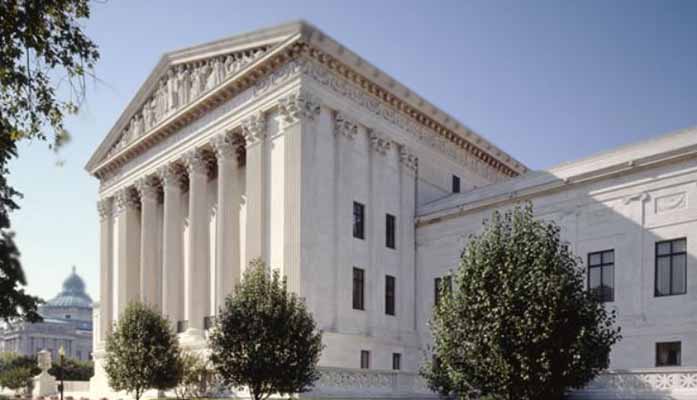
On November 22, the Supreme Court of the United States agreed to hear FCC v. Consumers’ Research in its current term. The case will be consolidated with SHLB Coalition v. Consumers’ Research. This case involves a question of the nondelegation doctrine, which, according to the Legal Information Institute at Cornell, is “the principle that Congress cannot delegate its legislative powers or lawmaking ability to other entities.”
The decision from the U.S. Supreme Court represents a significant victory for Republicans in the Arizona Legislature, who had joined an amicus brief from state attorneys general from around the country to urge the justices to hear arguments in this case.
On its X account, Consumers’ Research reacted to the order, writing, “American citizens and consumers alike deserve basic accountability in government and in the marketplace. Americans currently are forced to pay a tax with every phone bill, set by unelected bureaucrats, at the recommendation by the same private corporation that receives the revenue. This is absurd and we believe SCOTUS will agree as the 5th circuit did.”
Arizona Senate President Warren Petersen, who was instrumental in the Arizona Legislature joining the efforts to support Consumers’ Research, told AZ Free News that, “These carriers are unlawfully taxing the public to the tune of billions of dollars. Congress should instead determine what taxes our citizens are to pay and by how much, not unelected Washington bureaucrats.”
The brief that the Arizona Legislature signed onto was joined by 15 other states, led by the West Virginia attorney general. The other states were Alabama, Arkansas, Indiana, Kansas, Louisiana, Missouri, Montana, Nebraska, Ohio, Oklahoma, South Carolina, Tennessee, Texas, and Virginia.
In their brief, the attorneys general argued that “the states – and our country – need guidance on the nondelegation doctrine,” that “those who mean to scare the court away from these issues are wrong,” that “preserving Congress’s legislative power protects the states’ interests,” and that “this court should evaluate this statute.”
They wrote, “Every year, the Federal Communications Commission extracts billions from American consumers based on a vague statute that says telecommunications providers ‘should make an equitable and nondiscriminatory contribution to the perseveration and advancement of universal service.’ The only limits on this multi-billion-dollar fee are vague notions like ‘quality’ service. And the Commission – an independent agency already shielded from accountability in its own right – doesn’t even set these rates itself. Instead, a private company picks a number that the Commission rubberstamps later.”
The attorneys general added, “Make no mistake: Amici States recognize the goal of securing universal telecommunications service is laudable. Congress can and should find a way to provide these services for everyone. But it’s a ‘fundamental principle that, no matter how laudable its purposes, the actions of our government are always subject to the limitations of the Constitution.’ Congress needs to be the one to act here, not a private band of unaccountable industry participants. The Court should grant the Petition to say so.”
The Court’s decision to hear arguments in this matter follows an opinion from the U.S. Court of Appeals for the Fifth Circuit in July, which found that “this misbegotten tax violates Article I, Section I of the Constitution.” The appeals court stated, “The Q1 2022 USF Tax is not only difficult to square with the Supreme Court’s public nondelegation precedents. It was also formulated by private entities. That raises independent but equally serious questions about its compatibility with Article 1, Section 1, which requires ‘[a]ll legislative Powers herein granted shall be vested in a Congress.’ We (1) explain that the scope of FCC’s delegation to private entities may violate the Legislative Vesting Clause by allowing private entities to exercise government power. Then we (2) explain that even if FCC’s delegation could be constitutionally justified, FCC may have violated the Legislative Vesting Clause by delegating government power to private entities without express congressional authorization.”
According to SCOTUSblog, this case will likely be argued before the U.S. Supreme Court in the spring of 2025. The justices’ opinion will be rendered in June or July at the conclusion of their term.
Daniel Stefanski is a reporter for AZ Free News. You can send him news tips using this link.