The group seeking to end Arizona’s universal school choice program declared that it doesn’t have to disclose the percentage of out-of-state funds.
A complaint filed in April alleged the Protect Education, Accountability Now Committee (PEANC) falsely advertised that only 9% of contributions came from out of state.
PEANC’s ballot initiative, the Protect Education Act, would impose an income cap limiting enrollment in Arizona’s school choice program, Empowerment Scholarship Accounts, and eliminate funding rollover.
PEANC claimed in a response submitted on Friday and obtained by AZ Free News that Arizona law only requires the percentage of out-of-state contributors, not out-of-state contributions.
The section of Arizona law at issue (A.R.S. § 16-925) states the following:
“In addition to the disclosure required by subsection A of this section, a political action committee that makes an expenditure for an advertisement shall include a disclosure stating: […] The aggregate percentage of out-of-state contributors as calculated at the time the advertisement was produced for publication, display, delivery or broadcast. The disclosure shall state ‘paid for by _____’ as prescribed by subsection A of this section, followed by ‘with _____% from out-of-state contributors’ with the blank to be filled by the aggregate percentage prescribed by this paragraph.”
Counsel for PEANC argued in its response letter that, while nearly $4.5 million of its $4.6 million in net contributions did come from Washington, D.C. labor organizations, only 9% of all contributors to PEANC were from out of state.
“This text requires disclosure of the aggregate percentage of out-of-state contributors — i.e., based on contributor counts — not dollar amounts or ‘aggregate funding,’ and that percentage is calculated ‘at the time the advertisement was produced,’” stated PEANC’s counsel, Barton Mendez Soto. “The word ‘contributors’ refers to the people or entities making contributions, not the dollar amounts of their contributions.”
PEANC’s counsel said their interpretation accurately reflected what they dubbed the “contributors-percentage metric” represented by the statute.
The complainant, Jack Pannell, filed his complaint with the secretary of state after he observed a disclaimer on the bottom of PEANC’s website claiming that out-of-state contributors accounted only for 9% of total funding.
An archived version of the site captured in early February reflected an out-of-state contributions disclosure that totaled 50%.
Major Arizona-native donors to the PEANC came nowhere near the millions posted to PEANC’s finance reports; these donors include Arizonans For Quality Education (AFQE), $50,000; Nita and Phil Francis, $25,000; and the Arizona Education Association, $10,000.
Approximately 99% of AFQE’s funding has been tied to “shadow sponsors,” meaning unnamed corporations and LLCs. The remaining funds, less than half of a percent, came from an individual named Christopher “Chris” Kotterman on behalf of the Friends of ASBA, an affiliate of the Arizona School Boards Association.
Kotterman has served as Gov. Katie Hobbs’ senior policy advisor since late 2024.
The Protect Education Act would need about 256,000 signatures to make the ballot. The petition-filing deadline is July 2.
AZ Free News is your #1 source for Arizona news and politics. You can send us news tips using this link.
An Arizona mother says the state’s universal school choice program ensured the successes of her nine children.
Andrea attested that the Empowerment Scholarship Account (ESA) program allowed her family to have choice in the education of their nine children after she and her husband lost their jobs.
“It was a hard time to be able to pay for homeschool; we would have had to put our kids in a public school, and it was really stressing us out,” said Andrea.
ESAs empower kids with scholarships for the best fit education.
Listen to this AZ homeschool mom share how ESAs empower her kids.
— AZ Women of Action (@AZWomenofAction) May 19, 2026
Andrea told America’s Women that the job her husband acquired following his job loss didn’t provide enough income to cover the costs of homeschooling. The prospect of forcing her children to enter “a one-size-fits-all system” worried her; Andrea said the ESA program allowed her to provide her children with unique opportunities and freedoms not available within public education.
“Homeschooling with ESA has opened doors beyond traditional education. Our children have the opportunity to learn through real-life experiences — hiking in nature, visiting museums, and engaging in hands-on learning that brings lessons to life,” said Andrea. “They can move at their own pace, receive one-on-one attention, and explore interests that will shape their future paths and careers.”
As of Monday, the ESA program reported surpassing 101,500 students. The program also reported the enrollment of 3,300 new students for the next school year.
The ESA program may undergo reforms from two propositions gathering signatures to make it onto the November ballot: the Protect Education Act and the Reform and Accountability Act. Each would need 256,000 signatures to make it onto the ballot.
The Protect Education Act would impose an income cap on enrollment in the ESA program, in addition to eliminating the rollover of funding. This proposition is backed by two big critics of school choice: the state’s main teachers union, Arizona Education Association, and the nonprofit Save Our Schools Arizona.
Under the reforms on this proposal, qualified schools and tutors would have to pay fees and register annually with the Arizona Department of Education (ADE). Qualified schools must be accredited or administer state assessments, and the state would have greater oversight of nonpublic schools receiving ESA funds.
The Reform and Accountability Act would mandate the ADE to establish an online marketplace payments system starting July 2027. The proposed system would limit ESA purchases to approved vendors. This would eliminate the current system, in which parents rely on reimbursements and debit cards.
The program would need to issue quarterly reports to the attorney general detailing vendor payments, family disqualifications, and recovered funds. As part of that crackdown on misspending, this ballot measure would permanently disqualify parents from the program who intentionally misuse school choice funding.
Students not enrolled full-time at a qualified school would need to participate in an approved examination to gain entry to the ESA program. Then, the ADE would need to maintain lists of approved examinations and curricula.
The American Federation for Children has backed this proposition.
AZ Free News is your #1 source for Arizona news and politics. You can send us news tips using this link.
A new round of videos confirms that the spread of misinformation is extensive on both campaigns.
The entire Arizona school choice coalition opposes both measures because they would curtail the ESA program, which enables the families of more than 102,000 Arizona students to choose the learning environments that work best for them.
The initiatives would greatly disrupt their education by imposing new restrictions on how families can spend their funds, layering on bureaucratic red tape, and—in the case of the union-backed measure—kicking tens of thousands of children out of the program entirely.
In the latest clips, signature gatherers working for Protect Education Now, a joint project of Save Our Schools Arizona and the Arizona Education Association, and Fortify AZ, backed by the American Federation for Children, misrepresent the basics of the initiative and the ESA program itself.
Surprisingly, the talking points used by the supposedly pro-school choice campaign frequently mirror those used by ESA opponents.
Both Campaigns Grossly Exaggerate Misspending
In video after video, signature gatherers working for both initiatives wildly exaggerate the prevalence of fraud in the ESA program and hype the supposed purchase of “luxury” items such as jewelry, lingerie, trips to Disneyland, and other tabloid-ready spending that are forbidden under the ESA regulations.
One signature gatherer wearing a badge for Petition Partners, the group hired by the American Federation for Children-backed campaign, claimed that the ESA funds were used for jet skis and vacation rentals.
Another signature gatherer wearing a Petition Partners badge claimed there was $10.3 million in misspending in 2025. She failed to note that that accounts for barely 1% of total ESA spending, and that the vast majority of unallowed expenses were innocent mistakes, such as backpacks, lunch boxes, and water bottles.
Although there is room for improvement, Arizona’s ESA program is among the most accountable of any Arizona government program.
The Arizona Department of Education has confirmed that only 0.3% of ESA spending has been flagged as fraudulent or egregious—and nearly all of that occurred in the ClassWallet Marketplace channel that the American Federation for Children-backed initiative would preserve, while eliminating the debit card and reimbursement options that have almost no fraud at all.
Both Campaigns Spread Misinformation
Some gatherers from both campaigns have gone further still, telling voters verifiably false information in order to induce them to sign their petitions.
One Petition Partners signature gatherer told a voter that ESA parents were not required to submit receipts and that they could “buy a puppy” with their ESA and “say it’s for science class.” In fact, parents are required to provide receipts and other documentation. Moreover, the Arizona Department of Education confirmed that no ESA funds have been spent on puppies.
Another Petition Partners signature gatherer told a voter that parents were using ESA funds on cruises and home remodeling, while yet another claimed they were buying “cars and houses” with ESA funds. The Arizona Department of Education confirmed that no ESA funds have been spent on cruises, cars, houses, or home remodeling.
In some cases, the signature gatherers misrepresent the ballot initiatives to make them appear to be providing more education options for students.
In one video, a signature gatherer wearing a badge for FieldWorks, the group hired by the union-backed campaign, falsely tells voters that signing the petition would “help low-income students go to college.” The ballot initiative does no such thing.
In another video, a signature gatherer wearing a Petition Partners badge claims that the ballot initiative was “for everybody to be able to qualify for the [ESA] program.”
When the voter pushed back, noting that all students already qualify now, he replied (incoherently), “Because there’s something that’s against it already, so we [are] trying to get it on the ballot to be voted on instead of it just being changed.”
Ballot initiative workers have even spoken falsely to voters about the nature of their employment. In one video, a signature gatherer wearing a FieldWorks badge falsely tells a voter that he works for the Secretary of State’s office.
FieldWorks, the Arizona Education Association, and Save Our Schools Arizona did not respond to a request for comment.
It is unsurprising, if dishonest, when a teachers’ union and an avowedly anti-choice group resort to these tropes. It is genuinely appalling when a campaign backed by a self-described school choice organization spreads misinformation about a popular school choice program.
The American Federation for Children did not respond to a request for comment.
Previous videos have shown workers from the two campaigns colluding to gather signatures. In a new video, a signature gatherer with a FieldWorks badge that identifies her as a “team leader” introduces a voter to her fiancé, whom she claims is working for the “other education petition,” seemingly referring to the American Federation for Children-backed campaign.
The FieldWorks worker claims to be the “top signature gatherer in the state.” Her fiancé does not appear to be wearing a badge identifying the campaign for which he works, but he is holding a clipboard for the Fortify AZ petition.
When asked for comment, the owner of Petition Partners, Drew Chavez, deferred to their spokesperson David Liebowitz, who runs a self-described “public relations, political and crisis communication firm.”
The spokesperson declined to answer questions about the involvement of the American Federation for Children in crafting the messaging provided to the Petition Partners signature gatherers, instead providing the following statement: “Petition Partners has hands down the most thorough training program in the industry. Each of the more than 800 circulators hired for this effort has spent hours training on how to comply with state law and the facts of the measure itself.” The Petition Partners spokesperson said that they “have had reports of people pretending to be [Petition Partners] team members in an effort to discredit our work.” When asked to confirm or deny the employment of individuals who appeared in the videos, the Petition Partners spokesperson declined to answer.
Jack Reany, an ESA parent from Tucson, says that he has spoken with more than a dozen signature gatherers. He expressed shock at how little they tend to know about the ballot initiatives they’re asking people to sign.
“The public is being dangerously misled,” says Reany. “The fraud-and-accountability narrative is a smokescreen obscuring a deeply consequential piece of legislation: one that would strip legal protections from private schools, remove children from educational environments where they are thriving, and raid savings set aside by disabled students for their future.”
Arizona law is clear. Under A.R.S. § 19-116, knowingly misrepresenting an initiative’s subject matter to induce a signature is a Class 1 misdemeanor.
The videos keep accumulating. Whether Arizona’s anti-ESA attorney general acts on them is another question.
In the meantime, the advice from Arizona’s school choice advocates remains unchanged: If a gatherer approaches you with either petition, decline to sign.
Jason Bedrick is a Senior Research Fellow at the Heritage Foundation’s Center for Education Policy.
The Common Sense Institute (CSI) released the first report in its 2026 Ballot Guide series, examining the fiscal, educational, and family impacts of the proposed “Protect Education Act.” The analysis concludes that the measure would immediately disqualify approximately 20,300 current universal ESA families through a new income cap, while gradually excluding more than half of Arizona families with school-aged children over time as incomes rise faster than the cap’s limited adjustment.
The proposal would also impose new accreditations, testing, and spending restrictions on participating schools, potentially disrupting educational choices for over 100,000 Arizona students currently using Empowerment Scholarship Accounts (ESAs).
Arizona’s K-12 landscape has been shifting for more than a decade, with district enrollment declining since 2008 as families increasingly turned to charter, private, homeschool, and micro school options. District schools lost roughly 50,000 students in 2021-2022 alone—before universal ESA eligibility—and today enroll about 75,000 fewer students than in 2019-2020.
Fewer than 70% of Arizona’s school-aged children now attend district schools, down from 80% a decade ago.
In response to these trends and parent demand for alternatives, lawmakers expanded ESA eligibility in 2022 to all school-aged children, removing prior public-school attendance requirements. Participation surged to more than 100,000 students (nearly 10% of Arizona’s K-12 population), with annual awards totaling around $1.1 billion. One quarter of participants remain in pre-universal categories, including a rapidly growing share of students with disabilities.
Key Impacts of the Proposed Act
The Protect Education Act would limit universal ESA scholarships to households earning under $150,000 annually, require participating private schools to register, accredit, and/or conduct mandatory state testing, and further restrict allowable uses of funds by tightening definitions of “noneducational” and “luxury” items.
CSI’s analysis estimates that 24% of current ESA users have household incomes above the proposed threshold, immediately affecting roughly 20,300 universal-eligibility families.
Statewide, approximately 400,000 school-aged children—potentially up to 40% when accounting for family sizes—could be permanently excluded from universal ESAs based on 2024 income distributions.
Although the cap includes a 2% annual inflation adjustment. Arizona household incomes have historically risen closer to 4% per year, leading CSI to project that more than 52% of families with school-aged children could be income-excluded by 2045.
The restriction could also indirectly reduce participation in other eligibility categories. Growth in ESA usage among students with disabilities accelerated after universal expansion; without it, there might have been roughly 10,000 fewer participants in those targeted groups.
“Arizona’s K-12 system has been evolving for more than a decade as enrollment patterns, family preferences, and educational models continue to diversify,” stated Director of Policy & Research at CSI, Glenn Farley. “This analysis finds the proposed Act would not simply adjust ESA eligibility requirements, but could significantly reshape access to nontraditional education options over time. More families are signaling that one size does not fit all and are seeking educational choices that better meet their children’s needs.”
Fiscal Analysis: ESA Delivers Savings
ESA students receive significantly less funding than their public-school peers. The average universal ESA award is approximately $7,700 per student, compared to nearly $15,000 per public-school student. CSI estimates that shifting 20,000 universal ESA students back into district classrooms would increase annual taxpayers costs by about $115 million.
Despite serving over 100,000 students, the total number of publicly funded K-12 students (district, charter, and ESA) remains consistent with pre-2020 projections. The funding mix has simply shifted to better align with actual enrollment and family preferences, producing net savings for taxpayers. Arizona is also spending 30% more per-public school pupil (inflation-adjusted) than a decade ago, yet the share of funding reaching classrooms has declined slightly while support services have grown.
Academic Performance and Oversight
According to CSI, Arizona district students score low on state assessments with only 39% proficient in reading, 32% in math, and 27% in science. Available data indicate stronger outcomes in private and homeschool settings.
ACT scores show private school students outperforming public school counterparts by 19% and homeschool students by 12%. National Assessment of Educational Progress (NAEP) results similarly suggest private school students outperform roughly 70% of their public peers where comparable data exist.
CSI’s survey of participating private schools revealed that 84% already administer standardized testing and about two-thirds hold accreditation from recognized bodies. All respondents imply background checks and staff qualification standards. Private school leaders warned that the Act’s new requirements would create administrative burdens, with three-quarters indicating possible tuition increases and one in five suggesting they might stop accepting ESA students—potentially displacing over 4,600 reported ESA users.
Oversight mechanisms already exist in the ESA program. Arizona Department of Education audits found only 1.9% of sampled spending “unallowable” and 0.3% “egregious”—rates lower than many other public programs.
“Arizona was one of the first states to broadly expand Empowerment Scholarship Accounts, and a growing number of states have since adopted similar programs as demand for educational flexibility has increased,” added Farley. “If approved by Arizona voters, the proposal could significantly narrow access to options many Arizona families have increasingly turned to as part of the state’s changing education landscape.”
Ethan Faverino is a reporter for AZ Free News. You can send him news tips using this link.
This week’s erroneous attack on Arizona’s popular Empowerment Scholarship Accounts (ESAs) is another example of how biased reporting is misleading lawmakers and the public.
When the Arizona Auditor General last week released its Single Audit Report on the state for fiscal year 2024, Craig Harris of Channel 12 News had another fairy tale ready for viewers and readers. The ESA program, he claimed, is “plagued by weak controls, questionable spending, and internal management failures.”
No mention was made of the Arizona Department of Education’s recent finding that only 2% of ESA funds were spent on unallowed items (mostly innocent errors like backpacks and lunch boxes), and only 0.3% of ESA funds were spent fraudulently.
A new Arizona Auditor General report finds the the percentage of misspending in the state's Empowerment Scholarship program was a stunning 34 percent, based on a sample of transactions from July 23-October 25.
The report also is highly critical of @RealTomHorne management….
Both halves of that claim are false. And the falsehoods are not minor.
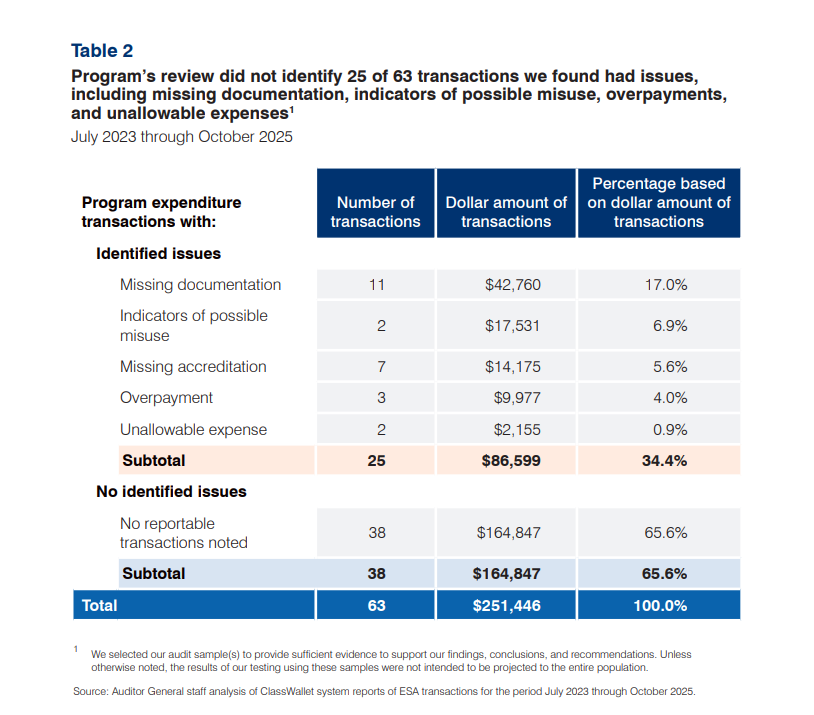
Start with “random.” The Auditor General’s report describes the relevant sample in unambiguous language: “we judgmentally selected 63 expenditure transactions for review occurring between July 2023 and October 2025 totaling $251,446.” [Emphasis added.]
A footnote on the same page adds, for the benefit of any reader who might be tempted to make the mistake that Harris did: “We selected our audit sample(s) to provide sufficient evidence to support our findings, conclusions, and recommendations. Unless otherwise noted, the results of our testing using these samples were not intended to be projected to the entire population.” [Emphasis added.]
Judgmental sampling and random sampling are not synonyms. They are distinct methodologies with distinct inferential properties. A random sample can be projected to a population; that is its entire purpose. A judgmental sample cannot, which is why auditors use it to probe suspected weaknesses rather than measure their prevalence.
In this case, the auditor general was testing the robustness of the Arizona Department of Education’s review process, not trying to determine the prevalence of misspending in the ESA program.
More responsible journalists, such as Garrett Archer of ABC 15, made sure to clarify that the auditor general’s findings were not generalizable to the entire program.
Note: This is not a program transaction error rate. The Auditor General's focus was on the review process itself.
— The AZ – abc15 – Data Guru (@Garrett_Archer) May 12, 2026
In other words, Harris completely misrepresented the auditor general’s methods and findings. That is sloppy at best, dishonest at worst.
Not only is the “34% misspending” figure not generalizable, it’s also not all misspending.
The 34.4% figure comes from dividing $86,599 in flagged transactions by the $251,446 sample. But Table 2 of Finding 2024-04 breaks those flagged transactions into five categories, and only two of them — “unallowable expense” ($2,155) and “overpayment” ($9,977) — involve money the program should not have disbursed.
The other three — missing documentation ($42,760), missing accreditation ($14,175), and “indicators of possible misuse” ($17,531) — are paperwork and compliance gaps. A tutor’s accreditation certificate that wasn’t uploaded is not the same thing as a misspent dollar. The actual confirmed misspending share within the sample (combining 0.9% unallowable expenses plus 4% overpayments) is about 4.9%, not 34%. Moreover, as the report concedes, even the 4.9% figure cannot be projected to the entire program.
In short, Harris conflates paperwork issues with misspending and treats a non-generalizable sample as generalizable, even though the auditor general warned readers not to do exactly that. Then Harris’s manufactured anti-ESA talking points are repeated ad nauseum by politicians and political activists.
Harris built an entire investigative series on a Department of Education internal review that supposedly reported a 20% misuse rate — except the internal review, like the auditors’ sample, was not designed to be projected. Harris projected it anyway.
When the same Department then produced a separate analysis suggesting misuse was minimal, Harris turned around and faulted that study for over-generalizing from its sample. For Harris, non-generalizable findings become generalizable when they damage ESA. Generalizable findings become non-generalizable when they don’t.
The convenient feature of this method is that the error always points the same direction. A reporter who genuinely struggled with the statistics of audit sampling would make mistakes in both directions over time. Harris’s don’t. They cluster.
And they remain uncorrected. Harris’s original 20% claim has never been retracted. The “random sample” language and the 34% framing are now circulating through campaign statements, legislative press releases, and social media posts, citing Harris’s distorted reading of the Auditor General report.
One cannot help but notice that Harris’s manufactured anti-ESA talking points come at a moment when anti-ESA groups are gathering signatures for two ballot initiatives to curb and regulate the ESA program. One also cannot help but wonder whether the downstream political effect is more than incidental to the reporting.
The Auditor General’s findings on ESA are real and worth engaging on their own terms. The program’s risk-based audit methodology is likely better than any other program in the state, but it could still be improved. The auditor has some substantive criticisms, and ADE will have to answer them.
Arizonans deserve honest reporting on those findings, not statistical fictions dressed up as “journalism.”
Jason Bedrick is a Senior Research Fellow and Corey DeAngelis is a Research Fellow at The Heritage Foundation’s Center for Education Policy.