by Jonathan Eberle | Jul 9, 2025 | News
By Jonathan Eberle |
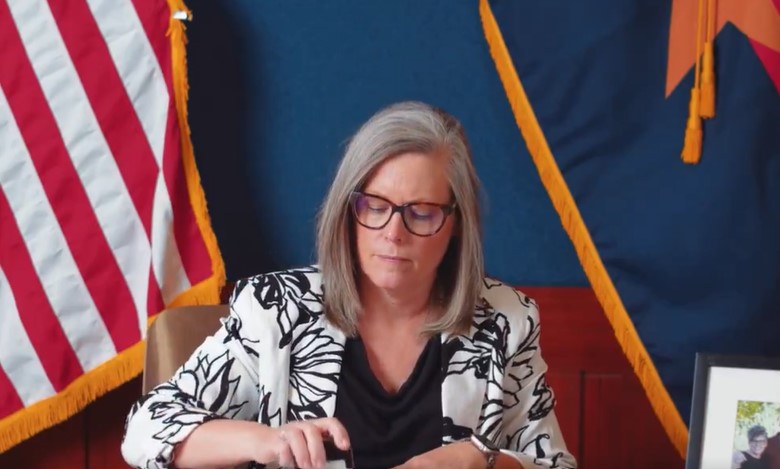
Arizona Governor Katie Hobbs has set a new record for vetoes in a single legislative session, rejecting 178 bills passed by the Republican-controlled Legislature, surpassing her previous record of 143 in 2023. While Hobbs wielded her veto pen often, she also signed 264 bills into law.
The legislative session, which ended in June, underscored the deep ideological divide between the Democratic governor and Republican lawmakers, with repeated clashes over immigration, election integrity, and social policy. Still, some bipartisan efforts did make it to the governor’s desk and gained her approval.
National Security and Border Policy
Hobbs approved Senate Bill 1082, a measure barring foreign adversaries—including China, Russia, Iran, and North Korea—from purchasing land in Arizona. The governor said the law would help protect military bases and infrastructure amid rising global tensions.
Yet, she vetoed a similar proposal, SB 1109, that targeted only China, along with a string of more aggressive border enforcement bills. Notably, SB 1164, known as the Arizona ICE Act, and HB 2099, both aimed to expand cooperation between state and federal authorities on immigration. Hobbs argued that decisions about immigration policy should remain in the hands of Arizonans, not Washington politicians.
Election Integrity Measures
Election security was another flashpoint. Hobbs rejected several Republican-sponsored bills she claimed would restrict voting access. Among them were:
- HB 2017, which would have capped voting precincts and eliminated on-site voting centers.
- HB 2046, a proposed change to audit procedures that Hobbs called inefficient.
- HB 2050, requiring daily updates on signature mismatches and enabling political party access to provisional ballots.
She also vetoed HB 2703, which sought to speed up election result reporting by cutting off ballot drop-offs on Election Day, calling it a form of voter suppression.
Education Policy
On education, Hobbs opposed efforts she viewed as punitive or politically motivated. She rejected:
- SB 1694, which would have barred state funding for higher ed institutions offering diversity, equity, and inclusion (DEI) courses.
- HB 2610, which would have allowed for the removal of school boards in financially mismanaged districts.
Conversely, she signed HB 2880, prohibiting unauthorized encampments on college campuses, and HB 2164, banning public schools from offering foods with synthetic chemicals like red dye 3 and potassium bromate.
Economic Legislation
Hobbs approved a slate of bills aimed at bolstering the state’s economy:
- HB 2704 greenlights renovations to Chase Field, home of the Arizona Diamondbacks, without raising taxes.
- SB 1182 ensures that construction crews can work early morning hours during Arizona’s scorching summers.
- HB 2119 increases transparency by requiring municipalities to give the public at least 60 days’ notice before voting on tax hikes.
This year’s record-setting number of vetoes highlights the persistent friction between Hobbs and the Legislature. While Republicans argue their legislation reflects the will of Arizona voters, Hobbs maintains that many of the bills would have restricted personal freedoms, hurt vulnerable communities, or created unnecessary bureaucracy.
With more sessions ahead and no signs of a political truce, Arizona’s divided government is likely to remain locked in debate.
Jonathan Eberle is a reporter for AZ Free News. You can send him news tips using this link.
by Jonathan Eberle | Mar 30, 2025 | Education, News
By Jonathan Eberle |
The Arizona State Senate is considering HB 2880, a bill that would prohibit individuals from establishing or occupying encampments on university and community college campuses. The bill, sponsored by State Representative Alma Hernandez (D-LD20), passed the Arizona House of Representatives with a 41-17-2 vote and outlines enforcement procedures and penalties for violators.
The legislation defines an encampment as a temporary shelter, including tents, set up on campus for overnight or prolonged stays. If an individual or group is found in violation, university or college administrators would be required to order the encampment dismantled and direct the individuals to vacate. Failure to comply would result in charges of criminal trespass and possible legal action, including removal by law enforcement.
Additionally, students who refuse to leave could face disciplinary action under their institution’s student code of conduct. Violators would also be held liable for any damages resulting from the encampment, including costs related to removal, campus restoration, and property repair.
The bill aligns with Arizona laws protecting free speech on college campuses, allowing restrictions only when expression violates laws, disrupts university operations, or falls outside First Amendment protections. While supporters argue that the bill upholds campus safety and prevents disruptions, critics contend it could limit protest activities and infringe on student rights.
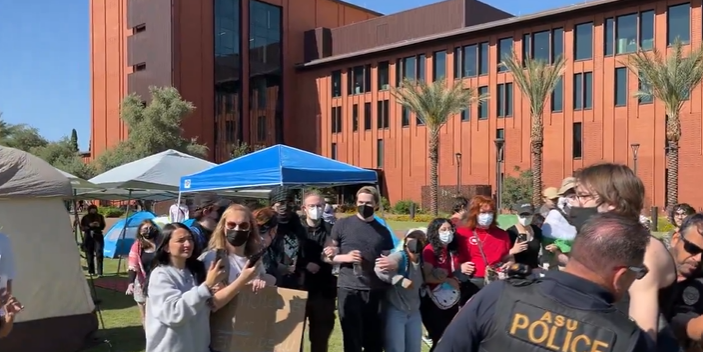
The issue of campus encampments recently came to the forefront in Arizona following the arrests of protesters at Arizona State University (ASU). According to reports, multiple demonstrators were detained during an anti-Israel protest on campus, where students and activists had set up an encampment in defiance of university regulations. Law enforcement intervened after the protest was deemed disruptive to campus operations.
The incident at ASU has intensified discussions surrounding HB 2880, with supporters arguing that the bill is necessary to prevent similar disruptions, while critics claim it could be used to suppress student activism. The event highlights the broader national debate over the limits of protest on college campuses and the role of law enforcement in maintaining order. Several states have introduced similar legislation in response to high-profile protests that have disrupted campus operations.
If enacted, the bill would require enforcement by campus security and local law enforcement agencies. The Arizona Board of Regents (ABOR) and community college governing boards would ensure compliance with student conduct policies.
The bill now awaits further deliberation in the Senate. As the debate continues, lawmakers, university administrators, and students will likely weigh the balance between maintaining order on campuses and protecting the right to protest.
Jonathan Eberle is a reporter for AZ Free News. You can send him news tips using this link.
by Corinne Murdock | Sep 22, 2023 | News
By Corinne Murdock |
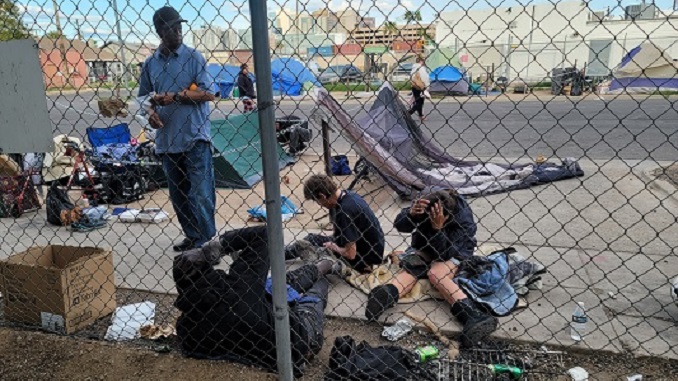
The Maricopa County Superior Court ruled on Wednesday that the city of Phoenix violated the law by enabling the existence of the infamous mass homeless encampment downtown known as “The Zone.”
Judge Scott Blaney declared in his ruling that the city displayed utter disregard for law-abiding citizens, instead issuing preferential treatment to the homeless by tolerating lawbreaking.
“[I]n their zeal to assist homeless individuals occupying the Zone, City personnel appear to be utterly indifferent to the plight of the City’s constituent property owners, their families, and small business owners that are attempting to make a living,” said Blaney. “The City’s refusal to meaningfully enforce statutes and ordinances in the Zone has created a classic siren song to certain individuals that are enticed at their peril by the Zone’s drugs, sex, and lack of societal rules.”
READ OUR PAST INVESTIGATIONS ON THE ZONE HERE
Blaney ordered the city to clear The Zone by Nov. 4, and keep the area clear of encampments and biohazards associated with the homeless (public defecation, drug paraphernalia, trash) thereafter. Blaney directed counsel for all parties to reconvene on Nov. 30 to review the city’s compliance with his order.
Blaney ruled that the city “intentionally” stopped or materially reduced the enforcement of criminal, health, and quality-of-life laws in The Zone; transported homeless individuals into The Zone with taxpayer-funded “courtesy rides” from police officers and community partners like Community Bridges; and generally allowed and even encouraged the occupation of The Zone.
As such, Blaney said the city was to blame for the increase in violent crime, organized crime, public drug use, biohazards, property crimes, prostitution, public indecency, fire hazards, blocked rights of way, environmental deterioration, and businesses’ decline.
The judge noted that prior to 2018, homelessness was limited, encampments weren’t present in the area, and residents considered the area safe. The ruling traced The Zone’s origins to early 2019, when current Mayor Kate Gallego assumed office.
A major argument presented by the city for their neglect of The Zone was a lack of shelter beds. Blaney declared the city failed to provide credible evidence of this claim; he also pointed out that there’s an unknown number of homeless individuals who are homeless by choice. City representatives admitted at trial that they determine whether an individual is “involuntarily homeless” based on self-reporting, not an investigation into that individual’s case. Some, as Blaney said, could well have the means to secure shelter through government benefits or a disability pension.
City representatives also admitted in testimony that it was their strategy to not prosecute individuals within The Zone for any crimes committed. The representatives relied on euphemistic language to describe their decriminalization approach, expressing that they “would prefer” those individuals to not “become justice involved.”
Blaney determined that the city’s approach essentially legalized all crime for any individual within The Zone.
“[I]f a homeless individual is confronted for an alleged crime, the city’s strategy is to pursue services for the individual instead of a conviction,” said Blaney.
As reported by AZ Free News and told to the residents who sued the city, police officers were advised that “the Zone is off-limits to enforcement.” Blaney also noted that the city appeared to reverse this policy of keeping police out of The Zone following his preliminary injunction earlier this year.
Blaney also detailed police’s delayed response to emergency calls, resulting in non-actions like asking a homeless individual to leave private property but refusing to remove those offenders from public easements or sidewalks adjacent to the property, even if that individual was intoxicated or high on drugs.
The mass encampments grew from an impasse of “service resistant” homeless that apparently stumped the city with their preference to life on the streets. These “service resistant,” reportedly didn’t want to follow the rules of the shelters by giving up their contraband of drugs and weapons, their pets, their partners, or the many possessions they’d accumulated that wouldn’t fit in the shelter space. According to a 2022 survey of the homeless conducted by the city, nearly 20 percent expressed this sentiment.
It’s likely the “service resistant” recognized that they could have the best of both worlds: three meals a day and a steady supply of other resources, like heat relief or hygiene packs provided by the city at no cost with no questions asked, and the ability to live “rule-free” and partake in all the drugs, alcohol, and prostitution they desired without fear of punishment from law enforcement.
“Although unthinkable for the general public, there are many individuals in the Zone that choose to live in a tent on the sidewalks or in the street, with three meals each day provided by the Human Services Campus and the ability to engage in antisocial behavior and drug use,” observed Blaney.
The city defended their inaction over the impasse. Their witness, Sheila Harris, attempted to convince Blaney of her plan to implement “permanent supportive housing” or “housing first,” in which homeless individuals are given the housing and then all other problems, like drug addiction, are dealt with afterward. Harris was credited as the main expert behind the city’s current approach in solving homelessness.
Blaney rejected Harris’ proposal. He sided with the perspective that the enforcement of laws resulted in more law and order, not less.
Blaney said that Harris’ “unusually soft” and “more expensive” approach wouldn’t come close to solving the causes behind homelessness or the myriad of dangers they’ve created, namely mental health and drug issues. Rather, Blaney pointed out that the increased enforcement of laws and interventions have proven to incentivize the homeless to either return to live with friends or family, move into transitional housing, or move to other cities with “more permissive laws” and no camping bans.
“According to Dr. Harris, the City of Phoenix’s plan, which she helped create, uses less enforcement and instead looks to an individual’s wants and needs,” said Blaney. “Although the Court agrees that all individuals, homeless or not, deserve to be treated with dignity, the Court does not believe that Dr. Harris’ unusually soft approach to addressing the dangerous and chaotic conditions in the Zone would be effective.”
Blaney also expressed doubt in the city’s estimation that 70 percent of individuals accepted services which translated into a permanent movement from the streets. The judge said that number was potentially misleading, noting that the city wasn’t able to disclose how many of those individuals accepted a “free hotel room for the night” before returning to The Zone the next day.
Unlike the homeless, the city would enforce laws on regular citizens, Blaney noted. The judge pointed out the irony of the city’s arbitrary enforcement of right-of-way law in its handling of a local business who took the opportunity presented by some gas line work to install sculptures in a spot where the homeless had been encamped. Yet, the city took no issue with the homeless encampment in the same spot also in violation of right-of-way law.
Corinne Murdock is a reporter for AZ Free News. Follow her latest on Twitter, or email tips to corinne@azfreenews.com.