Goldwater Institute attorneys urged the Arizona Supreme Court on Tuesday to allow Arizona State University (ASU) professor Owen Anderson to pursue his lawsuit alleging that the school’s “Inclusive Communities” employee training violated state law.
During oral arguments in Arizona Board of Regents v. Anderson, Goldwater Institute Vice President for Litigation Jon Riches argued that the Arizona Court of Appeals applied the wrong legal analysis when it concluded that Anderson had no implied private right to enforce the statute in court.
If a legal right exists, so does the right to enforce it.
That's the case we made before the Arizona Supreme Court today on behalf of @dr_owenanderson, a professor at ASU who is fighting for his right NOT to be forced into discriminatory DEI training. pic.twitter.com/OoPngHtixm
“Where there is a legal right, there is a legal remedy, is one of the oldest maxims in Anglo-American law,” Riches told the justices. “For decades, this court has applied that principle to find implied causes of action where a statute does not expressly create them. Yet without citing a single one of this court’s cases, the lower court did exactly what this court commanded it not to; it treated legislative silence as dispositive as to whether a statute creates a cause of action. But as this court [has held], legislative silence begins rather than ends the inquiry.”
In a post to X on Tuesday, Anderson invoked the legal maxim in Latin, writing, “‘ubi jus ibi remedium’ if there is a right there is a remedy. A cornerstone principle of common law. Yet @ASU and @AZRegents are asking the @AZCourts to suspend this principle and keep me as an employee from holding them responsible for racist DEI training.”
Anderson also shared a clip from the hearing in which Justice Clint Bolick characterized the right-remedy maxim as “the indispensable common law principle” and invoked Chief Justice John Marshall’s discussion of the principle in the landmark 1803 decision Marbury v. Madison.
Following the hearing, Anderson posted a statement saying, “That was an excellent hearing today before the @AZCourts. Jonathan Riches for @GoldwaterInst presented a solid case. The Justices asked the @AZRegents lawyer questions that exposed the contradiction at the heart of their claims, with their lawyer at one point stumbling so badly as to say, ‘I forgot the question.’ Oops! Now we wait for a decision.”
That was an excellent hearing today before the @AZCourts Jonathan Riches for @GoldwaterInst presented a solid case. The Justices asked the @AZRegents lawyer questions that exposed the contradiction at the heart of their claims, with their lawyer at one point stumbling so badly…
The Supreme Court limited its review to whether the Court of Appeals failed to apply the factors established in the court’s 1988 Transamerica Financial Corp. v. Superior Courtdecision before finding that A.R.S. § 41-1494 provides no implied private right of action.
Those factors include the statute’s context and language, its subject matter, its effects and consequences, and the law’s overall purpose. Riches argued that the lower court improperly treated the Legislature’s silence about a private cause of action as conclusive instead of beginning the broader analysis required under Transamerica.
The Arizona Board of Regents asked the justices to uphold the appellate ruling. In its supplemental brief to the Supreme Court, the board argued that courts should begin with the statutory text and consider secondary factors such as legislative history, consequences, and purpose only when the text is ambiguous.
The board maintained that § 41-1494 regulates government conduct without creating a private right or remedy. It also pointed to the statute’s annual compliance-reporting requirement and argued that lawmakers left enforcement to elected officials. The board said nearly all surrounding statutes contain express private rights of action, indicating that the Legislature deliberately omitted one from § 41-1494.
The statute prohibits the state, its agencies, and political subdivisions from requiring employees to undergo training, orientation, or therapy that presents blame or judgment based on race, ethnicity, or sex. It also prohibits the use of public money for such training and directs the Arizona Department of Administration to submit an annual compliance report to the governor and legislative leaders.
Anderson’s case began after ASU informed employees in October 2022 that they were required to complete its “Inclusive Communities” training. Anderson, a philosophy and religious studies professor, filed suit against the Board of Regents in 2024, seeking declaratory and injunctive relief.
Anderson alleges that the training presented prohibited concepts involving race, sex, and identity. His court filings cite training materials discussing “whiteness,” white supremacy, heterosexual privilege, land acknowledgments, and efforts to “decolonize the university.” The accompanying examination identified designated answers concerning systemic bias, transformative justice, and the incorporation of diversity, equity, inclusion, and belonging throughout the university.
A Maricopa County Superior Court judge found that the statute contained no express private cause of action but concluded that it implied one for employees subjected to prohibited training. The Arizona Court of Appeals reversed that decision in December, finding that the statute “unambiguously does not create a private right of action.”
The Court of Appeals left Anderson’s underlying allegations about the training unresolved. The Supreme Court’s current review also concerns the enforcement question rather than whether the content of ASU’s training violated § 41-1494.
The Board of Regents has disputed that the training was mandatory. Anderson said the alleged injury arose from being required to undergo the training.
“Well, I think the hurt is in taking the training, and so I would ask them to consider it from their perspective if they were asked to sit through hours of training that involved racial discrimination against a group they identify with, they would be offended by that and feel hurt,” Anderson said. “So the hurt — the consequence — is just in the fact that I had to sit through that.”
Anderson previously asked the Supreme Court to accept the case after the appellate ruling, arguing that public employees would otherwise lack an effective way to enforce the training prohibition. Goldwater’s petition sought recognition of an implied private cause of action allowing employees to challenge alleged violations by government employers.
The Supreme Court took the case under advisement following Tuesday’s arguments. Anderson said that he intends to proceed toward trial if the justices recognize his right to bring the claim. The court has not announced a deadline for its decision.
The Arizona Supreme Court will hear arguments Sept. 1 in Arizona State University (ASU) professor Owen Anderson’s effort to pursue a lawsuit alleging the school’s mandatory employee training violated state law. The law bars public employers from requiring training that assigns blame or judgment based on race, ethnicity, or sex.
The justices agreed to review whether the Arizona Court of Appeals should have applied factors established in a 1988 state Supreme Court decision before concluding that the law gives employees no implied private right to sue. The court’s review is limited to that enforcement question.
Anderson’s allegation that ASU violated the law remains unresolved. The Court of Appeals also did not decide whether the training’s contents violated the statute.
As AZ Free News reported in February, Anderson asked the high court to take the case after the Court of Appeals held in December that the statute supplied no private cause of action. His attorneys at the Goldwater Institute argued in their petition that the ruling departed from the method Arizona courts have used to determine whether lawmakers intended an implied remedy.
ASU forced a professor to take DEI training as a condition of employment.
ASU required employees to complete its “Inclusive Communities” module, one of three employee-training modules described in the Court of Appeals’ memorandum decision. According to Goldwater’s case materials, employees were instructed to repeat the training every two years, and Anderson viewed but did not complete the module or its accompanying quiz. The philosophy professor brought his lawsuit against the Arizona Board of Regents in 2024, alleging that the training presented race- and sex-based concepts prohibited by state law.
The statute bars the state and its political subdivisions from requiring employee training that presents “blame or judgment” based on race, ethnicity, or sex. It also prohibits the use of public money for such training and directs the Arizona Department of Administration to submit an annual compliance report to the governor and legislative leaders. The law exempts sexual harassment training from its restrictions.
“Ultimately, the question now before the Arizona Supreme Court isn’t a left or right issue—and it’s not just about DEI—it’s about whether a state employee has the right to hold their employer accountable when it violates the law,” Anderson said in a statement released by the Goldwater Institute.
In a statement to AZ Free News, Dr. Anderson added, “This case is now an employment case. ABOR/ASU is arguing a state employee does not have standing to hold them accountable for breaking § 41-1494. That means this is not a conservative vs. liberal issue. It is an employment issue that will affect all state employees going forward.”
A Maricopa County Superior Court judge denied the Board of Regents’ motion to dismiss Anderson’s statutory claim. The judge found that the Legislature had created an implied right for affected public employees to enforce the prohibition, despite the absence of an express authorization to sue. The Board then filed a special-action petition with the Court of Appeals, which accepted jurisdiction and vacated that portion of the trial court’s ruling.
The appellate panel concluded that the statute’s text contains neither an express nor an implied private right of action. It pointed to the statutory compliance reporting system and said a mandamus action could compel officials to submit the required reports. The panel left the superior court free to consider a separate request for equitable or declaratory relief if a proper party raises that issue on remand, according to the December decision
Goldwater’s petition for review argues that the appellate court should have applied the factors set out in Transamerica Financial Corp. v. Superior Court. Those factors include the statute’s context, language, subject matter, effects, consequences, spirit, and purpose. Goldwater contends that the law protects an identifiable group of public employees and that the reporting requirement does not give an employee a remedy after an alleged violation.
In its supplemental brief, the Board of Regents argues that the Court of Appeals correctly began with the statutory text. The Board says the provision prohibits specified government conduct without granting individuals a cause of action, and that the Legislature’s inclusion of a reporting system shows the enforcement approach it selected. It also points to express private remedies in surrounding statutes and argues that the Legislature deliberately left them out of § 41-1494.
Goldwater Vice President for Litigation Jon Riches said that lawmakers intended state employees to be able to challenge alleged violations in court.
“There is no doubt that when Arizona lawmakers banned mandatory DEI trainings for state workers, they intended for those workers to have ability to challenge their employers in court,” Riches said. “We’re now asking for the Arizona Supreme Court to correct the lower court’s error and restore Arizonans’ right to hold government agencies accountable when they violate the law.”
The hearing comes as Arizona voters prepare to consider Proposition 142 on the November ballot. The separate proposed constitutional amendment would expand the state’s prohibition on preferential treatment and restrict compelled support for race- or ethnicity-based preferential treatment in public education and employment, according to the official ballot language.
The Arizona Supreme Court has agreed to take on a case determining whether Arizona State University (ASU) can mandate diversity, equity, and inclusion (DEI) trainings for its employees.
Professor Owen Anderson sued the Arizona Board of Regents in 2024 after ASU required him to take a DEI training called “Inclusive Communities” (ASU referred to their version of DEI as “DEIB,” or “diversity, equity, inclusion, and belonging”).
ASU requires the Inclusive Communities training as a condition of employment upon hire and every two years.
The Goldwater Institute, a Phoenix-based public policy and litigation organization, filed on Anderson’s behalf. Goldwater Institute attorney Stacy Skankey said the case represented Arizonans’ right to hold government agencies accountable for violating the law.
Arizona law prohibits any mandatory trainings which impart “blame or judgment on the basis of race, ethnicity or sex.”
“No one should be forced to participate in divisive DEI training or endorse race-based ideology as a condition for holding a government job,” said Skankey. “That’s exactly why Arizona lawmakers banned mandatory trainings that teach discriminatory ideas about race, ethnicity, or sex. But a law without enforcement is no law at all.”
The Inclusive Communities training included materials which taught that white supremacy exists as a structural phenomenon, minority faculty don’t have authority or control due to structural inequalities like racism and sexism, white privilege and white fragility exist and impact communities, white people have a duty to combat their privilege, racism can be implicit even if not intended, and sexual identities yield power.
Transcript examples from the training materials were included in the Goldwater Institute’s filing within the Arizona Supreme Court.
Along with the training, ASU formerly required employees to pass an accompanying module quiz. This exam graded certain answers as correct which served to advance DEIB ideology; the Goldwater Institute argued this final test further proved the training served as an impermissible mandate for employees to accept blame or judgment on the basis of race, ethnicity, and sex.
Anderson said ASU’s mandate violated state law because the training assigned “race blame” based on skin color.
Anderson added that ASU’s training was rooted in a Marxist dichotomy reducing the world to oppressor versus oppressed, and that the training imparted impermissibly discriminatory teachings that conflicted with his religious and political beliefs. Anderson is a tenured faculty member who teaches philosophy and religious studies.
“Arizona State leaders broke the law when they forced me and every other employee to take part in an ideological training that taught that it’s okay to judge people on their race, ethnicity, religion, and sex. I simply refuse to do that,” said Anderson. “Ultimately, the question before the Arizona Supreme Court isn’t a left or right issue — it’s about whether a state employee has the right to hold their employer accountable when it violates the law.”
The Arizona Court of Appeals previously rejected Anderson’s lawsuit. The court ruled that the law doesn’t have a provision allowing individuals like Anderson to seek legal recourse.
AZ Free News is your #1 source for Arizona news and politics. You can send us news tips using this link.
Arizona State University (ASU) professor Dr. Owen Anderson has asked the Arizona Supreme Court to hear his case challenging mandatory diversity, equity, and inclusion (DEI) training after a lower court dismissed his lawsuit, according to a petition filed this week by the Goldwater Institute.
Anderson, a philosophy and religious studies professor at ASU, originally filed the lawsuit in 2024 against the Arizona Board of Regents. He argued that the university’s required “Inclusive Communities” DEI training violated an Arizona statute that prohibits public agencies from making employees participate in training that “presents any form of blame or judgment on the basis of race, ethnicity, or sex.” Arizona Senate President Warren Petersen (R-LD14) and then-House Speaker Ben Toma (R-LD27) filed an amicus brief in support of Dr. Anderson’s lawsuit.
According to the Goldwater Institute’s petition, Anderson objects to the DEI training materials, saying they include concepts about race and identity that he believes are unlawful under state statute.
“No one should be forced to participate in divisive DEI training or endorse race-based ideology as a condition for holding a government job. That’s exactly why Arizona lawmakers banned mandatory trainings that teach discriminatory ideas about race, ethnicity, or sex. But a law without enforcement is no law at all,” Goldwater attorney Stacy Skankey explained. “We’re asking the Arizona Supreme Court to correct the lower court’s error and restore Arizonans’ right to hold government agencies accountable when they violate the law.”
ASU forced a professor to take DEI training as a condition of employment.
Goldwater stated in a press release, “There’s no way around it—a law is meaningless if it can’t be enforced. If allowed to stand, the error by the Arizona Court of Appeals would eliminate an essential civil-rights safeguard for public employees and taxpayers. The ruling changes how Arizona laws are enforced by removing the ability of an ordinary Arizonan to ensure government officials obey the law.”
In its February filing, Goldwater said the Arizona Court of Appeals ruled that Anderson could not sue because it concluded the relevant law does not expressly provide an avenue for individuals to challenge such training in court.
The petition filed by the Goldwater Institute argues that allowing the Court of Appeals’ decision to stand would leave public employees without a means to enforce the statute and hold government employers accountable. It asks the Arizona Supreme Court to recognize an implied private right of action under the law, allowing employees to challenge alleged unlawful training mandates.
The case highlights a broader debate over DEI programs at public institutions. The previous lawsuit filed by the Goldwater Institute in March 2024 similarly challenged ASU’s DEI training and sought a court order preventing the Board of Regents from imposing or using public funds for the training, citing the same Arizona statute.
ASU has previously contested the Goldwater Institute’s claims, with university officials stating that its training reflects its commitment to inclusiveness and does not violate state law. However, as AZ Free News has previously covered, ASU lost 27 grants from the National Science Foundation (NSF) in 2025, worth approximately $28.5 million, in line with the NSF policy that ensures grants don’t prioritize certain groups or individuals.
Speaking of the ongoing lawsuit, Professor Anderson said in a statement, “Arizona State leaders broke the law when they forced me and every other employee to take part in an ideological training that taught that it’s okay to judge people on their race, ethnicity, religion, and sex. I simply refuse to do that. Ultimately, the question before the Arizona Supreme Court isn’t a left or right issue—it’s about whether a state employee has the right to hold their employer accountable when it violates the law.”
There is currently no set timeline for the Arizona Supreme Court to decide whether it will grant review of Anderson’s petition.
Turning Point USA held a vigil for Charlie Kirk at the Desert Financial Arena at Arizona State University on Monday. Thousands of people, young and old, showed up to honor the life of Kirk.
According to an email from Turning Point USA’s ASU Chapter, the vigil to remember Kirk, who was assassinated on Wednesday, was held under high security conditions with a ‘clear bag’ policy in effect and a prohibition on any banners, flags, and signs of any shape or size in the arena.
Initially, student attendance was prioritized on Sunday, September 14th, with general attendees asked to join a waiting list; however, by Sunday evening, the restriction was removed, and all attendees were invited to RSVP.
Tyler Bowyer, COO of Turning Point Action, wrote in a post to X, “Please join us tonight to celebrate his life and pray. We have a long week ahead of us and the entire Turning Point ecosystem feels your love and prayers. The students in particular deserve to feel it, especially in such a memorable place for us. ASU!”
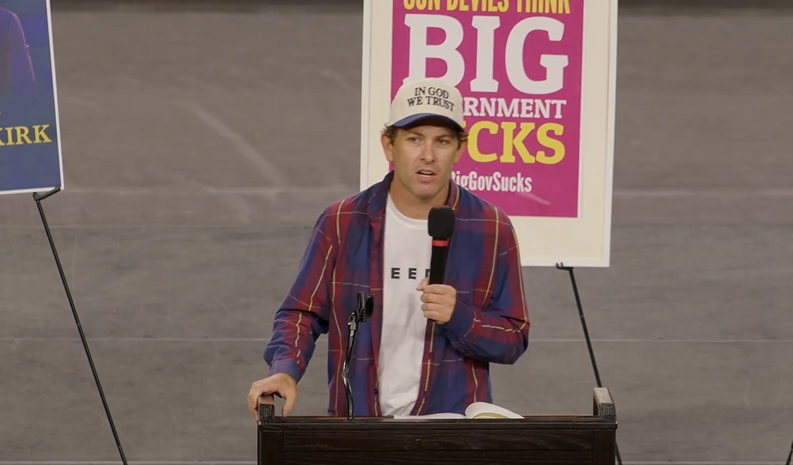
In an email, Dr. Owen Anderson, faculty advisor of the chapter wrote:
“I hope you can join us tonight. To understand what Charlie Kirk was doing, you have to remember his context.
Charlie was debating edgy university students who often used profane language and hurled insults at conservatives and Christians. He wasn’t playing cards at a retirement home.
In a setting where anti-Christian professors were never challenged, and where many Christian intellectuals felt pressured to compromise with leftism and remain silent, Charlie Kirk changed all of that.
Suddenly, conservative and Christian students felt they could speak up and defend their beliefs. They saw how wrong it was to pay tuition for ideological training camps. Charlie inspired them to have courage. And being courageous is loving because it presents the truth to students who are captive to unbelief.”