by Terri Jo Neff | Apr 20, 2021 | Education, News
By Terri Jo Neff |
An effort by the Arizona Legislature to craft permanent legislation to prevent a person from being denied access to businesses, government facilities, and even their child’s school unless they showed proof of being vaccination for COVID-19 was pushed aside Monday when Gov. Doug Ducey issued an executive order about the issue.
Under Executive Order 21-09, most private businesses in Arizona will be free to refuse service to “a customer” who does not provide proof of COVID-19 vaccination. Only companies which receive state funding to provide services to the public are banned from inquiring about someone’s status, although Ducey’s order does not protect those citizens who cannot receive a vaccine for a medical reason
“While we strongly recommend all Arizonans get the COVID-19 vaccine, it’s not mandated in our state — and it never will be,” Ducey said in announcing his latest COVID related executive order. “Vaccination is up to each individual, not the government.”
Daycares, schools, colleges, and universities would still be able to ask about a student’s vaccination record as already allowed by law, but parents could not be asked about their own vaccination status if the educational program receives any state funding.
In addition, hospitals and other healthcare facilities can inquire about the vaccination status of patients, prospective patients, vendors, visitors, and staff, even if the organization receives state funds.
There was initially some confusion Monday morning about what EO 2021-09 encompassed, as Ducey’s official Twitter account read “I’ve issued an Executive Order banning ‘vaccine passports’ and preventing state and local governments from requiring Arizonans to provide their #COVID19 vaccination status to receive service or enter an area.”
Many took the first sentence to mean businesses could not impose a vaccine requirement on customers. However, that misinterpretation was quickly corrected by the rest of the governor’s comments.
Ducey noted in the executive order that no person should be compelled to disclose their private health information -including their vaccination record- to a government entity as a condition of receiving services, obtaining a license or permit, or entrance to a public facility unless state law already requires proof of vaccination.
He added that federal and state laws allow individuals to refuse to be vaccinated, and that “it is not and will not be mandated in the State of Arizona.”
EO 2021-09 also prohibits any other state subdivision -including cities towns, counties, and state agencies- from adopting a policy or ordinance that contradicts the governor’s order. This ensures cities, towns, and counties cannot demand proof of vaccinations for people to use public parks and other public recreational and entertainment amenities.
Rep. Bret Roberts (R-LD11) first introduced legislation to ban such “vaccine passports” in Arizona. His effort was taken up by Sen. Kelly Townsend on March 28 in the form of HB2190, which would have protected Arizonans from having to divulge their vaccination record to shop, dine, or do most everyday activities.
HB2190 hit a snag in early April over concerns that it did not allow healthcare providers nor business owners to inquire about vaccination status of their employees. Negotiations have been underway all month on possible amendments to Townsend’s bill.
For his part, Roberts announced his support for EO 2021-09, noting Ducey’s “reasons for doing so are sound.” But he went on to note that many of those sounds reasons “also apply to the private sector.”
“No one should be required to give up their medical history to participate in commerce,” Roberts tweeted Monday morning. “When all businesses require it the individuals choice is lost. Allowing private business to do this amounts to segregation.”
Roberts also expressed concern that executive orders are intended to be temporary. After the governor’s announcement, Rep. Leo Biasiucci (R-LD4) said SB2190 should be voted on in the coming days as it “solves the issue with businesses requiring vaccine mandates.”
Also on Monday, Ducey rescinded a section of his EO 2020-51 which had directed K-12 schools to require masks.
“We will continue to work with public health professionals and Arizona’s schools as more students return to the classroom and our state moves forward,” the governor said.
by B. Hamilton | Apr 20, 2021 | News
By B. Hamilton |
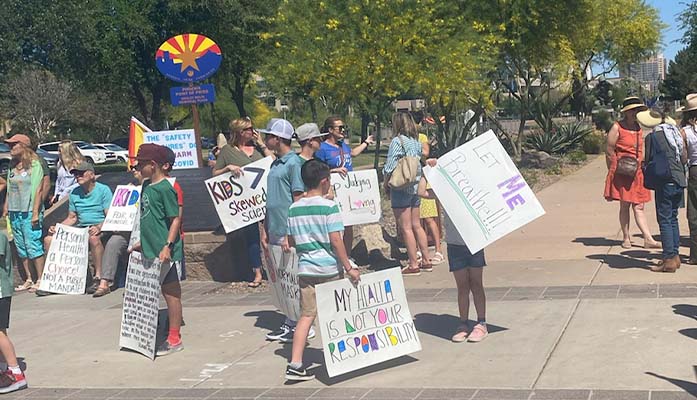
Parents of Arizona’s K-12 students are praising and Superintendent of Public Instruction Kathy Hoffman is slamming Governor Doug Ducey for rescinding orders that direct K-12 schools to require masks.
The Governor’s Office noted that with teachers having been vaccinated early on, the decision to require students to wear masks at schools are up to school leaders.
The governor’s action masking edict continues to provide K-12 school districts and charter schools the right to institute and enforce policies to mitigate against COVID-19 spread, including the use of masks.
The governor’s action aligns with CDC guidance and rescinds a section of Executive Order 2020-51, issued by the Governor in July directing schools to require face masks and Emergency Measure 2020-04, issued by the Arizona Department of Health Services (ADHS) outlining requirements for mask usage in schools.
Superintendent Hoffman, in her statement, released Monday, that the governor’s decision was “abrupt” and “destabilizes school
communities.”
Hoffman “encouraged school leaders and board members to work with their communities to make transparent evidence-based decisions to
build trust and the safety of our schools.”
Parents say they are doing just that and are now organizing to change policies on the school level. They say they will begin contacting school officials requesting the end-of-mask mandates on school sites as soon as possible.
by AZ Free News | Apr 16, 2021 | News
PHOENIX — This week, Governor Doug Ducey signed Senate Bill (SB) 1451, legislation which expands workers’ compensation for diseases presumed to be a result of Arizona’s firefighters and fire investigators’ job demands and requirements.
The bill strengthens the presumption that a firefighter’s cancer diagnosis is work related thereby ensuring that more firefighters are eligible for worker’s compensation and can spend more time focusing on their health and family and less time fighting with cities and insurance companies for their benefits.
This bill also protects female firefighters and fire investigators by adding breast cancer and ovarian cancer to the list of qualifying cancers to ensure that they have access to the same benefits and protections as their male co-workers.
Previously, to qualify for the presumption, a firefighter or peace officer must have passed a physical examination before employment that did not indicate evidence of cancer, been assigned to hazardous duty for at least five years, and documented with the department an exposure to a known carcinogen that is reasonably related to cancer. Firefighters were burdened with identifying exactly when and where they were exposed to a carcinogen that caused their cancer, which is why SB 1451 removes that specific requirement.
by AZ Free News | Apr 10, 2021 | News
PHOENIX — Governor Doug Ducey signed Rep. Joseph Chaplik’s bill, HB 2770, which empowers businesses in Arizona to decide whether or not to enforce on its premises a mask mandate that is imposed by politicians from the state, county, city/town or other jurisdiction in Arizona.
Chaplik says he proposed the measure because “business owners should be allowed to decide for themselves whether to require their customers to wear masks.”
“Recent developments show that without a protection in law, businesses and their customers are subject to the decisions of local rogue politicians who want to control you indefinitely,” said Chaplik. “This bill did not receive any Democrat votes throughout the entire process.”
The Free Enterprise club called Chaplik’s bill a “a commonsense solution” because it “allows people to exercise their freedom while removing the burden from businesses to play mask police.”
RELATED ARTICLE: Governor Ducey Should Follow The Science By Signing The “Mask Freedom” Bill
The governor issued an executive order last month banning local mask mandates, however several cities run by Democrats have refused to rescind their mask mandates. The governor never issued a mandatory state-wide mask mandate, but several democrat-controlled cities did. Those cities then failed to enforce their mandates, leaving the responsibility to local businesses. The governor said in the bill’s transmittal letter to Secretary of State Katie Hobbs that the cities’ failure caused “concern and heartache for many businesses.”
The governor called Chaplik’s bill “well-intentioned,” in his letter of transmittal, but “due to an error in drafting, may have unintended consequences.”
“Some rational mass requirements are not related to the spread of COVID-19 may not be enforceable,” explained the governor. “The state needs to be able to enforce long-standing workplace safety and infection control standards unrelated to COVID-19. I am grateful to the sponsor, Rep. Joseph Chaplik, for agreeing to fix this technical oversight in a future bill this session. With his commitment to fix this oversight, I am signing this bill, ensuring that our small businesses will no longer be required to enforce mandates imposed on them by the cities who are choosing not to force it themselves.”
by AZ Free News | Apr 9, 2021 | News
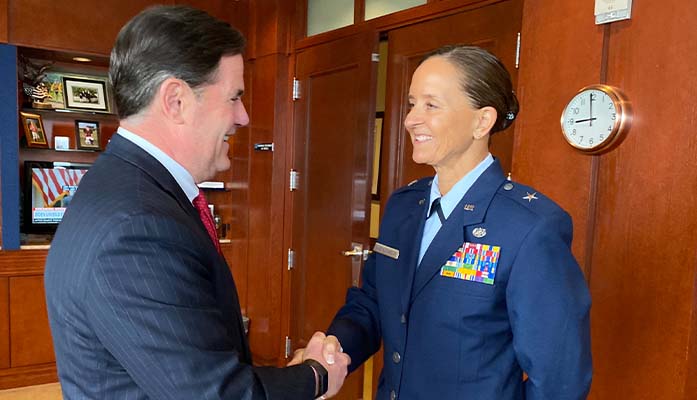
PHOENIX – On Thursday, Governor Doug Ducey appointed the first woman to commander of the Arizona National Guard. Brigadier General Kerry L. Muehlenbeck will replace Maj. Gen. Michael McGuire as the new Adjutant General and Director of the Arizona Department of Emergency and Military Affairs (DEMA).
McGuire announced his retirement on March 5, 2021. He served as Director of the Arizona Department of Emergency and Military Affairs and Adjutant General since 2013, and will officially retire on April 10, 2021.
“General Muehlenbeck’s impressive military experience and continued leadership are amplified by her legal and teaching background. She joined the Arizona Air National Guard in 1997 and served in many roles until she became Arizona’s Deputy Adjutant General in 2018. I look forward to working with General Muehlenbeck on protecting Arizonans, supporting our communities, and tackling the challenges ahead,” said Ducey.
Muehlenbeck served as the Deputy Adjutant General and the Director of Administrative Services. She was responsible for oversight of: the United States Property and Fiscal Office (USPFO); the State Risk Management Office; State Purchasing and Contracting; the State and Federal Human Resource Offices; the Public Affairs Office; the Office of the Inspector General; the General Counsel, the Tribal Liaison; the Legislative Liaison; the Sexual Assault Response Coordinator; the State Equal Employment Manager; and the Ordnance and Industrial operations within the Arizona Department of Emergency and Military Affairs. She also served as the Adjutant General’s delegate.
“I’m proud to have the opportunity to serve our great state as Adjutant General and Director of the Arizona Department of Emergency and Military Affairs,” said Muehlenbeck. “Having served and taught for years, I look forward to leading Arizona DEMA and the Arizona National Guard to help protect and support Arizona communities. It is an honor to succeed General McGuire after his years of admirable service, and I’m grateful to Governor Ducey for this tremendous opportunity.”
Muehlenbeck is currently a professor at Mesa Community College’s Administration of Justice Studies Department, where she also serves as Department Chair. She taught at Arizona State University between 2002 and 2014, specializing in crime, criminology, justice and social inquiry. Muehlenbeck was also an adjunct professor for the Criminal Justice Department at American Military University in West Virginia from 2009 to 2013 and for Embry-Riddle Aeronautical University from 1995 to 2001.
Prior to teaching, Muehlenbeck served as deputy county attorney at the Pima County Attorney’s Office from 1998 to 2001. In this role, she prosecuted felony offenders in superior court. She also served as an assistant prosecuting attorney for the Saginaw County Prosecutor’s Office from 1992 to 1993 and Assistant Staff Judge Advocate at the Davis-Monthan Air Force Base from 1993 to 1997.