by AZ Free News | May 19, 2021 | News
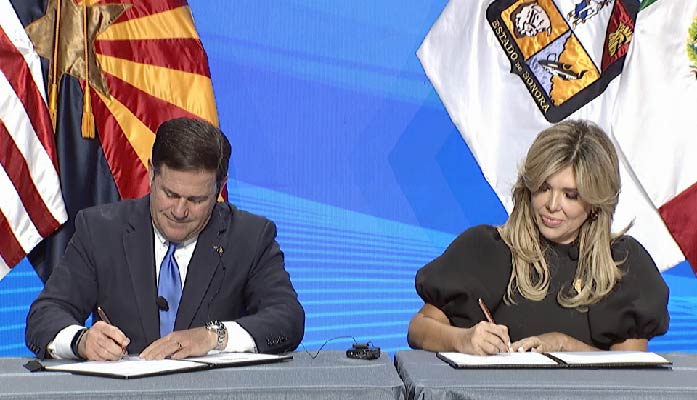
They have been long-time friends and on Tuesday, Governor Doug Ducey and Sonora Governor Claudia Pavlovich capped their professional relationship by signing an agreement to secure the neighboring states’ water future and expand collaboration to monitor air quality.
The agreement signed by the Governors is the result of negotiations between representatives of Arizona and Sonora serving on the Arizona-Mexico Commission (AMC), a cross-border non-profit organization aimed at strengthening the relationship between the neighboring states. Known as a Memorandum of Understanding, the agreement includes studying opportunities for desalination, the process to remove salt and other minerals from water so it can be made drinkable.
The professional partnership forged between Governors Ducey and Pavlovich stretches back to their first meeting in July 2015, and has remained solid through multiple changes in leadership at the national level in both Washington and Mexico City.
During today’s meeting, the Governors also met with members of the AMC and its 16 binational committees to discuss innovative measures to tackle issues facing the region and upcoming projects.
by Terri Jo Neff | May 17, 2021 | News
By Terri Jo Neff |
After months of meetings, crunching numbers, and compromises, the group of legislators and state staff tasked with hammering out Arizona’s $12 billion budget could be ready to roll it out this week.
Rep. Regina Cobb (R-LD5) told AZ Free News that after numerous meetings this session the fine-tuning of the budget package “is down to the last few items.” As a result, legislators could be presented with the package in a few days.
The two most anticipated features involve whether Arizona’s current multi-rate income tax structure will transition to a flat tax rate, and what types of immediate tax cuts will be divvied out of the state’s budget surplus of between $1 billion and $2 billion.
Cobb, who chairs the House Appropriations Committee, said tax relief via tax cuts was on top of the House’s budget wish list heading into budget negotiations, and now that all sides have come to “a general agreement on how much there is to spend” that income tax cuts for all Arizonans are part of the budget.
The other priority was a proposed flat tax which could drop Arizona’s four income tax brackets (which range from 2.59 percent to 8 percent) into one flat tax. According to Cobb, that plan is would get all Arizonans to a 2.5 percent income tax by 2024. A flat income tax has been supported by Gov. Doug Ducey although he had not proposed a rate plan.
Cobb has been involved in the budget or appropriation side of the legislature for five of the seven years she has been in office. Normally the House and Senate hammer out their differences and then bring the plan to the Governor’s Office. This year, however, the budget process differed in that the executive side became involved earlier.
“It was clear our philosophies between the House and the Senate were different, so we made it a three-way negotiation sooner than expected,” Cobb said, adding that the “majority of the negotiating and give-and-take is complete.”
Among those working with Cobb on this year’s budget is House Majority Leader Rep. Ben Toma, as well Sen. David Gowan, the chair of the Senate Appropriations Committee, and Sen. J.D. Mesnard, chair of the Senate’s Commerce Committee. A few issues remain, which is not unusual at this stage.
“The last items are always the most controversial items,” Cobb said.
Ducey introduced a budget for consideration by the legislature when the session started in January. The governor’s budget included discretionary spending and revenue changes necessary to enact a balanced budget, with a forecasted $350 million surplus.
That surplus prediction continued to exponentially grow every few weeks. In mid-April, the Joint Legislative Budget Committee and its Finance Advisory Committee of public and private sector economists pegged the surplus at $1 billion, while some economists put it closer to $1.5 billion or even $2 billion.
The budget discussions are also addressing the impact of Proposition 208, which mandates a 3.5 percent income tax surcharge for thousands of Arizonans, many of whom are small business owners. Those subject to the surcharge are being “walloped” by the tax and need relief, according to Scot Mussi, president of the Arizona Free Enterprise Club.
“We currently have an uncompetitive tax rate structure, which needs to be a priority for the legislature,” Mussi told AZ Free News. “We need a simpler tax code, we need to correct the damage from Prop 208, and we need to push for a $1 billion tax cut to return that money to the taxpayers.”
Another priority, particularly for business owners, is for Arizona’s income tax code to better conform or match up with the federal tax code. This limits the potential for double taxation of income, Mussi explained.
Mussi also noted none of the tax cuts or additional spending due to the surplus will impact Arizona’s rainy day fund, which was established in 1990 as a reserve of funds the state could turn to during economic downturns.
Once the budget bills pass the House and the Senate, Ducey will have the option to sign them, veto them, or let them take effect without his signature. He also has authority to do a line‐item veto of appropriations, although any veto can be overridden by a two-thirds vote in each chamber before adjournment.
But how long it will take for the budget to get approved is not very clear. Traditionally, the legislature will sine die after the budget is approved. Sine die marks the adjournment and end of the session without setting a date for reconvening. It also terminates any unfinished legislative business.
However, Sen. Kelly Townsend has suggested there should be no sine die in case the Senate’s election audit of Maricopa County requires some type of legislative action. She has also been critical of the fact several of her 18 election reform bills never made it out of a Senate committee this year.
It is possible Rep. John Kavanagh, as chair of the House Government & Elections Committee, will introduce strike-everything amendments to others bills in an effort to force the Senate to support Townsend’s legislation, thus potentially ensuring her vote on the budget.
None of the budget surplus being considered by the legislature involves COVID-19 funds, as Arizona is one of a handful of states in which the executive branch controls federal funds issued to the state. That means Ducey has control of his own multi-billion purse derived from federal monies.
Making matters even trickier is that approving the budget will require the support of all 16 Republican senators and 31 Republican representatives unless a Democrat or two cross the aisle. Such uncertainty means it is unclear how much time will be needed by the leadership in both chambers to be ready for a vote.
Another shadow hanging over the budget negotiations is whether Arizona will be punished by the U.S. Treasury Department if it approves tax cuts which the Biden Administration later considers were “directly or indirectly” offset by federal COVID-19 funds.
Attorney General Mark Brnovich has filed for a court order declaring part of the recent COVID-19 relief package unenforceable. That provision prohibits states from using COVID-19 federal monies to essentially underwrite tax cuts, but the language needs to be clarified, according to nearly two dozen attorneys general.
“The fact that those politically allied to enact the Act cannot even agree with each other as to what the Tax Mandate means provides powerful evidence that it is subject to multiple potential interpretations,” Brnovich argues in a lawsuit filed in March in U.S. District Court. “Indeed, the language of the Tax Mandate is patently ambiguous, and even borderline incoherent.”
[pdf-embedder url=”https://azfreenews.com/wp-content/uploads/2021/05/FY-2022-Summary-Book.pdf” title=”FY 2022 Summary Book”]
by AZ Free News | May 15, 2021 | News
On May 10, Governor Doug Ducey signed SB 12 71 into law, increasing the long term supply of fully licensed physicians. The legislation, sponsored by Sen. Nancy Barto, passed both chambers with bipartisan support.
The Association of American Physicians and Surgeons applauded Ducey and Barto for their work on SB 1271, which they say “puts in place commonsense reforms that benefit benefit patient care facilities, medical graduates, and patients in Arizona in both the short and long term.”
SB 1271 directs the Arizona Medical Board (AMB) and the Arizona Board of Osteopathic Examiners in Medicine and Surgery (ABOE) to grant a one-year transitional training permit (transitional training permit) to qualified applicants.
The bill also establishes training permittee eligibility, qualifications, permitted duties and supervision requirements.
Physician say the new law offers expanded options for those who unmatched graduates, who currently have no opportunities to train or serve. For facilities, say the physicians, SB 1271 increases the pool of “high caliber individuals available to serve under supervision.”
The physicians believe the reforms also benefit residency programs as they strengthen the skills of future applicants.
by AZ Free News | May 15, 2021 | News
On Friday, Governor Doug Ducey ordered flags at all state buildings be lowered to half-staff from sunrise to sunset tomorrow, Saturday, May 15, in honor of Peace Officers Memorial Day.
Every May 15, Peace Officers Memorial Day pays tribute to local, state, and federal law enforcement officers who have made the ultimate sacrifice or been injured in the line of duty. The observance takes place during Police Week.
According to the National Law Enforcement Officers Memorial Fund, more than 800,000 law enforcement officers serve in the United States today. Each year, the National Law Enforcement Officers Memorial adds new names to the wall. The average is 163 deaths per year. Fallen law enforcement officers represent all levels of law enforcement, including local, state, federal, tribal, and military law enforcement. They are family members, husbands, wives, parents, sons, and daughters.
The day honors fallen LEO across the nation and offers support to their surviving family members and officers.
“Arizona’s peace officers are on the frontlines every day serving our communities, protecting others and putting their lives on the line — and some don’t return home after carrying out their duties,” said Ducey. “Arizona is grateful to the heroic men and women who wear the badge, and we honor those who made the ultimate sacrifice. This Peace Officers Memorial Day, we take a moment to pause and remember the officers who died in the line of duty and thank those who bravely protect our communities every day.”
by AZ Free News | May 14, 2021 | Economy, News
PHOENIX — Across the state, chambers of commerce are applauding Governor Doug Ducey’s decision that Arizona will no longer be taking the Federal Pandemic Unemployment Compensation, and instead will offer one-time bonuses to returning workers, along with child care support, educational opportunities and rental assistance.
The announcement follows reports from employers that they are having trouble competing with the federal government’s unemployment payments, which are paying individuals more to stay home and not work than to find a job.
Arizona will stop taking the federal government’s pandemic unemployment benefits effective Saturday, July 10. Instead, the state will offer a $2,000 Back To Work bonus for eligible workers — with a goal of getting as many Arizonans as possible to rejoin the workforce by Labor Day, September 6, 2021.
Arizona will also provide support for unemployed individuals seeking to upskill their careers with adult education programs as well as additional child care opportunities.
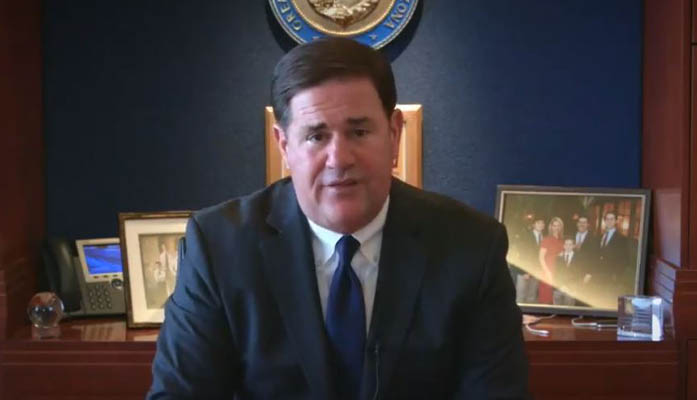
“In Arizona, we’re going to use federal money to encourage people to work…instead of paying people not to work,” Governor Ducey said in a video.
“With ample supplies of the COVID-19 vaccine on hand and millions of Arizonans vaccinated, people feel safer and are finally returning to life in Arizona as we knew and loved it before,” said Ducey. “People are back in the office, restaurants are at full capacity and tourists are flocking to our state.”
“There is dignity in work. Ronald Reagan said the best social program is a job. I agree with that,” Ducey said.
“We have worked tirelessly throughout the pandemic to ensure those who were displaced received the support they needed for themselves and their families,” said Arizona Department of Economic Security (DES) Director Michael Wisehart. “Now that employers in all sectors are hiring, we’re ready to transition and enhance our assistance to families, job seekers and employers. We are committed to ensuring the long-term strength of Arizona’s economy to provide self-sufficiency for Arizona’s families.”
The Governor’s Back To Work program is garnering support from community and business leaders across the state:
“Governor Ducey is breaking down many of the barriers that prevent people from returning to work. Getting people funding for GED programs, community college, providing funding for childcare, and bonus money for their hard work is the hand up Arizonans need,” said Arizona Regional Economic Development Foundation Executive Director Mignonne Hollis.
“After last week’s disappointing federal jobs report, Arizona is implementing a common-sense, conservative plan to ensure we continue our state’s strong economic rebound,” said Prescott Chamber of Commerce President and CEO Sheri Heiney.
“Across Arizona, restaurants of all sizes are ready to hire new employees and expand their teams,” said Arizona Restaurant Association President and CEO Steve Chucri. “When it comes to the food and beverage industry, things are much different than they were a year ago. Millions are vaccinated, we know how to keep patrons and staff safe, and people are ready to eat at restaurants again. Restaurants need to ensure they have enough staff to meet the demand, but many are struggling to fill positions. I’m grateful to Governor Ducey for encouraging Arizonans to find new employment opportunities so we can get our restaurants fully staffed and continue to move the state’s economy forward.”
“We’re excited to welcome new team members and provide great jobs for Arizonans,” said Westroc Hospitality President and Chief Operating Officer Bill Nassikas. “After weathering the pandemic, we know Arizonans are looking for employment opportunities. We’re ready to hire, along with countless other businesses across the state.”
“Arizona’s tourism and hospitality industry is poised and eager to welcome visitors,” said Arizona Tourism and Lodging Association President and CEO Kim Grace Sabow. We are prepared to offer safe and unique experiences to both leisure and business travelers. An array of quality jobs are available for those seeking a rewarding industry career path — and we’re ready to hire today!”