by azfreenews1 | Jun 11, 2021 | Economy, News
By Terri Jo Neff
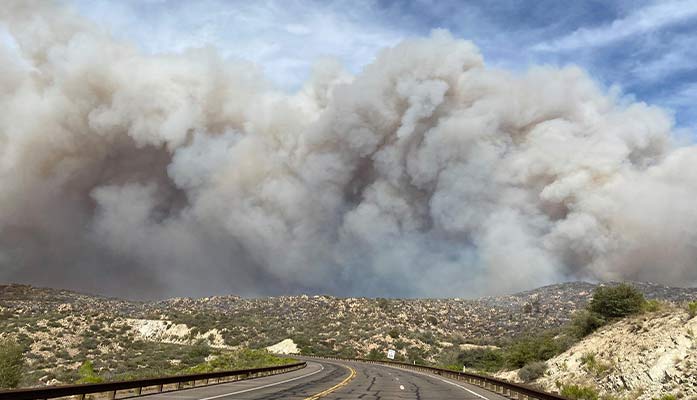
Gov. Doug Ducey was expected to call a special session any day now to address the legislative stalemate of 11 budget bills which have been the subject of some opposition even among the Republican majority. So his announcement Thursday of a special session related solely to funding for natural disasters caught many lawmakers off guard.
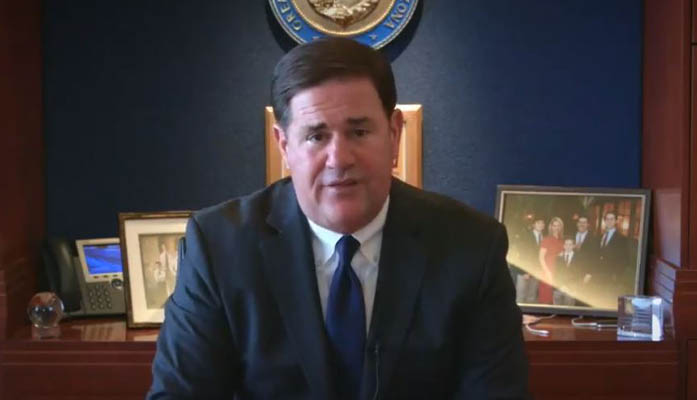
“I am calling a special session to make sure we have the resources needed to contain current wildfires, possible flooding, and any other natural disasters that arise from this emergency,” Ducey said in his announcement. He did not include a start date for the special session but legislators have been told it will take place next week.
News of the special session unrelated to an overall budget package came as Ducey and key Republican legislators representing communities burning under the Telegraph and the Mescal fires toured the damage. It also came one day after the governor said he would be agreeable to working with the Democrat caucus to resolve the budget stalemate that threatens Ducey’s last chance transition Arizona to a flat rate income tax.
Democrats, however, have been outspoken against the current wording of the flat tax portion of the budget package, although some have left the door open for passing the majority of the spending bills, as well as a tax cut funded by Arizona’s more than $1 billion surplus.
It is more likely, however, that Ducey and legislative leaders will need to amend the 11 bills in order to get the necessary 31 votes in the House and 16 votes in the Senate. If that cannot be done in the next week or so, the governor can call another special session dealing exclusively with the budget. Or lawmakers could end up approving with a bare-bones “skinny” budget to avert a state government shutdown on July 1.
Sen. Michelle Ugenti-Rita tweeted Thursday she supports Ducey’s special session to deal with the wildfires. But she could not resist a poke at the governor for his response this year compared to last year during the COVID-19 pandemic.
According to Ugenti-Rita, Ducey’s “leadership solution” last year was “to shutdown the economy, support the legislature prematurely ending session, issuing 50+ executive orders and steadfastly refusing to convene a special session” which she and other lawmakers requested.
“Now, under the guise of another emergency, you want to wait until next week to call the legislature into special session. I find your call for a special session in this scenario incongruent with your past decisions,” she tweeted, pointing out the legislature was in session on Thursday “ready and available to help” but both chambers adjourned until next Monday because key lawmakers were with Ducey touring fire damaged communities.
A vocal critic of this year’s budget package is Sen. Paul Boyer, who has called for one-time tax cuts for one-time revenues. “Rebate taxpayer’s money now,” he tweeted earlier in the week. “That is conservative.”
Some lawmakers in the Republican majority like Boyer object to the amount of the surplus which would get returned to taxpayers as tax cuts under the current budget bills. They point to the fact the cuts would likely also result in less shared revenue to Arizona’s cities and towns, while not focusing enough on the state’s debt, including serious under-funding issues with the Arizona Public Safety Personnel Retirement System.
The Joint Legislative Budget Committee and staff from Ducey’s office are expected to continue working on a proposed compromise over the next few days.
by Victor Riches | Jun 3, 2021 | Opinion
By Victor Riches |
By dramatically decreasing the state’s income tax and simplifying its tax code, the governor can help ensure Arizona’s future ideological and economic success.
Now in the twilight of his gubernatorial career, Arizona governor Doug Ducey has the unique opportunity to make history on two fronts. First, if he simply remains in office for the next 18 months, he will become the Grand Canyon State’s first governor since Jack Williams — whose term ended in 1974 — to both enter and leave office during regular election cycles.
This peculiarity began with Raúl Héctor Castro, who succeeded Williams as governor. Castro happily resigned his post a few years later once President Carter had appointed him ambassador to Argentina. Since Arizona does not have a lieutenant governor, then–secretary of state Wesley Bolin ascended to the governorship by virtue of being the state’s next highest-ranking elected official — only to pass away six months later from a heart attack.
Arizona’s constitution stipulates that in such circumstances the third-highest-ranking official is next in line, meaning that the attorney general, Bruce Babbitt, also achieved the governorship without having to run for the office. And on it went. Since then, Arizona has witnessed a gubernatorial impeachment, two resignations, and three more secretaries of state extemporaneously gaining the governorship — making the office of secretary of state much more significant than its otherwise mundane responsibilities would suggest.
Governor Ducey is term-limited at the end of 2022 and so is primed to become Arizona’s first governor in nearly half a century to be both elected to the office and then to actually serve out his full term(s). While this accomplishment is an interesting piece of trivia for political-history buffs, it’s not much of a résumé builder for a politician who may have greater ambitions come 2024.
>> READ MORE >>>
by AZ Free News | Jun 2, 2021 | News
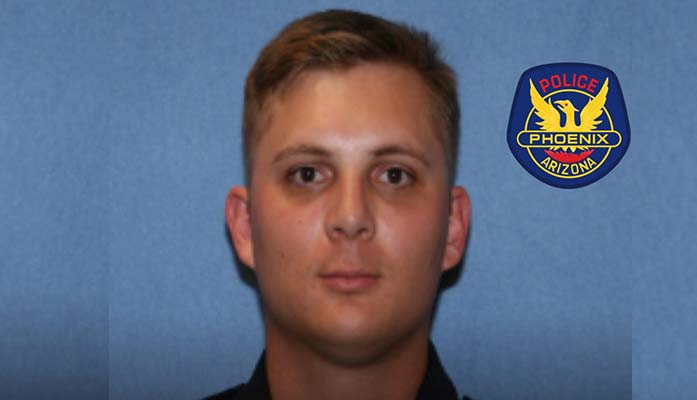
PHOENIX — Governor Doug Ducey ordered flags at all state buildings be lowered to half-staff until sunset on Tuesday, June 1, 2021, to honor Phoenix Police Officer Ginarro New, who died from a car accident while on duty last night.
“Officer Ginarro New of the Phoenix Police Department worked each day to protect Arizonans,” said Governor Ducey. “We are devastated by the loss of Officer New, who served with the Department for just under two years. He made safe communities his top priority, and we are grateful for his bravery and dedication to protecting others. Our prayers are with his wife and loved ones. I’ve ordered flags at all state buildings be lowered to half-staff in honor of Officer New’s life and service.”
Officer New was killed by a red light runner on Monday night. The crash occurred in north Phoenix at around 10:30 p.m. near Cave Creek Road and Greenway Parkway, according to the Arizona Daily Independent.
Officer New was transported to a nearby hospital, where he succumbed to his injuries. The driver of the other vehicle was pronounced deceased on the scene.
Officer New, age 27, is survived by his wife Kristen, his mother, Misty, his brother, Marcas, and his grandmother, Susan.
by Jeffrey A. Singer | May 25, 2021 | Opinion
By Jeffrey A. Singer |
Arizona’s Governor and lawmakers are displaying an enlightened shift in strategy addressing the overdose crisis. After the state experienced an estimated 48 percent jump in overdose deaths during the first eight months of 2020 (a 32 percent increase in most populous Maricopa County in all of 2020), they decided to embrace harm reduction.
On May 14 the Arizona House voted 48–11 to pass SB 1486, which removed fentanyl test strips from the list of legally prohibited drug paraphernalia, after the Arizona Senate voted unanimously in favor of the bill. On May 19, Governor Ducey (R) signed it into law.
Fentanyl test strips, made by a Canadian biotechnology company, were designed for urine drug screening. The tests strips are not approved for sale in U.S. drugstores or other outlets by the Food and Drug Administration, but harm reduction organizations—including “needle exchange” programs— have been buying them and handing them out to IV drug users who use them “off‐label” to test heroin, cocaine, and other drugs for the presence of fentanyl. Researchers claim the tests strips are highly accurate and can detect up to 10 analogs of fentanyl. They also find they save lives by causing drug users to use smaller amounts and/or take a drug more slowly when they detect it contains fentanyl.
When signing the bill into law, Governor Ducey said:
We want everyone who is using drugs to seek professional treatment. But until someone is ready to get help, we need to make sure they have the tools necessary to prevent a lethal overdose.
Speaking of “needle exchange” programs, syringe services programs (SSPs), the term public health professionals use for “needle exchange” programs, are endorsed by the National Institute on Drug Abuse, the Centers for Disease Control and Prevention, the National Academy of Science, Engineering, and Medicine, and the American Medical Association. In January 2020, then‐Surgeon General Jerome M. Adams and Professor Ricky D. Bluthenthal of the University of Southern California Keck School of Medicine spoke at the Cato Institute on the benefits of syringe services programs. They are proven to reduce the spread of HIV, hepatitis C, and other infectious diseases. They also serve to reduce overdose deaths because one of their services is to distribute the overdose antidote naloxone as well as fentanyl test strips and other drug‐testing materials. Dr. Adams pointed out SSPs offer the added benefits of screening IV drug users for hepatitis and HIV so they can get treatment, and bringing many of them into rehab programs.
Although federal law permits syringe services programs, many states prohibit or make the operation of SSPs very difficult. Researchers at Temple University’s Center for Public Health Law research reported in the July/August 2020 Public Health Reports:
Thirty‐nine states (including the District of Columbia) had laws in effect on August 1, 2019, that removed legal impediments to, explicitly authorized, and/or regulated SSPs. Thirty‐three states had 1 or more laws consistent with legal possession of syringes by SSP participants under at least some circumstances. Changes from 2014 to 2019 included an increase of 14 states explicitly authorizing SSPs by law and an increase of 12 states with at least 1 provision reducing legal barriers to SSPs. Since 2014, the number of states explicitly authorizing SSPs nearly doubled, and the new states included many rural, southern, or midwestern states that had been identified as having poor access to SSPs, as well as states at high risk for HIV and hepatitis C virus outbreaks. Substantial legal barriers to SSP operation and participant syringe possession remained in >20% of US states.
Until now, Arizona was among the states where paraphernalia laws prevented SSPs from operating out in the open. At least four such programs, all privately funded, have been operating in the state but constantly fear police interdiction—as do their clients. If they were explicitly legal, they could establish permanent locations and raise funds.
After an unsuccessful attempt to legalize syringe services in 2018, then‐Representative Tony Rivero (R‐Peoria) tried again in 2020. I testified on the benefits of SSPs before the House Health Committee in February of that year. A bill to legalize syringe services passed the House 50–10 but died in the Senate. This year Senator Nancy Barto (R‐Phoenix) introduced SB 1250, legalizing SSPs. The Arizona Senate passed the bill unanimously in mid‐April, and it passed the House 56–2 with 2 abstentions on May 18.
On May 24, Governor Ducey signed SB 1250 into law.
The bill requires operators of SSPs to “offer disposal of used needles and syringes,” but unlike laws in some states, it does not require one‐for‐one exchanges with people who access the programs. One‐for‐one requirements pose an undue burden on syringe services programs. The priority should be getting clean paraphernalia out to users in order to reduce the spread of disease. The Arizona law gets the priority right.
After multiple unsuccessful attempts, it is gratifying that Arizona lawmaker’s views evolved from initial reluctance to a now near‐unanimous embrace of harm reduction as a rational, evidence‐based, and compassionate approach to the drug overdose crisis. Add the enactment of these two harm reduction measures to the recent enactment of HB 2454, which allows Arizonans to access telehealth services from health care practitioners who hold out‐of‐state licenses, and 2021 is proving to be a year in which the rest of the country can look to Arizona for leadership in health care reform.
by AZ Free News | May 25, 2021 | News
The U.S. Department of Interior has given its approval to the amended tribal-state gaming compact, finalizing an agreement to modernize gaming in Arizona that was signed in April by Governor Doug Ducey and the state’s tribal leaders.
“Gaming creates thousands of jobs for Arizonans, it generates tax revenue that benefits key areas of our communities, and it draws visitors to our state,” said Governor Ducey. “The tribal-state gaming compact amendment, along with its associated legislation, was the culmination of a multi-year process and I was proud to work with all the stakeholders on this historic accomplishment.”
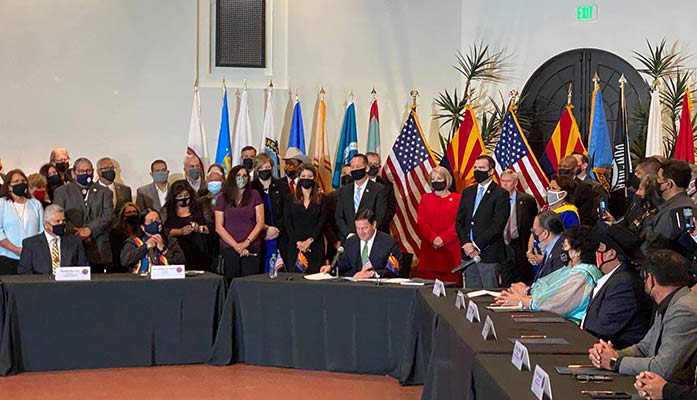
On April 15, Governor Ducey joined state lawmakers and tribal leaders to sign House Bill 2772, and the amended tribal-state gaming compact. The legislation is part of a compromise that was negotiated in the amended gaming compact, which underwent the most significant modernization in almost two decades.
The compact amendment and the associated legislation took more than five years to negotiate, and it ensures gaming in Arizona remains limited and regulated while providing certainty for the future of the state and tribes.