by B. Hamilton | Jun 27, 2021 | News
By B. Hamilton |
On Friday, a group of Arizona legislators reached out to Governor Doug Ducey with an offer to work with him to address the “omnipresent border crisis.” In a letter to the governor, the legislators also inquire as to the level of funding provided to the Border Strike Force.
Led by Rep. Shawnna Bolick, the lawmakers advised the governor that they hope to work with him to “come up with a concrete plan to further allocate resources to complete portions of the Border wall and ensure Border Strike Force is fully funded.”
The lawmakers accuse the Biden Administration of not making “the public safety or health of Arizonans” a top priority, noting that it “took until today for Vice President Kamala Harris to see the invasion for herself in El Paso.”
“We applaud other governors answering your call for assistance to send some of their law enforcement as back up as the ongoing invasion continues along the southern Border,” write the lawmakers. “The problem is real. We wish you didn’t have to rely on other states to bail us out because the federal government has failed us, but illegal immigration affects every state.”
The lawmakers cite as a source of concern an incident that occurred earlier this year which was “highlighted in the local newspaper that the Department of Public Safety release two confessed human smuggler with just a traffic citation after stopping him along a valley freeway in April with a van full of illegal immigrants.”
“It was rather alarming to read that the illegal immigrants in the van were released into the Phoenix area even though it is a direct violation of state law to be in our state unlawfully. It is noted that the federal agents would not pick up this van full of illegal immigrants if they weren’t violent felons. If the Border Strike Force isn’t identifying traffickers along the southern Border and they are making their way into the Valley, is the Border Strike Force understaffed and underfunded?”
The lawmakers expressed a desire to “work together to further investigate why this human trafficker was let go.”
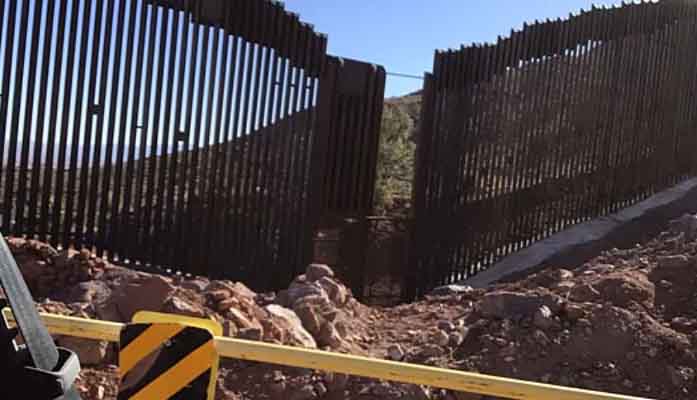
“We support trade relations with Mexico, but we do not want transnational crime rings bringing further ruin into our state. It is past time to plug the gaping holes on state land that buttress Mexico allowing traffickers to invade our state.”
The lawmakers argue that border security is a states’ rights issue.
Last week, Texas Governor Greg Abbott announced that Texas would build its border wall. Abbotts aid that the state will be soliciting donations from across the country to help fund the wall.
“When I do make the announcement later on this week, I will also be providing a link that you can click on and go to for everybody in the United States — really everybody in the entire world — who wants to help Texas build the border wall, there will be a place on there where they can contribute,” Abbott said on a podcast show called “Ruthless.”
As AZ Free News reported earlier this month, Ducey and Abbott urgently requested all U.S. governors to send available law enforcement resources to their states along the U.S.-Mexico border as illegal border crossings, apprehensions, and unaccompanied migrant children in federal custody increase.
The Customs and Border Protection apprehension numbers for May showed more than 180,000 illegal aliens were apprehended crossing the border over the course of the month, a 674% increase from the 23,237 illegal aliens apprehended at the border in May 2020.
In a joint letter from Ducey and Abbott, fellow governors were told: “In response to the ongoing surge of illegal border crossings, with the accompanying threats to private property and to the safety of our citizens, Governor Abbott has declared a disaster and Governor Ducey has declared an emergency.”
Bolick was joined in the letter by Reps. Becky Nutt, Tim Dunn, Walt Blackman, Brenda Barton, John Kavanaugh, Mark Finchem, Joseph Chaplik, Beverly Pingerelli, Leo Biasiucci, Judy Burgess, Frank Carroll, Quang Nguyen, John Fillmore, Jacqueline Parker, and Steve Kaiser.
by Terri Jo Neff | Jun 26, 2021 | Economy, News
By Terri Jo Neff |
Positive reactions continue to come in from business groups in response to the Arizona Legislature’s passage this week of a Fiscal Year 2022 budget package which includes more than $1.3 billion in tax cuts, $1 billion in payments toward state debt, and a transition of the state’s multi-tied income tax system to a flat rate.
The nonprofit, nonpartisan Arizona Tax Research Association called passage of the FY2022 budget “a watershed moment” for Arizona, while Scot Mussi, president of the Arizona Free Enterprise Club, commended the Legislature for passing what he called “historic” tax cuts.
“Every single taxpayer in Arizona will now get a tax cut,” Mussi said. “This is great news for the future of our great state!”
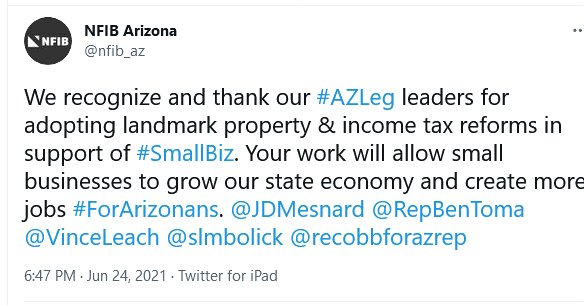
The National Federation of Independent Business, which advocates for small and independent businesses across the country, gave a shout out to the Legislature via Twitter for adopting “landmark property & income tax reforms” which support small businesses. “Your work will allow small businesses to grow our state economy and create more jobs #ForArizonans,” the message said.
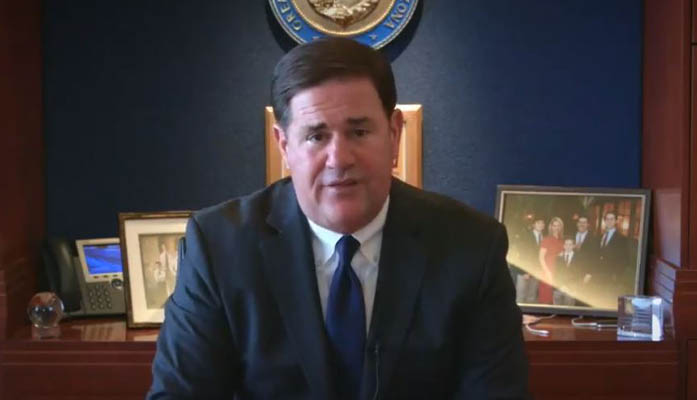
On Friday, Gov. Doug Ducey issued a video statement celebrating passage of the 11 bills which make up what he calls the state’s “fiscally conservative, forward-looking budget” that starts July 1.
“Here in Arizona our economy is booming,” said Ducey, thanking House Speaker Rusty Bowers, Senate President Karen Fann, and all the legislators. “New people and businesses are moving here every day. And at the state level that’s resulted in record revenue. With this budget we’re investing those dollars in the things that matter: schools, universities, community colleges, and new roads and bridges, just to name a few.”
Ducey added that “most importantly we’re giving a bulk of the surplus dollars back to the people who earned them.”
A budget signing ceremony must wait until at least Monday when the Senate returns from recess to formally transmit the budget bills to the governor.
Meanwhile, supporters of the voter initiative known as Proposition 208 are promising a court fight over a bill Ducey is also expected to sign next week.
Prop 208 passed last November by a slim margin of 51.75 to 48.25 percent. The purpose of the initiative was to provide additional funding for public and charter school by way of a new 3.5 percent income tax surcharge for many Arizonans.
Among those subject to the new tax surcharge would be thousands of small business owners who currently report business profits on their state personal income tax return. SB1783, however, provides a small business alternate income tax as an option for those who operate as sole proprietors, LLCs, professional partnerships, and S Corporations.
Under the alternate tax, income derived from small business can be reported on a special small business income tax form. This will ensure the income is not added into personal income for purposes of calculating the amount of Prop 208 surcharge a taxpayer owes.
Critics contend SB1783 is a way to unlawfully circumvent the taxation provision of Prop 208. Proponents of the bill point to the many statements made prior to the 2020 General Election which assured business owners that “business income” would not be subject to the surcharge.
by Doug Ducey | Jun 26, 2021 | Economy, Opinion
By Doug Ducey, Karen Fann & Rusty Bowers |
>>READ MORE >>>
by Terri Jo Neff | Jun 24, 2021 | News
By Terri Jo Neff |
In what could be a major rebalancing of powers between the executive and legislative branches, the State Senate passed legislation earlier this week to rein in a governor’s state of emergency powers.
Lawmakers have tried since January to pass legislation to ensure a governor confers with the legislature in certain instances once a public health emergency has been declared. The intent was to ensure a governor cannot issue unending emergency executive orders which impact business offerings, public health decisions, school functions, and whether families can see loved ones in nursing homes.
Many Arizonans do not realize the state remains under a declared emergency even though Gov. Doug Ducey has lifted many of his COVID-19 executive orders. Sen. Michelle Ugenti-Rita introduced a bill, SB1084, in an attempt to reassert the legislature’s power. Her bill was heard in the House and Senate but stalled in April due to concerns by some within the Republican caucus which holds a majority in both chambers.
Fast forward to the Senate’s marathon consideration of the 11-bill budget package on Tuesday and Wednesday. Ugenti-Rita proposed the text of her bill as a floor amendment to a budget reconciliation bill, SB1819. Her amendment passed on a 16 to 14 party line vote, as did SB1819 itself.
It is now up to House Speaker Rusty Bowers to secure 31 votes in his chamber to get the legislation to Ducey’s desk.
Current state law allows lawmakers to void a public health state of emergency based on a general majority vote in both chambers. However, if the legislature is not in session then two-thirds of lawmakers would have to authorize a special session, or the governor would have to call a special session.
According to the amendment language, a governor’s initial state of emergency
proclamation with respect to a public health emergency will be capped at 30 days beginning Jan. 2, 2023. It allows a governor to extend the public health state of emergency up to 120 days, but any single extension could not be for more than 30 days.
Once the 120 day period is up, the state of emergency will terminate unless extended in whole or in part by a concurrent resolution of the legislature. Lawmakers could vote to extend the state of emergency as many times as necessary in periods of not more than 30 days at a time.
Another key provision of the legislation prohibits a governor from proclaiming a new state of emergency upon termination of a state of emergency based on the same conditions unless there is passage of a concurrent resolution of the legislature consenting to the new state of emergency.
Another amendment which passed with SB1819 makes it clear what emergency powers cities, towns, and counties will have -and won’t have- in the future. It includes a ban on curfews, business closures, and other public health declarations such as mask mandates which run counter to a governor’s orders.
by Terri Jo Neff | Jun 22, 2021 | News
By Terri Jo Neff |
For the last three weeks the Arizona Legislature has spent more time not working on the state budget slated to start July 1 than they have spent working on it. But optimism is rising -particularly within the Republican caucus- that the impasse may be over.
Gov. Doug Ducey warned lawmakers at the end of May that he did not want to see any legislation hit his desk unless it was the 11 bills contained with the budget packet. He even vetoed 22 bills, all of which had Republican supports, to show he was serious.
On Monday, a number of people involved in the budget process signaled that compromises were being worked out to ensure 31 House and 16 Senate “aye” votes will be put forth for all 11 bills, or at least a significant number to get things moving forward.
According to Sen. Vince Leach, the proposed budget compromise provides money for education, public safety, road infrastructure, debt reduction, and “significant tax relief.” The first four of those items have been the key areas of disagreement, while the latter involves both tax cuts and a transition to a flat rate income tax.
Ducey also released a letter of support for a revised budget package which would now provide cities and towns with an 18 percent share of the state’s Urban Revenue Sharing Fund rather than 15 percent. The increased percentage is intended to cover $225 million in revenue municipalities were estimated to lose if Ducey’s proposed flat rate income tax is approved by lawmakers.
The transition to a flat tax would take place over a few years, and would limit the top rate at 4.5 percent, although Arizonans making less than $250,000 would have a rate of 2.5 percent.
Another compromise expected to be introduced would cap the amount of tax cuts next year at $1.3 billion unless certain revenue thresholds are hit. In that case, the tax cuts could go as high was $1.8 billion.
The Arizona Education Association has come out against the tax cuts and the flat tax. However, the Home Builders Association of Central Arizona threw its support behind Ducey’s efforts to reach a compromise on the budget package. According to a statement released Monday by HBACA, the budget “enhances Arizona’s economic environment, provides more resources to keep Arizona growing, and promotes housing affordability.”
The mayors who signed the letter to Ducey are from Avondale, Buckeye, Camp Verde, Chandler, El Mirage, Gila Bend, Gilbert, Glendale, Goodyear, Lake Havasu City, Kingman, Marana, Mesa, Payson, Peoria, Prescott, Sahuarita, Surprise, Winkenburg, Youngstown, and Yuma.