by Ethan Faverino | Aug 3, 2026 | News
By Ethan Faverino |
Congressman Paul Gosar (R-AZ-09) is calling on the Department of Veterans Affairs (VA) to implement recommendations from a recent Office of Inspector General (OIG) audit that found widespread failures in the administration of the Veterans Community Care Program (VCCP), including improper eligibility determinations, inadequate documentation, and hundreds of millions of dollars in unnecessary spending.
In a letter to VA Secretary Doug Collins and Acting Under Secretary John Figueroa, Gosar urged the department to fully implement the OIG’s recommendations to improve accountability and ensure veterans receive the care they are entitled to under federal law.
The audit, released by the VA Office of Inspector General on June 17, was mandated by the Senator Elizabeth Dole 21st Century Veterans Healthcare and Benefits Improvement Act.
It examined whether the Veterans Health Administration (VHA) accurately identified veterans eligible for community care and properly informed them of their options under the VA MISSION Act.
The OIG concluded that the VA was “not effectively identifying and informing all eligible veterans about all their care options within and outside VA.”
Investigators found that some veterans who qualified for community care were never informed of their eligibility, while others who did not qualify were improperly referred to outside providers.
According to the audit, nearly one in four community care referrals—approximately 340,000 of 1.4 million consults reviewed during the first quarter of FY25—were made even though veterans did not meet eligibility requirements.
At the same time, an estimated 1.8 million veterans who received care through VA facilities lacked documentation showing they had been evaluated for community care eligibility, with more than one million cases containing no evidence that veterans had voluntarily declined the option.
The OIG estimated that inaccurate eligibility determinations resulted in approximately $440 million in unnecessary spending during the first quarter of FY25 alone. If those issues continue unaddressed, the agency estimated the cost could reach $1.7 billion annually.
The audit attributed many of the problems to inconsistent guidance from the VA’s Office of Integrated Veteran Care, scheduling system limitations that prevented staff from viewing appointment availability across all VA facilities, and a lack of access to community care scheduling data needed to help veterans make informed decisions.
Investigators also found that some veterans referred to community care could have received treatment sooner through VA facilities, while others who qualified for community care were never informed of that option.
The report warned that these shortcomings not only waste taxpayer dollars but also risk delaying medical treatment for veterans by preventing them from accessing the care options that best meet their needs.
The Office of Inspector General issued six recommendations aimed at improving the effectiveness of the Veterans Community Care Program.
The Veterans Health Administration concurred with five recommendations and concurred in principle with the sixth, submitting corrective action plans intended to address the findings.
In his letter, Gosar encouraged Secretary Collins to work with Congress to fully implement the OIG’s recommendations, strengthen oversight of the Veterans Community Care Program, and ensure it is administered with the diligence and integrity America’s veterans deserve.
Ethan Faverino is a reporter for AZ Free News. You can send him news tips using this link.
by Matthew Holloway | May 22, 2026 | News
By Matthew Hollloway |
Rep. Eli Crane (R-AZ02) announced this week that language from his legislation aimed at restoring veterans’ Second Amendment rights has been incorporated into a bipartisan bill advancing through Congress.
According to a statement from Crane’s office, language from H.R. 496 was added to H.R. 1041, the Veterans 2nd Amendment Protection Act, which passed the U.S. House of Representatives this week and now heads to the Senate.
The legislation would prohibit the Department of Veterans Affairs (VA) from reporting veterans to the Federal Bureau of Investigation’s National Instant Criminal Background Check System (NICS) solely because they receive assistance managing their VA benefits through a fiduciary program.
Crane’s provision incorporated into H.R. 1041 would restore Second Amendment rights to veterans previously reported to NICS solely due to fiduciary participation.
The measure would require a judicial determination that a veteran poses a danger to themselves or others before Second Amendment rights could be restricted through NICS reporting.
Crane said the addition of his bill language strengthens the legislation by addressing veterans already affected by the prior reporting policy.
“I’m pleased to see the House Committee on Veterans’ Affairs add my language from H.R. 496 to the Veterans 2nd Amendment Protection Act,” Crane said. “This addition strengthens the bill, ensuring the retroactive removal of veterans who were wrongly added to the FBI’s NICS list.”
House Veterans’ Affairs Committee Chairman Rep. Mike Bost (R-IL) said the legislation is intended to protect veterans receiving financial assistance services from losing constitutional rights without court involvement.
“The men and women who have served and defended Constitutional rights for generations of Americans should not have to worry that they will be reported to NICS and lose their rights simply because they need help managing their books,” Bost said. “Veterans should never be treated like second-class citizens.”
Rep. Morgan Luttrell (R-TX), chairman of the Disability Assistance and Memorial Affairs Subcommittee, also supported the measure, stating that only courts—not agency officials—should determine whether constitutional rights are restricted.
The legislation follows policy changes announced earlier this year by the Department of Veterans Affairs. In February, the VA announced it would stop reporting veterans enrolled in the fiduciary program to NICS solely because they receive assistance managing benefits. The department stated it was also working with the FBI to remove prior VA-related NICS submissions connected only to fiduciary participation.
VA Secretary Doug Collins said at the time that veterans had been deprived of Second Amendment rights without sufficient due process protections.
Following House passage, Crane praised the legislation and urged Senate approval.
“If the federal government is willing to strip the God‑given, unalienable rights of those who served in uniform, there is no telling where they will draw the line. H.R. 1041 codifies the termination of this un‑American practice and prevents future administrations from unilaterally reversing this wise decision.”
He added, “I’m grateful to President Trump for protecting the rights of our nation’s heroes, and I appreciate Chairman Bost for adopting my language into his bill. I urge my colleagues in the Senate to quickly pass these necessary reforms.”
Matthew Holloway is a senior reporter for AZ Free News. Follow him on X for his latest stories, or email tips to Matthew@azfreenews.com.
by Ethan Faverino | May 8, 2026 | News
By Ethan Faverino |
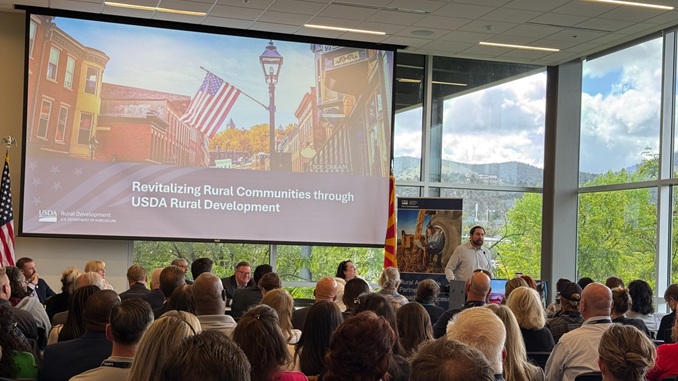
Congressman Eli Crane (R-AZ-02) participated in a Federal Partners Forum focused on addressing the distinct needs of Arizona’s rural communities, joining representatives from the U.S. Department of Agriculture (USDA) Rural Development and other federal agencies.
The event, held on May 5 at Yavapai College’s Center for Learning and Innovation in Prescott, convened more than 120 local and regional leaders alongside state and federal officials.
Senior Representatives from multiple federal agencies attended, including the National Park Service, U.S. Department of Health and Human Services (HHS), U.S. Department of Housing and Urban Development (HUD), U.S. Department of Veterans Affairs (VA), and the U.S. Small Business Administration (SBA).
During the forum, agency officials presented information on available federal resources and programs designed to support rural Arizona. Discussion topics included expanding access to healthcare, boosting small business growth, modernizing infrastructure, increasing affordable housing options, and enhancing broadband connectivity.
Participants were able to engage directly with federal partners to foster relationships, explore partnership opportunities, and identify practical solutions for long-term community development in rural areas.
“While our state faces many unique challenges, including Washington’s longstanding tendency to prioritize urban and coastal areas, we’re grateful to the Trump administration for putting rural interests at the forefront,” stated Rep. Crane. “Yesterday’s forum served as a catalyst for new opportunities and partnerships across local, state, and federal levels. I appreciate Yavapai College for hosting, and I’m thankful to Lori Urban, Lori Corbin, and everyone who helped make this event a success.”
The Federal Partners Forum is part of ongoing efforts to bridge gaps between rural communities and federal resources, ensuring Arizona’s rural priorities receive targeted attention and support.
Ethan Faverino is a reporter for AZ Free News. You can send him news tips using this link.
by Matthew Holloway | Feb 23, 2026 | News
By Matthew Holloway |
U.S. Representative Eli Crane (R-AZ02) issued a statement Wednesday praising the Trump administration for what he described as action to protect veterans’ Second Amendment rights.
According to a press release from Crane’s office, the administration clarified federal policy to ensure veterans who have a fiduciary appointed to manage their VA benefits are not automatically reported to the FBI’s National Instant Criminal Background Check System (NICS) as “prohibited persons.”
Under prior policy, veterans assigned a fiduciary to manage benefits could be reported to NICS, potentially preventing them from purchasing or possessing firearms under federal law. The change announced by the administration reverses that reporting practice, according to Crane’s statement.
“For nearly three decades, unelected bureaucrats violated the constitutional rights of hundreds of thousands of our nation’s heroes. If the federal government is willing to strip fundamental liberties from those who served in uniform, there’s no telling where they will draw the line,” Crane said. “I’m grateful to President Trump and Secretary Collins for correcting this injustice and protecting the freedoms that our veterans fought to defend. Congress must now codify this directive so no future administration can reimplement this disgraceful protocol.”
The press release states that the policy clarification impacts enforcement of federal firearm restrictions under the Gun Control Act of 1968, which prohibits firearm possession by individuals adjudicated as mentally defective or committed to a mental institution.
In a statement posted to X, VA Secretary Doug Collins wrote:
“Effective immediately, VA is halting enforcement of the interim final rule, Evaluative Rating: Impact of Medication. VA issued the rule to clarify existing policy and protect Veterans’ benefits in the wake of an ongoing court action. But many interpreted the rule as something that could result in adverse consequences.
While VA does not agree with the way this rule has been characterized, the department always takes Veterans’ concerns seriously. To alleviate these concerns, VA will continue to collect public comments regarding the rule, but it will not be enforced at any time in the future.”
Crane has previously pursued legislative efforts addressing the issue. In the 118th Congress, he introduced H.R. 9053 and H.R. 9054, which would have nullified prior VA submissions to NICS and prohibited the VA from participating in certain state-level firearm confiscation proceedings. He reintroduced similar legislation in the current Congress as H.R. 496 on January 16.
The bill has been referred to the House Subcommittee on Disability Assistance and Memorial Affairs under the House Committee on Veterans’ Affairs. Arizona Representatives Abe Hamadeh (R-AZ08) and Juan Ciscomani (R-AZ06) serve on the Veterans’ Affairs Committee, which, along with the Judiciary Committee, will consider the bill before it goes to the floor.
During the Fiscal Year 2025 appropriations process, Crane also sponsored an amendment to the Military Construction and Veterans Affairs Appropriations Bill stating that veterans reported to NICS by a VA fiduciary were unlawfully submitted and directing the VA Secretary to instruct the Attorney General to remove those names from the system. The amendment passed the House, but the underlying appropriations measure did not advance in the U.S. Senate.
The Trump administration has not yet released detailed regulatory language publicly outlining the changes referenced in Crane’s statement.
Crane has called on Congress to pursue legislative action to codify protections for veterans’ firearm rights in federal statute.
Matthew Holloway is a senior reporter for AZ Free News. Follow him on X for his latest stories, or email tips to Matthew@azfreenews.com.
by Matthew Holloway | Jan 9, 2026 | News
By Matthew Holloway |
Scammers are targeting veterans with fraudulent fees to register for the National Veterans Golden Age Games, prompting a Federal Trade Commission warning that the VA-hosted event is, and always has been, free for entrants to compete and caregivers, coaches, and loved ones to watch.
The alert was issued in a December 19th Consumer Notice published on the agency’s website.
In its alert, the FTC said veterans have reported finding websites or social media pages that purport to charge a fee to register for the Golden Age Games. According to the notice, these offers are fraudulent and not affiliated with the U.S. Department of Veterans Affairs. Registration for the Games is handled only through VA.gov using verified veteran credentials.
Local veterans and staff with the Phoenix VA Health Care System have long participated in the National Veterans Golden Age Games, with the system’s adaptive sports clinic helping prepare competitors for the event. In June, VA officials in Phoenix publicly recognized a team of Arizona veterans who won multiple medals at the Games. This local involvement underscores the importance of protecting veterans from bad actors online who charge illegitimate fees for an event that is officially free.
The National Veterans Golden Age Games is organized by the VA’s Veterans Sports Programs to promote health, wellness, and physical activity among older veterans. The FTC notice states the Games are free for veterans, coaches, caregivers, and spectators, and that official registration for the 2026 Games, scheduled for June 27 through July 2 in Tampa, Florida, will open January 28, 2026. Registration is only available through VA.gov using an ID.me account. Any online offer claiming immediate registration or requiring payment is likely a scam.
FTC Consumer Sentinel Network data show that Arizona residents filed more than 54,000 fraud reports in 2024, including thousands from military consumers, resulting in more than $336 million in reported losses statewide. Fraud involving imposter schemes, such as fake government fees or event registrations, was one of the top complaint categories among Arizona consumers.
The FTC recommends registering only through official VA channels and avoiding sharing login information or personal credentials with third-party websites. Veterans and families encountering potential fraud schemes are encouraged to report them through ReportFraud.ftc.gov.
The Arizona Attorney General’s Office also maintains a scam-reporting portal and consumer alerts for veteran-related fraud, directing residents to file complaints through the AG Office’s website or the FTC’s federal system.
Matthew Holloway is a senior reporter for AZ Free News. Follow him on X for his latest stories, or email tips to Matthew@azfreenews.com.