by Daniel Stefanski | Jun 13, 2024 | News
By Daniel Stefanski |
Arizona’s Attorney General is facing yet another instance of Republican opposition to her desire to sideline Maricopa County Attorney Rachel Mitchell in an investigation of the Governor’s Office.
This week, State Representative David Livingston became the latest Arizona official to weigh in on the brewing scandal and investigation over the Governor’s Office’s alleged impropriety with taxpayer dollars, writing a letter to Attorney General Kris Mayes, demanding that she “immediately recuse [herself] from investigating the pay-to pay scandal, which involves substantial donations to both the Arizona Democratic Party and Governor Hobbs’ inaugural fund.”
In his letter, Livingston reminded the state’s top cop that he had previously communicated with her office to “express disappointment with your disposition of my public resources complaint, which alleged that then-Governor-Elect Hobbs misused public resources in violation of A.R.S. S 16-192 by impermissibly funneling 53 contributions to the Arizona Democratic Party through a state website.”
Livingston pointed to Mayes’ handling of this issue, in what he called a “clear conflict of interest in investigating my public resources complaint,” as fuel for his latest transmission to the Attorney General’s Office. He wrote that Mayes’ “conflict of interest and mishandling of my complaint warrants your recusal from investigating the pay-to-play scandal because it likewise stems from Governor Hobbs’ unprecedented inaugural fundraising and political donations to the Arizona Democratic Party.”
The Republican legislator also told Mayes that she “either grossly misunderstand[s] Arizona law or [is] making a desperate attempt to claim jurisdiction over the pay-to-play investigation to protect Governor Hobbs and/or the ADP” with her efforts to shield the Maricopa County Attorney’s and Arizona Auditor General’s Offices from the inquiry. Livingston explained that “it is the county attorney that may refer criminal matters to [the Attorney General’s Office] for investigation by the State Grand Jury if the offenses fall within its jurisdiction,” and that “the Auditor General routinely works with county attorneys to conduct investigations and is statutorily authorized to do so.”
As he concluded his letter, Livingston opined that “if [Mayes] dislike[d] Arizona’s laws or the limits of [her] authority imposed by those laws, you are welcome to advocate for statutory changes through the legislative process. He added a warning, stating that “what you may not do, however, is make false statements about Arizona law to micromanage the conduct of other elected officials and public servants or prevent them from exercising their own powers and duties.”
Livingston’s letter to Mayes comes after letters from two of his Republican colleagues in the State Legislature, Senate President Pro Tempore T.J. Shope and Representative Matt Gress, were sent to Mitchell and Mayes. Shope sent a letter on June 5 to both Mayes and Mitchell, asking both officials to “examine the facts surrounding the Department of Child Safety’s alleged decision to approve a nearly 60% rate increase for Sunshine Residential Homes and determine if conduct by any of the involved parties warrants a criminal or civil investigation.”
Gress followed up with a letter on June 6 to Mitchell, letting her know that “the Auditor General’s Office stands ready to partner with you in getting the facts about this troubling matter,” and that the Joint Legislative Audit Committee “will allocate the resources the Auditor General needs to help restore what appears to be a major breach of trust in our government.”
That day (June 7), Mayes fired off two letters to both Mitchell and the Arizona Auditor General, Lindsey Perry, over the investigation. Mayes told County Attorney Mitchell that “it would not be appropriate or in the best interest of the state to conduct parallel investigations into the same matter,” and that “a separate process conducted by the MCAO could jeopardize the integrity of the criminal investigation that my office will now proceed with.”
Mayes similarly told Auditor General Perry that “while [the Auditor General’s] office is statutorily authorized to examine records and conduct audits at the direction of the Joint Legislative Audit Committee, at this time, the assistance of [her] office is not needed by the Attorney General’s Office for our investigation.”
After the letters from Mayes, Arizona State Treasurer Kimberly Yee sent a letter to Maricopa County Attorney Rachel Mitchell, requesting “that [she] investigate the allegations that have occurred in [her] jurisdiction.” Yee also delivered a letter to Arizona Attorney General Kris Mayes, highlighting the state’s top cop’s recent assertion to the State Auditor General and the Maricopa County Attorney that her office had singular control over any investigation “is not appropriate or authorized by law, as those entities have separate jurisdiction to investigate this matter.”
Daniel Stefanski is a reporter for AZ Free News. You can send him news tips using this link.
by Daniel Stefanski | Jun 17, 2023 | News
By Daniel Stefanski |
An Arizona Republican legislator has renewed his efforts to hold the state’s Democrat chief executive accountable to the rule of law.
On Wednesday, Representative David Livingston filed a complaint and request for investigation with Arizona Attorney General Kris Mayes, regarding Governor Katie Hobbs’ use of state resources to influence elections pursuant to state statutes. This action from Livingston follows an earlier attempt from the legislator to obtain a legal opinion on “whether Arizona law allows a Governor-Elect to fundraise for political entities that make expenditures to influence elections through a state website promoting inaugural events.” In this latest effort, Representative Livingston revealed that Attorney General Mayes had “declined to provide a legal opinion, stating there were factual questions that made the issue inappropriate for a legal opinion.”
Livingston released the following statement in conjunction with his announcement: “State law prohibits using public resources, including websites, to influence elections. As the Attorney General has already acknowledged, there are unanswered factual questions here that warrant an immediate and thorough investigation. If Governor Hobbs had simply transferred the leftover funds to the state protocol account like former Governors have done, it would not be necessary to file my complaint. But the Governor’s unprecedented actions and refusal to provide information to me about where the funds went, who controls the funds, and how the funds will be spent left me with no choice. As the state’s chief legal officer charged with investigating potential violations of Title 16, the Attorney General must scrutinize these transactions and seek judicial relief if necessary to remedy past violations and prevent future violations of state law.”
The state lawmaker argues that the Arizona Attorney General’s Office “is empowered to investigate potential violations of Title 16,” pointing out that “Mayes invoked this authority earlier this year when she filed an unsuccessful lawsuit against Cochise County, citing concerns that without taking legal action, the Cochise County Board of Supervisors might hide actions that should be done publicly in compliance with Arizona’s open meeting law.”
This issue rose to importance earlier this year as Arizona lawmakers received murky and incomplete information about Hobbs’ inaugural fund, which totaled more than $1.5 million in the lead-up to her inauguration at the State Capitol on January 5. After multiple weeks of questions, Hobbs’ campaign manager released the donor list, showing 120 contributors to the fund.
Even with the uncovered donor list, lawmakers wanted more transparency from Hobbs, but they weren’t finding the level of cooperation they sought from her Office. Reports showed that the inauguration cost $207,000, which was a fraction of the funds received from the Hobbs’ Inaugural Fund. With knowledge of how much was raised and spent from the fund, Senate President Warren Petersen and House Speaker Ben Toma sent a letter to the Governor on January 26, asking her to “commit the balance of her $1.3 million inaugural fund proceeds to the state, as past governors have, for the sake of transparency & accountability to the people of Arizona.”
The legislative leaders wrote that “Given….the Inaugural Fund’s own descriptive title, Arizonans would have reasonably anticipated that any excess funds would be used for state interests. In any event, given the public resources that were utilized to solicit funds for the Inaugural Fund and to host the inauguration, it would be inappropriate to utilize any monies in the Inaugural Fund to influence an election.”
The governor’s actions in this matter prompted the introduction of SB 1299, sponsored by Senator Wendy Rogers, which dealt with the governor reporting inauguration expenses. The bill required “the Governor’s Office to publish on its website, within 15 days after the inauguration ceremony, information detailing each organization that organized, supported or funded the ceremony.” The proposal was passed out of both legislative chambers with broad bipartisan support and signed into law by Hobbs.
Representative Livingston’s communication to Attorney General Mayes references this legislation, stating that SB 1299 “is no impediment to your investigation. Because SB 1299 requires all inaugural donations to be deposited directly into the state protocol account, it prohibits future Governors and Governors-Elect from unlawfully using state resources to engage in political fundraising. However, SB 1299 does not have retroactive application and does not remedy past violations of A.R.S. 16-192.”
The legislator ends his referral letter with an exhortation for the state’s top cop to take his complaint seriously, writing, “No one is above the law, including Governor Hobbs.”
Daniel Stefanski is a reporter for AZ Free News. You can send him news tips using this link.
by Daniel Stefanski | May 19, 2023 | News
By Daniel Stefanski |
Arizona’s recently passed budget continues to divide Democrats as they bemoan Governor Katie Hobbs’ failure to negotiate more progressive additions.
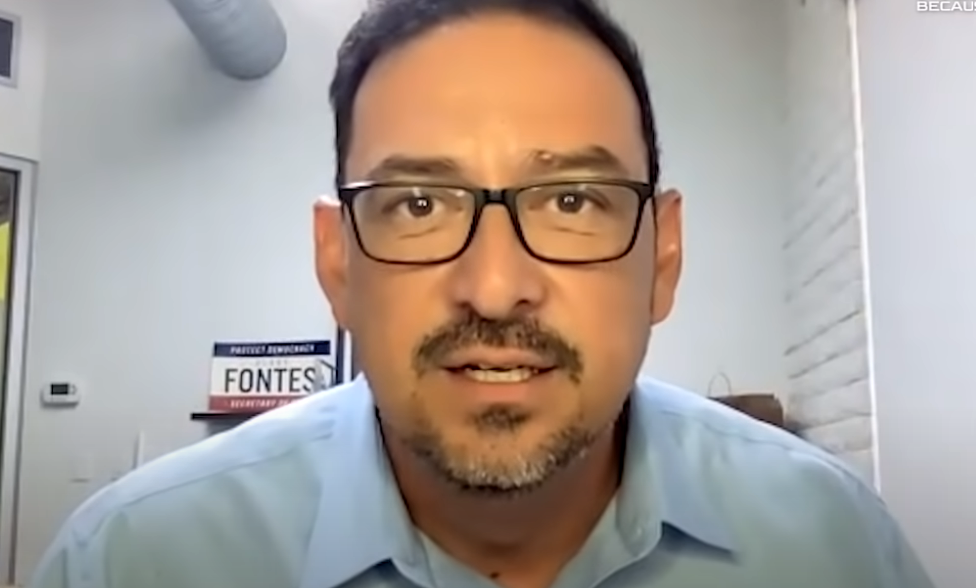
Before the new budget was approved by the Arizona Legislature and signed into law, Democrat Secretary of State Adrian Fontes tweeted, “The present form of the budget proposal fails to fulfill the requirements we’ve conveyed to the Governor and the Legislature. This is because relying on one-time funds cannot address our urgent need for a larger number of SOS staff to boost IT security and offer technical support to the counties. As elections are critical infrastructure, the current budget proposal neglects the significance of maintaining the security and quality of our elections over time.”
After the budget was signed by Governor Hobbs, a Republican lawmaker alleged more discontentment from Fontes. Freshman Representative Austin Smith wrote, “During a House Elections Committee meeting this year @Adrian_Fontes came to testify for the ballot images bill to @electjacqparker, @realAlexKolodin, @azjustinheap, @RJ4arizonaand me. Fontes was storming through the State House yesterday cussing because he didn’t get what he wanted in the state budget for his left-wing pet projects. You CAN question ANYTHING in this country including elections. Only actual fascists and democracy frauds like Adrian Fontes hate it. Pound sand, @Adrian_Fontes.”
A few other individuals added some insight to this revelation by Smith, including Representative Jacqueline Parker, who stated: “Maybe if he stopped calling us fascists & working against us, & did his job better we would care about funding his department more… if I was in charge, A LOT more government agencies would have received much less funding. I thought he was treated too generously, considering…”
Representative Justin Heap said, “Uh oh. SofS Adrian Fontes is fuming about the Budget! He just discovered that the House Elections Committee made sure we stripped his control over millions of HAVA dollars he planned to use to “fortify” our elections. Tough break, Man. Seeya at the Joint Oversight Committee!”
Jen Wright, a former top attorney in Attorney General Mark Brnovich’s administration, tweeted, “Why would Sec. Fontes storm thru the AZ State House upset about the budget? Maybe because @realAlexKolodin & the @AZHouseGOP, & @AZSenateGOP refused to give him unfettered access to the MILLIONS in HAVA money that he had requested? #ElectionIntegrityHeroes #ThankALegislator”
Another freshman representative, Alexander Kolodin, responded to Wright’s post, saying, “Oh Gina Swaboda and I went through his budget MOST carefully. A little legislative oversight never hurt, right?”
Senator Wendy Rogers also chimed in to praise Kolodin for his contributions to the budget: “@repalexkolodin applies THE finest-toothed comb of anybody I know on planet earth… seriously. Picayune. Wonkish. But freakin’ sharp. I’m glad he’s on our side, is all I can say.”
Fontes’ issues with the budget follow the high-profile pushback from Democrat Attorney General Kris Mayes, which occurred before the budget was passed and signed into law. Mayes previously sent a letter to Hobbs and members of the Legislature, writing, “The Legislature and Governor need to go back to work and produce a budget that is in the best interest of all Arizonans. We need a budget that funds essential state services that protect the well-being and safety of all Arizonans. I will continue to fight, especially for our most vulnerable residents, as well as the dedicated, hard-working public servants in the Attorney General’s Office.”
Mayes also threatened legal action if the Legislature swept “the authority of the Attorney General to direct funds received through consent judgments against several pharmaceutical companies for their roles in the opioid crisis.” Republican Representative David Livingston fired back against those statements, tweeting, “Attorney General Mayes should learn the facts first, and accurately convey those facts in committee hearings, before making demands and threats to sue the Legislature and the Governor over the budget.”
Daniel Stefanski is a reporter for AZ Free News. You can send him news tips using this link.
by Daniel Stefanski | May 10, 2023 | News
By Daniel Stefanski |
Amid a growing dispute with Governor Katie Hobbs and the Arizona Legislature over water issues, Democrat Attorney General Kris Mayes is adding another grievance to her tab: the Arizona Fiscal Year 2024 budget.
On Saturday, Attorney General Mayes transmitted a letter to Governor Hobbs and the Arizona Legislature, expressing her “alarm concerning what is currently under consideration for the Arizona Fiscal Year 2024 budget.” According to Mayes’ knowledge of the state of budget negotiations at the time, “most state agencies, including executive offices established by the Constitution such as the Arizona Attorney General’s Office, would not receive any new ongoing monies from the state’s General Fund in FY24.”
In her letter, Mayes noted that her office had requested “a 15 percent pay increase equal to $3,864,700 in ongoing General Fund dollars for the DCS Attorney General Special Line Item to protect Arizona’s children;” an appropriation of “$3,014,500 from the General Fund for 18.5 full-time employees in the Criminal Division that are currently funded from a temporary appropriation from our Consumer Protection Revolving Fund (CPRF);” $1,750,000 to backfill that (National Mortgage) Settlement funding with a CPRF appropriation (for 13 employees in the Consumer Protection Section of our Civil Litigation Division);” and another “$2,150,400 from the General Fund to replace this funding (from the Anti-Racketeering Revolving Fund) we will lose (because of recent statutory changes).”
General Mayes explained her reasoning for this letter in a statement issued Monday, writing, “Over the weekend, I expressed my alarm over a budget proposal that ignores vital needs of Arizonans – including much-needed funding for our office to continue to crack down on crime and fraud. Today, we see a budget proposal moving forward that appears to be politically expedient for a few, but wholly inadequate for the majority of people in our state. As I said, I am opposed to any statewide budget proposal that does not adequately fund Arizona’s ability to fight the fentanyl crisis and the drug cartels, protect Arizona’s children and combat elder abuse and consumer fraud.”
The State’s Chief Law Enforcement Officer also challenged the governor and members of the Legislature to come up with the requested funds, saying, “The Legislature and Governor need to go back to work and produce a budget that is in the best interest of all Arizonans. We need a budget that funds essential state services that protect the well-being and safety of all Arizonans. I will continue to fight, especially for our most vulnerable residents, as well as the dedicated, hard-working public servants in the Attorney General’s Office.”
Mayes, however, saved her most contentious declaration for the end of her letter, mentioning the “talk of the Legislature sweeping the authority of the Attorney General to direct funds received through consent judgments against several pharmaceutical companies for their roles in the opioid crisis.” She warned, “Sweeping this authority from the Attorney General would be a breach of the consent judgments, and as Attorney General I will not stand by and allow this to happen. I fully intend to consult with the Legislature as the judgments dictate. Any proposal that contradicts this provision by having the Legislature instead direct how the state funds will be used is not acceptable, and I am prepared to go to court to ensure that the State is able to obtain and properly direct those funds for opioid treatment, prevention and education if warranted.”
“Attorney General Mayes should learn the facts first, and accurately convey those facts in committee hearings, before making demands and threats to sue the Legislature and the Governor over the budget,” tweeted Livingston with a copy of his letter to her in which he points out that the Legislature does in fact have a say in how the funds are used.
Daniel Stefanski is a reporter for AZ Free News. You can send him news tips using this link.
by Daniel Stefanski | Feb 15, 2023 | News
By Daniel Stefanski |
Two weeks after the Arizona Senate passed the state’s budget for 2023-2024, the House followed suit, setting the stage for another early legislative session showdown with Democrat Governor Katie Hobbs’ office.
Last week, the Arizona House attempted to pass a budget, but Republican Liz Harris voted with Democrats to stop progress on this front in a narrowly divided chamber. Rep. Harris tweeted after her February 9 vote that she “will reject this budget until we right size and restore it to a level that is commensurate with our economic growth.”
Time was ultimately on Speaker Ben Toma’s side, and this week, all House Republicans came together to join their Senate colleagues in passing the $15.8 billion budget. According to the communication from the Arizona Senate Republican Caucus on February 1, this budget is “$2.3 billion less than the state budget that was approved last year and $1.3 billion less than the Governor’s proposed budget.”
Also, “to absorb any revenue loss, this approved budget leaves $1.8 billion in cash available by the end of fiscal year 2024, in addition to the $1.4 billion available in the state’s Rainy-Day Fund.”
In a release sent out by the Arizona House Republicans touting the passage of this budget, Speaker Toma proclaimed victory and challenged the governor to sign the legislation for the good of all Arizonans:
“House Republicans have acted today to pass a responsible state budget. It’s one that was crafted with the needs of the state, and of Arizona’s families in mind, families who are struggling during this economic recession caused by reckless federal overspending and far-left priorities….This budget passed today continues the same budget which was approved less than a year ago with a bipartisan majority and was cheered at the time by Governor Hobbs and Democratic Minority Leader Cano.”
Speaker Toma’s reference to then-Secretary of State Hobbs supporting the last budget was highlighted by Rep. Jacqueline Parker, who shared a tweet from Hobbs from the conclusion of last year’s process:
Arizona Senate Republicans also cheered this week’s action by the House:
Other House Republicans celebrated the budget passage after their votes on the floor. Rep. Austin Smith tweeted, “I voted YES on the budget today to keep the government running so no Arizonan is held hostage to special interests. Democrats keep threatening a veto from Katie Hobbs. They are willing to shutdown the government to protect special interests. SAD!”
Rep. David Livingston wrote, “Great news, the Arizona House just passed the 2023-2024 Budget! Now we transfer the budget bills to Governor Hobbs.”
House Majority Leader Leo Biasiucci stated, “Arizona House passes budget to avoid Arizona shutdown. Will Governor Hobbs Veto this bipartisan budget or will she do what’s right for every resident of Arizona?”
Arizona House Democrats were much less complimentary of this week’s action to pass the budget and transmit to the governor’s office.
Rep. Laura Terech tweeted, “This is a budget that is destined for a veto. Hopefully, we will be sitting down together soon to do the real work of finding meaningful bipartisan solutions for Arizonans.”
Minority Whip Marcelino Quiñonez said, “The dynamics in Arizona politics changed in November 2022, & this rushed budget headed to the Governor’s desk ignores that reality. The final budget we pass as a body this session must be bipartisan, everything until then is only a distraction. The work starts after the veto.”
The Republican-led budget is dead on arrival at the Ninth Floor. Governor Hobbs released a statement in opposition to the incoming budget, saying, “The issues Arizonans are facing require more than business as usual. I will not sign a budget that is just more of the same and does nothing to demonstrate a desire to move our state forward.”
Daniel Stefanski is a reporter for AZ Free News. You can send him news tips using this link.