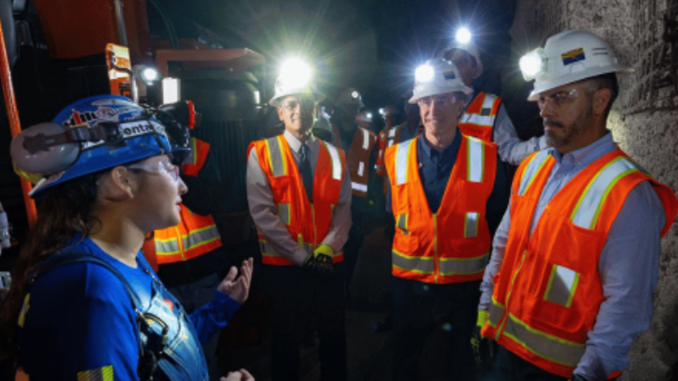
Congressman Juan Ciscomani (R-AZ-06) applauded two major announcements he said further solidify Arizona’s position as a national leader in copper production and critical minerals. The announcements include a $1 billion investment in the Ivanhoe Santa Cruz Copper Project near Casa Grande and $180 million in grants to strengthen mining education programs, including at the University of Arizona.
✅$180 MILLION to strengthen mining education, including at @uarizona.
Arizona has the resources, workforce, and expertise to lead America’s mining future 🇺🇸 ⛏️ pic.twitter.com/lDPDKuWmtv
— Congressman Juan Ciscomani (@RepCiscomani) August 7, 2026
Arizona is home to some of the world’s largest copper deposits, as well as an abundance of other critical minerals essential to the nation’s energy, manufacturing, defense, and technology sectors.
The University of Arizona is consistently ranked among the nation’s top mining engineering programs and reports a 100% job placement rate for its graduates, helping prepare the workforce needed to meet growing demand for domestic mining and mineral production.
Two Arizona mining and eduction leaders attended the announcements at the White House and praised the investments.
Kray Luxbacher, Executive Director and Head of the School of Mining Engineering & Mineral Resources at the University of Arizona, highlighted the significance of the investment in mining eduction.
“This was a historic investment in American mining engineering schools, and we’re really grateful, said Luxbacher. “I also want to say thank you for what you’ve already done toward accelerating permitting for mining in the United States. It’s really been unbelievable.”
Proud to see Kray Luxbacher representing the University of Arizona's world-class mining program at the White House today!
UofA's leadership in mining education is second to none and today's federal investment in developing the workforce will power America's future. Thank you,… https://t.co/qvLJt1BQar
— Congressman Juan Ciscomani (@RepCiscomani) August 7, 2026
Vicky Peacey, President and General Manager of Resolution Copper, also praised the administration’s efforts to revitalize the domestic mining industry.
“Mr. President, you have brought mining back to America, single-handedly,” said Peacey.
Ciscomani called the announcements a landmark investment in Arizona’s mining industry and workforce.
“From a $1 billion investment in the Santa Cruz Copper Project to $180 million to strengthen mining education, including at the University of Arizona, these are major wins for Arizona,” said Congressman Ciscomani. “Arizona is leading America’s effort to produce the critical minerals our economy and national security depend on.”
“These once-in-a-generation investments by President Trump and the administration will create good-paying mining jobs, strengthen our workforce, and train the next generation of miners and engineers right here in Arizona,” added Ciscomani. “I am proud to see Arizona’s local leaders Vicky and Kray at the table. They are leaders in this industry and this is a transformational moment for Arizona and America’s mining future.”
Ciscomani has made strengthening America’s domestic critical materials supply chain a legislative priority.
He championed the Critical Mineral Consistency Act (H.R. 755), legislation designed to align the Department of Energy’s and U.S. Geological Survey’s separate lists of critical minerals and materials, making copper a critical mineral.
The legislation would establish a more consistent federal framework for identifying critical minerals, with the goal of reducing regulatory uncertainty, streamlining permitting, attracting investments, and accelerating domestic mining and processing projects.
For Arizona, the legislation could help facilitate the development of copper projects by ensuring federal agencies use consistent standards when determining which minerals qualify as critical.
Ethan Faverino is a reporter for AZ Free News. You can send him news tips using this link.
The U.S. Forest Service has finalized a long-contested land exchange with Resolution Copper tied to the proposed mining project near Superior, Arizona.
Resolution Copper announced that the exchange with the federal government has been finalized following years of environmental review, legal challenges, and consultation. The exchange transfers more than 2,400 acres of land in the Tonto National Forest to Resolution Copper, while the company conveys more than 5,400 acres of land across Arizona to federal agencies for conservation and public use.
The land exchange was authorized by Congress in the 2014 National Defense Authorization Act and has been subject to ongoing litigation and regulatory review in the years since.
The announcement follows a March 13 decision in the U.S. Court of Appeals for the Ninth Circuit, which declined to block the exchange, and the U.S. Supreme Court’s 2025 decision not to issue an emergency stay requested by Apache Stronghold, a nonprofit effort of the San Carlos Apache tribe and mine opponents.
This land exchange isn’t just a milestone, it’s a commitment. To protect what matters. To support local and tribal communities. To power a future with responsibly produced copper.
The parcel transferred to Resolution Copper includes Oak Flat, an area within the Tonto National Forest that sits above a large underground copper deposit. The project has been identified as one of the largest undeveloped copper resources in North America, with estimates of more than 40 billion pounds of copper.
Resolution Copper, a joint venture owned by Rio Tinto and BHP, has stated that the project could eventually supply a significant share of U.S. copper demand and support domestic supply chains for energy and infrastructure.
The Forest Service completed a Final Environmental Impact Statement (FEIS) for the project in 2025 following more than a decade of study and consultation.
Despite the completion of the land exchange, the project remains subject to additional federal, state, and local permitting requirements before mining operations can begin.
The land transfer has been the focus of sustained opposition from the San Carlos Apache Tribe and other groups, who argue that Oak Flat—known as Chi’chil Biłdagoteel—is a site of religious and cultural significance.
The Resolution Copper project has drawn national attention due to its potential economic impact and its role in domestic mineral production, as well as ongoing legal and political disputes surrounding the land exchange.
In February, Resolution Copper announced a $285,000 donation to the United Food Bank amid rising food assistance demand in Arizona.
The U.S. House of Representatives passed bipartisan legislation led by U.S. Rep. Juan Ciscomani (R-AZ-06) to strengthen domestic supply chains for critical minerals, including copper, on Tuesday.
The measure, the Critical Mineral Consistency Act (H.R. 755), would align federal definitions used by the U.S. Department of Energy and the Department of the Interior for materials considered critical to national security, manufacturing, and energy infrastructure. The legislation passed the House unanimously.
Currently, the Department of Energy maintains a list of “critical materials,” while the U.S. Geological Survey within the Department of the Interior maintains a separate list of “critical minerals.” Because the lists differ, certain materials do not qualify for federal incentives, financing opportunities, or streamlined permitting available to resources designated as critical minerals.
The legislation would align the two federal lists, allowing materials identified by the Department of Energy to receive the same recognition and benefits granted to those listed by the U.S. Geological Survey.
According to Ciscomani’s office, the policy change is intended to provide greater clarity for federal agencies and industry while accelerating domestic mining and processing projects.
“America should never have to depend on adversaries for the materials that power our economy and national defense,” Ciscomani said in a statement announcing the bill’s passage. “With today’s passage of the Critical Mineral Consistency Act, we are streamlining permitting, attracting investment, and unlocking Arizona’s vast mineral resources — especially copper — to strengthen our supply chains and our security.”
Big win for Arizona and for American energy security.
My Critical Mineral Consistency Act just PASSED the House — aligning federal definitions to streamline permitting and accelerate domestic mining.
— Congressman Juan Ciscomani (@RepCiscomani) March 3, 2026
The legislation was introduced with bipartisan support and has backing from industry groups, including the Copper Development Association, National Mining Association, National Electric Manufacturers Association, and the Business Council for Sustainable Energy.
“Accessing critical minerals and materials is essential for our national security and energy grid. Government red tape should not be a barrier to development and innovation,” said Rep. Susie Lee (D-NV-03), a co-sponsor of the bill. “Whether something is a ‘critical mineral’ according to the Interior Department or a ‘critical material’ according to the Energy Department, the federal government should treat all as critical resources. I’m glad my commonsense, bipartisan bill is one step closer to providing the clarity that both industry and federal agencies need.”
The bill now moves to the U.S. Senate for consideration.
The National Republican Congressional Committee also issued a statement following the vote, saying the legislation would reduce regulatory barriers affecting critical minerals important to the U.S. energy grid, national security, and Arizona’s economy.
NRCC Spokesman Ben Petersen credited Rep. Ciscomani, stating, “Representative Juan Ciscomani continues working to grow Arizona’s economy, create good-paying jobs, and lower energy costs. Getting things done has made Representative Ciscomani the most-effective and most-bipartisan Member of Congress from Arizona.”
Representative Blackman said, “The Resolution Copper project is a rare opportunity to strengthen Arizona’s economy—especially in the historic Copper Corridor and across District 7. It will bring high-wage jobs, critical infrastructure investments, and lasting economic support for local businesses.”
The Resolution Copper Project is anticipated to create thousands of construction jobs at first, with thousands more supported during decades of mine operations.
With Arizona’s average mining wage at around $100,000, these jobs promise to enhance the livelihoods of working families across the state.
The project is also expected to generate tens of millions in annual tax revenue, enabling critical investments in public roads and essential services for the Town of Superior and the surrounding areas.
The FEIS, culminating over a decade of National Environmental Policy Act analysis, incorporates extensive input from tribal governments, local communities, and other stakeholders.
Resolution Copper’s Community Working Group has played a vital role in developing mitigation strategies and promoting shared goals.
Additionally, more than 23 local municipalities and organizations have signed Good Neighbor Agreements, establishing a structure for responsible land and community management throughout the mine’s lifespan.
Blackman added, “Resolution Copper has made a genuine effort to work with the community and earn local support—truly being a good neighbor. This project is ready to move forward, and it’s time it does. I urge the Forest Service to act without further delay.”
Representative Blackman emphasized the project’s alignment with Arizona’s legacy as a leader in U.S. copper production. He urged the USFS to proceed with the land exchange, highlighting the potential to drive sustainable economic growth for the Copper Corridor and throughout Arizona.
Ethan Faverino is a reporter for AZ Free News. You can send him news tips using this link.
The Resolution Copper project, a joint venture of BHP and Rio Tinto, issued a statement Tuesday welcoming the republication of the Final Environmental Impact Statement (FEIS) by the U.S. Forest Service (USFS) for its proposed underground mine 60 miles east of Phoenix near Superior, AZ.
The proposed development of the largest untapped copper deposit in the world relies on a major land-swap between the Rio Tinto, BHP, federal and state governments to proceed.
Initially the FEIS for the project was released by the Forest Service in 2021, but was later withdrawn by the agency to provide additional time for the USFS to study the objections of tribal governments and the overall community.
The proposed mine is controversial and would ultimately transform the Oak Flat parcel southwest of Superior, currently forest service land, into a 1.8-mile-wide crater between 800 and 1,115 feet deep, in exchange for 6,005 acres of land to be transferred by BHP and Rio Tinto local, state and federal governments and agencies.
“As part of the land exchange, Resolution Copper has committed to initiatives that support cultural preservation, recreation, education, employment, economic development, and nature through long-term partnerships with Native American Tribes and local communities. This includes significant funding in a long-term Native American Trust Fund and Emory Oak restoration,” Resolution Copper stated. “Other commitments focus on conservation and monitoring of seeps and springs; restoration and preservation of creeks, rivers, and watersheds; and habitat enhancement for biodiversity.”
Vicky Peacey, General Manager of Resolution Copper said, “Through this process, we have deepened our relationships with local communities and Native American Tribes, including our senior leaders spending time with Tribal leaders to listen and build mutual understanding. We welcome the opportunity to continue these conversations as we move into the next phase of permitting. Working together, mining can co-exist with cultural heritage, recreation, and nature, while delivering new economic opportunities in rural Arizona.”
“This project has undergone one of the most comprehensive environmental and social reviews in U.S. history,” she added. “The republication of the FEIS reflects the thorough work by the USFS, local communities, and Native American Tribes and the seriousness with which all stakeholders have approached this process. We remain committed to earning trust through transparency, engagement, and responsible development as we move forward.” In PR posts to social media, Resolution Copper boasts the prospects of adding $1.2 Billion to Arizona’s economy and thousands of jobs in Superior and Magma, AZ, totaling $270 million in annual salaries.
USDA announces one major step toward unleashing American mineral independence with this draft record of decision for the Resolution Copper mining project. @POTUS is putting America First
In a statement posted to X, U.S. Secretary of Agriculture Brooke Rollins expressed the Trump administration’s support for the proposal early in the week, noting that the republication of the withdrawn FEIS is “an important step in advancing President Trump’s goal of emergency and mineral independence by boosting domestic mineral production.” Rollins added, “The Resolution Copper project is a prime example of how we can harness America’s abundant resources to fuel growth in rural America, reduce our dependence on foreign imports, strengthen our supply chains, and enhance our national security.”
The U.S. Department of Agriculture detailed in a Tuesday release that the land transfer cannot occur until August 19, 2025, or 60 days after the Federal Register notice is published per a ruling from a U.S. District Court on June 9th. It added that, if approved, the mine is projected to generate $149 million in annual payroll, with approximately 1,500 jobs, providing between $80 and $120 million a year in estimated state and local tax revenue as well as $200 million a year to the federal government. The final environmental impact statement is expected to be posted to the Federal Register, along with the draft decision record from the USFS on June 20th.
The public has 45 days to make any objections to the decision and the USFS must respond and address any objections within 90 days, meaning the project could see final approval as soon as November 2nd.