Financial fraud is emerging as one of Arizona’s most costly economic threats, with residents projected to lose more than $4 billion in 2025, according to a new analysis from the Common Sense Institute (CSI). The report, The Impact of Financial Fraud in Arizona, outlines how scams, identity theft, and other fraudulent activity are draining household finances and hampering economic growth. In 2024, Arizonans reported nearly 55,000 fraud cases, leading to $521 million in losses—an increase of 384 percent since 2020.
CSI economists estimate that only about 14 percent of fraud is ever reported, meaning the true cost is far higher. By next year, the institute projects that reported losses could reach $558 million, with an additional $3.4 billion in unreported incidents.
“Arizona is projected to lose over $4 billion to financial fraud in 2025. That’s nearly 1% of the state’s total GDP,” said Zachary Milne, senior economist and research analyst at CSI. “Fraud is a systemic drain on Arizona’s families and the economy. Eliminating these losses would mean billions in growth, tens of thousands more job opportunities, and lower prices for Arizonans.”
Key Findings from the Report
The average loss per incident in Arizona was $6,270—nearly 30 percent higher than the national average.
Arizona ranked 11th nationally for fraud cases, with 1,459 reports per 100,000 residents.
Older residents face the greatest impact. Adults 60 and older account for two-thirds of internet-based fraud losses, with those 70 and older suffering the highest average dollar losses.
For every dollar lost to fraud, Arizonans lose $1.06 in personal income due to broader economic effects. Families also face slightly higher prices on everyday goods and services.
Fraud contributes to reduced economic activity, costing Arizona more than 45,000 jobs.
Fraud schemes cited in the report range from identity theft and phishing to romance scams, wire transfer fraud, and elder financial abuse. As more commerce moves online, CSI researchers warn that the risks will only grow.
The study also highlights how financial crime affects more than direct victims. Lost spending power, higher security costs, and reduced consumer confidence create ripple effects across the state’s economy. CSI estimates fraud-related losses shrink Arizona’s GDP by $5.2 billion annually. Nationally, the FBI and Federal Trade Commission tracked tens of billions of dollars in fraud losses in 2024, part of a steady upward trend over the past five years. Arizona, with its above-average loss rate and older population, is particularly vulnerable.
The report concludes that combating fraud is not only a matter of protecting individuals but also of preserving Arizona’s long-term economic health.
Jonathan Eberle is a reporter for AZ Free News. You can send him news tips using this link.
The Common Sense Institute’s recent report, Echoes in the Halls: Arizona School Districts’ Growing Problem with Empty Buildings and Empty Buses (August 2025), quantifies a reality that many parents and educators in Arizona already sense: the traditional district school system is struggling to adapt to the new education marketplace. The report highlights a staggering mismatch between student enrollment and district assets. District schools across the state now operate with seventy-eight million square feet of unused space—capacity for more than six hundred thousand students who are not there—representing assets valued at more than twelve billion dollars. Since 2019, district enrollment has fallen by nearly fifty thousand students, while close to forty percent of incoming kindergarteners are now enrolling outside their local district.
The story of transportation is equally telling. Even as eligible bus ridership has dropped by forty-five percent, districts have added more than three thousand new vehicles, bringing annual transportation spending to more than half a billion dollars. At the same time, capital expenditures have surged by sixty-seven percent in just five years, reaching nearly nine billion dollars, with hundreds of new buildings added even as families continue to leave for other options. The evidence points to a system built on assumptions of perpetual growth, unable to pivot as students migrate toward charter schools, private schools, and homeschooling.
The question is not whether Arizona has too many empty classrooms and idle buses—the report makes that clear—but why the system finds it so difficult to adapt. The answer lies not in the commitment of teachers and administrators, but in the political structure that governs districts themselves. For more than a century, Arizona’s districts have operated under locally elected boards with broad political and taxing authority. This design once served an important democratic purpose, anchoring schools to their communities. But in an environment defined by choice and specialization, it has become a straitjacket.
What is clear for anyone with any visibility on the governance model districts operate within is that the political cycle ensures instability. Board turnover, electioneering, and the shifting priorities of competing constituencies disrupt long-term strategy. Every few years, districts are thrown off course by new agendas, new mandates, new programs, new superintendents, and a seemingly unending supply of divisive debates. In a consumer-driven education market, where parents prize clarity, stability, and quality, such volatility is profoundly counterproductive.
By contrast, Arizona’s most successful education providers—charter networks like Great Hearts and BASIS—operate under governance models insulated from political churn. Their boards are mission-driven and stable, enabling them to stay focused on long-term priorities and to deliver a coherent and trustworthy experience. Families know what to expect from a BASIS or a Great Hearts school. Each has built a distinctive value proposition and a consistent culture, refined over years without disruption from local political battles. Governance stability has been essential to their growth and attraction, and it is no accident that they are now among the most sought-after public schools in the state.
The one-size-fits-all assumption that once defined public education—that a child would simply attend the local district school—has evaporated. Today, nearly half of Arizona’s students are educated outside of their neighborhood district school. Parents are no longer defaulting to their assigned option; they are actively choosing models that align with their values and aspirations for their children. They want education providers that are both distinctive and stable—schools that can deliver excellence without being buffeted by every election cycle or politicized by the latest ideological controversy.
The traditional political governance of districts is increasingly out of sync with these expectations. It undermines the very qualities—consistency, coherence, and focus—that families prize. Meanwhile, two generations of charter operators in Arizona have demonstrated that nonprofit governance structures free from political cycles can create durable, attractive, and scalable school systems. These operators are not without challenges, but they have proven that clarity of mission and insulation from politics allow for the steady building of educational brands that families trust.
The lesson is plain: if Arizona’s districts are to thrive rather than decline, they must be unshackled from their archaic political governance model. Continuing to operate under structures designed for the early twentieth century ensures further erosion of parent confidence and continued inefficiencies in managing billions of dollars of underutilized assets. A new path is needed, one that allows districts to reimagine themselves as nonprofit education management organizations, brings simplicity and flexibility to sources and uses of capital, allows for the restructuring of real estate portfolios, and the establishment of governance models capable of long-term stewardship. It would mean shifting from political governance to mission-driven governance, from reactive cycles to strategic stability. Nothing about this would be easy. It will take a thoughtful integration of the tax and governance issues that are best considered by a new commission of governance transformation.
Such a transformation is not about abandoning public education but about liberating it. It would align districts with the same best practices that have made Arizona’s most successful charters so attractive to families. It would give teachers a more stable environment in which to do their work, free from the whiplash of shifting political priorities. It would give parents confidence that their schools are governed for the long-term benefit of students, not for short-term political gain. And it would give students schools that are full, focused, and flourishing, rather than echoing with the costs of inefficiency.
The Echoes in the Halls report demonstrates that Arizona has reached a tipping point. Families have embraced choice, and the state’s education landscape has been reshaped accordingly. What remains is for governance to catch up with this reality. The way forward is not to cling to political structures of the past, but to free districts from them so they can compete on the same terms as the schools parents are already choosing. Only then can the empty classrooms and idle buses be replaced with what every community wants most: the sound of students learning in schools built on mission, stability, and trust.
Erik Twist is the Principal Partner and President of Arcadia Education. He served as President of Great Hearts Arizona from 2017 to 2022.
Channel 12 continued its clumsy crusade against school choice this week with a breathless report about fraudsters abusing Empowerment Scholarship Accounts to buy diamond rings and necklaces, flights and hotel stays, and even lingerie.
It paints a picture of a program rife with abuse. But is it?
The Arizona Department of Education gave Channel 12 the records for more than 1.2 million ESA requests. Yet when askedrepeatedly what percentage of those requests were fraudulent, Channel 12’s reporter refused to comment.
Why? Because the truth undermines the anti-ESA narrative.
The salacious report is intended to persuade policymakers who support ESAs to impose regulations that would undermine the ESA program. It goes without saying that anyone engaged in fraud should be prosecuted to the fullest extent of the law, and the Arizona Department of Education is appropriately cracking down on fraudsters. But before policymakers rush to amend the ESA program, they should know the context that Channel 12 left out.
ESA Misspending Is a Tiny Fraction of Total ESA Spending
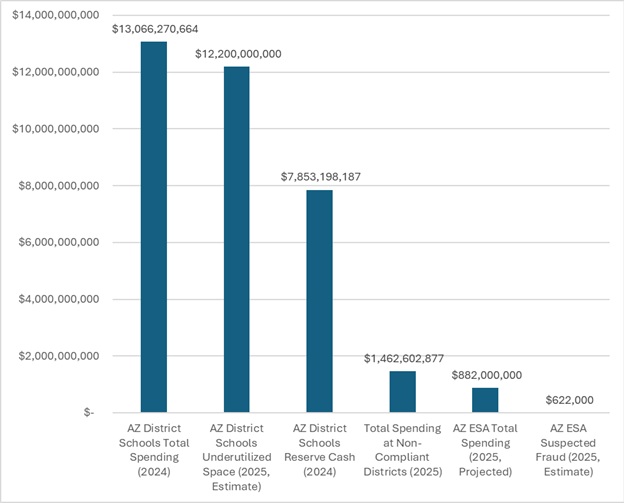
The ESA program currently serves about 90,000 students at a projected cost of $882 million this year and $939 million next year, or about 6.7% of the $14 billion spent on Arizona’s district schools. Families can use ESAs to purchase a wide variety of educational expenses to customize their child’s education.
The typical ESA student receives about $7,500 per year, compared with more than $15,300 per pupil at Arizona’s district schools. Students with special needs—who account for more than 19% of ESA students, compared with 14% of district school students—can receive more funding, although the accounts are still worth 90% of what the state spends on similarly situated students at public schools. According to the Common Sense Institute, “a disproportionate share of middle-income households use an ESA.”
On Tuesday, the Arizona Department of Education revealed that their internal audit had turned up $622,000 in ESA funds that are “possible fraud or misuse.”
That’s less than one-tenth of 1% of total ESA spending.
Ignoring Mountains, Covering Molehills
Meanwhile, there are 30 school districts that the Arizona Auditor General currently deems to be non-compliant with state reporting requirements or that have internal control deficiencies. The total spending in those districts is more than $1.4 billion, more than the total spending of the ESA program. Yet aside from its coverage of the disastrous overspending in the Isaac Elementary School District, Channel 12 has barely covered it at all.
For that matter, Channel 12 has ignored the $7.8 billion that Arizona school districts are holding in cash reserves. That’s about $7,000 per pupil. The reserves have grown $2 billion in two years, yet Channel 12 doesn’t evince even the slightest curiosity about why.
Nor is anyone at Channel 12 interested in the $12 billion worth of unused and underutilized buildings that districts are sitting on, often just to prevent private or charter schools from buying them.
Channel 12 found space in the aforementioned ESA exposé to mention that a judge recently ruled that the state supposedly “isn’t properly funding capital needs for its public schools,” but the station had no space to mention that school districts are sitting on $20 billion in cash reserves and underutilized buildings.
Indeed, Channel 12 has barely covered any of these facts even as they pump out multiple anti-ESA stories each week, despite the fact that the ESA program is dwarfed by the spending at non-compliant districts, district school cash reserves, and underutilized buildings.
School-choice opponents and their media allies are hyper-focused on ESA misspending because they want to pressure lawmakers to undermine the program via regulation.
The Arizona Department of Education adopted its risk-based auditing strategy—automatically approving ESA spending requests below $2,000, then auditing accounts on the back end—because Superintendent Tom Horne’s previous “review every penny” approach was causing massive backlogs and delays in approving expense requests and reimbursements.
There were nearly 11,000 transactions in quarter 3 of this year alone. It’s impossible for the department’s staff to review each transaction in a timely manner, but parents trying to teach their kids can’t wait months just to buy a textbook or pay their child’s tutor or school.
To Horne’s credit, he listened to parents and made some incremental improvements that make it easier for parents to use the program. Now a tiny percentage of ESA holders are taking advantage of the looser rules, but they will be forced to pay the money back and could face prosecution.
The Arizona Department of Education has suspended 400 accounts due to improper spending —just 0.4% of the total accounts—and has referred some to the Attorney General for further investigation and prosecution.
Punishing fraudsters is necessary. Every government program is subject to some amount of fraud and abuse, and it’s incumbent upon public officials to implement rules that keep fraud as close to zero as possible. But it is not in the public interest to undermine a program’s effectiveness, especially when that program is helping kids get access to a better education and a brighter future.
School-choice opponents are using misspending as a pretext. If that was their real concern, they’d be raising alarms about all the waste, fraud, and abuse in the district school system. They’re not really concerned with stopping the 0.4% of ESA holders committing fraud, they just don’t want the program to work for 99+% of families just trying to do right by their kids.
Supporters of education freedom and opportunity should ignore the manufactured outrage and work to ensure that the ESA program works well for the families it serves.
Jason Bedrick is a Research Fellow at The Heritage Foundation’s Center for Education Policy.
A new report from the Common Sense Institute (CSI) revealed a crisis in Arizona’s district public school system, marked by declining enrollment, expanding infrastructure, and misallocated resources that fail to serve students effectively.
Despite a 5% drop in district school enrollment since 2019, Arizona’s public-school districts have continued to expand facilities, increase capital spending by 67% to $8.9 billion, and boost transportation costs by 11.3% to $561.2 million, even as eligible bus riders plummeted by 45%.
As Arizona’s population surged, districts expanded, constructing thousands of school buildings, hiring teachers, and extending bus routes to accommodate a growing student body.
Since peaking in 2008 with 931,000 students, district school enrollment has steadily declined, dropping to 859,519 students by 2024—a 5% decline since 2019 alone.
According to the report, this trend is accelerating, driven by demographic shifts and changing parental preferences.
Arizona’s school-aged population (ages 5–17) shrank for the first time in 2022, with a loss of 30,000 children by 2023.
Meanwhile, school choice has reshaped the educational landscape with 40% of incoming kindergarteners now opting for charter or private schools, which operate with leaner facilities and no formal transportation systems.
In the meantime, Arizona’s district schools have doubled down on expansion. Since 2019, districts added 499 new buildings, increasing gross square footage by 3% to 148.6 million square feet—78 million square feet more than needed, enough to accommodate 630,000 additional students.
The fastest-shrinking districts have increased capital spending the most, with 20% of districts (serving 73% of students) receiving 81% of capital funding.
Math proficiency in Arizona’s district schools fell 25% since 2019, and English proficiency dropped 5%, according to NAEP assessments.
Staffing has grown by 1.5% to 108,330 employees, with teacher salaries rising 24.1% to $65,113, yet class sizes remain stable at 17.7 students per teacher.
Administrative staffing has surged 6.7% since 2019, outpacing classroom staff growth, but these investments have not translated into academic gains.
Ethan Faverino is a reporter for AZ Free News. You can send him news tips using this link.
Every year, a horde of school district officials and their lobbyists come before the state legislature, rattling their tin cups, begging for more money for their supposedly underfunded schools. They tell sob stories about crumbling buildings and underpaid teachers who had to pay for school supplies from their own pockets. Their schools, they say, are financially starved.
Hogwash.
School bureaucrats don’t want you to know it, but school spending is at an all-time high, and Arizona’s school districts are sitting on more than $20 billion in cash reserves and buildings they don’t need while student achievement craters. A new report from the Common Sense Institute (CSI) reveals the shocking scope of waste plaguing our traditional public school system, and it’s time taxpayers demanded answers.
The numbers are staggering. As has been documented, Arizona’s school districts are already hoarding $7.8 billion in cash reserves, up $1 billion since the prior fiscal year. Now we learn they’re also sitting on $12.2 billion worth of excess real estate—78 million square feet of unused and underutilized space that could house 630,000 additional students. Combined, that’s over $20 billion in resources that could be put to better use serving Arizona’s children.
Since 2019, district school enrollment has declined 5% statewide, yet these same districts increased their building space by 3% and boosted capital spending by a jaw-dropping 67% to $8.9 billion. As CSI has documented, districts have added 499 new buildings while losing 47,500 students. This isn’t just inefficient, it’s fiscally reckless.
The massive spending on new buildings might be justifiable if schools were overcrowded or expecting a huge influx of new students, but they’re not. In fact, Arizona’s district schools are already significantly overbuilt, operating at just 67% capacity while charter schools run at 95% capacity and private schools at 75%. CSI estimates that the excess space in district schools could accommodate 630,000 additional students—nearly half the current statewide district school enrollment.
The excess capacity comes at an enormous cost. CSI estimates that the market value of excess district space alone—$12.2 billion—could fund a decade of capital expenditures. Alternatively, eliminating maintenance costs for unused space would save taxpayers $1 billion annually. That’s real money that could reduce taxes, improve education, or address Arizona’s other pressing needs.
There are plenty of willing buyers. Indeed, the fastest-growing school systems—charters and private schools chosen by increasing numbers of Arizona families—struggle to find adequate facilities. Yet school districts often go to incredible lengths to avoid selling buildings to them, such as when Tucson Unified School District sold an unused building for 25% less than what a Christian school had offered, just so that a “competitor” wouldn’t have it.
In response to such cases, Gov. Doug Ducey signed a law requiring school districts to sell buildings to the highest bidder, even if it’s a private or charter school. Now, rather than comply, school districts are just letting their underutilized space languish and forcing the taxpayers to pay the bill.
The wastefulness is also a slap in the face to teachers and students alike.
As we noted previously, the districts have enough cash reserves to raise the average teacher pay from $64,420 to more than $80,000 for 10 years and still have funds left over. If they sold off all their underutilized space, they could raise the average teacher pay to $100,000 for a decade and still have billions left over.
There is no evidence that spending on buildings is contributing to student learning. As the buildings have gone up, math scores have gone down, plummeting 25% since 2019. As CSI documents, the lowest-performing schools have the most excess space, operating at just 19% capacity, while high-performing schools run at 70% capacity.
This isn’t about helping kids learn; it’s about protecting a bloated bureaucracy that puts institutional self-interest above student needs.
Fixing the problem will require realigning incentives. CSI recommends more transparency—including a “Facilities Condition Index” that would give policymakers and the public objective information about the quality of existing school facilities—and more state oversight of severely underutilized facilities. In the meantime, any funding requests from the school districts should be greeted by state lawmakers with a healthy dose of skepticism.
Arizona’s children deserve better than a $20 billion monument to government inefficiency. They deserve a system that puts their education first, not one that hoards resources while performance plummets. If local officials can’t or won’t deliver, then state lawmakers will have to step in.
Jason Bedrick is a Research Fellow and Matthew Ladner is a Senior Advisor for education policy implementation at the Heritage Foundation’s Center for Education Policy.