Despite recent claims of financial strain, Arizona cities are experiencing robust revenue growth, according to the Arizona Tax Research Association’s (ATRA) April 2025 newsletter. The report highlights that municipalities have accumulated substantial cash reserves, even as some city officials advocate for tax increases.
ATRA’s analysis reveals that for Fiscal Year (FY) 2025, Arizona cities collectively budgeted $9.1 billion for their general funds, with nearly $4.2 billion—approximately 47%—allocated to cash reserves. This financial strength is attributed to consistent growth in sales and income tax revenues, bolstered by legislative changes and economic factors.
A significant contributor to this revenue surge is the 2019 Wayfair legislation, which enabled Arizona to tax remote sales. This change led to a substantial increase in sales tax collections, with shared revenues to cities rising over 55% from $589 million in FY 2020 to $915.5 million in FY 2025. Projections indicate this figure will reach $918 million in FY 2026.
In addition to sales taxes, cities benefit from Urban Revenue Sharing (URS), which distributes a portion of state income taxes based on collections from two years prior. In FY 2025, URS allocations amounted to over $1.26 billion. However, this represents a 19% decrease from the previous year, primarily due to the implementation of a 2.5% flat income tax rate in FY 2024. To mitigate the impact on municipalities, the state increased the shared percentage from 15% to 18%.
Despite these strong revenue streams, some city leaders cite recent state tax reforms—such as the 2021 personal income tax cut and the elimination of taxes on residential rents—as reasons to consider raising local taxes. ATRA cautions against this approach, emphasizing the importance of prudent fiscal management and the existing financial cushion that many cities possess.
The association’s findings suggest that while state-level tax policy changes have influenced revenue dynamics, Arizona cities continue to enjoy a favorable financial position. As discussions around taxation and budgeting persist, ATRA advocates for transparency and accountability in municipal fiscal practices.
Jonathan Eberle is a reporter for AZ Free News. You can send him news tips using this link.
Every time the Republican-controlled legislature considers cutting taxes, the biggest obstacle is the taxpayer-funded lobbyists representing cities, towns, and counties. They come down to the legislature year after year accusing lawmakers of “defunding” local government. And, of course, it is always police, fire, and public safety on the chopping block and never DEI programs, art projects, or other unessential and unnecessary spending projects.
The problem with this narrative is that it is completely false. Cities and towns are flush with cash and have actually received enormous windfalls, not cuts, from the legislature. The result has been hundreds of millions in new revenue for the cities in just the last 6 years. Most of it from two sources—online sales and enhanced state shared revenue.
Online Sales Tax Windfall
In 2019, the legislature passed legislation responding to the Wayfair decision, allowing the state and local governments to tax online sales from sellers outside of this state. At the time, it was sold as a “meager” $85-million-a-year tax increase. But now, five years since the legislation was enshrined into law, taxpayers are doling out over one billion dollars in total collections each year to state and local government…
A proposed amendment to Arizona’s tax laws could make it significantly harder for cities and counties to raise taxes and fees. Senate Concurrent Resolution (SCR) 1008, sponsored by Senate President Warren Petersen, proposes requiring a two-thirds majority vote from municipal and county governing bodies before they can increase assessments, taxes, or fees.
SCR 1008 builds upon Arizona’s existing tax-related voting requirements. In 1992, Proposition 108 established that any net increase in state revenue—including tax hikes or new fees—requires a two-thirds vote in both chambers of the state legislature. More recently, Proposition 132, passed in 2022, mandated that any tax-related ballot initiative or referendum must receive at least 60% voter approval to become law.
Currently, municipal and county governments must provide a 60-day public notice before imposing new business taxes or fees. However, SCR 1008 would go further by requiring a supermajority vote at the local level before such increases could be enacted.
Key provisions of SCR 1008 include:
A two-thirds vote by a city’s common council would be required to increase any assessment, tax, or fee.
A two-thirds vote by a county’s board of supervisors would be required for similar increases.
The measure declares tax and fee regulation a statewide concern, limiting the ability of local governments to adopt different rules.
The proposal must be approved by voters in the next general election before becoming law.
If approved by the legislature, the measure would head to the ballot for voters to decide its ultimate fate.
SCR 1008 reflects ongoing efforts by Arizona lawmakers to place additional restrictions on tax increases at both the state and local levels. Supporters argue that requiring a supermajority vote will protect taxpayers from excessive government fees, while opponents contend it could limit the ability of local governments to fund critical services such as infrastructure, public safety, and education.
The bill narrowly passed the Senate Government Committee with a 4-3 vote and now awaits further legislative consideration.
If approved by voters, SCR 1008 would significantly change the way local governments in Arizona raise revenue, ensuring that any tax or fee increase has broad political support before becoming law.
Jonathan Eberle is a reporter for AZ Free News. You can send him news tips using this link.
The Arizona state coffers are running over with cash. The state is set to receive $12B in federal recovery funds, more than the entire annual state budget. On top of that, forecasting by the Joint Legislative Budget Committee projects by 2024 the state will have a $6.4B cash balance with $1.5B in ongoing revenues. Republicans in the Legislature and Governor Ducey are looking to return the record high, multi-billion-dollar state surplus to taxpayers by passing major tax cuts.
On the front lines to defeat these efforts—the cities—that are claiming major income tax reductions will significantly impact their bottom line. But it isn’t just the state sitting comfortably on a mountain of cash, the cities are too.
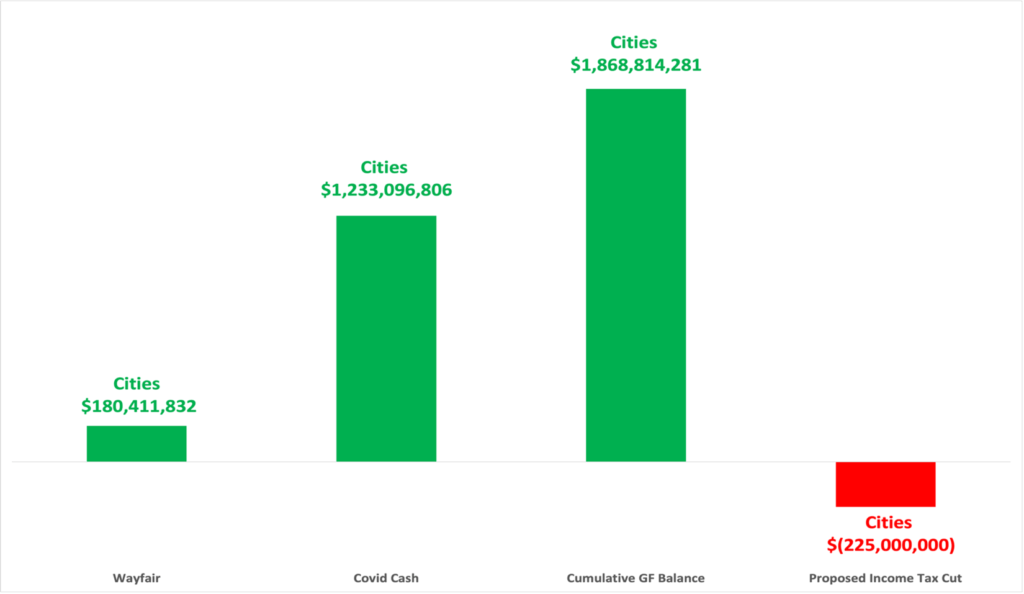
In opposing the proposed tax cuts, cities are arguing that the package will result in a $225 million decrease in their shared revenue from income tax collections. Despite this estimate being seriously flawed, their projections are in reality insignificant.
Based on research from the Arizona Tax Research Association, we’ll look at 4 cities—urban, rural, small, and large—comparing their estimated “cut” from the tax package to their cash balances and scored against additional revenues generated from the 2019 Wayfair legislation, which permanently expanded the cities’ tax base.
Chandler
The city of Chandler has a budget of just under $317 million in general fund expenditures for FY2021, leaving nearly $135 million in the general fund.
So far in FY2021, the city has collected close to $3.6 million in new, local TPT revenue and $1.2 million in state shared TPT collections by remote sellers. Taking the average from the 8 months of collections so far in FY2021, this would result in just over $7 million annually.
The estimate of Chandler’s decrease in shared revenue? Just over $10 million.
With a cash balance of $135 million, $7 million in new revenue from Wayfair, Prop 207 revenue, and nearly $36 million in Covid cash from the latest package, residents of Chandler need not worry about their city providing a high level of service.
Their estimated “cut” represents a 0.67% decrease in Chandler’s general fund when scored against new ongoing tax revenues.
Flagstaff
The city of Flagstaff budgeted $81.7 million in general fund expenditures for FY2021, leaving the city with a cash balance of over $33 million.
From Wayfair, Flagstaff has already collected $1.3 million from remote sellers and their estimated state share is $340,000. Averaged out this is just under $2.5 million in new annual revenue. Flagstaff has also received $15.2 million in new Covid cash.
The estimated “cut” from income tax reductions? $2.9 million. This represents a mere 0.36% decrease in the general fund when scored against new ongoing tax revenues…