Earlier this year on July 20th, a small group of moms and residents gathered together for the first time at the Chandler City Council meeting. They simply wanted to share their thoughts on some of the books in the Chandler Public Library system that they found while at the library with their kids.
One of the books brought by Chandler Unified School District candidate Carley Morgan was It’s Perfectly Normal, a picture book labeled “Juvenile”—meaning for kids. The book contains images of nude men, women, and children. It also explains in detail how sex happens including talking about “When the penis enters the vagina, the wall to the vagina stretches open and around the penis.” Carley’s son Riley, a 13-year-old also spoke about how no one wants to have these “awkward” conversations with their children before they are ready to. Parenting should always be in the hands of the parents and not the library.
Andrew Adams, the Chair of Republican Legislative District 14, also spoke saying his 1-year-old daughter was with him and if someone showed his daughter the images in these books, they would be dealing with him “personally.”
On the night of September 19, 2023, many concerned citizens, parents, and residents gathered together again to express their dismay for the books that were found in the juvenile section of the libraries.
Some of the same citizens at the previous council meeting came out yet again—this time to speak to a seven-person board appointed by the Mayor and Council called the Library Board. The President of the Board, Beth Brizel, a former City Council candidate, said “I have taken notes and will definitely discuss with library staff on the possibility of this.”
The citizens who spoke were loud and clear while talking to this board. The first speaker Aubrey Savela, who is with Turning Point Action, read from the book What’s Going on Down There? On page 116 of that book, what is especially concerning is a question that is prompted by a young man, “If I get my girlfriend pregnant can I make her get an abortion even if she doesn’t want to?” Should public libraries really be used to promote getting an abortion in such a way to innocent and unsuspecting minors?
Another speaker, Jenine Cortes, who is a mother of four and is also running to serve the Chandler Unified School District board, told the board that she used to “live in the library” with her kids when her oldest child was younger. But now, she fears bringing her children to the library because they might go to the wrong shelf and find pornographic materials.
These books not only contain graphic words, but they also include graphic illustrations: pictures of women bending over to see themselves in the mirror, a penis entering the anus, and many other graphic images that have no place in the juvenile section of a public library!
Carley and Andrew also discussed how they both sat down with the Library Manager named Rachele. They shared that they asked Rachele what kind of content filters there are on the library’s computers in the youth section. According to Carley and Andrew, Rachele replied that “there are none” because the library does not want to “restrict access of their patrons.” But this is highly concerning, especially given the Supreme Court’s ruling in the case United States v. American Library Association, which stated that libraries that implement software for content filtration is NOT a violation of the Constitution.
To wrap up the night, the Library Board watched footage of the City Council meeting which drove the parents’ points home again! Now, the board needs to make the right decision before its next meeting in November to ensure that kids don’t get unfettered access to pornography in public libraries.
Joseph Yang is a young community leader and grassroots activist. He currently runs a community organization and serves on the Chandler Police Review Panel. Joseph is the Founder of the East Valley Young Republicans and current assistant state advisor for the TeenAge Republicans. He hosts a show called “The Conservative Seoul Show” that you can find here.
The Maricopa County Public Library is stocking up on controversial LGBTQ+ and anti-racist children’s books.
Children’s books put on display at the libraries included those that teach that systemic racism is real, and that LGBTQ+ lifestyles and ideologies are healthy and cause for celebration.
Several of the LGBTQ+ and anti-racist books offered were board books: thick, durable picture books intended for infants through children up to four years old.
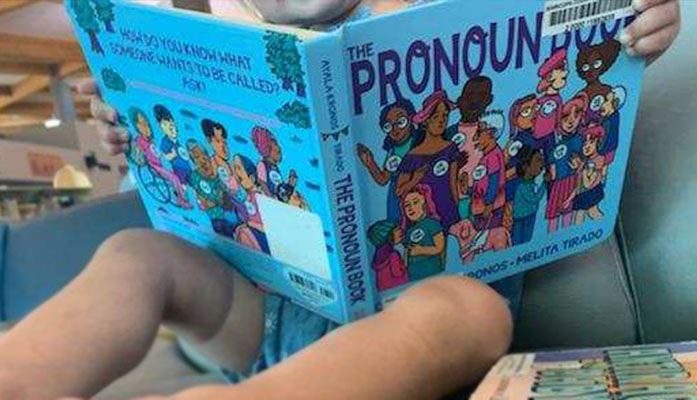
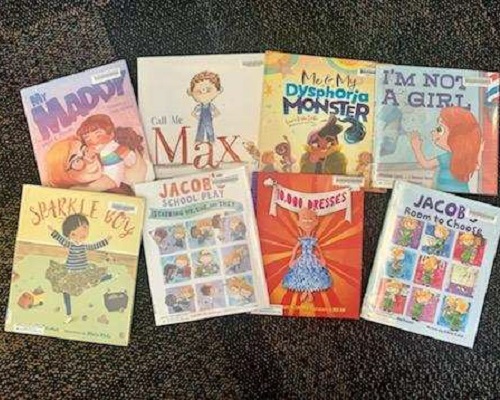
The controversial children’s books included the “Pronoun Book,” “My Two Dads,” “I’m Not a Girl,” “Antiracist Baby,” “Me & My Dysphoria Monster,” “My Maddy, “Call Me Max,” “Sparkle Boy,” “Jacob’s School Play: Starring He, She, and They” “10,000 Dresses,” “Jacob’s Room to Choose,” “Stella Brings the Family,” “Love Makes a Family,” “Lovely,” “Grandad’s Camper,” “What Riley Wore,” “My Rainbow,” “Prince & Knight,” “And Tango Makes Three,” “Mommy, Mama, and Me,” “Julian is a Mermaid,” “King & King,” “One Family,” “In Our Mothers’ House,” “Happy in Our Skin,” “Morris Micklewhite and the Tangerine Dress,” “Jacob’s New Dress,” “Uncle Bobby’s Wedding,” “Home at Last,” “This Day in June,” “Fred Gets Dressed,” “When Aidan Became a Brother,” “My Shape is Sam,” “Adventures With My Daddies,” “Papa, Daddy, 7 Riley,” “Except When They Don’t,” “Jack (Not Jackie),” “Mr. Watson’s Chickens,” “Old MacDonald Had a Baby,” “Rainbow: a First Book of Pride,” “One of a Kind, Like Me,” “Sam is My Sister,” “A Plan For Pops,” “From Archie to Zack,” “Bye Bye, Binary,” “My Shadow is Pink,” “It Feels Good to Be Yourself,” “The Truly Brave Princesses,” “The Bread Pet,” “Peanut Goes For the Gold,” and “Patrick’s Polka Dot Tights.”
LGBTQ and anti-racist children’s board books featured in a Maricopa County Public Library.
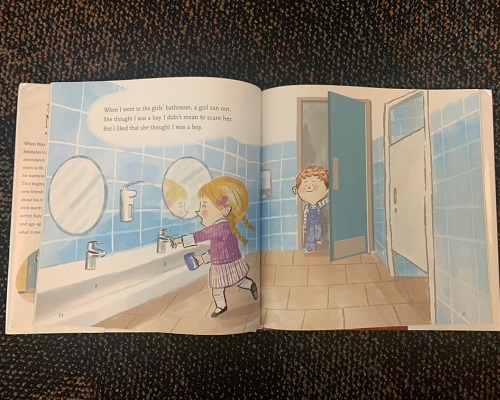
In “Call Me Max,” a little girl dressed like a boy scares another little girl as she enters the bathroom; her peer believes the little girl is actually a boy.
“When I went to the girls’ bathroom, a girl ran out,” read the book. “She thought I was a boy. I didn’t mean to scare her. But I liked that she thought I was a boy.”
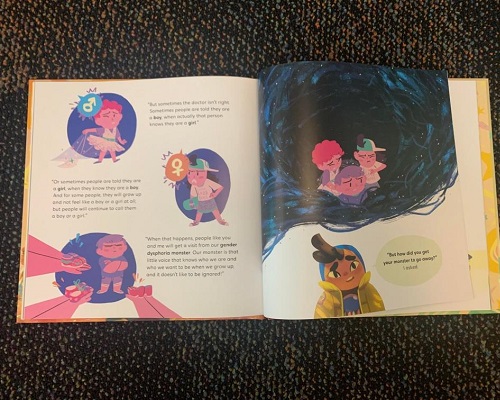
In “Me & My Dysphoria Monster,” the protagonist grapples with his gender identity.
“Sometimes people are told they are a boy when actually that person knows they are a girl,” stated the book. “Or sometimes people are told they are a girl when they know they are a boy.”
The book then advises the reader that a “gender dysphoria monster” may visit, and warns that it “doesn’t like to be ignored.” The book teaches the reader that children who ignore this gender dysphoria monster will only result in it growing bigger, and that the only remedy for it is to identify as the opposite gender. The moment of triumph between the little boy and the “gender dysphoria monster” was when he was allowed to join the girls’ soccer team.
In “Antiracist Baby,” children are taught that they must see other people’s races rather than be “color-blind,” that not every race is treated equally in society, and that they should always be watching out for instances of racism. It also included depictions of same-sex couples, teaching that no lifestyles are better or worse.
Some of these controversial books were declared “award-winning” works at one point by the American Library Association’s (ALA) Stonewall Book Awards. The award-granting organization has issued awards for LGBTQ+ works since 1971, but only began issuing awards to children’s and young adult books since 2010.
Awards were granted to: “10,000 Dresses” (2010), “Mommy, Mama, and Me” (2010), “Morris Micklewhite and the Tangerine Dress” (2014), “This Day in June” (2014), “Julian Is a Mermaid” (2019), “When Aidan Became a Brother” (2020), and “Grandad’s Camper” (2022).
Some of the younger children’s books were given special recognition with their inclusion on the 2023 Rainbow Book List, organized by the ALA’s Rainbow Round Table. The list includes nearly 200 books discussing LGBTQ+ ideology published between 2021 to present.
“The importance of this list (and others like it) cannot be understated, especially in a time when we are seeing a record number of efforts to ban both materials and support for LGBTQIA+ young people and their families,” stated the ALA. “The suppression of these books is a detriment to all youth, and we cannot ignore the damage these challenges are having on the young people in our society.”
In addition to the ALA’s Stonewall Book Awards and Rainbow Book List, there’s the Walter Dean Myers Award and the Lambda Literary Award.
Click an image in the gallery below for more images:
Corinne Murdock is a reporter for AZ Free News. Follow her latest on Twitter, or email tips to corinne@azfreenews.com.