by Corinne Murdock | Dec 4, 2023 | Education, News
By Corinne Murdock |
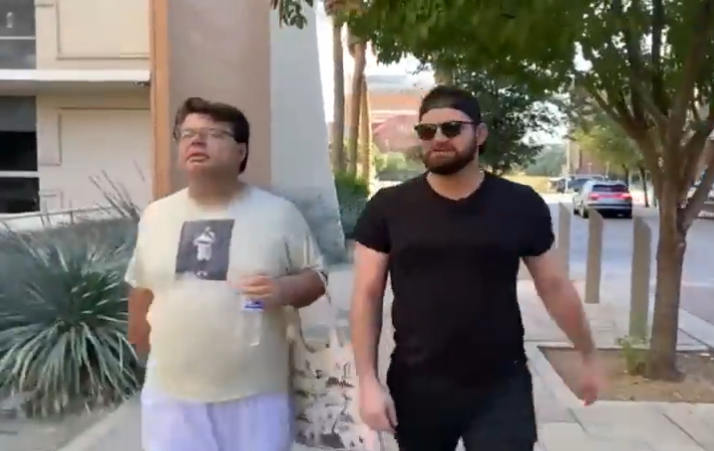
Two Turning Point USA (TPUSA) journalists have been charged with harassment and assault in an altercation involving an Arizona State University (ASU) professor.
Last month, reporters Kalen D’Almeida and Braden Ellis attempted to ask questions of ASU professor and Drag Queen Story Hour co-founder David Boyles. In response to questioning from D’Almeida and filming from Ellis, surveillance footage shows Boyles lunge and grab at Ellis before D’Almeida pushes Boyles away. Boyles falls from the shove.
D’Almeida questioned Boyles about his involvement in sexual education and drag shows for minors, his writings, and whether he harbors attractions to minors. Boyles refused to answer D’Almeida’s questions.
D’Almeida and Ellis each face a charge of harassment, a class one misdemeanor carrying a prison sentence of up to six months and fines up to $2,500 (A.R.S. §§ 13-2921, 13-707, and 13-802). D’Almeida also faces additional charges of assault (A.R.S. § 13-1203 (A)(1) and (B)) and disorderly conduct (A.R.S. § 13-2904) both class two misdemeanors carrying a prison sentence of up to four months and fines up to $750.
Immediately after the incident last month, ASU President Michael Crow sided with Boyles in a public statement. Crow likened the TPUSA journalists to “bullies.” Crow also claimed that D’Almeida and Ellis “ran away” from the scene before police arrived, but surveillance footage shows the pair, along with Boyles, walk together in the same direction off camera after the altercation.
In a Facebook post, Boyles called D’Almeida and Ellis “right-wing fascists” and “terrorists,” echoing Crow’s claim that the pair “ran off” after the incident. Boyles said that he only moved to block the camera before D’Almeida pushed him.
“And the first thing we can do to stop it is to stop coddling these f*****g terrorists,” said Boyles. “These people should be shunned from society.”
ASU police confirmed they’re investigating D’Almeida and Ellis to determine whether the altercation was motivated by bias or prejudice.
In a statement responding to the charges against D’Almeida and Ellis, TPUSA spokesman Andrew Kolvet declared that neither man committed any wrongdoing.
“Kalen and his cameraman did absolutely nothing wrong,” said Kolvet. “We will vigorously defend them and look forward to taking this matter into a courtroom where the very clear video evidence documenting what actually happened will quickly prevail over ASU’s gaslighting and the media’s propaganda. Our team members will be vindicated.”
TPUSA CEO Charlie Kirk issued a statement of his own, in which he accused ASU of retaliation over their organization’s campaign to pull taxpayer funding from ASU.
“Our two @TPUSA journalists are expected to be charged and arrested for defending themselves against an aggressive weirdo professor at ASU who physically attacked them,” said Kirk. “ASU is retaliating against TPUSA because we’re rallying support to pull taxpayer $ from their institution.”
Corinne Murdock is a reporter for AZ Free News. Follow her latest on Twitter, or email tips to corinne@azfreenews.com.
by Ann Atkinson | Aug 23, 2023 | Opinion
By Ann Atkinson |
Higher education, ideally a bastion of free thought and inquiry, should eagerly embrace a multitude of voices and perspectives—we usually call that thinking and learning. Yet, in practice, the ubiquitous doctrines of inclusion inscribed into university charters are not without exceptions. These exceptions materialize from the judgments of self-appointed arbiters of speech, who wield the authority to classify ideas and individuals as hateful and unsafe as they break from a general orthodoxy of perspective. Disguised as protections of students from pernicious notions, these arbiters diligently strive to condemn, censor, and chill speech they do not like – while university leadership does nothing.
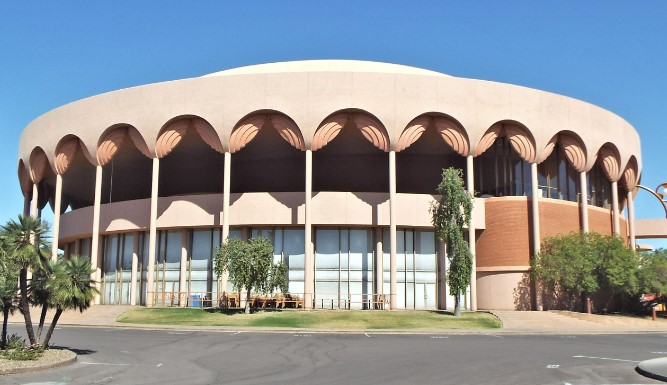
I experienced this exact condemnation when I orchestrated a university-sanctioned event in my capacity as the Executive Director of the T.W. Lewis Center for Personal Development at ASU’s Barrett Honors College. The event, titled “Health, Wealth, and Happiness,” took place at ASU Gammage Auditorium on February 8, 2023. Esteemed experts joined the panel, with Dr. Radha Gopalan, a distinguished heart transplant cardiologist, engaging on health; Robert Kiyosaki, expert on money and the acclaimed author of “Rich Dad Poor Dad,” delving into wealth; and Dennis Prager, co-founder of PragerU and, for over 40 years running, a nationally syndicated radio host, addressing happiness. Complementing the panelists were speakers Charlie Kirk, the visionary behind Turning Point USA, and Tom Lewis, a notable businessman, philanthropist, and namesake donor of the Lewis Center.
At Arizona State University (ASU), the culture of arbitration of speech has infiltrated deeply. This might come as a surprise given ASU’s acclaimed reputation for its free speech policies and its president’s commitment to this cause. In June, I published editorials in the Wall Street Journal “I Paid for Free Speech at Arizona State” and in the National Review, “Some Universities Care About Free Speech…Until They Don’t,” in which I revealed the free speech crisis at ASU’s Barrett Honors College while I also praised ASU for its free speech policies, at least as they state them on paper. I had hoped for a steadfast defense against blatant infringements on free speech that undermine ASU’s policies and declarations. Regrettably, my optimism faded. With each day, ASU’s actions, or lack thereof, erode my confidence in their stated defense of free speech.
It is imperative to grasp the suppression of speech in our academic institutions and to fully comprehend the essence of true freedom of thought which can only come from true freedom of speech. Only then can we embark on endeavors that genuinely promote the education and advancement of society.
ASU President Michael Crow may declare that “speakers speak at ASU,” but can we truly consider speech as free when over 80% of the faculty retaliates against speech they deem “wrong”? Do free speech ideals hold when deans prescribe limitations on speakers’ speech? Can we claim freedom of speech when marketing materials are removed due to faculty offense, while contrasting viewpoints bask in promotional spotlight? Is speech uninhibited when professors dedicate valuable class time to condemn the speech of other units? Does true free speech persist when professors discourage student participation in an event? And then stand vigilantly at the event entrance, watching attendees approach. Can we genuinely say that speech is free when college deans fire leaders and dismantle centers that uphold values no longer in harmony with the college’s leanings? The resounding answer is no. This is free speech under siege.
On August 3, 2023, a group of scholars who convened at Princeton established the “Princeton Principles for a Campus Culture of Free Inquiry.” This assembly distinctly underscores the pressing predicament faced by numerous higher education institutions that falter in upholding cultures of robust and uninhibited speech.
The Princeton Principles squarely confront this concern: “Some members of the university community argue that robust freedom of inquiry permits speech that can ‘harm’ students’ well-being or hinder institutional efforts to attain particular conceptions of social justice or ‘diversity, equity, and inclusion.’”
The case of the Lewis Center is illustrative, with 39 of the 47 Barrett Honors College faculty launching a nationwide condemnation campaign against the Health, Wealth, and Happiness program, speakers, donors, and staff. The Barrett deans actively endorsed this campaign and exercised censorship of speech the faculty found objectionable. The campaign led to intimidations and firings, which is to say prices to pay—sanctions—for exercising free inquiry and speech.
Having policies and ratings extolling free speech alone isn’t enough if university leadership doesn’t enforce their own standards. My experiences at ASU revealed a bureaucratic machinery that prioritizes safeguarding the institution’s interests over addressing free speech violations. I spent months reporting these violations internally and escalated the matter to ASU’s upper echelons and even testified in a legislative hearing. As of mid-August 2023, ASU and its board maintain that they have discovered “a series of examples of unfettered free speech,” aligning with the arbiters.
Self-governance alone proves inadequate in safeguarding our First Amendment rights on campus. The arbiters of speech are not likely to relinquish their control in the absence of decisive action by leadership. The responsibility rests upon parents, students, donors, the media, concerned citizens, and elected officials to unite and reestablish freedom of speech without fear of retribution, for there is no freedom of anything if it comes with a penalty for its exercise, including speech.
The Princeton Principles underscore that “If there is clear and convincing evidence that faculty members and administrators are not adequately fulfilling their responsibilities to foster and defend a culture of free inquiry on campus, other agents including regents, trustees, students, and alumni groups in the wider campus network may and indeed should become involved.”
Gratitude must be extended to parents, students, alumni, donors, lawmakers, and concerned citizens for following this story who rallied behind the cause of free speech. Special acknowledgment should be given to leaders like Arizona Senator Anthony Kern and State Representative Quang Nguyen for co-chairing the Joint Legislative Ad Hoc Committee on the Freedom of Expression at Arizona’s Public Universities. And sincere thanks should be extended to Arizona Speaker of the House Ben Toma and Arizona Senate President Warren Petersen for their unwavering support of free speech for all.
Despite receiving broad support, sustained vigilance is imperative. We must persist in recognizing speech suppression and holding university leadership accountable for defending the realm of free speech, even for ideas deemed offensive, such as, laughably, health, wealth, and happiness.
Ann Atkinson can be reached at her Twitter handle, @Ann_Atkinson_AZ.
by Corinne Murdock | Aug 2, 2023 | Education, News
By Corinne Murdock |
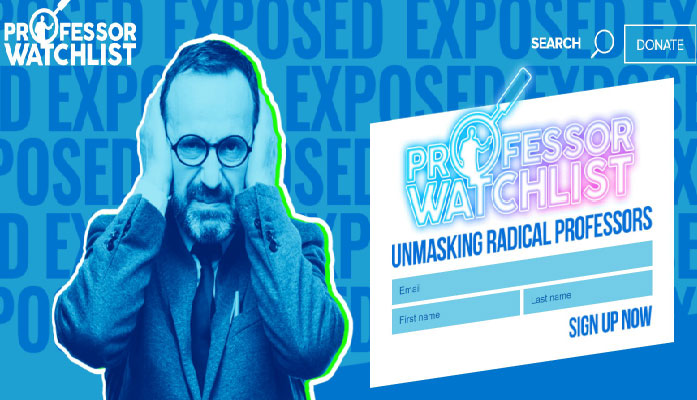
Arizona State University (ASU) faculty behind a campaign against the now-dissolved T.W. Lewis Center asked to be added to a watchlist of professors who discriminate against conservative students, emails reveal. Those faculty members later cried foul for their inclusion on the watchlist.
In emails shared with Arizona Sun Times, a Barrett Honors College faculty member requested his addition to the professor watchlist, a product of the Phoenix-based conservative advocacy organization Turning Point USA (TPUSA). That faculty member, professor Mike Stanford, emailed former T.W. Lewis Center executive director Ann Atkinson to request that she forward his request to TPUSA.
“I thought, ‘Why should my colleagues get all the glory? What am I, chopped liver?’ I even filed a ‘tip’ about myself on the website. Yet to no date, no joy,” stated Stanford. “I respectfully request that you direct your minions to add me to the Watchlist. It seems only fair.”
ASU closed the Lewis Center following the principal funder’s decision to withdraw his backing over the “left-wing hostility and activism” of a majority of Barrett Honors College faculty. The faculty launched a campaign with a letter to oppose the invitation of the three conservative speakers at the event: Charlie Kirk, founder and president of TPUSA; Dennis Prager, radio talk show host and founder of conservative educational group PragerU; and Robert Kiyosaki, author and PragerU presenter.
Since then, several of those involved in the controversial event have come forward alleging retaliation for their involvement. The Arizona legislature ordered an investigation into the ordeal, specifically to review whether free speech violations had occurred.
Stanford received further endorsement for inclusion on the anti-conservative watchlist from another signatory, professor Michael Ostling. Ostling’s role in the campaign against the Lewis Center event resulted in his inclusion on the professor watchlist. Ostling called the watchlist an “honor” for him and his colleagues.
“It is thus only fair that he should be honored, along with his colleagues, as a Professor in need of Watching,” wrote Ostling.
Yet, Ostling and fellow Barrett signatories Jenny Brian and Alex Young alleged months later in an Arizona Republic opinion piece that their inclusion on the watchlist resulted in threats of violence. The three professors also argued that those who reject inclusivity were a threat to debate and, therefore, should be barred from public discourse.
Democratic Sen. Christine Marsh (LD04) further claimed that it was faculty members’ fear over the Professor Watchlist that caused them to decline to testify at last month’s state legislature’s joint committee hearing on allegations of free speech violations at ASU.
ASU has 42 faculty members listed on the Professor Watchlist. Among those 42 are the 39 of 47 Barrett faculty members who signed onto the letter opposing the Lewis Center event: Abby Loebenberg, Abby Wheatley, Adam Rigoni, Alex Young, April Miller, Benjamin Fong, Christiane Fontinha de Alcantara, Dagmar Van Engen, David Agruss, Don Fette, Elizabeth Meloy, Gabriella Soto, Georgette Briggs, Irina Levin, Jacquie Scott, Jennifer Brian, John Lynch, Joseph Foy, Joseph O’Neil, Laura Jakubczak, Laurie Stoff, Lisa Barca, Mathew Sandoval, Matthew Voorhees, Michael Ostling, Mina Suk, Nilanjana Bhattacharjya, Peter Schmidt, Phillip Cortes, Rachel Fedlock, Rebecca Soares, Robert Mack, Sarah Graff, and Taylor Hines.
The University of Arizona has nine faculty members included on TPUSA’s watchlist, and Northern Arizona University has two.
Corinne Murdock is a reporter for AZ Free News. Follow her latest on Twitter, or email tips to corinne@azfreenews.com.
by Corinne Murdock | Jul 30, 2023 | Education, News
By Corinne Murdock |
Arizona State University (ASU) leaders accused of retaliation by a former employee for hosting two “faith-based” events have kept quiet on the allegations raised against them.
The former events operator of the ASU Gammage theater alleged retaliation in a letter last week to the Arizona Board of Regents (ABOR) for allowing “faith-based” events to take place.
The complainant, Lin Blake, alleged in a timeline spanning six pages that she had only received positive performance reviews for the nearly three years leading up to the controversial events. It wasn’t until January, the month leading up to the controversial events, that Blake faced challenges to her work performance. Blake allegedly experienced unprecedented scrutiny throughout the planning, preparation, production, and post-event processes concerning the event, though she noted the event was approved last fall.
“This marked the beginning of the micromanagement of my duties and the overall hostile work environment that would become my future,” stated Blake.
AZ Free News reached out to each of the individuals allegedly behind the intimidation campaign and punitive measures against Blake regarding the controversial events. None of them responded by press time.
One of the controversial events, hosted by the now-dissolved T.W. Lewis Center at Barrett Honors College, featured conservative speakers Charlie Kirk, president and founder of activist group Turning Point USA; Dennis Prager, radio host and founder of PragerU; and Robert Kiyosaki, a personal finance book bestseller and PragerU presenter.
The other controversial event, hosted by Bethel Chandler Church, focused on raising awareness for sex trafficking.
Ahead of the events, Blake alleged that ASU Gammage leadership convened a meeting to express concern that she was allowing a “church program” and “white supremacists” to have a platform at their theater. She also alleged enduring public condemnation and boycotting from her colleagues.
“While I was left with the obligation to run two large and high-profile events, my colleagues that did not show up to work received praise for standing by their personal beliefs,” said Blake. “ASU Gammage staff and leadership should not discriminate against any views, yet they did in plain sight.”
In addition to the accusations of supporting white supremacy, AZ Free News reported previously that Gammage Executive Director Colleen Jennings-Roggensack was alleged to have told staff that they were aligned in beliefs, that they all had voted for President Joe Biden and Gov. Katie Hobbs — even if they hadn’t.
At a faculty and leadership meeting following the upbraiding from Jennings-Roggensack, Blake said she was singled out to explain Gammage’s core values.
Blake further alleged that two ASU Dean of Students representatives breached security to enter a restricted backstage area and intimidate former Lewis Center director Ann Atkinson.
“[I]f speech was truly free at ASU, producing events with unpopular viewpoints would not have cost my job. There is no freedom of speech when it comes with the punishment of job loss for those who administer it,” wrote Blake.
Corinne Murdock is a reporter for AZ Free News. Follow her latest on Twitter, or email tips to corinne@azfreenews.com.
by Corinne Murdock | Jul 19, 2023 | Education, News
By Corinne Murdock |
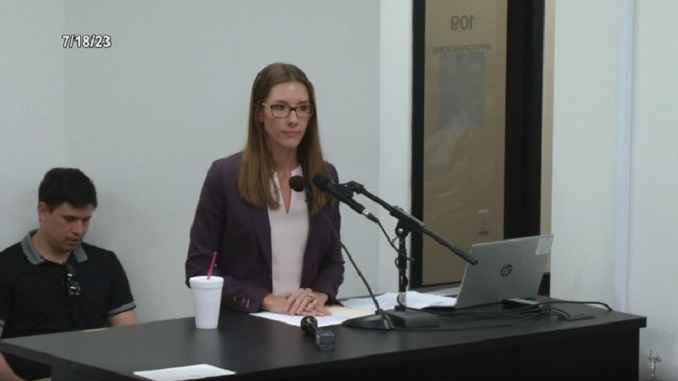
On Tuesday, a joint committee of the Arizona legislature launched an investigation into allegations of censorship at Arizona State University (ASU). Lawmakers issued a 60-day deadline to conduct the investigation.
The directive arose from the Joint Legislative Ad Hoc Committee on Freedom of Expression at Arizona’s Public Universities hearing concerning the T.W. Lewis Center, shuttered this year after the revocation of $400,000 in annual funding from its namesake, Tom Lewis, who cited “left-wing hostility and activism” as his reason for defunding the program.
Lewis’ contention arose from the efforts of 37 Barrett Honors College faculty members, who launched a coordinated campaign to prevent an event featuring prominent conservative speakers Dennis Prager and Charlie Kirk. Prager testified at Tuesday’s hearing; he also published an opinion piece on the event ahead of the hearing.
State Sens. Anthony Kern, co-chair (R-LD27), Frank Carroll (R-LD28), Sally Ann Gonzales (D-LD20), Christine Marsh (D-LD04), and J.D. Mesnard (R-LD13) served on the committee, as did State Reps. Quang Nguyen (R-LD01), Lorena Austin (D-LD09), Analise Ortiz (D-LD24), Beverly Pingerelli (R-LD28), and Austin Smith (R-LD29). Kern and Nguyen served as co-chairs.
“This is to get to the bottom of a state-funded university that is not meeting its obligation to freedom of expression and freedom of speech,” said Kern.
The center relied on an annual budget of around $1 million; ASU representatives explained that the center would live on through the classes taught, though the actual center itself and the executive director at its helm, Ann Atkinson, would be gone.
ASU Vice President of Legal Affairs Kim Demarchi explained that Lewis’ funding provided for career development and education. Demarchi testified that ASU considered what programs it could continue without Lewis’ funding, and declared that they could only sustain the faculty without Lewis’ funding. Demarchi also shared that the Barrett Honors faculty weren’t punished in any way for the letter or allegations of intimidation.
“It is possible it [their letter] has a chilling effect,” said Demarchi.
However, Demarchi clarified that a professor would have to explicitly threaten a student’s grade in order to be in violation of university policy.
Atkinson went public with the closure of the Lewis Center last month. (See the response from ASU). She told AZ Free News that the university turned down alternative funding sources that would make up for the loss of Lewis’ funding necessary to keep the Lewis Center running.
Nguyen opened up the hearing by recounting his survival of Vietnam’s communist regime as a child, and comparing that regime’s hostility to free speech to the actions of Barrett Honors College faculty.
“My understanding is that there is an effort to prevent conservative voices from being heard,” said Nguyen. “I crossed 12,000 miles to look for freedom, to seek freedom.”
Nguyen expressed disappointment that none of the 37 faculty members that signed onto the letter showed up to testify in the hearing. He said if he accused someone, he would show up to testify.
Democratic members of the committee contended that the event occurred and therefore censorship hadn’t taken place. Kern said the occurrence of the event doesn’t resolve whether freedom of speech was truly permitted, citing the closure of the Lewis Center.
ASU Executive Vice Provost Pat Kenney emphasized the importance of freedom of expression as critical to a free nation. Nguyen asked whether Kenney read the Barrett letter, and agreed to it. Kenney said the letter was freedom of expression. He claimed the letter didn’t seek cancellation of the event.
“When faculty speak out on their own like that, they’re covered on the same topic we’re here about, which is free speech,” said Kenney.
ASU representatives claimed near the beginning of the hearing that Lewis and ASU President Michael Crow had discussed the withdrawal of funding. However, toward the end of the hearing Kern announced that he’d received information from a Lewis representative that the pair hadn’t discussed the funding, and accused ASU representatives of lying.
Ortiz called the anonymous complaints from students hypotheticals because no formal complaints were lodged. She also claimed that the hearing was merely an attempt to delegitimize public and higher education. Marsh claimed that lawmakers shouldn’t consider the claims of student fears of retaliation because the students should’ve gone to ASU directly.
Nguyen asked whether ASU would defend guest speakers, such as himself, if ASU faculty were to lodge claims of white nationalism. Kenney said that, in a personal capacity, ASU faculty were free to make their claims, but not if they spoke out on ASU’s behalf.
Atkinson contested with the characterization that the Barrett faculty spoke out in their personal capacity. She pointed out that Barrett faculty signed the letter in their capacity as ASU faculty, emailed her using their ASU emails, and sent communications to students about opposing the event using ASU technology.
Ortiz announced receipt of a letter from the Arizona Board of Regents (ABOR) on the outcome of the requested investigation into the incident, the results of which Kern and the rest of the committee appeared to not have been made aware, determining that no free speech violations took place at ASU.
Marsh speculated that the professors didn’t show up because they faced death threats, citing media attention and conservative speaker Charlie Kirk’s Professor Watchlist. Kern said that would be a “lame excuse.” He also pointed out that the professors launched a national campaign and initialized bringing themselves into a bigger spotlight.
“You’re making excuses where we don’t know that’s the case,” said Kern.
Atkinson said that she could provide “dozens, if not hundreds” of students that could testify to experiencing faculty intimidation. She also claimed that Williams told her to avoid booking speakers that were political.
“We allow the speaker but you have to take the consequences,” said Atkinson, reportedly quoting Williams.
Atkinson testified that TV screen ads were removed and flyers were torn down following the Barrett Honors faculty letter. She also said she shared the information for the person responsible on June 13, yet it appears ASU took no action. ASU said they weren’t aware of any advertising for the event pulled.
Additionally, Atkinson testified that Williams pressured her to postpone the event “indefinitely.” She noted that Williams interpreted ASU’s policy of not promoting political campaigns as not allowing political speech at all.
“We were in an environment telling us that this was ‘hate speech,’” said Atkinson.
Atkinson said she was directed by leadership ahead of the event to issue a preliminary warning that the event contained potentially dangerous speech.
Gonzales told Atkinson that hate speech doesn’t qualify as constitutionally protected speech. However, the rules attorney corrected her that the Supreme Court ruled hate speech as protected.
ASU professor Owen Anderson also testified. He said that he’s previously had to get the free speech rights organization Foundation for Individual Rights and Expression (FIR) involved twice due to faculty attempts to suppress free speech. Anderson also said that faculty have attempted to restrict speech by adding anti-racism and DEI to policy on class content and annual reviews of professors.
“Insults abound, but rational dialogue is rare. What we need are administrators that call these faculty to higher conduct,” said Anderson.
In closing, Kern said he doesn’t trust ASU, the University of Arizona, or ABOR. He argued that ABOR hadn’t issued a real investigation and called their report “typical government fluff [and] garbage.” Kern also called for the firing of Barrett Honors College Dean Tara Williams.
Corinne Murdock is a reporter for AZ Free News. Follow her latest on Twitter, or email tips to corinne@azfreenews.com.
Page 9 of 10«12345678910»