While the main focus along the southwest border is on who and what is coming into the United States, the director of one U.S. Port of Entry in Arizona is making the public aware of the strides his officers are having at keeping firearms from getting into the hands of cartel members in Mexico.
Michael Humphries has been the U.S. Customs and Border Protection’s Nogales Port Director since 2018. His responsibilities include two major border crossings—the Dennis DeConcini POE and the Mariposa POE—as well as the Morley pedestrian gate, the Nogales International Airport, and the Rio Rico railyard.
On Sunday, Humphries tweeted about a southbound vehicle that was preparing to leave the U.S. on Sept. 22 through the Nogales POE.
“As officers spoke to the driver, a K9 alerted to the trunk area of the vehicle and the driver fled,” Humphries wrote. “Officers were able to stop the car before it escaped into Mexico and found 3 AK style semi-auto rifles.”
Just days earlier, Humphries tweeted about a vehicle attempting to leave the U.S. with several firearms hidden in the cargo area.
9/18: CBP officers working outbound ops at the Nogales POE stopped a vehicle attempting to leave the US with 4 AK47 assault rifles and an AK47 pistol hidden in the cargo area of a vehicle. These weapons were most likely intended for Transnational Criminal Organizations in Mexico pic.twitter.com/81owvgVTxJ
— Port Director Michael W. Humphries (@CBPPortDirNOG) September 20, 2022
Federal officials estimate more than 200,000 firearms were illegally trafficked last year from the U.S. into Mexico, particularly through Arizona and Texas crossings.
A tracing program operated by the U.S. Bureau of Alcohol, Tobacco, Firearms and Explosives (ATF) and the Mexican government shows more than 70 percent of guns used in criminal activity in Mexico came from the U.S.
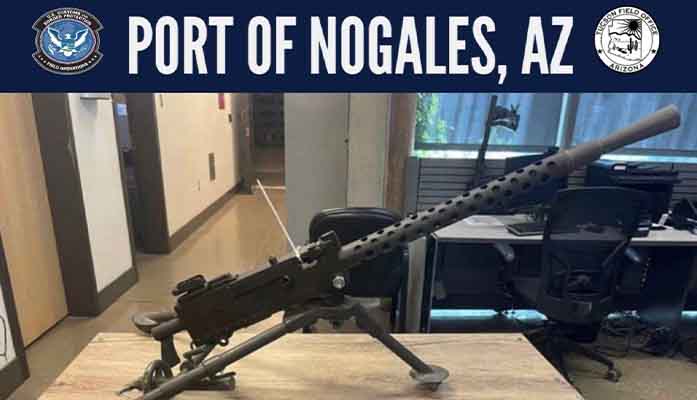
One of Humphries’ tweets from June featured the seizure of a machine gun, 20,000 rounds of ammunition, and other firearms, all of which were headed into Mexico.
Nogales seized a machine gun, an AR-15 assault rifle, a handgun and 20,000 rounds of ammunition before exiting the US. Thanks officers for keeping these powerful weapons from reaching dangerous criminal organizations. pic.twitter.com/GgIzwAQ6DL
— Port Director Michael W. Humphries (@CBPPortDirNOG) June 7, 2022
A few days before, CBP officers encountered two men attempting to walk into Mexico with assault weapons taped to their bodies.
CBP Officers seized four assault rifles strapped to the body of two males attempting to walk into Mexico. Excellent job #Nogales for your vigilance and protecting both sides of the border. pic.twitter.com/glXSorKjGh
— Port Director Michael W. Humphries (@CBPPortDirNOG) June 9, 2022
And in May, Humphries tweeted about the seizure of 10 rifles concealed in one vehicle headed to Mexico.
SEIZURE OF ASSAULT RIFLES Great work CBP Nogales! @CBP Officers conducting outbound operations seized 10 rifles of which 9 were assault rifles concealed within compartments in a vehicle. Thank you for preventing these powerful weapons from reaching violent criminal organizations! pic.twitter.com/F8hbcWVRNG
— Port Director Michael W. Humphries (@CBPPortDirNOG) May 18, 2022
The same day the Washington, D.C. mayor pleaded for National Guard troops to handle the “crisis” her city is experiencing from undocumented migrants, a fatal vehicle accident near Interstate 10 in Benson shut down one of southeast Arizona’s key roadways for several hours due to yet another human smuggling effort.
Mayor Muriel Bowser was upbraided July 28 by Arizona Gov. Doug Ducey after she complained about 4,000 or so migrants in the nation’s capital. Ducey pointed out Arizona dealt with more than 10 times that number in June alone, not counting thousands more illegal border crossers who were not apprehended due to a lack of federal resources.
Then just hours after Ducey’s comments, law enforcement agencies and emergency medical responders were on scene of a deadly two-vehicle accident one block south of the I-10 interchange with State Route 90, the key route to Sierra Vista and the border.
According to the Cochise County Sheriff’s Office, deputies attempted a traffic stop of a white Ford Expedition on Davis Road near Tombstone around 1:15 p.m. The driver of the Ford failed to yield and began travelling at speeds over 100 miles per hour, forcing the deputy to end the effort due to safety concerns.
An “attempt to locate” the vehicle was put out by the deputy to surrounding law enforcement agencies. A sighting was made shortly after 3 p.m. when the vehicle was spotted several miles to the west, heading north on SR90 toward I-10.
The Ford was still traveling at speeds estimated over 100 miles per hour, prompting law enforcement personnel to deploy tire deflation devices a few blocks south of the Interstate. Unfortunately, the driver of the Ford -later identified as a Tucson woman in her 20’s- failed once again to stop, eventually crashing into a white SUV at a controlled intersection.
The Ford driver was removed from the vehicle with serious injuries and airlifted to a Tucson hospital where she remains in critical condition. A male passenger trapped in the Ford died at the scene, while two undocumented immigrants in the Ford were injured.
The SUV driver and a passenger also suffered injuries which required their transportation to a hospital for treatment. No medical update has been provided by Arizona Department of Public Safety as of press time.
Thursday’s fatal accident is just the latest serious crash the last 18 months involving drivers engaging in human smuggling. The additional responses are overtaxing the resources of law enforcement, first responders, and medical facilities.
Which makes last week’s comment by another Washington, D.C. official that their city’s situation is “unsustainable” particularly upsetting to those living along and protecting the southwest border.
Like Ducey, Texas Gov. Greg Abbott’s office also hit back at Bowser last Thursday, noting that Washington, D.C. finally sees what states like Arizona and Texas “have been dealing with every single day, as our communities are overrun and overwhelmed by thousands of illegal immigrants” since President Joe Biden’s open border policies began in January 2021.
“If the mayor wants a solution to this crisis, she should call on President Biden to take immediate action to secure the border — something he has failed to do,” Abbott spokeswoman Renae Eze added.
Bowser’s request for National Guard deployment in Washington, D.C. requires Presidential approval. The U.S. Department of Defense confirmed Secretary of Defense Lloyd J. Austin III received the mayor’s request and is taking it “very seriously.”
The fatal accident in Benson and the call for National Guard troops in the capital also came the day U.S. Department of Homeland Security Secretary Alejandro Mayorkas announced he was authorizing funding to complete a critical section of the border wall at the Morelos Dam in Yuma.
No date was provided for undertaking the construction which will close four gaps in an area along the swift moving Colorado River. However, Mayorkas’ statement implies it won’t be any time soon.
“Prior to construction, DHS will engage in standard environmental planning and conduct stakeholder outreach and consultation,” the announcement states. “DHS will move as expeditiously as possible, while still maintaining environmental stewardship.”
On Monday, Attorney General Mark Brnovich issued a warning about cartels recruiting Arizona teens to traffic illegal immigrants across border.
The cartels recruit teenagers through social media ads. They promise to pay up to $2,000 for each illegal immigrant passenger they transport in vehicles, nicknamed “load cars,” to either Tucson or Phoenix.
Brnovich noted that his office has partnered with local, state, and federal agencies to prevent human smuggling in a task force known as “Operation Safe Streets.” At present, their task force averages two to ten load cars stopped a day.
Additionally, Brnovich reported thousands of smugglers coming to the border.
Load car drivers may face a slew of charges including kidnapping and unlawful fleeing.
In March, the youngest load car driver to date was arrested in Cochise County. The 14-year-old had two illegal immigrants in his car.
Earlier this month, Governor Doug Ducey petitioned the major social media companies — Twitter, Snap, Facebook, and Tik Tok — to take down “load driver” posts.
“Inaction only enables cartels to victimize countless youths and families,” wrote Ducey. “Just as your companies work to protect youth from obscenity and violence on your social media platforms, it’s time to protect them from criminal solicitation as well.”
It doesn’t appear the social media giants have taken action.
Corinne Murdock is a reporter for AZ Free News. Follow her latest on Twitter, or email tips to corinne@azfreenews.com.
The State of Arizona is getting no support from the White House against an ongoing invasion by Mexican cartels, which gives Gov. Doug Ducey the authority to deploy the Arizona National Guard in self-defense, according to a legal opinion released by Arizona Attorney Mark Brnovich on Monday.
“The federal government’s failure to secure the border and protect Arizona from invasion is dangerous and unprecedented,” the 25-page opinion states. “Thankfully, the Founders foresaw that States might need to protect themselves from invasion and made clear in the Constitution that States retain the sovereign power to defend themselves within their own territory.”
The attorney general’s opinion was prompted by an inquiry submitted in October by Rep. Jake Hoffman (R-LD12) about whether the Biden Administration “has failed –intentionally or unintentionally– to uphold its obligations” under Article IV of the U.S. Constitution to protect Arizona from invasion.
The opinion contends the federal government “has lost or severely degraded its operational control” of Arizona’s 372-mile border with Mexico, where cartels and gangs are openly trafficking in drugs, weapons, and human beings while engaging in attacks on Arizonans and acting “as if they are above the law.”
Among the issues the attorney general examined in response to Hoffman’s inquiry was the definitions of “actually invaded” and “invasion” as used in the State Self-Defense Clause and the Invasion Clause of the U.S. Constitution.
ARTICLE I, SECTION 10
“…No State shall, without the Consent of Congress, lay any Duty of Tonnage, keep Troops, or Ships of War in time of Peace, enter into any Agreement or Compact with another State, or with a foreign Power, or engage in War, unless actually invaded, or in such imminent Danger as will not admit of delay.”
ARTICLE IV, SECTION 4
“The United States shall guarantee to every State in this Union a Republican Form of Government, and shall protect each of them against Invasion; and on Application of the Legislature, or of the Executive (when the Legislature cannot be convened) against domestic Violence.”
The examination also included whether a state has constitutional power to defend itself from “hostile non-state actors” such as armed cartels or only an invasion by a foreign power. Finally, the attorney general had to determine whether the current crisis at the Arizona / Mexico border satisfies the definitions of “actually invaded” and “invasion.”
“The violence and lawlessness at the border caused by transnational cartels and gangs satisfies the definition of an ‘invasion’ under the U.S. Constitution, and Arizona therefore has the power to defend itself from this invasion under the Governor’s authority as Commander-in-Chief,” the opinion states, adding that an invasion “permits the State to engage in defensive actions within its own territory.”
The legal questions addressed by the attorney general have not been adjudicated in court with factors similar to the situation in Arizona. However, the opinion was welcomed by Hoffman, who called on Ducey to utilize the powers afforded to him by the U.S. Constitution to immediately secure the border.
“I’m glad to see that Attorney General Brnovich today agreed with my assessment that the crisis occurring on our southern border constitutes an invasion and a total failure by the Biden administration to fulfill its constitutional obligation to protect the people of Arizona,” Hoffman said.“The human smuggling, cartel drugs and violence, sex trafficking, and other illicit activity must end.”
Ducey’s office did not issue a formal comment on whether the governor agrees with the opinion’s legal conclusions of his authority as commander-in-chief. Since April 2021, several dozen National Guard soldiers have been rotated in and out of border county sheriff’s offices to perform administrative, non-law enforcement functions.
This has been well-received by the sheriffs as it frees up deputies to respond to the increase in reported crimes along the border.