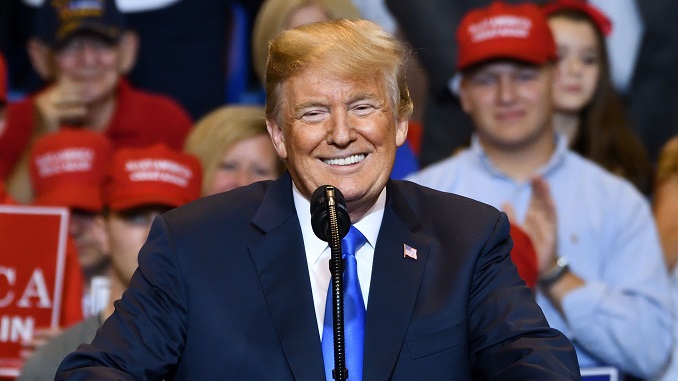
This analysis looks at President Trump’s first three years in office—2017, 2018 and 2019, the pre-COVID era—to get a more unbiased view of the policy impact of his approach.
In Trump’s first three years:
Trump extended economic growth to achieve the longest economic expansion in the history of the U.S.: 10.5 years.
To do this, Trump created 7.1 million full-time jobs in his first 3 years as president, the jobs that count: full-time jobs, in the pre-COVID era. This is more than an amazing feat because Trump only created 6.7 million total jobs. How did Trump increase full-time jobs by more than his total job increase? By making every job he created a full-time job, and, most importantly, converting 400,000 of Obama’s part-time jobs into full-time.
By comparison, Harris/Biden only created 1.0 million full-time jobs in the last two years, September 2022 to September 2024, the post-COVID era. Most of their job creation has been part-time jobs.
Trump created so many jobs that job openings exceeded the number of unemployed for the first time in history, not only exceeded but went on to double the number of unemployed.
The open job force was so strong under Trump’s first three years that he was stripping 160,000 people per month out of welfare for a total reduction of welfare recipients of 8.5 million, 19% of the total recipients.
The open job force was so strong that, for the first time ever, a million people left Social Security Disability and went from consuming Social Security tax dollars to paying into the system.
Trump pushed the bankruptcy date for the Social Security system back by years through welfare enrollment reduction and increased employment and wages.
Trump’s lowest unemployment rate of 3.5% was the lowest level since Eisenhower, just 0.1%, a tenth of a percent from its lowest level ever.
Trump set 12 all-time records for Black employment, pushing Black unemployment to its lowest level in recorded history, 5.3%, far below Obama’s lowest rate of 8.0%.
Trump reduced the personal income taxes for all families of four or more making $53,000 or less to zero. In the other 150+ countries of the world, such families are considered rich and pay tens of thousands in taxes. Economists have not begun to understand the full ramifications of this feat. In chess, it’s called checkmate. No other country can get the upper hand.
As a result, the wealth of the bottom 50% of the U.S. increased by $1.4 trillion under Trump. Under Obama’s last four years? 0.8 trillion
In a sane, rational world, Trump would have earned three economics Nobel prizes, setting records for trade, unemployment reduction, economic growth, and achieving economic equality. (That’s equality, not equity).
Trump’s strategy for his second term: the roaring 20s, where growth was 40% as compared to Obama’s 11%. The 1922 Fordney-McCumber tariffs of 40% were combined with a reduction of the personal income tax rate from 76% to 25% under Calvin Coolidge.
I am confident that Trump is eyeing a massive trade deal with China, just like Trump’s USMCA, which has shifted the trade balance of the world.
If Trump is successful at combining a modest and carefully designed broad tariff of 20% or less with equal or greater business tax rate reduction, we are likely to have the roaring 20s all over again. Hard to believe that the U.S. economy of $28 trillion could grow another 40% in the next four years but hold on to your hats.
John Huppenthal was the Arizona Superinterndent of Public Instruction from 2011-2015. Prior to this role, John served as a member of the Arizona State Senate and the Arizona House of Representatives. You can follow him on Twitter here.
Two Arizona Republicans are challenging the Environmental Protection Agency’s (EPA) increased regulation on energy policies affecting many Americans and Arizonans.
Last week, Arizona Senate President Warren Petersen and House Speaker Ben Toma joined a coalition of states and private parties in an amicus brief to the U.S. Court of Appeals for the District of Columbia Circuit in Nebraska v. Environmental Protection Agency. The petitioners are challenging the EPA’s final rule, “Greenhouse Gas Emissions Standards for Heavy-Duty Vehicles – Phase 3.”
FOR IMMEDIATE RELEASE: Senate President @votewarren Files Opening Brief Against Biden-Harris Administration's EPA Over Economically Damaging Electric Vehicle Mandates
According to the press release issued by the State Senate Republican Caucus, this newly enacted standard by the EPA would “require by 2032 nearly 70% of all new vehicles and 25% of all new semitrucks or similar heavy-duty vehicles sold in the United States to be electric, guaranteeing to raise the costs of everything Arizonans purchase, and without adequate charging infrastructure in place or the necessary power grid capacity to accommodate the transition.”
In the brief, the coalition argues that “under the Major Questions Doctrine, EPA lacks statutory authority to effectively mandate electric vehicles,” that “EPA lacks statutory authority to set standards that can be met only by averaging in electric vehicles,” and that “EPA’s rule is arbitrary and capricious.”
“Our federal government does not have the power to mandate electric vehicles, and their actions show just how out of touch the Biden-Harris Administration is by creating costly policies that will inflict more financial pain on our citizens who have already been burned by skyrocketing costs over the past three-and-a-half years,” said Senate President Warren Petersen. “The EPA egregiously overstepped its authority with these arbitrary rules, and the negative impact of forcing industries that every American consumer depends on, to make unreasonable and unattainable changes, will be detrimental to our economy. The Arizona Legislature will continue to hold this Administration accountable and defend our citizens from this big government negligence.”
“Hardworking Americans are hurting enough as it is from soaring inflation caused by the Biden-Harris Administration,” said Senator Frank Carroll, vice chairman of the Senate Committee on Transportation, Technology & Missing Children. “The last thing we need is for this Administration to prioritize expensive and scientifically baseless polices all in the name of a radical climate change agenda from Democrats that imposes unattainable goals, which will lead to soaring consumer prices. The average working-class citizen or trucking business will cripple under these mandates and the cost of just about every basic essential will increase exponentially.”
The coalition writes, “As in West Virginia, EPA cannot unilaterally reshape the energy and transportation sectors by reimagining its statutory authority. Heavy-duty vehicles transport city commuters, move consumer goods across the country, remove refuse, and harvest our food. The question of whether and how internal-combustion-engine heavy-duty vehicles should be phased out in favor of electric vehicles is hugely consequential: It involves millions of jobs, the restructuring of entire industries, and the Nation’s energy independence. If the federal government is going to require that major shift, then a Congress accountable to the American public must say so. It has not.”
Over the past two years, Petersen and Toma have led a prolific defense of state and federal laws against the Democrat administrations in both the Arizona Governor’s Office and the White House. The lawmakers have long had their sights on the Biden Administration’s environmental and energy policies that have threatened to overhaul the country’s systems.
Daniel Stefanski is a reporter for AZ Free News. You can send him news tips using this link.
While the Biden-Harris administration is still boasting of the success of the CHIPS and Science Act, the Intel Corp. announced it will cut 15,000 jobs across the nation, “as part of the broad-based cost savings plan.” New reports show that almost four hundred of those job cuts will be at the company’s Ocotillo campus in Chandler.
As reported by Phoenix Business Journal, the series of layoff has come despite an upcoming injection of billions of taxpayer dollars via the CHIPS Act aimed at expanding the Chandler facility. Intel as a whole has approximately 12,000 employees in Arizona.
In a written statement Intel explained, “As part of the broad-based cost savings plan we announced in August, we are making the hard but necessary decisions to reduce the size of our workforce. These are the most difficult decisions we ever make, and we are treating people with care and respect. These changes support our strategy to become a leaner, simpler and more agile company as we position Intel for long-term sustainable growth.”
According to The Center Square, the office of Arizona’s Democrat Governor Katie Hobbs was quick to announce the mobilization of state taxpayer-funded resources being made available to the laid off Intel workers.
Spokesman Christian Slater told the outlet, “The Governor’s Office is already mobilizing rapid response resources at DES to connect affected workers with the resources they need to receive support and find new employment. Ensuring that every Arizonan has access to good-paying jobs is a top priority for Governor Hobbs, and she will continue bringing together workers and businesses to navigate challenges, create jobs and build an economy that helps every Arizonan thrive.”
The company was recently granted up to $8.5 billion in CHIPS Act funding, leading to scrutiny over their 15k global layoffs.
I've been asking AZ politicians about this, given that AZ was one of the four states to which the money was allocated for Intel.https://t.co/m2sIsRzW1i
In an August statement, Hobbs stressed Intel’s expansion in the state after the non-specific “cost savings plan,” was announced saying, “They’re expanding here. We’re thrilled to have their expansion here. We’re working with them on workforce initiatives to grow the skilled pipeline of workers that they need. We’re continuing to do that.”
Any direct mention of the billions of dollars earmarked for Intel via the CHIPS Act was decidedly absent from the Hobbs administration’s statement. However, a statement from the office of Senator Mark Kelly (D-AZ) doubled down on the multi-billion-dollar giveaway, which failed to prevent the layoffs.
Kelly’s office wrote that the round of layoffs, “further underscores the importance of the CHIPS Act.” His office added, “American companies like Intel are facing unprecedented competition from China, but thanks to the CHIPS Act, we’re making sure Intel, and other companies can manufacture the most advanced chips right here in America—creating thousands of construction jobs, and generating even more good-paying, permanent technician jobs in Chandler and across the state that don’t require a four-year degree.”
As reported by the New York Post in August, despite the passage of the CHIPS Act, Intel suffered a staggering $1.6 billion in losses, with CEO Pat Gelsinger saying, “Simply put, we must align our cost structure with our new operating model and fundamentally change the way we operate,” per the memo published to the firm’s website. “Our revenues have not grown as expected – and we’ve yet to fully benefit from powerful trends, like AI. Our costs are too high, our margins are too low.”
When the initial announcement broke in August, Republican Senate candidate Kari Lake placed the blame for Intel’s problems squarely on the Biden-Harris administration in a post to X, writing, “For over 45 years, Arizona has been Intel’s U.S. manufacturing powerhouse. In the last job reports, Intel Shares plunged 20%, forcing them to lay off more than 15% of their employees. These are the devastating consequences #Bidenomics is having on our state. In the US Senate, I will work with President Trump to cut the deficit, turbocharge the economy, & bring back good jobs so that all companies both big & small can thrive in State 48.”
For over 45 years, Arizona has been Intel’s U.S. manufacturing powerhouse.
In the last job reports, Intel Shares plunged 20%, forcing them to lay off more than 15% of their employees.
These are the devastating consequences #Bidenomics is having on our state.
Intel’s CEO also noted that staff drawdowns through voluntary exits in September via “early retirement and separation offerings,” already had the company almost halfway to its 15k downsizing goal. But Gelsinger warned at the time, “We still have difficult decisions to make and will notify impacted employees in the middle of October.”
The dead-end hyperinflationary policies of the Biden-Harris administration have put the American Dream out of reach for many young people. I have talked to my 21-year-old daughter about this so many times that it breaks my heart.
Ruby, like so many young Americans, is doing everything right. She works hard, she saves up, but that old-fashioned notion of the white-picket fence seems to be slipping away from her grasp. Part of the reason I am running for Senate is to make America affordable again. And I know that bringing down out-of-control housing prices is the key to restoring access to the American Dream for our young people.
Per Federal Reserve data, in 1984, the median U.S. household income was $22,400 and the median home price was $78,200, or about 3.5 times the median income. By 2022, median household income had risen to $74,580, but median home prices had risen to over $433,000 — or nearly six times median income.
Elected officials owe it to our constituents to take clear and decisive action to reduce housing costs.
There has been so much focus on the role of interest rates, but the answer to bringing them back down, while hard to achieve, is fairly straightforward: the federal government needs to stop printing money we don’t have so that it can pay bills that we can’t afford. Taming that imbalance won’t be quick or easy, and anyone who tells you otherwise is selling you a bill of goods.
But there is another key element of the housing crisis that we can address quickly and effectively: a lack of skilled tradespeople. According to an analysis by Associated Builders and Contractors, the United States is short over half a million skilled construction workers. The lack of skilled construction workers combined with rapidly increasing costs of materials is creating a roadblock to building the millions of additional housing units that are needed to relieve the cost bottleneck.
Bringing down the cost of materials largely hinges on three things: reducing the price of energy and fuel, eliminating excessive regulations created by the Biden-Harris administration, and increasing the number of skilled workers available to producers. Limitations on oil-and-gas production and refining are leading to rapidly increasing fuel and energy costs that have inflated the price of building materials by tens of thousands of dollars per home.
Likewise, excessive regulation and DEI mandates being forced on producers by the Biden-Harris administration are also increasing materials and labor costs, without appreciable benefit to society in terms of reduced inequality. Lastly, the rush to send every high school graduate to a four-year college, with massive government subsidies, is draining the workforce of skilled tradespeople which both increases the cost of construction and delays additional new home starts.
Solving the first two problems is very simple. Replace President Joe Biden and Vice President Kamala Harris with Donald Trump, overturn the current administration’s pointless and counterproductive executive mandates, and you are two thirds of the way there. The last step — increasing the number of skilled construction workers — is going to take more effort.
But with some simple changes in federal education funding and policy, we can turn that deficit around in a matter of just a few years by revising federal education funding and loans to stop discriminating against trade schools and technical education and support the development of a skilled workforce sufficient to meet the demands of our housing market.
First, we need to revise the guidelines for Pell grants to allow them to be issued and used for more students to attend trade and technical schools. Second, if the government is going to continue to back student loans, eligibility for those loans needs to be aggressively expanded to include more trade schools.
Currently, trade-school students can access government-backed student loans, but only if their trade school is federally accredited. Many are not. Getting the vast majority of trade schools nationwide accredited so their students have access to government-backed loans should be a major priority for the next administration and will be a priority of mine in the U.S. Senate.
Lastly, the government needs to aggressively partner with industry to expand trade school opportunities by making low-interest loans available to companies and unions to invest in new and expanded trade and technical-school facilities.
The cost to attend trade and technical schools is far less than the cost of a four-year degree, and the returns on that investment are astronomical. A few thousand dollars of up-front investment in these careers yields a lifetime of high earnings, and resultant increased tax revenues. As a result, investing in expanding our skilled workforce is responsible governance, and must be a priority going forward.
Congressman Juan Ciscomani (R-AZ) released a new advertising campaign Thursday taking aim at the enormous economic fallout of the Biden-Harris administration’s fiscal policies. Those policies are also supported by Ciscomani’s Democrat opponent, former Arizona State Senator Kirsten Engel.
Sharing the new ad in a post to X, Ciscomani wrote, “Arizonans are feeling the impact of rising prices, an open border, and out-of-touch politicians pushing failed policies. My opponent, Kirsten Engel, supports the reckless spending that got us here. ‘It’s exactly what we need,’ said Engel. I’m focused on real solutions: bringing costs down, securing our border, and standing up for Arizona families. Watch my latest ad to learn more. #AZ06”
According to a campaign press release, the advertisement is designed to capture, “everyday struggles Arizonans face: rising costs, an open border, and out-of-touch D.C. politicians who continue to push policies that worsen inflation.”
The partisans love to talk without making any progress. As Arizona's most bipartisan member of Congress, I'm delivering results: ✅Better water infrastructure ✅Improved roads ✅Secure border And… 🇺🇸Endorsed by 40+ local leaders, police, border agents, & small businesses
As reported by the Common Sense Institute of Arizona, as of September 2024, the average Phoenix household is spending $1,004/month more than they would have at a 2% inflation rate.
The CSI of AZ reported, “Since the end of 2020, the typical Arizona household would have had to spend a cumulative $39,722 more on food, housing, transportation, and other goods and services to buy the same stuff as they were buying three years ago.”
“In Congress, I’ve been focused on delivering real solutions for Arizona – securing the border, cutting wasteful spending, and lowering taxes for middle-class families,” Ciscomani said in a statement. “My opponent, Kirsten Engel, supports the same reckless, inflation-driving policies that have made it harder for Arizonans to afford everyday essentials. We need leadership that understands our struggles and is willing to take decisive action, not another out-of-touch politician who rubber-stamps the failed policies that got us here.”
Citing Engel’s legislative history of voting against essential measures like the Border Strike Force, Ciscomani continued, “Kirsten Engel’s out-of-touch record speaks for itself. From voting against border security measures to advocating for reckless spending, Engel has proven time and again that she would fit right in with the D.C. politicians who have failed Arizona families.”
Shortly after releasing the ad, Ciscomani addressed the tightly choreographed “Border Visit” conducted by Vice President Kamala Harris in a statement to KVOA saying, “Vice President Harris’ visit to the border smells like nothing more than a photo opportunity to try and score political points. For three and a half years, the vice president has been in a position to address this crisis but instead she has ignored it. As a result border districts, like mine, have suffered under her lack of leadership. Our communities have become less safe and vulnerable people are being exploited by coyotes, human smugglers, drug cartels, and transnational criminal organizations. If she was truly serious about addressing the crisis at the border, she would have done something as the sitting vice president to help border communities that have been calling for help.”