by Jonathan Eberle | Apr 20, 2025 | Education, News
By Jonathan Eberle |
Arizona students will soon face new limits on cellphone and social media use during the school day under a law signed Monday by Governor Katie Hobbs. The bill, HB 2484, passed with bipartisan support and aims to reduce digital distractions in public and charter school classrooms across the state.
The legislation, sponsored by Representative Beverly Pingerelli (R-LD28), requires school districts and charter schools to adopt policies that restrict student access to personal wireless devices and social media platforms during instructional hours. Exceptions are provided for emergency communication, medical needs, and teacher-approved academic use.
“Education requires attention, and attention is exactly what today’s students are being robbed of by addictive devices and endless scrolling,” Pingerelli said in a statement. “Arizona classrooms are for learning, not TikTok. Teachers can finally reclaim their classrooms.”
The new law mandates that Arizona schools develop and enforce policies that limit or prohibit non-educational cellphone use during school hours; restrict access to social media platforms while on school premises; and provide exemptions for emergencies, health-related needs, or educational tools as determined by teachers.
Districts will have flexibility in crafting the specific guidelines, but they must meet the state’s minimum requirements. Supporters say the law empowers teachers, supports student focus, and responds to growing concerns among parents and educators about the impact of screen time on learning.
Arizona is the latest in a growing number of states considering restrictions on student cellphone use. Educators across the country have increasingly voiced concerns that smartphones, social media, and digital distractions are interfering with learning, fueling anxiety, and making classroom management more difficult.
Research has shown that heavy cellphone use in school correlates with lower academic performance, increased mental health concerns, and reduced attention spans. In response, some districts nationwide have independently instituted bans or restrictions—though results and enforcement vary.
Critics of such policies have occasionally raised concerns about student safety, parental access, and equitable enforcement. However, HB 2484 includes exceptions to ensure students can still reach caregivers in emergencies and access necessary medical technology.
The law aligns with the Arizona House Republican Majority Plan’s emphasis on academic focus, teacher support, and increased parental involvement in education. While the issue drew support across party lines, it also sparked debate about how best to balance technology in modern classrooms.
“Teachers shouldn’t have to compete with YouTube and Instagram to be heard,” Pingerelli said. “This law puts students’ education first.”
Arizona schools are expected to begin implementing the new policies in the upcoming academic year.
Jonathan Eberle is a reporter for AZ Free News. You can send him news tips using this link.
by Daniel Stefanski | Feb 17, 2025 | Education, News
By Daniel Stefanski |
A bill to help improve students’ focus at schools around Arizona passed a legislative committee.
Last week, the Arizona House Committee on Science & Technology passed HB 2484 “to require school districts and charter schools to adopt policies that regulate student access to the internet and limit the use of wireless communication devices during the school day.” State Representative Beverly Pingerelli is the sponsor of the legislation.
In a statement that accompanied the announcement of the bill’s progress, Representative Pingerelli said, “The excessive use of cell phones in schools is a growing crisis that is harming our children’s education and well-being. It’s time to restore order in the classroom. My bill ensures that schools establish common-sense policies to keep students focused on learning rather than scrolling through social media and texting during class. The goal is simple: devices should be ‘away for the day’ so kids can engage in their education, free from constant digital distractions.”
Pingerelli added, “Education should be about equipping our children with knowledge and skills, not competing with TikTok and Snapchat for their attention. This bill restores a learning environment where teachers can teach, and students can succeed.”
Additional information about the bill revealed that it would “require school districts and charter schools to adopt policies that restrict student access to social media on school-provided internet and limit personal device use during instructional time, allow teachers to grant access to social media only when necessary for educational purposes, [and] ensure that students can use their devices in emergencies or when directed by a teacher for academic work.”
On the Arizona Legislature’s Request to Speak system, representatives from Stand for Children, AZ School Administrators, and Arizona School Boards Association signed in to support the proposal; while a representative from the Arizona Education Association signed in as neutral.
State Representatives Biasiucci, Gress, Hendrix, and Márquez joined as co-sponsors of the bill.
In committee, all nine members of the panel voted to send the bill to the full House, giving this proposal an overwhelmingly bipartisan win ahead of its next step in the legislative journey.
Daniel Stefanski is a reporter for AZ Free News. You can send him news tips using this link.
by Daniel Stefanski | Apr 29, 2024 | Education, News
By Daniel Stefanski |
A bipartisan school tax bill has become law in the State of Arizona.
Earlier this month, Governor Katie Hobbs signed HB 2173, which “revises statutes relating to tax levy calculations for a common school district not within a high school district (Type 03 district), [and] details session law provisions that redirect monies collected by the additional tax in a Type 03 district in TY 2023 to the state General Fund” – according to the overview from the Arizona House of Representatives.
According to a press release from Arizona legislative Republicans, this bill “was introduced after mistakes identified in the current fiscal year caused dramatic tax increases in several rural school districts, most prominently in the Continent Elementary School district in Green Valley.” Due to this bill’s enactment, “elementary-only districts like Continental will no longer pay tuition for these high school students, but rather they will be ‘open enrolled’ in the school of their choice like any other student around the state.”
The three legislators in the district that was particularly targeted by the bill – Republican State Representatives Gail Griffin and Lupe Diaz and State Senator David Gowan – issued statements to cheer on the success of this emergency measure.
“Property tax increases significantly impacted Green Valley residents this year, prompting immediate actions to remedy this situation,” said Representative Gail Griffin. “Despite the complexities involved, collaboration with school finance experts has led to a sustainable solution.”
“We will resolve the issue of overpaid property taxes for these districts in the upcoming budget, Representative Lupe Diaz added. “We have proposed a reasonable resolution to the Governor’s office to provide targeted funding to those rural school districts, so taxpayers receive an equitable reduction in order to pay them back for last year’s overcharge.”
“As soon as we were made aware of these unintended consequences, we swiftly came together to find a solution,” said Senator Gowan. “My amendment on this bill ensures the dollars that should not have been collected will be returned to taxpayers in the form of a deduction on the following year’s property tax. I also made sure the school districts most disproportionally affected in LD-19 were taken care of.”
HB 2173 was sponsored by House Education Committee Chairwoman Beverly Pingerelli.
Daniel Stefanski is a reporter for AZ Free News. You can send him news tips using this link.
by Corinne Murdock | Jul 19, 2023 | Education, News
By Corinne Murdock |
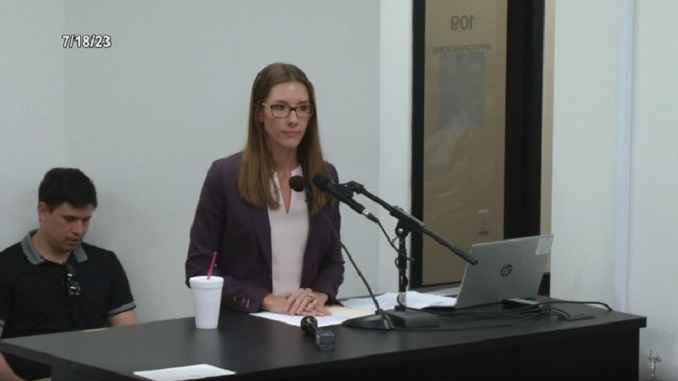
On Tuesday, a joint committee of the Arizona legislature launched an investigation into allegations of censorship at Arizona State University (ASU). Lawmakers issued a 60-day deadline to conduct the investigation.
The directive arose from the Joint Legislative Ad Hoc Committee on Freedom of Expression at Arizona’s Public Universities hearing concerning the T.W. Lewis Center, shuttered this year after the revocation of $400,000 in annual funding from its namesake, Tom Lewis, who cited “left-wing hostility and activism” as his reason for defunding the program.
Lewis’ contention arose from the efforts of 37 Barrett Honors College faculty members, who launched a coordinated campaign to prevent an event featuring prominent conservative speakers Dennis Prager and Charlie Kirk. Prager testified at Tuesday’s hearing; he also published an opinion piece on the event ahead of the hearing.
State Sens. Anthony Kern, co-chair (R-LD27), Frank Carroll (R-LD28), Sally Ann Gonzales (D-LD20), Christine Marsh (D-LD04), and J.D. Mesnard (R-LD13) served on the committee, as did State Reps. Quang Nguyen (R-LD01), Lorena Austin (D-LD09), Analise Ortiz (D-LD24), Beverly Pingerelli (R-LD28), and Austin Smith (R-LD29). Kern and Nguyen served as co-chairs.
“This is to get to the bottom of a state-funded university that is not meeting its obligation to freedom of expression and freedom of speech,” said Kern.
The center relied on an annual budget of around $1 million; ASU representatives explained that the center would live on through the classes taught, though the actual center itself and the executive director at its helm, Ann Atkinson, would be gone.
ASU Vice President of Legal Affairs Kim Demarchi explained that Lewis’ funding provided for career development and education. Demarchi testified that ASU considered what programs it could continue without Lewis’ funding, and declared that they could only sustain the faculty without Lewis’ funding. Demarchi also shared that the Barrett Honors faculty weren’t punished in any way for the letter or allegations of intimidation.
“It is possible it [their letter] has a chilling effect,” said Demarchi.
However, Demarchi clarified that a professor would have to explicitly threaten a student’s grade in order to be in violation of university policy.
Atkinson went public with the closure of the Lewis Center last month. (See the response from ASU). She told AZ Free News that the university turned down alternative funding sources that would make up for the loss of Lewis’ funding necessary to keep the Lewis Center running.
Nguyen opened up the hearing by recounting his survival of Vietnam’s communist regime as a child, and comparing that regime’s hostility to free speech to the actions of Barrett Honors College faculty.
“My understanding is that there is an effort to prevent conservative voices from being heard,” said Nguyen. “I crossed 12,000 miles to look for freedom, to seek freedom.”
Nguyen expressed disappointment that none of the 37 faculty members that signed onto the letter showed up to testify in the hearing. He said if he accused someone, he would show up to testify.
Democratic members of the committee contended that the event occurred and therefore censorship hadn’t taken place. Kern said the occurrence of the event doesn’t resolve whether freedom of speech was truly permitted, citing the closure of the Lewis Center.
ASU Executive Vice Provost Pat Kenney emphasized the importance of freedom of expression as critical to a free nation. Nguyen asked whether Kenney read the Barrett letter, and agreed to it. Kenney said the letter was freedom of expression. He claimed the letter didn’t seek cancellation of the event.
“When faculty speak out on their own like that, they’re covered on the same topic we’re here about, which is free speech,” said Kenney.
ASU representatives claimed near the beginning of the hearing that Lewis and ASU President Michael Crow had discussed the withdrawal of funding. However, toward the end of the hearing Kern announced that he’d received information from a Lewis representative that the pair hadn’t discussed the funding, and accused ASU representatives of lying.
Ortiz called the anonymous complaints from students hypotheticals because no formal complaints were lodged. She also claimed that the hearing was merely an attempt to delegitimize public and higher education. Marsh claimed that lawmakers shouldn’t consider the claims of student fears of retaliation because the students should’ve gone to ASU directly.
Nguyen asked whether ASU would defend guest speakers, such as himself, if ASU faculty were to lodge claims of white nationalism. Kenney said that, in a personal capacity, ASU faculty were free to make their claims, but not if they spoke out on ASU’s behalf.
Atkinson contested with the characterization that the Barrett faculty spoke out in their personal capacity. She pointed out that Barrett faculty signed the letter in their capacity as ASU faculty, emailed her using their ASU emails, and sent communications to students about opposing the event using ASU technology.
Ortiz announced receipt of a letter from the Arizona Board of Regents (ABOR) on the outcome of the requested investigation into the incident, the results of which Kern and the rest of the committee appeared to not have been made aware, determining that no free speech violations took place at ASU.
Marsh speculated that the professors didn’t show up because they faced death threats, citing media attention and conservative speaker Charlie Kirk’s Professor Watchlist. Kern said that would be a “lame excuse.” He also pointed out that the professors launched a national campaign and initialized bringing themselves into a bigger spotlight.
“You’re making excuses where we don’t know that’s the case,” said Kern.
Atkinson said that she could provide “dozens, if not hundreds” of students that could testify to experiencing faculty intimidation. She also claimed that Williams told her to avoid booking speakers that were political.
“We allow the speaker but you have to take the consequences,” said Atkinson, reportedly quoting Williams.
Atkinson testified that TV screen ads were removed and flyers were torn down following the Barrett Honors faculty letter. She also said she shared the information for the person responsible on June 13, yet it appears ASU took no action. ASU said they weren’t aware of any advertising for the event pulled.
Additionally, Atkinson testified that Williams pressured her to postpone the event “indefinitely.” She noted that Williams interpreted ASU’s policy of not promoting political campaigns as not allowing political speech at all.
“We were in an environment telling us that this was ‘hate speech,’” said Atkinson.
Atkinson said she was directed by leadership ahead of the event to issue a preliminary warning that the event contained potentially dangerous speech.
Gonzales told Atkinson that hate speech doesn’t qualify as constitutionally protected speech. However, the rules attorney corrected her that the Supreme Court ruled hate speech as protected.
ASU professor Owen Anderson also testified. He said that he’s previously had to get the free speech rights organization Foundation for Individual Rights and Expression (FIR) involved twice due to faculty attempts to suppress free speech. Anderson also said that faculty have attempted to restrict speech by adding anti-racism and DEI to policy on class content and annual reviews of professors.
“Insults abound, but rational dialogue is rare. What we need are administrators that call these faculty to higher conduct,” said Anderson.
In closing, Kern said he doesn’t trust ASU, the University of Arizona, or ABOR. He argued that ABOR hadn’t issued a real investigation and called their report “typical government fluff [and] garbage.” Kern also called for the firing of Barrett Honors College Dean Tara Williams.
Corinne Murdock is a reporter for AZ Free News. Follow her latest on Twitter, or email tips to corinne@azfreenews.com.
by Daniel Stefanski | Apr 18, 2023 | Education, News
By Daniel Stefanski |
An education-related bill is receiving rare bipartisan support, though Republicans and Democrats still have major differences on a key part of the proposal as it moves through the legislative process.
HB 2456, sponsored by Representative Beverly Pingerelli, “continues the Arizona State Schools for the Deaf and Blind (ASDB) for four years.”
According to background provided by the State Senate, “the Arizona Constitution requires the Legislature to provide by law for the education and care of pupils with visual or hearing impairment. Originally established in 1912 within the University of Arizona, the Legislature established ASDB as its own agency in 1929 to provide schools and programs for the education of persons with visual or hearing impairment and serve as an optional resource to school districts, state institutions and approved educational programs.”
Over the past year, the Senate and House Education Committees of Reference held public meetings and “recommended that the Legislature continue ASDB for eight years.”
Pingerelli’s bill, which was originally introduced to continue ASDB for eight years, first sailed through the House Education Committee in January with a unanimous vote of 10-0. In February, it passed the full House chamber with a 60-0 result. It was then transmitted to the Arizona Senate and the Government Committee, where an amendment was adopted to reduce the number of years ASDB was continued from eight to two. The bill passed unanimously out of that committee, 8-0.
The full Senate chamber then amended the bill, led by Senator Ken Bennett, to continue the ASDB for four years. The body then officially considered the legislation and passed it 27-1, with two Democrat members not voting. Democrat Senator Juan Mendez was the only member to vote against the measure.
After the vote, the Arizona Senate Republican Conference tweeted out a statement, writing: “Senate Republicans are fighting to ensure students and families of the Arizona State Schools for the Deaf and Blind receive the best education possible. On the other hand, Senate Democrats are pushing for inequities within this community by refusing to support the oversight needed to guarantee these students are being properly served. Absolutely disgusting!”
The Senate Republicans shared a clip of Senator Jake Hoffman on the floor during the Committee of the Whole consideration of the legislation, explaining “why an 8-10 year continuation of these schools without proper oversight would be a big mistake.” In his remarks, Hoffman stated that “the Constitution gives us the authority and responsibility to provide educational services for deaf and blind children. Yet for some reason, we’ve been treating this incredibly important community within our state like we do the paper pushers at ADOA (Arizona Department of Administration)…. Our job, that the Constitution tasks us with, is to provide the best possible education to deaf and blind children in our state.” He championed the Legislature ensuring that oversight was happening more often at ASDB.
Count Arizona Republican Superintendent of Public Instruction Tom Horne in support of the continuation of the ASDB. Superintendent Horne told AZ Free News: “This school provides a unique curriculum that would be difficult to replicate in a traditional school setting. Braille instruction, direct communication in American Sign Language (ASL), and training in Orientation and Mobility are skills that are critical to the growth of sensory-impaired students.”
Although most of their members voted to clear the bill from the chamber, the Arizona Senate Democrats Conference was furious after the vote, tweeting the following response to the Senate Republicans’ statement: “Try talking to the community before you speak on their behalf. You know that the Conference Committee recommended 8yrs., the House passed 8yrs., the community asked for 8yrs. Senator Hoffman is dragging his caucus down with him.”
Following the Senate’s amendments and action, the bill was sent back to the House to be reconciled before its final trip to Democrat Katie Hobbs’ office for her signature or veto.
Daniel Stefanski is a reporter for AZ Free News. You can send him news tips using this link.