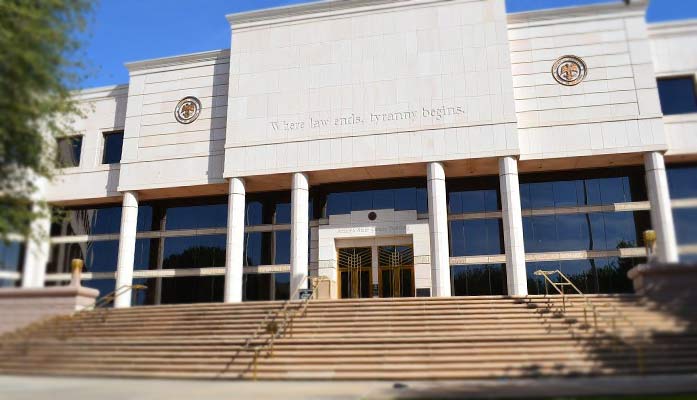
Arizona Supreme Court Rules Government-Financed Union Work Is Unconstitutional
By Staff Reporter |
The Arizona Supreme Court ruled on Wednesday that the practice of union release time was unconstitutional.
Release time occurs when government agencies direct their employees to be released from their job duties in order to work for their union advancing private interests such as lobbying and recruitment. While on release time, those government employees would still receive their regular government pay, benefits, and retirement.
Chief Justice Clint Bolick on behalf of the Arizona Supreme Court ruled in Gilmore v. Gallego that release time constituted a violation of Arizona’s Gift Clause prohibiting the granting of public money to private entities, or “gifts,” because it used public funds raised by general taxation in the aid of enterprises engaged in private business.
“[R]elease time should be separately scrutinized to determine if it has a public purpose and provides sufficient tangible, enforceable consideration to the City,” wrote Bolick. “The release time provisions at issue are precisely that: a ‘release’ from the ordinary duties for which [city] employees were hired, to instead perform, in the main, lawful union activities.”
The Gift Clause prohibits the state and its subdivisions from giving or loaning credit, or making any donations or grants, to any individuals, associations, or corporations.
The Goldwater Institute sued the city of Phoenix in October 2019 over the practice of time release, on behalf of two non-union city employees and taxpayers.
In a press release on their court win, the Goldwater Institute’s Timothy Sandefur and Jon Riches said that the end to government-funded union activities through release time would ensure private interests weren’t financed by taxpayers.
“Today’s ruling is a watershed decision that ensures taxpayer dollars will be spent to advance public interests, not private special interests, including the politically powerful special interests of government labor unions,” read the joint statement.
As disclosed in court documents, release time cost the city of Phoenix nearly $500,000 annually.
That six-figure cost became a factor in the court’s decision. Bolick noted that the city had no direct control or supervision over the employees under release time, “an essential criterion” to establish the public purpose standard for Gift Clause adherence.
“[T]he City costs are substantial, but the benefits are so negligible as to render them largely illusory. The Union receives four full-time employees, who are released from their public duties but paid as if they were performing public work, for the Union to direct as it sees fit,” said Bolick. “In return, the MOU provides ‘examples’ of the uses of release time, and the City argues that ‘release time promotes cooperative labor relations and facilitates an open dialogue about employment issues.’ At best, these are anticipated indirect benefits that do not count as enforceable obligations for consideration purposes.”
The city of Phoenix argued that release time yielded benefits to city work by improving union-government relations. The Arizona Supreme Court rejected that argument.
“To the extent that the City values the purposes to which release time might be devoted, it has not explained why it could not assign employees, under its direction and control, to perform precisely those tasks (such as serving on task forces), rather than placing them at the Union’s disposal,” wrote Bolick. “Indeed, the costs and benefits here are so one-sided that it is difficult to envision how such expansive time release provisions could ever survive the consideration prong unless the employees genuinely paid for them through foregone wages or otherwise[.]”
However, the Arizona Supreme Court did reject arguments that the release time provisions violated the state’s constitutional protections for free speech and free association.
AZ Free News is your #1 source for Arizona news and politics. You can send us news tips using this link.