by Staff Reporter | Feb 2, 2026 | News
By Staff Reporter |
The Republican majority at the Arizona House and Senate are advancing legislation to ensure full income tax conformity.
The state remains without conformity since Gov. Katie Hobbs rejected a solution by the Republican-led legislature amounting to $1.1 billion. Republicans are trying to bring another solution to the table with HB 2785. It’s unclear if Hobbs will pull up a seat for it.
Earlier this month, Hobbs vetoed legislation that would have aligned Arizona tax code with many of the congressional changes passed last summer under the One Big Beautiful Bill Act.
The governor accused Republicans of giving tax breaks to special interests and increasing taxes on working senior citizens. Hobbs said she would only agree to the Democratic minority’s Middle Class Tax Cuts Package.
“I urge you to rethink your partisan political theater and send the Middle Class Tax Cuts Package to my desk,” said Hobbs. “We should not hold tax cuts for over 88 percent of Arizonans hostage in order to force through tax breaks for special interests. Other questions of tax conformity must be decided through budget negotiations, following the precedent set by Governor Ducey.”
Unfortunately for the governor, the Arizona Department of Revenue (ADOR) had already advised Arizonans on how to file under federal tax law changes.
Several days before the governor issued her veto, ADOR notified lawmakers of the impossibility of altering their forms during the filing season. This latest bill from Republicans would codify ADOR’s instructions to taxpayers. Senate Finance Committee Chairman J.D. Mesnard (R-LD13) said the bill wasn’t the preferred approach since it wouldn’t provide as much relief to working families.
“The Department of Revenue has already told taxpayers how to file, and we are compelled to make sure the law and that guidance align, especially since the Department has publicly advised taxpayers not to wait to file,” said Mesnard. “Doing nothing would only guarantee more confusion and force families and businesses to fix the government’s mistakes later. We will never support a plan that requires taxpayers to amend their returns because state leaders failed to act when it mattered. It would be completely unjust.”
Without conformity, Arizonans have no way of knowing the accuracy of their filings. It’s likely taxpayers will need to refile, and even possibly pay more than they are prepared to pay.
House Speaker Steve Montenegro (R-LD29) said Hobbs was to blame for the present burden of impossible compliance facing Arizona taxpayers. The speaker said the governor has refused to communicate further with Republican leadership on conformity.
“Arizona taxpayers are being asked to file on forms that do not clearly match state law, while the Governor offers no answers and no alternative plan,” said Montenegro. “We asked for clarification privately. We asked publicly. We sent a detailed letter. We received silence. With tax season underway, waiting is not an option. This legislation exists because executive inaction left taxpayers exposed, and the Legislature has a responsibility to step in and restore clarity.”
Senate President Warren Petersen (R-LD14) said it was Hobbs’ agency that introduced the deductive provisions for wealthier filers to which she objected.
“It’s unfortunate the Governor has chosen not to work with us. The Legislature is stepping in to provide certainty by conforming state law to the tax forms her DOR has already released, including the State and Local Tax Deduction,” said Petersen. “The Governor would call that provision a tax break for the rich. We do not support the SALT deduction, but her agency has already included it on the forms, leaving the Legislature no choice but to address it. Tax reform was meant to make filing simpler and more predictable, not create confusion, anger, and frustration for Arizona taxpayers.”
AZ Free News is your #1 source for Arizona news and politics. You can send us news tips using this link.
by Staff Reporter | Feb 1, 2026 | Education, News
By Staff Reporter |
Arizona Senate Republicans are refusing to let a parental rights bill die under Gov. Katie Hobbs’ heavily-used veto pen.
Senate Republican leadership revived the legislation through a concurrent resolution, passed out of committee on Wednesday. This legislative pathway allows the slim Republican majority to avoid another inevitable veto from the governor.
SCR 1006 from Senate Majority Leader John Kavanagh (R-LD3) directly challenges the supremacy of transgender-affirming policies and practices within schools.
“Parents have a fundamental right to know what’s happening with their kids at school, and students deserve privacy and safety. No 14-year-old girl should be forced to stand naked in a shower with an 18-year-old man who thinks he’s a girl,” said Kavanagh. “Families shouldn’t be sidelined, and schools shouldn’t be forced into confusion. This reflects what most Arizonans already believe, and it gives them the final say.”
If passed, the resolution would have voters decide whether to require schools to obtain parental permission prior to engaging in transgender-affirming behaviors: referring to a minor student by a name other than the one listed on school records, or referring to a minor student using pronouns that differ from that student’s biological sex.
Voters would also decide whether public schools must provide reasonable accommodations: access to a single-occupancy or employee restroom or changing facility for any individual unwilling to use the facility designated for their biological sex.
Lastly, voters would decide whether individuals could sue public schools for subjecting them to transgender-affirming policies, such as encountering an individual of the opposite sex in a restroom or changing facility designated for their biological sex, or being required to share sleeping quarters with a person of the opposite sex.
Gov. Hobbs vetoed two bills that contained these legislative provisions last year (SB 1002 and SB 1003). In identical letters, Hobbs said the state had more pressing matters than asserting parental rights over transgenderism within schools.
“[These] bill[s] will not increase opportunity, security, or freedom for Arizonans. I encourage the legislature to join with me in prioritizing legislation that will lower costs, protect the border, create jobs, and secure our water future,” said Hobbs.
AZ Free News is your #1 source for Arizona news and politics. You can send us news tips using this link.
by Matthew Holloway | Aug 31, 2025 | News
By Matthew Holloway |
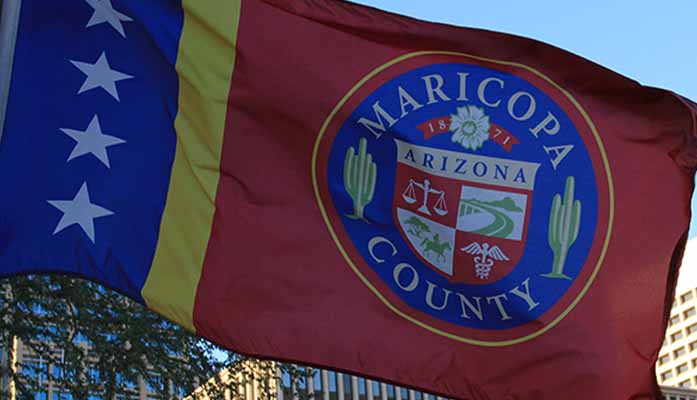
The legal fight between Maricopa County Recorder Justin Heap and the County Board of Supervisors escalated Monday. America First Legal filed two motions on Heap’s behalf, and Arizona’s legislative leaders submitted an amicus brief supporting him.
In a press release, the County Recorder’s Office stated that the motions filed by America First Legal “reveal how the County Board of Supervisors and County Attorney Rachel Mitchell have weaponized county government against duly-elected Recorder Justin Heap simply because he dared to fulfill his statutory duties and protect the sanctity of Arizona elections.”
Heap said in a statement, “It’s unfortunate that the Board’s unprofessional and bad faith actions have forced us to litigate this issue; however, it’s significantly more unfortunate that the Board continues to deny the voters of Maricopa County the positive, common sense election integrity reforms that they voted for last November when they elected me. As I’ve promised from day one, I am working to ensure honest, secure, and transparent elections for every voter in Maricopa County. I am not, and will not, waiver in my commitment to executing on this promise. I’m grateful to America First Legal for standing by my side in this battle.”
America First Legal detailed Heap’s allegations in the first filing: “The Defendants — the members of the Maricopa County Board of Supervisors (‘BOS’) — have crossed from fiscal oversight into outright sabotage. Ignoring [state law] and decades of precedent, the BOS has refused to fund the Recorder’s ‘necessary expenses’ — from modern ballot-processing equipment to indispensable IT staff — while simultaneously seizing control of the very election functions its stonewalling endangers. The BOS’s obstruction is not mere bureaucratic foot-dragging; it is a calculated power grab that throttles the Recorder’s constitutional duty to administer secure, timely elections.”
In an amici filing in support of Heap, Arizona House Speaker Steven Montenegro and Senate President Warren Petersen’s legal representation call for a strict interpretation of state statutes which govern the responsibilities of the county recorder and board of supervisors. They argue that the “court should narrowly conclude that, based on the statutes’ plain language, when the statute authorizes ‘the county recorder or other officer in charge of elections’ to act, it is the recorder’s duty to ensure the statute is complied with unless the recorder expressly agrees to delegate that duty to another ‘officer in charge of elections.’”
As previously reported by AZ Free News, the months-long negotiations between Heap and the Board, led by Chairman Thomas Galvin, devolved steadily since Heap’s election and the replacement of Stephen Richer in January until finally collapsing into litigation in June.
The crux of the disagreement between the Board of Supervisors and County Recorder Heap rests upon a Shared Services Agreement (SSA) agreed to by Heap’s predecessor, Richer, who ardently opposed the election integrity efforts that Heap ran for office to enact. For nearly six months, the two county offices negotiated; however, Heap and the Supervisors were unable to reach an agreement, culminating in a lawsuit filed by Heap.
Since then, Heap has alleged that the Supervisors have “taken retaliatory actions” describing a series of measures that “make it impossible for him to do his job, including removing nearly all his election-related IT staff; seizing the servers, databases, and websites necessary to fulfill his duties; and restricting access to necessary facilities and equipment,” as reported by The Federalist.
In a second filing, Heap and America First Legal introduced allegations involving Maricopa County Attorney Rachel Mitchell, bringing a third County office into the fray in a dispute over who may represent the County Recorder, an attorney chosen by Heap or Maricopa County Attorney Rachel Mitchell. In the legal brief, they allege, “Attorney Mitchell originally appointed a criminal defense attorney to advise the Recorder; however, in April, America First Legal agreed to represent Heap pro bono, a move that Mitchell objected to.”
“When the Recorder complained that the original attorney appointed for him lacked sufficient subject matter expertise, County Attorney Mitchell appointed former Arizona Supreme Court Justice Andrew Gould to advise the Recorder only during negotiations with the Board. However, County Attorney Mitchell and the Board did not allow Justice Gould to litigate on the Recorder’s behalf,” the filing revealed.
But according to AFL, that wasn’t the end of it. “In May of 2025, Justice Gould specifically asked the Maricopa County Attorney’s Office for permission to litigate on Recorder Heap’s behalf but was not allowed to do so because the scope of his representation was limited to negotiation of the SSA and did not include litigation, and, accordingly, the County would not compensate him for litigation-related work.”
Mitchell responded by penning a letter to the AFL attorneys, writing in part, “This letter is to inform you that I am the Recorder’s attorney and that you do not represent the Maricopa County Recorder’s Office or Recorder Heap in his official capacity.”
Per The Federalist, AFL attorney James Rogers retorted that the “County Recorder is allowed to pick his own lawyer in litigation,” adding that Heap “is not subject to the whims of the county attorney.”
In the midst of the complex legal battle between the Recorder’s Office and the Board of Supervisors, which has drawn the attention of legislative leaders, the dispute with Mitchell adds yet another layer of infighting within the already divided county government, with the calendar counting down to the 2026 elections.
Matthew Holloway is a senior reporter for AZ Free News. Follow him on X for his latest stories, or email tips to Matthew@azfreenews.com.
by Jonathan Eberle | Aug 29, 2025 | News
By Jonathan Eberle |
Arizona Senate President Warren Petersen announced on Monday several senior staff promotions and new hires within the Senate Majority office, moves he said will strengthen support for the chamber’s 17 Republican members as they pursue their legislative agenda.
Fletcher Montzingo has been elevated to Deputy Chief of Staff after more than a decade in state government, including six years staffing the Senate Finance and Appropriations Committees. In his new role, Montzingo will help oversee daily staff operations, advise on tax policy, and provide support for the newly formed Senate Committee on Appropriations & Transportation.
Brooke Huppenthal will join the staff on Sept. 15 as Deputy General Counsel. She will advise the Senate Committees on Judiciary & Elections and Military Affairs & Border Security, while also assisting the Senate Rules Committee. Huppenthal previously served as an Assistant Attorney General in Tennessee and clerked for Arizona Supreme Court Justice Clint Bolick.
Simone Westbrook Hall has been named Senior Policy Advisor for the Senate Committees on Natural Resources, Energy & Water and Public Safety. She most recently served as Arizona’s Deputy Land Commissioner and has experience in both public and private sector land use and natural resource policy.
Abigail McLain will begin on Sept. 8 as Policy Advisor for the Senate Committees on Finance and Health & Human Services. A graduate of Grand Canyon University, McLain previously worked on the government relations team at Alliance Defending Freedom, focusing on First Amendment policy.
“These new additions and promotions ensure that the Arizona Senate Majority Caucus has one of the most experienced and capable legislative staff teams in the country,” Petersen said in a statement. “They will play an important role in helping us deliver results for Arizona families.”
The updated Majority Staff roster includes:
- Josh Kredit, Chief of Staff
- Fletcher Montzingo, Deputy Chief of Staff; Policy Advisor for Appropriations & Transportation, Finance
- Rusty Crandall, General Counsel; Policy Advisor for Director Nominations, Ethics, Judiciary & Elections, Rules
- Brooke Huppenthal, Deputy General Counsel; Policy Advisor for Judiciary & Elections, Military Affairs & Border Security
- Kim Quintero, Director of Communications
- Alayna Kowaleski, Deputy Director of Communications; Policy Advisor for Federalism, Joint Legislative Audit
- Blaze Baggs, Senior Policy Advisor for Health & Human Services, Government
- Simone Westbrook Hall, Senior Policy Advisor for Natural Resources, Energy & Water, Public Safety
- Emma Blair, Policy Advisor for Education, Appropriations & Transportation, Regulatory Affairs & Government Efficiency
- Abigail McLain, Policy Advisor for Health & Human Services, Finance, Government
- Gina Jenkins, Senior Executive Assistant
Jonathan Eberle is a reporter for AZ Free News. You can send him news tips using this link.
by Jonathan Eberle | Aug 24, 2025 | News
By Jonathan Eberle |
The Arizona Senate will host the concluding session of the Joint Legislative Ad Hoc Committee on Family Court Orders on Wednesday, August 27, at 9 a.m., with parents and families invited to share personal testimony about their experiences in the state’s family court system.
Committee Chairman Mark Finchem announced that the hearing, to be held in Hearing Room 1 at the State Senate, will feature testimony from the public alongside a presentation from the Arizona Department of Child Safety (DCS). The department is expected to outline its role in custody cases, child welfare matters, and its interactions with court orders.
Finchem emphasized that the hearing marks the culmination of a series of statewide meetings aimed at collecting information and input from Arizonans affected by family court proceedings. He said the committee intends to use the findings to guide potential legislative reforms during the next session.
“The final hearing is one you won’t want to miss,” Finchem said in a statement. “If you have been impacted by the family court system or a judge has threatened you with a gag order, I strongly encourage you to come forward and share your story. This is your opportunity to provide fact-based testimony directly to lawmakers before the committee concludes its work.”
In addition to public and agency testimony, the hearing will feature a guest speaker involved in federal family court reform initiatives. Organizers say this perspective will provide broader context on efforts to increase accountability and transparency in courts handling child custody and welfare cases.
Lawmakers on the committee have framed the series of hearings as an opportunity to define the oversight responsibilities of state agencies and ensure that the family court system is responsive to the needs of Arizona families. The session will run from 9 a.m. to noon.
Jonathan Eberle is a reporter for AZ Free News. You can send him news tips using this link.