
Arizona Sells Prison, Rejects Plan To Repurpose For Illegal Alien Detainment

Arizona Sells Prison, Rejects Plan To Repurpose For Illegal Alien Detainment

By Staff Reporter |

Under the direction of Governor Katie Hobbs, the Arizona Department of Administration (ADA) sold the state’s first private prison rather than repurposing it for illegal alien detainment. 

The State House overwhelmingly rejected a bill last Thursday to lease the prison, Marana Community Correctional Treatment Facility adjacent to Tucson, to the federal government for illegal aliens and other violators of immigration law for just $1 a year. The bill failed due to bipartisan rejection despite its party-line passage in the Senate. 

“The federal government should have access to the empty Marana Prison to house these dangerous criminal illegal aliens so that Arizonans are protected from further threats,” said the bill’s author, Senator John Kavanaugh.

One Republican lawmaker representing Marana, Rep. Rachel Keshel, rejected repurposing the prison for immigration violations over concerns of bringing criminal illegal aliens into their community. 

Keshel and fellow lawmaker to the area, Democratic Rep. Kevin Volk, alleged in remarks to Capitol Media Services that Kavanaugh failed to consult with local leaders about his proposed plan. 

“Now, I do agree that something needs to happen with it instead of it just sitting there. But why was I not consulted with?” Keshel asked. “Why wasn’t I able to go to the mayor, the vice mayor, the town council of Marana, and figure out what their desires were for their community?”

The prison’s buyer, Management and Training Corporation (MTC) out of Utah, had operated and managed the prison. MTC purchased the 500-bed facility for about $15 million last Wednesday. 

MTC owns nearly 40 correctional facilities, community release centers, and treatment programs across the nation. 

The Marana prison was the state’s first private prison, established over 30 years ago. The minimum-security facility housed around up to 500 prisoners requiring substance abuse intervention. The declining prison population in the state prompted the prison’s closing and its recent sale. 

The sale comes less than two years after Governor Katie Hobbs announced the prison’s closure in late 2023. The prison closed with under half of the number of prisoners that would constitute capacity. 

Hobbs said the closure was a means of saving taxpayer dollars and eliminating government waste. The governor projected a savings of $15 million between the 2024 and 2025 fiscal years. 

Arizona Department of Corrections Rehabilitation and Reentry (ADCRR) absorbed the Marana inmates into other prisons throughout the state. ADCRR operates 15 prisons, six of which are private. 

“So not only are we demonstrating significant savings, we’re demonstrating, with actions, our ability to be more efficient with the resources already provided to us,” said ADCRR Director Ryan Thornell. 

The move by the Hobbs administration put off some local leaders. Marana Mayor Ed Honea said Hobbs gave notice to nearly 90 prison employees and staff of their impending job loss just three weeks before Christmas. The prison had the capability of employing over 200 individuals at full capacity. 

Per Honea, the Marana inmates also provided affordable labor for the town. The inmates managed and cleared roadways, and during storm seasons would also clear debris.

AZ Free News is your #1 source for Arizona news and politics. You can send us news tips using this link.

Arizona Prohibits Discriminations Against Patients With Disabilities Needing Organ Transplants

Arizona Prohibits Discriminations Against Patients With Disabilities Needing Organ Transplants

By Corinne Murdock |

Arizona now prohibits health care providers from using an individual’s disability as a disqualification from an organ transplant. The sole exception would be in the case that a patient’s disability poses a medical problem when receiving an organ transplant, excluding that patient’s ability to comply independently with the procedure. 

The legislation also requires health care facilities to accommodate their organ transplant-related services for disabled patients, such as communications and counseling. It included specific provisions for patients with hearing and visual impairments, as well as cognitive, neurological, developmental, or intellectual disabilities. 

Comprehensive information on all organ transplant centers’ policies regarding patients with disabilities doesn’t exist — only studies exist. A 2019 study from the National Council of Disability, a federal agency, confirmed that to be the case, observing a lack of transparency and consistency concerning organ transplant policies. What’s more, the council reported that individuals with disabilities and their families actually face pressure to donate organs. One of the most comprehensive studies, conducted in 2008, estimated that 43 percent of organ transplant centers “always” or “usually” deny children with a neurodevelopmental disability, while about 39 percent “rarely” or “never” do.

One Arizona mother, Felicia (Josie) White testified to the House Health & Human Services Committee that she supported this bill because Phoenix Children’s Hospital policy didn’t confirm that they would approve her daughter for a heart transplant, due to her having Down Syndrome. The White family felt compelled to seek treatment across the country, 3,000 miles away, in Boston, Massachusetts. 

“We know individuals with Down Syndrome live full and fruitful lives well into adulthood. If transplant centers can teach illiterate, non-English speaking parents to dose meds, there’s no reason someone with Down Syndrome could not be taught,” said White. “I understand that organ allocation is a limited resource, but I also know that labeling anyone with cognitive delays ‘unable to transplant’ is a slippery slope that could include everything from ADHD to who knows what.”

Another mother, Andrea Temarantz, shared that her son also has Down Syndrome and would be jeopardized if he needed an emergency organ transplant. Temarantz informed the legislators of the studies on organ transplant discrimination. She insisted that the federal Americans with Disabilities Act (ADA) already prohibited such discrimination, but that there weren’t any enforcement mechanisms to protect patients with disabilities from ADA violations in Arizona.

“Every life is precious, and no one should be blocked from a transplant because of stereotypes about persons with disabilities,” said Temarantz.

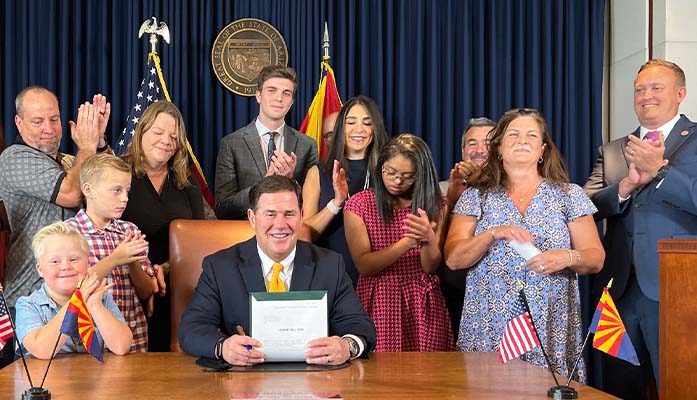
Governor Doug Ducey signed that anti-discrimination bill, HB2659, into law in March. 

The bill received no opposition in the state legislature. Both the House and Senate, as well as their respective committees, passed it unanimously. 

State Representative Steve Kaiser (R-Phoenix) sponsored the bill. It received an endorsement from the Center for Arizona Policy (CAP). 

Corinne Murdock is a reporter for AZ Free News. Follow her latest on Twitter, or email tips to corinne@azfreenews.com.