by AZ Free Enterprise Club | May 4, 2026 | Opinion
By the Arizona Free Enterprise Club |
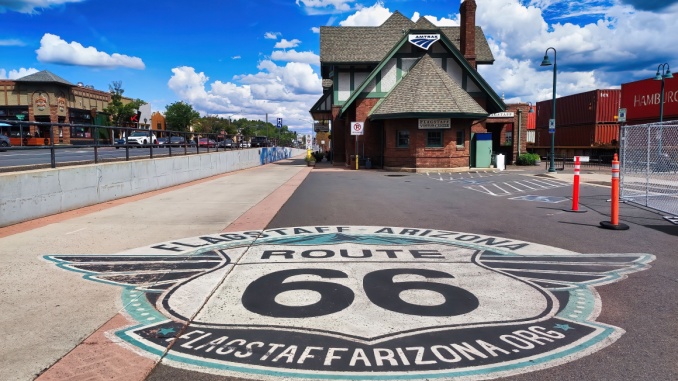
Flagstaff residents have until May 19th to vote on the Flagstaff Regional Land Use Plan 2045, a mail-in only election that will determine whether this becomes the city’s guiding blueprint through 2045. The plan will shape “growth, development, conservation, housing, transportation, and other long-term community priorities.” It is a roadmap for how city leaders want Flagstaff to grow, move, build, and live for the next two decades.
The main themes of this Regional Plan are Climate Action, Housing Attainability and Equity. Climate and equity, two of the left’s favorite virtue-signaling obsessions. The plan runs roughly 250 pages and buried inside the planning jargon is a much bigger agenda: a comprehensive restructuring of everyday life in Flagstaff.
The plan repeatedly sounds the alarm over the so-called “climate emergency,” declaring that “climate change, driven by human-induced GHG emissions, is intensifying global weather disruptions.” Translation: the climate is spiraling into chaos, and it’s your fault, therefore the city government now needs to center major policy decisions around climate activism.
The plan repeatedly references Flagstaff’s Carbon Neutrality Plan (CNP) that has the goal to “achieve carbon neutrality by 2030.” What is supposed to be a land use and regional planning document instead reads like an environmental manifesto. In city government’s attempt to “save the planet,” residents should expect pressure for more mandates, regulations, and costly transitions as officials target emissions from “buildings, transportation, waste, etc.” Their call for the “displacement of fossil fuel-based generation with zero-carbon sources such as wind, solar, and nuclear energy,” will inevitably drive-up costs – even in the areas, like housing affordability, they claim to be trying to reduce.
Transportation is another major target…
>>> CONTINUE READING >>>
by AZ Free Enterprise Club | Jan 27, 2026 | Opinion
By the Arizona Free Enterprise Club |
What’s being sold as a harmless planning document is actually a blueprint to fundamentally reshape how West Mesa residents live and move about their city. The MesaCONNECTED Transit-Oriented Development (TOD) Plan has been in the works since 2021. Funded by a federal grant from the Federal Transit Administration (FTA), the plan covers a five-mile “transit corridor” in West Mesa and is intended to guide future land-use decisions in that area. At first glance, it appears benign, seemingly focused on growth and beautification. City officials repeatedly emphasize that it is not a transit plan and does not initiate any specific projects. However, taken as a whole, MesaCONNECTED lays the groundwork to transform West Mesa into what is effectively a 15-minute city (or even a 5-minute city, by their own standards) without explicitly using that label.
The plan draws inspiration from communities in Oregon and California, as well as Arizona’s own Tempe Cul-De-Sac neighborhood, all of which follow planning models that prioritize density, transit-oriented development, and reduced automobile use. The stated goal is to create fully walkable areas centered around “transit nodes” while making existing transit easier to access. The section of West Mesa encompassed in the plan includes major hubs such as Mesa Riverview, the Asian District, Mesa Community College, Banner Desert Medical Center, Downtown Mesa, and surrounding areas.
A central objective of the plan is to increase density and place housing closer to employment to “reduce vehicle miles traveled” (pg. 5). This is not a neutral goal. It assumes driving is a problem to be corrected rather than a freedom to be preserved. In a city like Mesa where families rely on personal vehicles for work, school, church, medical care, and more, designing communities to deliberately discourage driving punishes the very behavior that allowed the city to grow in the first place. Rather than responding to how residents already live, the plan attempts to reshape daily habits by making driving less practical and alternative modes more “convenient…”
>>> CONTINUE READING >>>
by AZ Free Enterprise Club | Mar 24, 2024 | Opinion
By the Arizona Free Enterprise Club |
The Biden administration and his liberal allies have been moving at warp speed to impose their radical agenda on the American people. From banning gas cars and gas stoves to adopting race-based DEI programs in our schools, proposals that would have seemed preposterous just 5 years ago have now become mainstream positions within the Democrat party.
Nothing appears to be off limits, and that even includes our ability to travel in our automobiles without having the government monitor, limit, and tax our vehicle miles traveled (VMT).
All throughout the country, there are efforts by government bureaucrats and climate change zealots to adopt these authoritarian VMT tax schemes. They are all motivated to eliminate carbon emissions and create a new revenue stream for expensive and rarely used transit projects.
For instance, tucked in the Inflation Reduction Act passed by the Biden administration was a pilot program for a VMT tax that would monitor your miles traveled in your vehicle while charging you a fee for any miles you do travel. And if you’re driving a gas-powered car, buckle up because now you’ll get to pay two taxes…
>>> CONTINUE READING >>>
by AZ Free Enterprise Club | Sep 9, 2023 | Opinion
By the Arizona Free Enterprise Club |
For local governments—and councils of governments—in Arizona, it appears that creating a climate action plan has become all the rage. Maybe that’s because it pays well.
The latest group to bow down at the altar of the Biden administration’s climate change agenda is the Maricopa Association of Governments (MAG). Back in August, MAG received a $1 million grant from the Environmental Protection Agency’s (EPA) Climate Pollution Reduction Grant Program to serve as the lead planning organization for the Phoenix-Mesa-Chandler metro area. The grant requires MAG to develop a priority climate action plan by next March, a comprehensive climate action plan by 2025, and a status report in 2027 after the four-year grant period expires.
But this $1 million grant isn’t the only way MAG stands to benefit…
>>> CONTINUE READING >>>
by AZ Free Enterprise Club | Jul 28, 2023 | Opinion
By the Arizona Free Enterprise Club |
How much do you like to walk in 110-degree heat? If you’re a resident of the city of Phoenix, you may need to start getting used to it if the city council gets its way.
A proposed ordinance in Phoenix is looking to significantly reduce the minimum number of parking spaces it requires for apartments. Currently, Phoenix requires a minimum of 150 parking spaces for every 100 one or two-bedroom apartments. Under the proposed ordinance, that number would decrease to 125 spaces. But that’s not the end of it. For new affordable apartment complexes near light rail stations, the requirement for most would be reduced to zero! Yes. Zero parking spaces at an apartment complex. Have you caught on to their agenda yet?
If you’ve been keeping score, you already know that—in just this year—climate change zealots have been seeking to prohibit gas stoves; put limits on things like lawn and garden equipment, motorized boating, and water heaters; and ban the internal combustion engine. Now, this latest attempt to reduce parking spaces makes it clear. They want to force you out of your air-conditioned car to walk in 110-degree heat with your reward being to wait for a bus or light rail. But that’s not all…
>>> CONTINUE READING >>>