by AZ Free News | Jun 17, 2021 | News
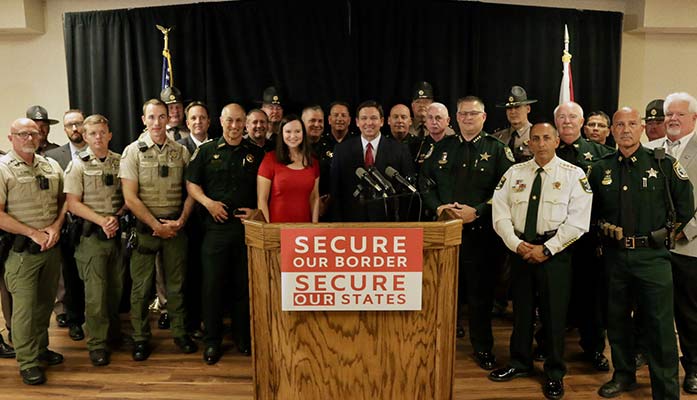
Florida Governor Ron DeSantis is the first to heed the calls by Arizona Governor Doug Ducey and Texas Governor Greg Abbott to send help to deal with the crisis on the U.S.-Mexico border. Ducey and Abbott made the request for assistance through the Emergency Management Assistance Compact.
DeSantis announced that state and local law enforcement officers have committed to deploying to Texas and Arizona to provide additional resources in response to the border crisis including:
- The Florida Highway Patrol
- The Florida Department of Law Enforcement
- The Florida Fish and Wildlife Conservation Commission
- Brevard County Sheriff’s Office
- Escambia County Sheriff’s Office
- Hillsborough County Sheriff’s Office
- Holmes County Sheriff’s Office
- Lee County Sheriff’s Office
- Okaloosa County Sheriff’s Office
- Pasco County Sheriff’s Office
- Santa Rosa County Sheriff’s Office
- Walton County Sheriff’s Office
“America’s border security crisis impacts every state and every American,” said DeSantis. “The Biden Administration ended policies implemented by President Trump that were curbing illegal immigration, securing our border, and keeping Americans safe. Governors Abbott and Ducey recently sent out a call for help to every state in the nation, needing additional law enforcement manpower and other resources to aid with border security. I’m proud to announce today that the state of Florida is answering the call. Florida has your back.”
“As Attorney General, I am dedicated to ending human trafficking, protecting our children from sexual predators, and fighting the opioid crisis now claiming 21 lives a day in our state, but President Biden is hurting, not helping us achieve these vital public safety goals,” said Florida Attorney General Ashley Moody. “The crisis the President created at our southern border makes all of us less safe, and I am proud to stand with Governor DeSantis as he tries to fix the President’s disaster at the border to protect Floridians.”
As a result of the Biden Administration’s open border policies, attempts at drug trafficking and human trafficking have also increased. FBI Director Christopher Wray recently said that there is “no question” that Mexican cartel activity has crossed the border into the U.S. In just January to April of this year, the Texas Department of Public Safety seized nearly 95 pounds of fentanyl in Texas. That equates to 21.5 million lethal doses of this drug. That is a spike compared to 2020, when the same agency seized only 11 pounds over the first four months.
According to multiple former border patrol agents, children are being used by human traffickers who pose as a family to make their way across the border. These human trafficking attempts are now unchecked by the Biden Administration, which has put pressure on officials to release families within 72 hours and canceled policies that required families to wait before crossing the border while their case was being reviewed. As a result of these policies, according to a recent UNICEF report, there are nine times more migrant children in Mexico than there were at the start of 2021.
According to U.S. Customs and Border Protection, last month there were more than 180,000 illegal immigrants caught attempting entry along the Southwest Border. For the five fiscal years ending in 2019, an average of just 15% of individuals encountered by law enforcement had previously attempted to cross the border within that year. Alarmingly, under the Biden Administration this figure has skyrocketed 38% in May 2021.
by B. Hamilton | Jun 17, 2021 | News
By B. Hamilton |
Arizona has joined a 16-state coalition pushing back against a Biden Administration initiative that would require companies to make policy statements unrelated to financial performance to the U.S. Securities and Exchange Commission. Arizona joins the West Virginia-led fight against what is seen as an attack on the freedom of speech.
The attorneys general of Alaska, Arkansas, Kansas, Kentucky, Louisiana, Mississippi, Missouri, Montana, Nebraska, Ohio, Oklahoma, South Carolina, Utah and Wyoming join in arguing that the initiative would require companies to make policy statements not related to financial performance to serves a political agenda.
In comments filed this week to SEC Chairman Gary Gensler, the attorneys general expressed concerns that the proposed climate change disclosures are unnecessary from a market protection standpoint, writing that “the Commission has an important and difficult mandate with respect to safeguarding public trading, but it is hard to see how it can legally, constitutionally, and reasonably assume a leading role when it comes to climate change.”
The attorneys general contend that to pass constitutional muster, “speech regulation must advance a constitutionally sufficient government interest, must be adequately related to advancing that end and may be required to use the least restrictive means,” the comments read.
by Terri Jo Neff | Jun 16, 2021 | News
By Terri Jo Neff |
Since early on in the legislative session, Arizona Rep. Bret Roberts has tried to convince his fellow lawmakers that it was crucial to protect citizens from mandatory COVID-19 vaccination demands.
A bill, HB2190, introduced by Sen. Kelly Townsend on Roberts’ behalf would prohibit companies and government agencies in Arizona from demanding proof, referred to as a vaccine passport, of someone’s vaccination status in order to receive government benefits or enter a place of business.
HB2190 stalled out but fast forward nearly three months to Ducey’s decision this week to issue an executive order banning Arizona’s universities and community colleges from mandating that students show proof of their COVID-19 vaccination status or be forced to wear masks “in order to participate in learning.”
The governor’s action came after Dr. Joanne Vogel, Vice President of Student Services for Arizona State University (ASU), announced that students who have not received the COVID-19 vaccination would be subjected to daily health checks, twice-weekly testing, and mandatory face mask use in all indoor and outdoor spaces on ASU campuses.
Rep. Travis Grantham, the Speaker Pro Tempore, issued a statement Tuesday calling for the immediate rescindment of Dr. Vogel’s COVID-19 policy or her departure from ASU. At stake is not only students’ freedom to be vaccinated or not, but the university’s finding, according to Grantham.
“I have received numerous calls from concerned parents whose kids have no other option but to attend a state university,” Grantham noted. “It’s important that this tyrannical policy must not prevent any Arizonan from accessing our state university system. Moreover, as the legislature prepares to pass a state budget for next year, I will not support funding for any state university that intends to harass or discriminate against non-vaccinated students on campus.”
Rep. Jake Hoffman also opposes the ASU policy which he called “a gross abuse of students’ liberties.” He pointed out Tuesday that the state’s universities receive hundreds of millions of dollars of taxpayer funds and that it was common knowledge lawmakers have language in the pending state budget which would prohibit ASU’s COVID-19 policy.
“They’re just basically giving the Legislature the finger and that’s a problem for our State,” Hoffman said in a radio interview. “It’s an unacceptable overreach by a political subdivision of the state.”
In announcing his executive order, Ducey called on the legislation to codify his executive order into law. The question now is whether the legislation Ducey is seeking will be HB2190 or if it will include something else.
For his part, Roberts said during a radio interview Tuesday morning that the governor’s executive order is “a good start” but he believes all Arizonans -not just students- deserve the same protections. Which would be provided by HB2190.
Roberts also said he is not surprised by the ASU vaccination dustup, although he found it interesting the University of Arizona did not try to implement such as policy. He remains hopeful his vaccine bill -or something similar- will pass.
The problem, he noted, “is future political interest” of those who have so far opposed legislating vaccine policies for private and public purposes.
“If the people make it clear that future political interest are in jeopardy then maybe there’s a chance” of passing HB2190, he said. “I put the right of the individual to make that choice (to vaccinate or not) before a business should be able to dictate whether or not you have to give up your personal medical information in order to particulate in commerce.”
Meanwhile, Sen. Michelle Ugenti-Rita provided a shout-out to Roberts for “taking an early lead on this important issue,” and called on lawmakers to prohibit vaccine passports “from ever being mandated by any government or business.”
by azfreenews1 | Jun 16, 2021 | News
By Terri Jo Neff |
Although two Yuma County women charged by the Arizona Attorney General’s Office with ballot fraud are scheduled to be back in court next month, two local election integrity watchdogs say the problem in their county runs much deeper, and it has garnered the attention of the FBI.
Last week Gary Garcia Snyder and David Lara revealed in a radio interview with Sergio Arellano that they utilized hidden cameras to record ballot harvesting incidents at two San Luis polling stations on Aug. 4, 2020, which was primary election day. The city of 33,000 is in the far southwest corner of Arizona on the Mexico border.
Among those seen on the video dropping off more than their one personal ballot were Guillermina Fuentes, a member of the Gadsden Elementary School District board in San Luis, and Alma Yadira Juarez. Both women have been indicted on a Class 6 felony of ballot abuse for allegedly collecting four ballots which were later processed and counted by the Yuma County Recorder.
Snyder and Lara, who are local businessmen, discussed the problem of fraudulent ballot harvesting with Arellano, who has testified at the Arizona State Senate about ballot harvesting in Southern Arizona and how voters can be taken advantage of, particularly in majority-minority areas.
Lara first wanted to clarify that the type of illegal ballot harvesting taking place in San Luis does not involve simply helping someone get their ballot to a polling station. Instead, it is much more insidious, he says.
What most people commonly think of as ballot harvesting involves a closed envelope with a ballot that had been voted by the voter. But the men say what is happening in some communities, particularly Latino and low-income neighborhoods, is the taking of someone’s blank ballot and signed early ballot affidavit envelope.
The ballot is then filled out and dropped off (aka harvested) without the voter’s input. Because the real voter signed the early ballot affidavit, there is no way for election officials to know someone other than the voter filled out the ballot.
“It’s done in such a manner that it’s so subtle and gradual that the community believes it’s the norm,” Lara explained. “They think that it’s acceptable and they think this is the way it’s done; this is the way you do things.”
Snyder said that among the videos he turned over to the FBI is one purportedly showing Juarez, 41, bringing multiple early ballots to a local San Luis polling station. The footage, he says, shows the early ballot affidavits were signed but the envelopes were not sealed. Fuentes, 65, is reportedly at the same table when the ballots are dropped off.
The women have been ordered to appear in Yuma County Superior Court for a July 1 case management conference. If they do not enter into a plea deal by that date then Judge Roger Nelson will set their cases for trial later this year.
According to Snyder, others in the San Luis area -including elected officials- have been fingerprinted as part of the attorney general’s investigation. He believes it is being done to compare fingerprint evidence obtained from ballots.
“Yeah, of course we’re a smaller demographic, less votes, less ballots but one ballots very important. It’s the integrity of our voting system,” Snyder told Arellano.
Ballot abuse can be done by local officials but also various staff members of non-profits which come into contact with residents, Lara explained.
“So what happens is this: you go to a non-profit, you know as a member of the community, and you ask for help,” he told Arellano. “It could be housing, it could be health, it could be whatever, filling out documents, you name it. When you walk in they will ask you, oh, by the way, are you registered to vote? Oh, well, no, I’m not. Is your family registered? No. Well, we can help you.”
After building trust with that staff member or the organization in general, the new voter is likely to seek help understanding the ballot. And that, says Lara, is when a new voter is told ‘well, don’t worry about it, just sign it and I’ll take care of it for you’ or they are instructed who to vote for.
“They’ve actually tricked the community in believing they’re doing the right thing, they’re voting, they’re participating, yet they’re not really informing the community that they’re being lied to, used, and manipulated,” Lara added. “San Luis is ground zero as far as voter fraud. That’s where it started in 1997. It has spread through the state and it was perfected in San Luis.”
Lara also noted how significant it can be for those living in smaller communities to preserve the status quo by what he called “the tricks of the trade.”
“Being a board member and especially if you have majority, if your party or your group have majority on the school board then you control each year the hires, new hires, rehires, contracts, fires,” he explained. “So what happens is if somebody wants a job — bring me your ballots, your neighbors’ ballots, your family’s. It becomes a web.”
He added that the same incentive presents itself for various city employees and those who control non-profits serving the area.
That prompted Lara and Snyder set out early on Primary Election Day 2020 to see what they could discover. They were ready shortly before 7 a.m. with Snyder hunkered into his vehicle with his camera at one of the polling stations. Lara left to keep an eye on the other polling station.
It was not long before Snyder had evidence of alleged criminal conduct.
“I pop in my iPad and put Netflix on so that [poll observers] think I’m just watching Netflix, but during that whole time I was recording any movement, any voters that would walk up to their booths,” Snyder recounted to Arellano. “And, yep, within 5 to 10 minutes after David left, the first crime was committed.”
Snyder later went to the other polling station.
“I found another criminal act,” he says, describing one incident in which an elected officials appeared to be “blocking” so another elected official could receive an unsealed ballot envelope.
Throughout the day Lara passed along Snyder’s videos to Yuma County Recorder Robyn Pouquette, who notified local Sheriff Leon Wilmot. It was not long until the FBI got involved, and then the attorney general’s election integrity unit.
Both men are hopeful many other people seen in the videos will be indicted. Attorney General Mark Brnovich’s office did not respond to a request from AZ Free News for comment on the status of the investigation.
In the meantime, a recall is underway in the San Luis community to remove two city council members and all three Gadsden school board members. Fuentes is one of the officials under recall; if she is convicted of a felony -either via a plea deal or found guilty at trial- she will be disqualified from holding public office.
The experience has not soured Snyder on Yuma County politics. The Republican has announced he is running in 2022 for State Senate against Lisa Otondo, a Democrat who has been in the legislature since 2013.
by AZ Free News | Jun 15, 2021 | News
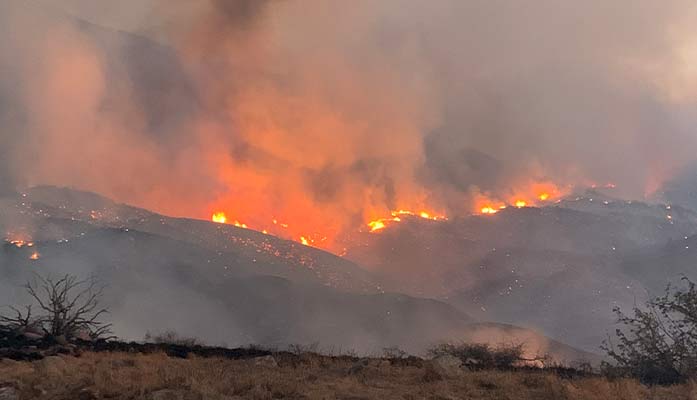
On Tuesday, June 15, the Arizona Legislature will convene for the special session and is expected to vote on a proposal by Governor Doug Ducey later this week. Ducey and legislative leaders announced the special session’s goal is to approve $100 million to combat and prevent wildfires, equip firefighters and communities with the resources they need, and prepare for after effects such as flooding and mudslides.
“This wildfire season has already been devastating, and we still have a long, hot summer ahead of us. While Arizona has strong wildfire suppression and prevention efforts in place, we need to do more,” said Governor Ducey. “Our brave firefighters must have all the necessary tools, resources and support to fight the blazes and stay safe. We need to protect our communities from floods and other disasters that could result from these wildfires. Hard-hit communities and nonprofits offering support need financial assistance to weather the devastation of this wildfire season and protect families in need. We can get this done — and we can do it in an urgent, bipartisan manner. Thank you to Legislative leadership for coming together to develop an investment package that will help so many Arizonans.”
Governor Ducey, state fire professionals, and legislative leadership have identified targeted investments for wildfire preparedness, response and recovery in consultation with impacted local communities. The investments include:
-
$24.6 million for a partnership between the Department of Forest and Fire Management and the Arizona Department of Corrections, Rehabilitation and Reentry to reduce wildfire risk to Arizona communities by conducting hazardous vegetation removal; and
-
$75 million for fire suppression efforts, recovery efforts including post-fire floods, economic assistance for those displaced, and assistance to landowners for emergency repairs to infrastructure damaged by wildfires.
On June 9, the Governor issued two Declarations of Emergency in response to the Telegraph and Mescal Fires, making available up to $400,000 for response efforts.
In March, the Governor signed Senate Bill 1442 to prevent wildfires by allowing for additional partnerships to employ Arizona inmates to clear forests of debris. The legislation aligns with the Arizona Healthy Forest Initiative proposed in the Governor’s budget which builds on proven methods to protect communities, while engaging individuals in state correctional facilities to equip them with new skills and reduce recidivism.
This is the third special session since the Governor took office in 2015.
by B. Hamilton | Jun 15, 2021 | News
By B. Hamilton |
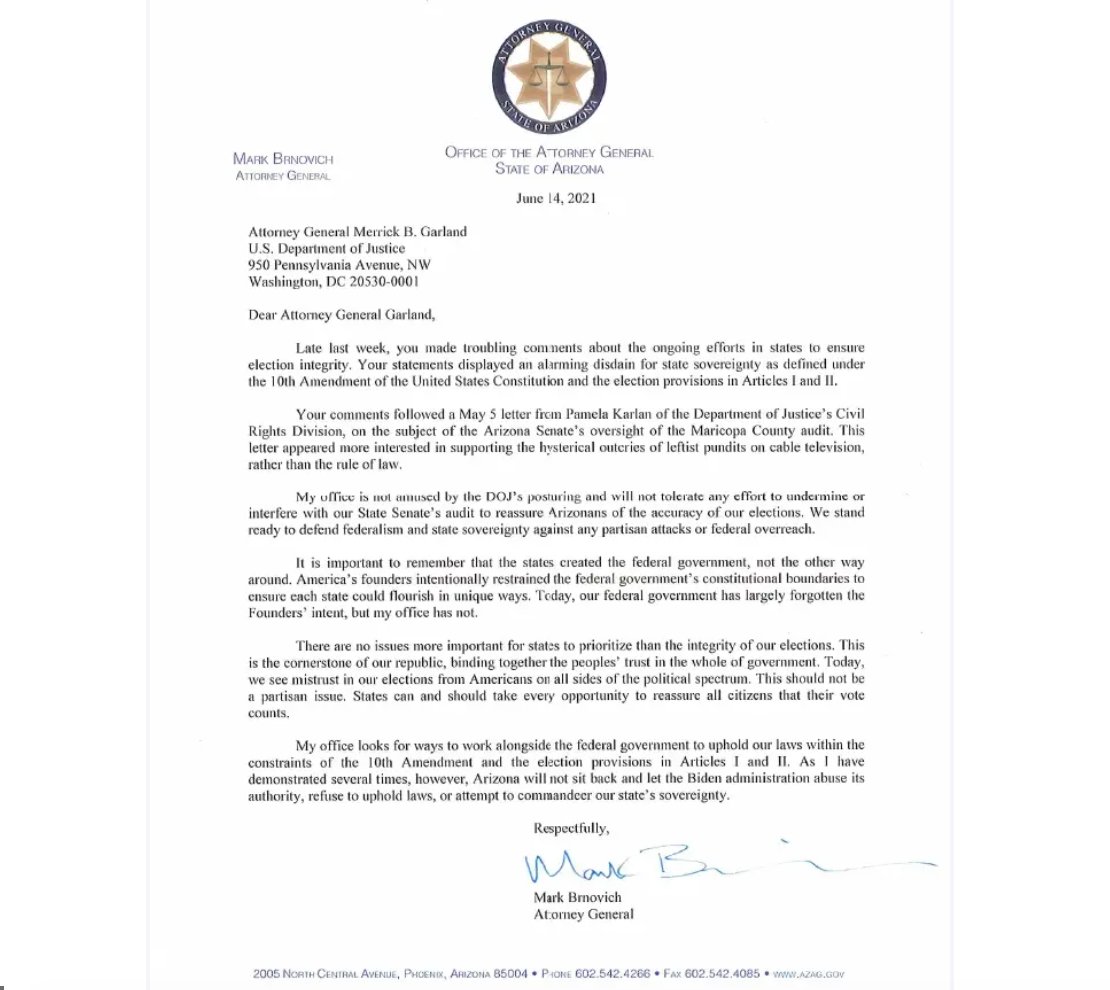
On Monday, Arizona Attorney General Mark Brnovich advised U.S. Attorney General Merrick Garland that the Biden administration’s Department of Justice had no right to interfere with the audit of the Maricopa County 2020 General Election.
Brnovich accused Garland of giving in to the “hysterical” audit opposition.
“My office is not amused by the DOJ’s posturing and will not tolerate any effort to undermine or interfere with our State Senate’s audit to reassure Arizonans of the accuracy of our elections,” wrote Brnovich to Garland.
“My office looks for ways to work alongside the federal government to uphold our laws within the constraints of the 10th Amendment and the election provisions in Articles I and II.” Brnovich concluded, “As I have demonstrated several times, however, Arizona will not sit back and let the Biden administration abuse its authority, refused to uphold laws, or attempt to commandeer our state’s sovereignty.”
Garland has attacked the audit ordered by the Arizona State Senate. “Many of the justifications proffered in support of these post-election audits and restrictions on voting have relied on assertions of material vote fraud in the 2020 election that have been refuted by law enforcement and intelligence agencies,” Garland said last week.