by Corinne Murdock | Aug 10, 2021 | News
By Corinne Murdock |
Congressman Andy Biggs (R-AZ-05) announced on Friday that he will file articles of impeachment against Department of Homeland Security (DHS) Secretary Alejandro Mayorkas over the burgeoning border crisis.
In a press release, Biggs called Mayorkas a threat to the country. Biggs intends to file the articles of impeachment in the coming weeks. The congressman hasn’t specified a date.
“Secretary Mayorkas is a threat to the sovereignty and security of our nation. As a result of his actions and policies, America is more in danger today than when he began serving as Secretary. He is willfully refusing to maintain operational control of the border and is encouraging aliens to enter our country illegally,” stated Biggs. “Under his direction, DHS is systematically releasing COVID-19 positive aliens into our communities, subjecting the American people to unnecessary and avoidable risks. Secretary Mayorkas is failing to faithfully uphold his oath of office and is presiding over a reckless abandonment of border security and immigration enforcement, at the expense of the U.S. Constitution and the security of the United States.”
Mayorkas hasn’t issued a response to Biggs’ promise.
AZ Free News reached out to both Biggs and Mayorkas for comment. Neither responded by press time.
Another leading the charge on Mayorkas’s removal is Congressman Chip Roy (R-TX-21). Last Monday, Roy advocated for Mayorkas’ impeachment.
“It’s time to draw a line in the sand, for the sake of our country, our communities, our kids, and those who seek to come here. It’s time to impeach @SecMayorkas for failing to uphold immigration law, enforce Title 42, and secure our border,” said Roy. “We demand a secure border and safe neighborhoods. It’s our country. These are our terms.”
https://twitter.com/chiproytx/status/1422278133470973961
As context for his call to impeach Mayorkas, Roy cited the preliminary border patrol numbers on illegal immigrants for July. This included over 205,000 encounters, with 37,400 total known “gotaways.” For the fiscal year 2021, there are 1.3 million of those so far.
Gotaways are illegal immigrants that are observed breaching the border but not apprehended.
Roy noted that these totals reflect the largest monthly encounter for illegal immigrants in all of DHS history. The current total is bigger than every full-year total since last year. In addition to that data, Roy shared that agents and officers have seized over 8,500 pounds of fentanyl during the first nine months of fiscal year 2021 – enough to kill every American citizen five times over.
Then on Monday, Rody led 21 House Republicans to demand answers on the Biden Administration’s border crisis from Mayorkas and DHS on Monday.
“[The] numbers are appalling and are a direct result of the Biden Administration’s weak border policies and your lackluster performance as the Secretary of the Department of Homeland Security. DHS’s mission is ‘with honor and integrity, we will safeguard the American people, our homeland, our values.’ Frankly, you are not fulfilling that mission,” wrote Roy. “The southern border is in crisis despite the Biden Administration’s refusal to call it what it is. The American people can see the numbers, and Americans in communities across the nation are feeling the burden of our open borders.”
The House Republicans requested information including any executive orders to repeal or rescind policies in effect before President Joe Biden’s inauguration, the total number of illegal immigrants (including children) and their demographics, the number of U.S. Customs and Border Patrol (CBP) and Office of Field Operations agents who were reassigned from border patrol sectors to shelters detaining illegal immigrants, the number and handling of COVID-19 positive illegal immigrants, and information on all illegal immigrant shelter operations and their funding.
Biggs didn’t sign onto Roy’s letter.
Representatives Randy Weber (R-TX-14)), Beth Van Duyne (R-TX-24), Michael Cloud (R-TX-27), Debbie Lesko (R-AZ-08), Marjorie Taylor Greene (R-GA-14), Gregory Steube (R-FL-17), Doug Lamborn (R-CO-05), Troy Balderson (R-OH-12), Glenn Grothman (R-WI-06), Vern Buchanan (R-FL-16), Bob Gibbs (R-OH-07), Matthew Rosendale (R-MT), David Rouzer (R-NC-07), Dan Bishop (R-NC-09), Lauren Boebert (R-CO-03), Bob Good (R-VA-05), Barry Moore (R-AL-02), Madison Cawthorn (R-NC-11), and Jody Hice (R-GA-10) signed onto the letter.
Corinne Murdock is a reporter for AZ Free News. Follow her latest on Twitter, or email tips to corinnejournalist@gmail.com.
by Terri Jo Neff | Aug 9, 2021 | News
By Terri Jo Neff |
The owners and operators of the several critical pipelines which crisscross Arizona have been directed by the Department of Homeland Security’s Transportation Security Administration (TSA) to make cybersecurity a priority, the second such mandate this year.
A Security Directive issued in late July requires owners and operators of TSA-designated critical pipelines which transport hazardous liquids such as gasoline, diesel, and jet fuels, as well as natural gas (also known as methane) to implement a number of “urgently needed” protections against cyber intrusions.
The mandate also applies to dedicated high vaper pressure (HVP) pipelines used for the transport of liquefied petroleum gases (LPGs) such as propane, normal butane, and isobutane.
According to the Arizona Corporation Commission, Arizona is served by several interstate pipeline transmission systems including Cross Country Energy Corp’s Transwestern Pipeline, Dominion Energy’s Southern Trails Pipeline, Energy Transfer Partners’ Transwestern Pipeline, Kinder Morgan’s El Paso Natural Gas, Mohave Pipeline, Questar’s Southern Trails Pipeline, Southwest Gas, and TransCanada’s North Baja Pipeline.
There are then several intrastate distribution and transmission pipelines, including Abbott Nutrition, Alliant Gas Arizona, Applied LNG Technologies, Arizona Public Service, Calpine Pipeline, Desert Gas Services, Duncan Rural Services, Gila River Power, Mineral Park Mine, Nucor Steel Kingman, Pimalco Aerospace Aluminum, Plains LPG Services, Swissport Fueling, UniSource Energy, and Zapco / Biogas Energy Tactics.
The recent Security Directive requires those operating critical pipelines to put into place mitigation measures to protect against ransomware cyberattacks and other threats to information technology and operational technology systems. They must also develop and implement a cybersecurity contingency and a recovery plan, and conduct a cybersecurity architecture design review.
“Through this Security Directive, DHS can better ensure the pipeline sector takes the steps necessary to safeguard their operations from rising cyber threats, and better protect our national and economic security,” according to Alejandro Mayorkas, Secretary of Homeland Security. “Public-private partnerships are critical to the security of every community across our country and DHS will continue working closely with our private sector partners to support their operations and increase their cybersecurity resilience.”
DHS and TSA issued an initial Security Directive in May following a ransomware on Colonial Pipeline, which moves gasoline, diesel, and jet fuel from Texas to the eastern United States. Colonial Pipeline paid a $4.4 million ransom to hackers who accessed the company’s billing software, triggering a pipeline shutdown until it was certain the cyberattack had not targeted the company’s operational software.
The May directive mandated the reporting of all confirmed and potential cybersecurity incidents to DHS’s Cybersecurity and Infrastructure Security Agency (CISA). Each pipeline owner or operator was also required to immediately designate a Cybersecurity Coordinator who would be available 24 / 7 to federal officials.
There was also a requirement for an internal review of all current cybersecurity practices by the end of June, as was a report to TSA and CISA of all gaps in remediation measures.
TSA’s heightened attention on pipeline cybersecurity issues follows the agency’s efforts over the last two decades to enhance the physical security preparedness of hazardous liquid and natural gas pipeline systems across the country.
by AZ Free News | Aug 9, 2021 | News
The Arizona Attorney General’s Office is warning consumers to be on alert against property rental scams. As the Arizona housing market continues to price many out of purchasing a home, a growing number of residents are seeking rental properties.
According to the Arizona Attorney General’s Office (AGO), scammers are seizing the opportunity to prey on unsuspecting consumers. Two of the most prevalent scams involve individuals advertising rental properties that they do not own or manage, and individuals advertising rental properties as a way to obtain personal and banking information to steal identities.
Landlords looking to lease their property are also advised to be aware of individuals offering to pay deposits or rent with certified funds in excess of the actual amount owed, and requesting the excess funds be wired back to the renter. Return the check or wait until the certified funds have cleared your account before returning any excess funds.
The AGO offers the following tips to consumers seeking to rent homes and apartments:
- Be skeptical of rental prices “well below” market price for similar properties.
- Look up the property address on a search engine to verify that the property is not “for sale” elsewhere, or physically drive by the property to verify that it actually exists.
- Be wary of poorly written rental descriptions that include misspellings or bad grammar.
- Avoid companies or individuals listing rental properties who are not reachable by phone during normal business hours; who tell you that they are out of state or out of the country; or who request communication via text only.
- Be skeptical of companies or individuals charging “up front” fees in addition to the normal application and credit check fees.
- Always be wary of companies or individuals requesting personal information such as your social security number and bank account information up front.
- Don’t pay the security deposit until you have a signed lease.
- Avoid companies or individuals requesting payments be sent overseas or by wired funds, gift cards or through peer-to-peer payment apps (such as Cash App).
- Deal with reputable companies or agents who have appropriate licenses.
There are several online resources available for consumers to check appropriate licenses and review information regarding a company’s reputation. The Arizona Department of Real Estate contains information regarding licensed Real Estate Professionals. The Better Business Bureau is also a good source of information regarding a business’ reputation.
by Corinne Murdock | Aug 8, 2021 | Education, News
By Corinne Murdock |
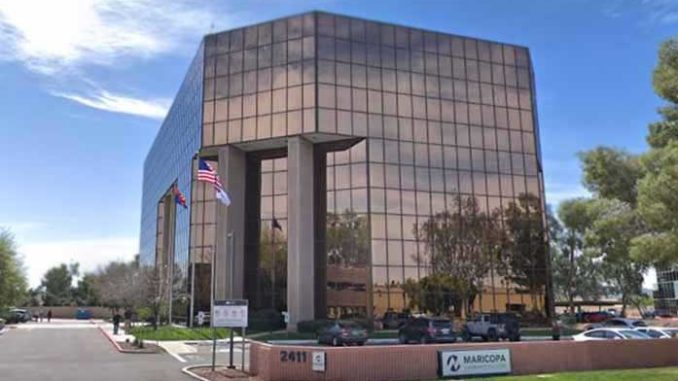
Maricopa Community Colleges (MCCCD), announced they will offer educational events on critical race theory and other social justice topics through new “Cultural Humility and Equity Office Hours.” Both students and faculty may participate in these optional events, which run from next week until the end of 2022.
The content of the Cultural Humility and Equity Office Hours challenges recently-passed state laws. House Bill (HB) 2898 prohibits schools from teaching students that any race, ethnic group, or sex is superior to another and/or deserving of discrimination. Schools in violation of the law may be fined up to $5,000 for each violation. House Bill (HB) 2906 prohibits the state and any local government from requiring employee trainings, orientations, or therapies suggesting that someone is inherently and either consciously or subconsciously racist, sexist, or oppressive. Governor Doug Ducey signed both bills into law over the course of this summer; however, they don’t go into effect until September 29.
Although these Cultural Humility and Equity Office Hours are characterized as optional, MCCCD Board Member Kathleen Winn told AZ Free News that there’s an unofficial expectation for faculty to participate. This pressure reportedly comes from the Faculty Executive Committee (FEC).
“[The faculty] are in fear. When something like this happens and they feel differently, they pretty much just suck it up because what happens is retaliation. Retaliation is alive and well at the community college. They retaliate against someone that’s against their doctrine,” explained Winn.
As of press time, AZ Free News learned that none have taken legal action against MCCCD.
MCCCD Office of Diversity, Equity, Inclusion, and Engagement (DEIE) issued the announcement last week. Their first event, “Racelighting and Critical Race Theory,” will occur on Wednesday. According to the supplementary reading list for the event, racelighting is a take on gaslighting in which members of any race except the white race second-guess their experiences of racism and/or don’t recognize that negative life circumstances or events are a result of systemic racism.
Other readings for Wednesday’s event include a bill of rights for “people of mixed heritage,” and a 2014 article discussing critical race theory in K-12 and higher education. Critical race theory proponents have argued that critical race theory isn’t being taught in K-12 schools.
The other upcoming events for this year are: “Hiring Equity” with Professor Jaime Herrera, September 1; “Deferred Action for Childhood Arrivals (DACA),” September 8; “Dismantling Microaggressions in STEM and MCCCD” categorized as a “nationally recognized student-led session” and led by Dr. Nicole Neal, Chandler-Gilbert Community College, and students, date to be determined; “Structural Oppression in Higher Education: Accessibility” with Drs Jo Pina and Karen Winters, Justin Yarbrough, and Lisa Hitzler, October 13; “The Shift of Political Parties in the U.S.” by Professor John Coughlin, November 3; and “The Power of Music” by Professor Rod Golden. Next year, there is currently one event scheduled for each month.
Next year’s topics include “Educational Equity: The Ungrading Project,” “Educational Equity: What LGBTQT Students Want,” “Intersecting Religion with other Social Identities,” and “What it Means to Be White in the USA.”
Corinne Murdock is a reporter for AZ Free News. Follow her latest on Twitter, or email tips to corinnejournalist@gmail.com.
by Terri Jo Neff | Aug 8, 2021 | News
By Terri Jo Neff |
If two companies create a third, independent company which later runs out of money, it can be possible for creditors to sue the parent companies, but those creditors need to act fast, according to the Arizona Supreme Court.
On Thursday, the justices affirmed a Maricopa County judge’s order which dismissed a 2015 lawsuit filed against Meritage Homes of Arizona by a subcontractor of a residential real estate development. The lawsuit stemmed from Meritage’s ownership interest in Maricopa Lakes, LLC.
The Supreme Court ruled the subcontractor, Specialty Companies Group LLC, was barred by the statute of limitations from initiating the legal action which sought to collect more than $234,000 as payment on a 2011 default judgment against Maricopa Lakes.
Court records show the controversy dates back to 2004 when Meritage Homes and Hacienda Builders, Inc., joined forces to create Maricopa Lakes to develop a real estate project. Maricopa Lakes then hired G&K South Forty Development to serve as project manager.
In August 2007, G&K hired Specialty Companies Group, LLC, to provide grouted riprap for the development. Grouted riprap refers to rocks which are cemented or wired into place along inclined shorelines, spillways, and ditches to prevent erosion.
By the end of 2007, Hacienda Builders was no longer able to meet its financial obligations to the Maricopa Lakes partnership due to the burgeoning real estate crash. In April 2009, Specialty Companies sued G&K for more than $150,000 in unpaid work, and G&K then sought indemnification from Maricopa Lakes.
G&K and its subcontractor ran into a problem, however, as Maricopa Lakes had already been administratively dissolved by the Arizona Corporation Commission.
In November 2011, G&K was awarded a default judgment for nearly $235,000 which it later assigned to Specialty Companies. Then in January 2015, Specialty Companies sued Meritage Homes and Hacienda Builders under the legal theory of alter ego, also known as piercing Maricopa Lakes’ corporate veil.
According to Mark N. Goodman of Goodman Law in Prescott, the protections normally afforded to those with an interest in a limited liability corporation (LLC) in Arizona can be removed in some situations. In the case of Maricopa Lakes, responsibility for the company’s debts could have fallen onto Hacienda Builders and Meritage Homes.
“The alter ego status is said to exist when there is such unity of interest and ownership that the separate personalities of the corporation and owners cease to exist,” Goodman explains, adding that piercing the corporate veil based on alter ego status is only available to third parties, such as creditors, and not to shareholders.
But a Maricopa County judge dismissed Specialty Companies’ 2015 alter ego lawsuit against Meritage and Hacienda, ruling the claim was untimely based on a six-year statute of limitation for disputes involving a written contract. The subcontractor appealed, but only as to Meritage Homes’ alter ego liability.
The Arizona Court of Appeals came to a much different decision, ruling last year that Specialty Companies had simply took action in 2015 to enforce the 2011 judgment which had its own five-year statute of limitations.
The Arizona Supreme Court did not agree. Its unanimous opinion released Aug. 5 states an attempt to pierce the corporate veil to enforce a judgment is not its own cause of action. Instead, a plaintiff “is bound by the limitation period applicable to the cause of action to which the alter-ego claim is tied,” Justice Clint Bolick wrote in the opinion.
And the initial cause of action involving Hacienda Builders, Meritage Homes, and Maricopa Lakes is a breach of contract.
“A claim for breach of contract accrues when the plaintiff knew or should have known the facts giving rise to the claim,” Bolick wrote, adding the Maricopa County judge heard evidence that the necessary facts about Maricopa Lakes’ ownership was known in late 2007 or early 2008.
Therefore, the six-year statute of limitations expired before Specialty Companies sued Meritage Homes in 2015, the opinion states. Bolick noted the statute of limitations dismissal meant the justices did not take up whether Maricopa Lakes was in fact Meritage Homes’ alter ego.
And even though Meritage Homes was the prevailing party on review, the justices chose to “exercise our discretion” in denying the company’s request for attorney fees.
by Corinne Murdock | Aug 8, 2021 | News
By Corinne Murdock |
Banner Health, one of the largest health care companies in the United States, is exempting pregnant nurses from their COVID-19 vaccine mandate. Banner Health hasn’t announced these exemptions publicly.
This exemption was outlined in an email from a Banner Health nursing director, obtained by AZ Free News. The email also noted that Banner Health’s human resources may extend that exemption to women who are breastfeeding, of childbearing age, and more. The email didn’t clarify why pregnancy was considered an exemption by the health care company, nor did it elaborate why it was considering exemptions for women who are breastfeeding or of childbearing age.
“I learned today that pregnancy will be an approved exemption,” wrote the official. “The HR team is also working other automatic exemptions (breast feeding, child bearing age, etc). I will keep you all posted as I learn more.”
The CDC still recommends that pregnant women, breastfeeding women, and women of childbearing age get the COVID-19 vaccine (the CDC calls breastfeeding women “lactating people”).
Banner Health announced last month that it would require all employees to be vaccinated by November 1. The mandate didn’t bode well with the company’s employees.
This past week, hundreds of nurses protested against the vaccine mandate. Nurses say they oppose the mandate because the safety and efficacy of the vaccine isn’t proven, and they would like a choice in their own health care decisions.
Corinne Murdock is a reporter for AZ Free News. Follow her latest on Twitter, or email tips to corinnejournalist@gmail.com.