The Arizona Department of Transportation is hoping to protect consumers from having a bad time buying a used vehicles.
An increased demand for certified pre-owned or used vehicles has been seen in recent months in response to manufacturer supply chain interruptions and the increased cost of new vehicles coming off the assembly line. Add that to tightened underwriting rules for new vehicle loans, and the used car market has become the next best option for many Arizonans.
But purchasing a used vehicle comes with its own risks, whether buying from a private party or a car dealer. Which is why ADOT urges consumers to use care in such transactions, and to “walk away” if anything seems off with the car, the deal, or the seller.
Most used cars sold in Arizona come with only an implied warranty of merchantability lasting 15 days or 500 miles, whichever comes first. Therefore, ADOT recommends consumers not buy a used vehicle until a trusted mechanic has performed an inspection.
In addition to checking the vehicle’s general mechanical condition, the inspection should look at whether the odometer was tampered with and whether the vehicle has any water or collision damage which was not reported or properly repaired. Such damage could lead to future malfunctions of the electrical system or engine.
A prospective buyer should also obtain a Motor Vehicle Record to ensure the vehicle’s title is not encumbered by a lien. When a vehicle title has a lien, it cannot be transferred to a new owner without a release first being recorded.
“Unfortunately, there are unscrupulous sellers that go to an auto-title / loan business and receive a loan against their vehicle one day before they sell it. The auto-title / loan business applies a lien to that particular vehicle so it can’t be sold until the loan is paid,” according to ADOT.
A Motor Vehicle Record is available at MVD offices and authorized MVD third party office. Private companies such as CarFax and Experian Automotive also sell similar records, often referred to as a vehicle history report.
A third way to avoid fraud is to ask the vehicle seller to be present with the buyer to transfer the title at an MVD or Third Party office where the payment can be exchanged.
ADOT even has advice for anyone selling a used vehicle, as seller’s too can be targeted by scammers. First, make sure to obtain the buyer’s name and address. Second, make sure to remove the license plate and any handicap placard before the new owner drives away.
It is also critical to complete an ADOT-MVD “sold notice” and submit it to ADOT. This step ensures the seller is not held responsible for any tickets or liability connected with the vehicle after the sale is reported.
Additional consumer information concerning auto purchases is available from the Arizona Attorney General’s Office here.
On Wednesday, Secretary of State Katie Hobbs chose to stall on the invalidation of a ballot initiative attempting to kill school choice, despite it not having the required number of signatures.
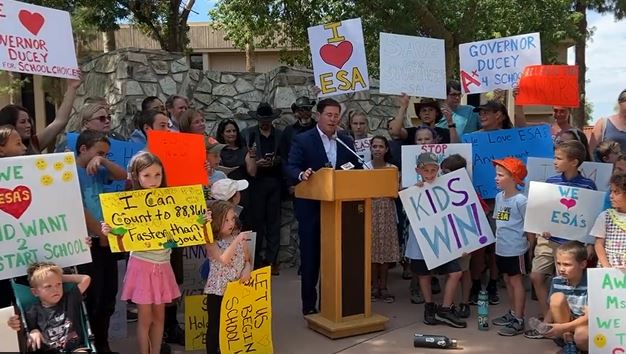
School choice advocates gathered outside of the State Capitol on Wednesday to protest Hobbs’ inaction. Hobbs told frustrated parents that her office would wait out the entire 20-day period offered by state law to verify the Save Our Schools Arizona (SOSAZ) ballot initiative signatures.
Governor Doug Ducey spoke at the rally, telling Hobbs to expedite her signature verification. He also directed Arizona Department of Education (ADE) Superintendent Kathy Hoffman to take charge and free the universal school choice funds.
“Arizona is going to be a state that funds students, not systems,” said Ducey.
We need to get Arizona’s universal Empowerment Scholarship Account program started for our kids. Joined families at the Arizona State Capitol to echo their call for Secretary Hobbs to expedite the verification process of signatures. pic.twitter.com/JI3VCXI7sB
One Empowerment Scholarship Account (ESA) Program mother, Christine Accurso, pleaded with the media to question Hobbs’ choice. Accurso led “Decline to Sign,” the countermovement to SOSAZ’s ballot initiative.
“Help us parents of Arizona. Ask Katie Hobbs why they won’t release this,” said Accurso.
Accurso added that if a group of four moms was able to verify the signature number total in a matter of days, it shouldn’t take the secretary of state’s office nearly a month to do the same.
According to earlier reporting from this week, pro-ESA Program parents, organizations such as the American Federation for Children, and various reporters reviewed the SOSAZ signature sheets and found them far short of the claimed totals. However, Hobbs and her office took SOSAZ’s signature total claim at their word.
Today a Citizen Referendum has filed with our office to refer part of HB2853 to the ballot! The committee is reporting 141,714 signatures which is above the min required: 118,823 signatures.
“Conservative Circus” radio host James Harris also spoke at the rally. He declared that Hobbs’ Republican gubernatorial opponent, Kari Lake, wouldn’t stand in the way of school choice funds for parents the way he said that Hobbs did this week.
“We don’t need more obstacles. We need liberty and we need freedom,” said Harris.
AZ Free News reached out to Hobbs’ office on Tuesday for clarification about whether their decision to accept SOSAZ’s word for their petition signature count without verification was protocol. They haven’t responded.
We also reached out to SOSAZ Director Beth Lewis; she didn’t respond to our questions, either.
Senate President Karen Fann (R-Prescott) sent a letter to Hobbs on Wednesday, informing the secretary of state that anything less than an immediate rejection of the SOSAZ ballot initiative would make Hobbs complicit in misreporting and interfering with the law.
“As our country enters into a recession, we know that every dollar is valuable to lives and livelihoods,” said Fann.
This morning, @FannKfann calls upon @SecretaryHobbs to end the uncertainty and confusion for families wanting to take part in Arizona's Universal ESA School Choice Program. The hold on this funding for students is unjustified and unnecessary. Read more… pic.twitter.com/lom1VsI1qb
While awaiting response from Hobbs’ office, AZ Free News posed the same question to former Secretary of State Ken Bennett. Though he said he was shocked by Hobbs’ handling of the ballot initiative, he said that Hobbs’ actions weren’t in violation of any laws. Bennett explained that Hobbs’ handling of this recent initiative didn’t align with the precedent of her predecessors, including his administration.
“We just felt the integrity of the whole process was worth at least a verification of the number of sheets and the purported number of signatures on those sheets when they first turned them in when I was there,” said Bennett. “Each secretary can decide how they want to do it, but my administration felt that we at least owed the public the fact that we checked the signatures per sheet. At least we would add the total sheets and total signatures up, so we weren’t getting somebody a false receipt of what we had received from them.”
Corinne Murdock is a reporter for AZ Free News. Follow her latest on Twitter, or email tips to corinne@azfreenews.com.
On Monday, Arizona Attorney General Mark Brnovich petitioned Congress to reject legislation reducing states’ land-use and energy rights in order to federalize the energy grid.
The letter warned that the legislation would empower private companies to wield the authority of eminent domain against state land, enable the Federal Energy Regulatory Commission (FERC) to construct whenever and wherever it desires regardless of state input, and authorize private companies to pass on the construction costs of new facilities from one state to another.
“These provisions eviscerate state sovereign authority, commandeer companies to carry out the will of a three-vote majority of FERC Commissioners, undermine the power of each citizen’s vote to decide policies at the state level, and inevitably force the citizens of our states to subsidize the costs of expensive and unreliable energy policy preferences of California and New York,” stated the letter.
The letter also noted that Congress was rushing the legislation through without the transparency of committee hearings, markups, or debate.
Brnovich warned in a press release that the proposed legislation, the Energy Independence and Security Act of 2022, would burden Arizonans with other states’ problems.
“The Act is unfair and takes power from states to decide policies for their own people,” said Brnovich. “Arizona and Louisiana should not be forced to pay for California and New York’s expensive energy preferences.”
Senate Majority Leader Chuck Schumer (D-NY) and Senator Joe Manchin (D-WV) introduced the legislation under the promise of creating energy independence, citing the ongoing Russian war abroad.
THREAD: If the United States wants to remain the superpower of the world, we must have energy independence. The Energy Independence and Security Act of 2022 will make necessary permitting reforms to ensure we can produce the cleanest possible energy for ourselves & our allies. pic.twitter.com/ehJ045mgSz
Some renewable energy analysts say that the legislation would help fast-track the country’s adoption of “clean” energy.
The Energy Independence and Security Act of 2022 is out! @SenSchumer , @Sen_JoeManchin led. We think it can drive a very large amount of clean energy, because transmission is renewable energy's biggest barrier. Importantly, NEPA is preserved, including public participation.🧵
Brnovich joined a coalition of 18 states led by Louisiana Attorney General Jeff Landry to request the rejection of the legislation: Alabama, Alaska, Arkansas, Georgia, Indiana, Kansas, Kentucky, Mississippi, Missouri, Montana, Nebraska, South Carolina, Tennessee, Texas, Utah, and Virginia.
Louisiana Attorney General Jeff Landry is leading a coalition of 18 states in vocal opposition to the Energy Independence and Security Act of 2022.
On Monday, Planned Parenthood Arizona (PPAZ) filed a motion to stay a court ruling reinstating Arizona’s total abortion ban.
Last Thursday, Pima County Superior Court Judge Kellie Johnson lifted an injunction on the 1901 total abortion ban in Planned Parenthood Center of Tucson, et al. v. Gary Nelson, et al. The court case is a continuation of the 1970s case that enjoined the total abortion ban as unconstitutional based on the Supreme Court (SCOTUS) ruling in Roe v. Wade.
Johnson ruled that SCOTUS overturning Roe v. Wade earlier this year nullified the Pima County Superior Court’s injunction against Arizona’s total abortion ban. Johnson added that she wouldn’t be addressing the legality of Arizona’s abortion statutes.
“The Court finds that because the legal basis for the judgment entered in 1973 has now been overruled, it must vacate the judgment in its entirety,” stated Johnson. “The Court finds an attempt to reconcile fifty years of legislative activity procedurally improper in the context of the motion and record before it. While there may be legal questions the parties seek to resolve regarding Arizona statutes on abortions, those questions are not for this Court to decide here.”
The 1901 ban, which predated Arizona’s statehood, resembles the most recent abortion law enacted by Governor Doug Ducey in March. While the former institutes a total abortion ban, the latter limits abortions to 15 weeks. However, the latter law stipulates that it doesn’t supersede the 1901 ban.
In a press release, PPAZ President and CEO Brittany Fonteno had a different view of the two laws’ relationship. Fonteno contended that Johnson’s ruling enabled conflicting laws to exist in the state, therefore forcing their facilities to continue suspension of abortions.
“This confusion has forced Planned Parenthood Arizona to pause abortion services and cancel appointments scheduled this week — meaning that members of the community once again have been and will continue to be denied medical care that they deserve and need while this decision is in effect,” said Fonteno. “This is unacceptable.”
BREAKING: Planned Parenthood Arizona Seeks Immediate Stay of Pima County Superior Court Ruling pic.twitter.com/MAE46nwS2P
— Planned Parenthood Advocates of Arizona (@ppazaction) September 26, 2022
The few abortion clinics that continued to provide certain services while awaiting the court ruling, such as Camelback Family Clinic, have suspended their services due to this latest ruling.
Arizona’s abortion fund providers — Abortion Fund of Arizona (AFAZ) and the Tucson Abortion Support Collective (TASC), as well as a national network that serves Native American women only in Arizona, Indigenous Women Rising (IWR) — continue to collect funds to provide abortions and all associated costs, such as transportation and time off work.
The fundraising page for the three abortion fund providers, launched through the Democratic fundraising platform ActBlue, has raised nearly $47,800 with a goal of $100,000 as of press time.
“Funding abortion care is a radical act of compassion and you, too, can be a part of this work!” reads the fundraiser page.
A cruel, pre-statehood, 1864 abortion ban has gone into effect in AZ that bans nearly all abortions.
It's time to stand up//fight back & show some love to the AZ abortion funds, incl @abortionfundAZ, @IWRising & Tucson Abortion Support Collective.
Arizona Attorney General Mark Brnovich, who argued for the court to lift the 1973 injunction on the state’s total abortion ban, commended Johnson for issuing proper legal recourse.
“We applaud the court for upholding the will of the legislature and providing clarity and uniformity on this important issue. I have and will continue to protect the most vulnerable Arizonans,” stated Brnovich.
A Pima County judge lifted an injunction that was placed on AZ’s abortion statute. We applaud the court for upholding the will of the legislature and providing clarity and uniformity on this important issue. I have and will continue to protect the most vulnerable Arizonans.
In addition to Arizona, 14 other states have total abortion bans: Idaho, Texas, Oklahoma, Missouri, Arkansas, Louisiana, Mississippi, Alabama, Tennessee, Kentucky, and West Virginia. 9 more states are fighting to restore or have total abortion bans on the books in addition to current abortion restrictions: Utah, Wyoming, North Dakota, Nebraska, Iowa, Wisconsin, Michigan, Indiana, and North Carolina.
Corinne Murdock is a reporter for AZ Free News. Follow her latest on Twitter, or email tips to corinne@azfreenews.com.
It was announced last week that two defense contractors with a large presence in Arizona will partner on one of the U.S. Air Force’s most cutting edge weapons—a hypersonic air-breathing missile capable of sustained speeds of Mach 5 or greater.
Tucson-based Raytheon Missiles & Defense has been selected along with Northrup Grumman Corp. to deliver a first-of-its-kind Hypersonic Attack Cruise Missile (HACM) which utilizes a scramjet engine that forcibly compresses incoming air with a hydrocarbon fuel for combustion to travel at least five times the speed of sound.
This allows a HACM to reach its targets more quickly than similar traditional missiles, allowing it to potentially evade defensive systems, according to the companies which have been working together since 2019 to integrate Northrop Grumman’s scramjet engines onto Raytheon’s air-breathing hypersonic weapons.
In July, they conducted the second successful flight test of a Hypersonic Air-breathing Weapon Concept (HAWC) for the U.S. Air Force and the Defense Advanced Research Projects Agency.
During the flight test, the concept weapon was released from an aircraft and accelerated to hypersonic speeds using a scramjet engine. The vehicle then flew a trajectory which engineers designed to intentionally stress the weapon to explore its limits and further validate digital performance models from the first flight test in September 2021.
“The second flight test is a big step toward scramjet technology being mission ready,” Dan Olson, vice president and general manager of Weapon Systems for Northrop Grumman said at the time. “Nearly twenty years of scramjet propulsion research and development have come to fruition to significantly advance our nation’s weapon capabilities.”
The contract announced earlier this month now calls for Raytheon Missiles & Defense and Northrop Grumman to finetune development of the concept technologies and deliver operationally ready HACMs to the U.S. Air Force.
“Advancing our nation’s hypersonic capabilities is a critical national imperative, and this was an important step forward,” said Wes Kremer, president of Raytheon Missiles & Defense, in August. “Having back-to-back successful flight tests gives us even greater confidence in the technical maturity of our HAWC operational prototype.”
Hypersonic weapons demand novel design solutions because their speed and maneuverability create challenging operating environments. To develop and validate the system quickly, Raytheon has used digital engineering, specifically modeling and simulation, along with ground testing.
“It’s hard to recreate in the real world the most advanced threat scenarios, and that’s especially true in hypersonics,” Kremer said after the July flight test. “But we have the power to model a hypersonic flight regime. Advances in artificial intelligence, machine learning and big data allow us to develop capabilities at scale in a way that wasn’t possible before.”
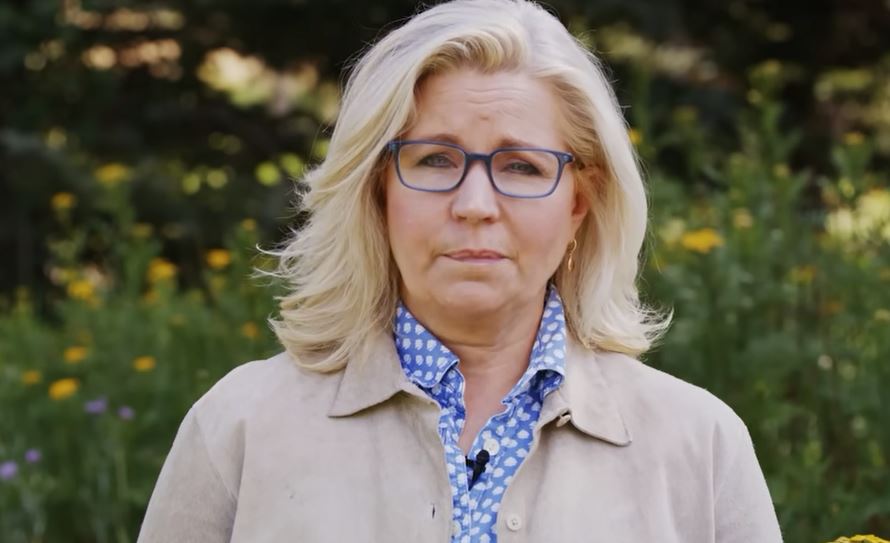
Republican gubernatorial candidate Kari Lake said she’s glad to hear that ousted congresswoman Liz Cheney launched a $15 million political action committee (PAC) to defeat her and other Trump-backed candidates. Lake called Cheney’s plan “a gift.”
Lake made those remarks during an interview with Fox News pundit Maria Bartiromo on “Sunday Morning Futures.” Cheney first promised to defeat Lake about a month ago through her newly-launched “The Great Task” PAC, shortly after she lost her own re-election.
“That might be the biggest, best gift I’ve ever received,” said Lake. “The new Republican Party is the party of ‘we the people,’ it is no longer the party of warmongers. Liz Cheney probably should change her voter registration — turns out she really is a Democrat after all.”
As AZ Free News reported last month, one of the top donors to Cheney’s PAC was James (Jim) Kennedy, chairman of Arizona’s top communications services provider, Cox Enterprises, who gave $10,800.
Other principal donors included Jeffrey Katzenberg: former Walt Disney Studios chairman, co-founder and CEO of DreamWorks Animation, and one of the Democratic Party’s top fundraisers dubbed “Hollywood’s political kingmaker.”
Since last month, Cheney has embarked on a press tour to discuss her plan to defeat Trump-endorsed candidates like Lake.
Last weekend, Cheney told The Texas Tribune that she would do everything necessary to ensure Lake’s defeat, such as campaigning for Democrats like Lake’s opponent Katie Hobbs.
.@Liz_Cheney: “I’m going to do everything I can to make sure Kari Lake is not elected.”
Cheney also told the outlet that she would no longer be a Republican if former President Donald Trump became the 2024 presidential nominee.
In addition to her engagements with the press, Cheney recently worked with Congresswoman Zoe Lofgren (D-CA-19) on legislation to limit objections to electors.
Other Trump-endorsed candidates in Arizona are Blake Masters (U.S. Senate), Mark Finchem (Secretary of State), Abraham Hamadeh (Attorney General), David Farnsworth (State House), Anthony Kern (State Senate), Wendy Rogers (State Senate), Robert Scantlebury (State Senate), and Janae Shamp (State Senate).