by Matthew Holloway | Aug 11, 2025 | News
By Matthew Holloway |
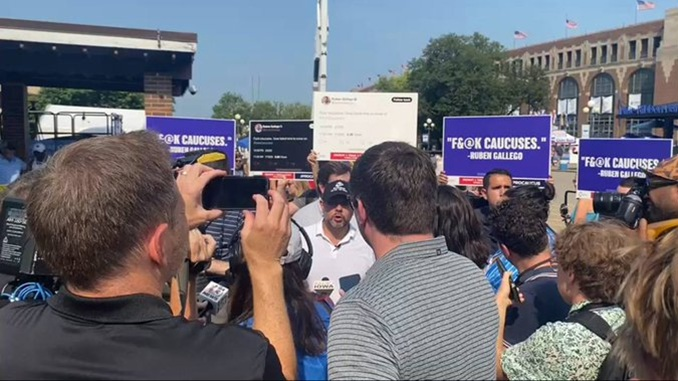
Video footage of Senator Ruben Gallego donning an apron and flipping burgers for the cameras in Iowa appears to show the publicity stunt backfiring on the Arizona Democrat as a chorus of merciless boos could be heard arising from the heckling crowd.
The video, shared by Turning Point Action Field Representative John J. Trotta IV, picked up traction on X with Trotta writing, “Ruben Gallego gets overwhelmingly booed while flipping patties at the Iowa State Fair. Iowans see right through radical Ruben and know he’s nothing but a fraud!”
Host of The Afternoon Addiction on 550 KFYI Garrett Lewis shared the post with the caption, “Iowans are brutal to @RubenGallego! It’s so good! So savage! You love to see it!”
Senior Advisor for the U.S. Agency for Global Media Kari Lake shared a much different memory of her 2024 trip back to her childhood home, writing, “I had a wonderful time at the Iowa State Fair last year. I even got to educate a New York Times reporter about the various genders. ‘The New York Times should try to milk a cow and then try and milk a bull and see how that goes.’”
Lake quipped in a comment, “Of course, @RubenGallego thinks cows have nuts, so he might be in for a rude awakening there too,” referring to an August 2023 video of Gallego lampooning Republicans as people whose “cultural identity” consists of owning guns and driving jacked up trucks with “cow nuts” hanging off their tailgates.
Notabl, as AZ Free News observed at the time, “Cows don’t have testicles, or ‘nuts’; only bulls do. Hence the centuries-old proverbial folly, ‘milking the bull.’ Furthermore, if Gallego knew anything about pickup trucks, the ‘nuts’ hang from the tow hitch, NOT the tailgate.“
A torrent of posts from Turning Point Action COO Tyler Bowyer followed, with Bowyer writing in one, “Ruben Gallego is upset because we ruined his trip to Iowa. Just wait until he goes to New Hampshire!”
He followed this up with the observation that “This guy was making Pfizer burgers in Iowa today? Or was that just for Tacos. We know who owns Ruben between Big Pharma and George Soros!”
After his Iowa debacle, Gallego is set to visit the West Valley next to deliver a Capitol update at the West Valley Regional Chamber on Wednesday, according to the West Valley View.
Matthew Holloway is a senior reporter for AZ Free News. Follow him on X for his latest stories, or email tips to Matthew@azfreenews.com.
by Jonathan Eberle | Aug 11, 2025 | Economy, News
By Jonathan Eberle |
The Greater Phoenix housing market continued its gradual reset in June 2025, signaling a clear shift in momentum from sellers to buyers according to a report from The Ravenscroft Group. Home prices dipped modestly, builders ramped up incentives, and buyers found themselves in the strongest negotiating position in years—marking a pivotal moment for one of the nation’s hottest real estate regions.
While not a repeat of the 2008 housing crash, market data shows a softening across key indicators, as elevated mortgage rates, seasonal slowdowns, and affordability pressures weigh on demand.
According to the group, the median sales price in Phoenix edged down to $449,500, a 0.3% dip from May’s $451,000. Phoenix’s Market Index—a measure of supply vs. demand—fell to 71, further cementing the area’s tilt toward a buyer’s market.
With 30-year fixed mortgage rates hovering around 6.89%, homebuilders are stepping in to maintain momentum. Many are offering interest rate buydowns into the mid-3% range, along with generous closing cost credits, appliance packages, and landscaping perks. This reality has made new construction homes particularly appealing to buyers, many of whom are priced out of the resale market due to borrowing costs.
Real estate trends varied across the Valley in June. Buckeye saw the steepest price shift at -8% while Fountain Hills and Phoenix proper each declined by -6%. Cave Creek transitioned into buyer’s market territory, and Avondale moved from a seller’s to a balanced market.
As of June, the groups says 2 cities are in seller’s markets, 7 cities are considered balanced, and 9 cities have shifted into buyer’s market territory. Outlying cities like Arizona City, Casa Grande, and Gold Canyon lean even more heavily toward buyers.
High recurring costs—such as HOA dues and special assessments—are driving buyers away from attached housing. The listing success rate for condos and townhomes dropped to 58% in May, the lowest since 2011. Manufactured homes fared worse, with fewer than half of listings resulting in a sale.
The Phoenix housing market isn’t collapsing—it’s correcting. Buyers are better positioned than they’ve been in years, and sellers are being forced to recalibrate.
This moment offers unique opportunities for those ready to act—especially in a region still driven by long-term population growth and economic expansion. But navigating it successfully will take strategy, patience, and flexibility on both sides of the deal.
Jonathan Eberle is a reporter for AZ Free News. You can send him news tips using this link.
by Matthew Holloway | Aug 10, 2025 | News
By Matthew Holloway |
Kari Lake’s work as Acting-Chief Executive Officer of the U.S. Agency for Global Media (USAGM) has progressed significantly in recent months after damning revelations in June on the state of the agency and its subsidiary operations including Voice of America (VOA). In her latest move to root out waste and international influence at VOA, Michael Abramowitz, the Biden-appointed now-former Director of VOA, was reportedly terminated Friday after he refused reassignment to a posting in Greenville, North Carolina.
According to a legal filing from Abramowitz, he was informed on July 8, 2025, that he was “removed from his ‘current position of Director, Voice of America’ and reassigned to a different one—as Chief Management Officer in Greenville, North Carolina,” and if he did not “accept” this reassignment he would face “adverse action procedures.”
Abramowitz reportedly responded in an email that the decision to “remove [him] from [his] position as Director of Voice of America[] . . . is illegal” because, “[u]nder the law,” the VOA director “can only be removed . . . with the approval of the International Broadcasting Advisory Board.”
As reported by the Washington Post, Abramowitz was subsequently terminated for “failure to accept directed geographic reassignment.”
Responding to the initial WaPo article on Abramowitz’s termination, Lake lampooned it as “biased,” and “anti-American propaganda,” in a post to X.
As previously reported by AZ Free News, Abramowitz has consistently worked in opposition to Lake and the Trump administration, actively speaking out against Lake’s program to “rightsize” the agency to within its statutory limits.
Responding to a raft of cost-saving measures Lake announced in early May, which included the termination of at least 584 employees and the end of J-1 visa employment, Abramowitz said he was “heartbroken” over the downsizing.
“I find this action inexplicable, and to my knowledge, no rationale has been provided by USAGM for this decision,” he wrote in a statement to the Post. “We will continue to make efforts to help individual PSCs, especially those who face possible return to hostile countries, in any and every way we can during this difficult time,” he continued, in a clear break from USAGM leadership under Lake.
In a letter he posted on Linkedin, Abramowitz informed VOA staff of his imminent ouster writing, “I wanted you to be aware that my lawyers have filed a motion in federal court today challenging efforts by USAGM to remove me as director of Voice of America. They believe USAGM’s action is plainly illegal. I can’t say much about the details of the case beyond what is laid out in the court filing. But I do want to stress that this action is not about me personally but about preserving the rule of law and fulfilling VOA’s vital mission of delivering fact-based news and information about America to the world.”
Correction: This story has been updated to reference Kari Lake’s new title as Acting-Chief Executive Officer of the U.S. Agency for Global Media.
Matthew Holloway is a senior reporter for AZ Free News. Follow him on X for his latest stories, or email tips to Matthew@azfreenews.com.
by Jonathan Eberle | Aug 10, 2025 | News
By Jonathan Eberle |
Arizona lawmakers are intensifying their investigation into systemic failures within the state’s child protection system after the tragic deaths of three children—each of whom had prior involvement with the Department of Child Safety (DCS). Senator Carine Werner (R-LD4), Chair of the Senate Health & Human Services Committee, is spearheading the effort through a formal legislative probe targeting the state’s oversight of licensed group homes.
The investigation was first launched earlier this year following the gruesome murder of Emily Pike, a 14-year-old who ran away from a DCS-licensed facility in January and was later found dead. Now, with the deaths of Zariah Dodd, a pregnant 16-year-old fatally shot after leaving a similar facility, and Rebekah Baptiste, a 10-year-old who died despite multiple abuse reports to DCS, momentum behind the inquiry has grown significantly.
“These tragedies make it painfully clear that when our child protection systems—both state and tribal—fail, the consequences can be horrific,” Werner said in a statement. “We must explore opportunities for system improvement. That is the work ahead of us, and we will not stop until no child in Arizona falls through the cracks.”
The first stakeholder meeting of the Joint Legislative Oversight Committee on the Department of Child Safety will take place on Wednesday, September 3. It marks the second phase of a broader review process that will include legislative hearings, stakeholder input, and proposed reforms. While the meeting will be closed to the public and media, Werner is expected to brief reporters in the following days. Earlier this year, Werner called on the Arizona Attorney General’s Office to launch a formal investigation into DCS’s regulatory oversight. She has voiced serious concerns about “underlying systemic issues” that may be placing children and even staff at risk within state-licensed group homes.
“Arizona’s licensed group homes have repeatedly made headlines for egregious mistakes that have cost lives and threatened the safety of staff,” Werner said at the time. “There may be underlying systemic issues requiring immediate reforms, so we must assess where mistakes are occurring and determine the next steps.”
The Joint Oversight Committee’s work will involve officials from DCS, law enforcement, tribal governments, lawmakers from both parties, and social service providers. Their goal: assess current policies, examine communication breakdowns, and identify both short-term interventions and long-term legislative fixes.
As the investigation unfolds, Arizona finds itself once again grappling with the conversation of how to ensure that tragedies like these never happen again.
Jonathan Eberle is a reporter for AZ Free News. You can send him news tips using this link.
by Ethan Faverino | Aug 10, 2025 | Economy, News
By Ethan Faverino |
State Representative Walt Blackman, Chairman of the House Committee on Government, reiterated his strong support for the Final Environmental Impact Statement (FEIS) for the Resolution Copper project, completed by the U.S. Forest Service (USFS).
In a letter addressed to the Acting Forest Supervisor Ericka Luna, Representative Blackman called for the swift execution of the land exchange authorized by Congress in Section 3003 of the National Defense Authorization Act for the 2015 Fiscal Year.
Representative Blackman said, “The Resolution Copper project is a rare opportunity to strengthen Arizona’s economy—especially in the historic Copper Corridor and across District 7. It will bring high-wage jobs, critical infrastructure investments, and lasting economic support for local businesses.”
The Resolution Copper Project is anticipated to create thousands of construction jobs at first, with thousands more supported during decades of mine operations.
With Arizona’s average mining wage at around $100,000, these jobs promise to enhance the livelihoods of working families across the state.
The project is also expected to generate tens of millions in annual tax revenue, enabling critical investments in public roads and essential services for the Town of Superior and the surrounding areas.
The FEIS, culminating over a decade of National Environmental Policy Act analysis, incorporates extensive input from tribal governments, local communities, and other stakeholders.
Resolution Copper’s Community Working Group has played a vital role in developing mitigation strategies and promoting shared goals.
Additionally, more than 23 local municipalities and organizations have signed Good Neighbor Agreements, establishing a structure for responsible land and community management throughout the mine’s lifespan.
Blackman added, “Resolution Copper has made a genuine effort to work with the community and earn local support—truly being a good neighbor. This project is ready to move forward, and it’s time it does. I urge the Forest Service to act without further delay.”
Representative Blackman emphasized the project’s alignment with Arizona’s legacy as a leader in U.S. copper production. He urged the USFS to proceed with the land exchange, highlighting the potential to drive sustainable economic growth for the Copper Corridor and throughout Arizona.
Ethan Faverino is a reporter for AZ Free News. You can send him news tips using this link.
by Jonathan Eberle | Aug 9, 2025 | News
By Jonathan Eberle |
Arizona Public Service (APS), the state’s largest electric utility, announced Wednesday it will no longer pursue its previous pledge to achieve zero carbon emissions by 2050. The company also scrapped its interim emission reduction targets and removed a commitment to end coal-fired generation by 2031 from its website. The utility now aims to be “carbon neutral” by 2050 — a less stringent target that allows for continued fossil fuel use if emissions are offset through technology such as carbon capture.
“Our aspiration has evolved based on changes to energy markets and customer needs, and our plans are built around doing what’s right for the people and prosperity of Arizona,” said APS spokeswoman Jill Hanks in a statement to 12News.
The announcement quickly drew sharp criticism from environmental advocates, who accused the company of backing away from its public commitments. “APS is walking away from every clean energy promise it made to the public, to regulators, to shareholders, and to the communities it serves,” said Autumn Johnson, Executive Director of the Arizona Solar Energy Industries Association. “We are left with vague intentions and zero accountability.”
A free-market advocacy group also voiced concerns, though from a different perspective. The Arizona Free Enterprise Club argued that the new plan still comes with a heavy cost to consumers. “While this is modestly better than the carbon-free plan they have been pushing for the last five years, APS’ new ‘carbon neutral’ plan will still cost ratepayers billions,” said Scot Mussi, the group’s president. “The priority should be reliable and affordable baseload power for Arizonans, not meeting arbitrary carbon goals that require massive amounts of expensive wind and solar that will degrade the grid.”
Some of Arizona’s elected officials also weighed in. Arizona Governor Katie Hobbs criticized the decision on X, writing, “Arizona needs an abundance of energy, with a strong, and reliable grid to keep our communities safe and to continue our economic growth. This decision sets us back. It makes our air dirtier, hurts our growing clean energy economy, and forfeits the cost savings of renewable options.”
She continued, “I’ll be reaching out to APS to discuss their decision and reiterate that we must continue investing in new energy technologies and diversify our energy portfolio at the fastest rate possible.”
Hobbs’ response is interesting given her history with APS. After her inauguration, it was revealed that Pinnacle West Capital Corp., the owner of APS, donated $250,000 to Hobbs’ inaugural fund. The group also made a $100,000 donation in 2024 to Hobbs’ secret litigation fund.
Republican gubernatorial candidate, and sitting U.S. Representative, Andy Biggs offered a sharply different take than Hobbs, posting, “Every utility in our state should be prioritizing reliable and affordable energy for Arizonans, not trying to meet the demands of environmentalists pushing the Green New Scam that hurts Arizona businesses and families. As Governor, I’ll make sure Arizona aligns with President Trump’s energy agenda to help our economy flourish.”
APS data shows most of the state’s surging energy demand is coming from the expansion of data centers rather than residential growth. The company and its investors view the sector as a major opportunity for revenue.
While APS maintains it remains committed to expanding cost-competitive clean energy, the rollback represents a significant departure from the 2020 pledge.
Jonathan Eberle is a reporter for AZ Free News. You can send him news tips using this link.