by AZ Free News | Jul 13, 2021 | Education, Opinion
By Richard K. Vedder,, Amy L. Wax |
A growing number of parents of K-12 and high school students throughout the country have rebelled against the teaching of critical race theory (CRT) and “anti-racism” in public and private schools. The reasons for their alarm vary, and the rhetorical battles can be confusing, but it is not hard to get to the heart of parents’ objections.
They reject the presentation of our country, its history, its founding, its institutions and its present laws and practices as pervasively, uniformly, profoundly and irredeemably racist. Nor do they accept the corollary that all white Americans automatically enjoy illegitimate “white privilege”—and that they are to blame for every problem that people of color, especially blacks, experience today.
We think that these tenets are dubious at best. But in our opinion the most pernicious aspect of CRT instruction, from an educational perspective, is not its content, but the one-sided, dogmatic intolerance of any alternative point of view.
CRT banishes any classroom mention, let alone thoughtful discussion, of the full range of ideas about race currently articulated across the political spectrum. (The same thing is true in corporate America and at universities, where employees know better than to openly object to CRT’s rigid dogmas.) The CRT-approved story, in a nutshell, is that white racism is pervasive and accounts for all racial deficits and disparities. What is not being taught—what students are not exposed to, and not even allowed to hear—is the contrary position that persistent racial inequalities are oftentimes rooted in cultural differences and behavioral tendencies that are not all traceable to slavery or Jim Crow, and cannot all be solved by purging the vague category of “structural racism.”
>>> READ MORE >>>
by Goldwater Institute | Jul 12, 2021 | Education, Opinion
By the Goldwater Institute |
In too many of our nation’s classrooms, children are being taught that everything should be seen through the lens of race—a divisive and damaging worldview that negates the value of the individual. Instead of reading our country’s founding documents, students are being told that America was founded on fundamentally hateful and intolerant ideas. And they’re learning that the American Dream isn’t really for everyone. What is a parent to do?
In a new paper released by the American Enterprise Institute, Goldwater Institute Director of Education Policy Matt Beienburg shows that in order to truly put parents—and not bureaucrats—in control of kids’ education, more sunlight is the answer. And Goldwater is leading the effort to bring that sunlight to school districts across America, in the form of academic transparency.
To date, state lawmakers have dealt with the issue of politically charged classroom content by either doing nothing or banning certain curricula or materials. But neither path is sufficient to proactively root out political content in our schools. And neither path gives parents the power they need to make the best possible decisions regarding their children’s education.
>>READ MORE >>>
by Terri Jo Neff | Jul 7, 2021 | Economy, Education, News
By Terri Jo Neff |
Chairman Larry E. Penley of the Arizona Board of Regents has high praise for the investment made by Gov. Doug Ducey and the State Legislature in the Fiscal Year 2022 budget passed last week which recognizes the role the state’s three public universities play in Arizona’s economic wellness.
“This spending plan invests in Arizona’s competitiveness by supporting public university instruction, research and development, especially in the key growth sectors of health care, the sciences, biomedicine and engineering,” Penley recently said. “State funding also will assist ongoing efforts by Arizona State University, Northern Arizona University and the University of Arizona to meet the needs of a growing number of Arizona students.”
The 12 members of the Arizona Board of Regents (ABOR) serve as the governing board for Arizona’s three public universities – Arizona State University, Northern Arizona University, and the University of Arizona. The board is tasked with providing policy guidance for nearly every aspect of the university system, including capital development plans, strategic plans, and legal affairs.
The regents also set policy related to financial and human resource programs; academic and student affairs; public outreach; and the all-important student tuition, fees, and financial aid programs.
The main Higher Education budget bill, SB1825, involved more than just funding appropriations. Among other things, it requires the UA cooperative extension office to establish an Agricultural Workforce Development Program to provide incentives to food-producing agricultural organizations to hire apprentices.
“As Arizona emerges from the COVID-19 pandemic, focus shifts toward ensuring our state is ready for the challenges of a New Economy increasingly built on the innovation, adaptability and skills of our workforce,” Penley said.
Another SB1825 provision allows the three state universities to offer pro bono assistance to claimants in the general stream adjudication of water rights if the claimants are small landowners and not represented by counsel.
The legislation also calls for ABOR to administer and implement a Promise Program to provide financial assistance to students in a baccalaureate degree who qualify for in-state student status, graduated from an Arizona high school with a qualifying grade point average, and meet eligibility criteria for the Federal Pell Grant.
“With the state’s initial investment in the board’s Arizona Promise Program scholarship, qualifying low-income Arizona students will have their tuition and fees paid in full to attend the Arizona public university of their choice,” Penley said. “The value of a university degree has never been higher, and this program represents our promise that cost won’t be a barrier to any deserving Arizona student.”
ABOR will take on yet another new responsibility thanks to the budget bill. On Jan. 1, 2022, the statutory duties of the Commission for Postsecondary Education and the e Arizona Teacher Student Loan Program will be transferred to ABOR.
State law designates the governor and the superintendent of public instruction -currently Kathy Hoffman- as ex-officio ABOR members along with two student regents who serve two-year terms. The other regents serve eight-year terms after being appointed by a governor and confirmed by a majority of the 30-member state senate.
In addition to Penley, the current regents are Fred DuVal, Kathryn Hackett King, Lyndel Manson, Cecilia Mata, Bill Ridenour, Ron Shoopman, and Karrin Taylor Robson. ASU student Nikhil Dave is serving as a student regent until 2022; the second student regent seat is currently vacant, according to the ABOR website.
Next up for the ABOR is a Sept. 9 meeting of the Finance, Capital and Resources Committee as well as the Academic Affairs and Educational Attainment Committee.
by Terri Jo Neff | Jul 6, 2021 | Education, News
By Terri Jo Neff |
The Fiscal Year 2022 K-12 Education bill signed last week by Gov. Doug Ducey contains several provisions which could vastly change school transportation options for students during the 2021-2022 school year, especially those who live in rural areas or outside a district’s boundaries.
House Bill 2898 contains In Lieu of Transportation Grants (ILT Grants) which among other things allows a school district to use a portion of the district’s transportation funding to provide ILT Grants to parents of students who attend the school district.
The grants, which require a plan submission to the Arizona Department of Education, also permit charter schools to use a portion of its Charter Additional Assistance funding for the same purpose.
Among the offerings which can be included in an ILT Grant plan is financial support for an individual parent or a neighborhood carpool which transports students to school. The legislation also includes a provision protecting a school district which seeks to offer ILT Grants for its students from having its transportation funding allocations reduced.
Charter schools which use CAA funding for transportation awards to parents must report such expenditures to the Department of Education.
HB2898 also establishes a Public School Transportation Modernization Grants Program (PSTMG Program) through the Arizona Department of Administration. The program, which would end in 2025, would select a third-party administrator to distribute grants to school districts, charter schools, or other eligible entities based on demand and the most innovative solutions.
The administrator, who would be permitted to retain up to five percent of the appropriations each year, must award at least 25 percent of the grants to rural and remote proposals if a sufficient number of qualified remote and rural proposals are submitted.
In another effort to ensure parents understand transportation options, HB2898 included language which now requires a school district to include transportation resource information in its open enrollment policies.
And for non-resident students with disabilities, a district will be required to provide transportation of no more than 30 miles (up from 20 miles) if the students’ individual education program specifies that transportation is necessary.
Meanwhile, school districts will have the option in 2021-2022 to provide transportation for nonresident students up to 30 miles if the student is deemed eligible for the Free or Reduced Price Lunch program. The current limit is 20 miles.
The school transportation legislation was signed by Ducey as districts across Arizona ramp up efforts to recruit drivers for the new school year. Some districts have reported needing to hire several dozen drivers, many who will be assigned to rural routes which often have only a handful of student riders.
by Jose Borrajero | Jul 6, 2021 | Education, Opinion
By Jose Borrajero |
As one of the longest legislative sessions in Arizona history comes to a close, we come to the customary conclusion that no one is totally happy with the results. That is to be expected. No individual or group of individuals should expect to get all they want.
However, this session fell considerably short of conservative goals in several areas. Most prominent among these were election integrity and balance of power. Balloting irregularities and dictatorial executives are anathema to good governance.
Still, we did not do so badly considering the current composition of our legislature. Hopefully, that composition may be improved during the next election cycle.
Two areas in which we did better than many had expected were the budget and tax reform. But these are precisely the two areas in which we are getting tremendous pushback from organizations that support unionism, socialism, and radicalism (please excuse the redundancy).
One major radical group is Save Our Schools Arizona. They are already calling for a citizen’s initiative to undermine the hard-earned progress we made in the areas of budgeting and taxation.
In fact, Save Our Schools AZ, in their June 28 Legislative Report made the following outrageous, irresponsible, and patently false statements:
“The Bad: House lawmakers passed a K-12 budget bill packed with myriad attacks on schools and teachers.” And…
“The Brutally Awful: Both the House and Senate passed identical bills pushing Arizona’s largest tax cut in history into law”.
Let us evaluate the second claim first. It should be pointed out that whenever these radical organizations bitch and moan about “tax cuts” they are bitching and moaning about “tax cuts for the rich”. They don’t bitch and moan about the portion of the tax relief that helps low- and middle-class taxpayers. With that in mind let us look at the overall taxation of the rich, to determine whether this is a giveaway to the wealthiest among us, or simply a much-needed tax relief to prevent job providers from fleeing Arizona.
Marginal income tax rate paid by the wealthiest Arizonans:
| Before Prop 208 |
4.5% |
| After Prop 208 |
8.0% (4.5% + 3.5%) |
| After Tax Relief |
6.0% (2.5% + 3.5%) |
Can someone, with a straight face, explain how going from a 4.5% tax rate to a 6.0% tax rate constitute a “tax cut”? Tax relief would be a much better name for it.
It should also be noted that there is nothing in the omnibus tax relief tax relief bill (SB1828), or in any of the budget reconciliation bills to remotely suggest that the Education industry will not get their 3.5%. This brings us to addressing the other claim made by the Save Our Schools cabal.
The only way that a thinking person can agree with the SOS’s claim that the legislature gave us a “K-12 budget bill packed with myriad attacks on schools and teachers” is to conclude that a whopping 24% increase in funding constitutes “myriad attacks”. Let us look at some numbers taken from the JLBC’s and the Governor’s websites:
| FISCAL YEAR |
TOTAL BUDGET |
EDUCATION BUDGET |
| 2021 |
$11.5 BILLION |
$6.7 BILLION ($5.0 B K-12 + $1.7 B HIGHER ED) |
| 2022 |
$12.8 BILLION |
$8.2 BILLION ($6.2 b K-12 + $2.0 B HIGHER ED) |
While the overall budget went up by a relatively modest 11%, the education budget increased by 22%, and the K-12 portion increased by 24%.
Under this new budget, the portion allocated to education is 64%, leaving only 36% for healthcare, law enforcement, border security, street repairs, infrastructure, etc.
The SOS and other groups that claim to support students should be praising our legislature and thanking them for their generosity, instead of plotting to undermine their work via mob rule.
by Terri Jo Neff | Jul 1, 2021 | Education, News
By Terri Jo Neff |
The Democrats in the Arizona Legislature may have held firm on their complete opposition to the proposed K-12 budget bill, but all 47 Republicans worked through their differences in the House and Senate to get the multi-faceted House Bill 2898 to Gov. Doug Ducey’s desk Wednesday.
The major holdup with the 200-plus page HB2898 involved a Senate amendment which expanded eligibility for Empowerment Scholarship Accounts (ESAs) from about 250,000 students to more than 700,000. ESAs give credit to an eligible child for most of the government education funding that would have been paid to that student’s public or charter school.
Those funds can then be used toward expenses at private schools as well as other educational costs.
Most House Republicans supported the Senate’s amended version of the K-12 bill but opposition from Reps. Joel John (R-LD4), Michelle Udall (R-LD25), and Joanne Osborne (R-LD13) meant the House ended up approving a K-12 bill which differed from the Senate’s version.
The 16 Republican senators and 31 Republican representatives could pass any bills if they all vote together. But the differing positions on HB2898 required members of both chambers to negotiate a compromise. The result was changes to how soon certain students can qualify for an ESA, although the bill will not benefit another 450,000 students.
Rep. Bret Roberts (R-LD11) supported a larger ESA expansion in the Senate’s bill, but noted the final version still “gives parents more choices.” He added that it “brings the free market into the education system.” Meanwhile, Rep. Jake Hoffman (R-LD12) liked the “opportunities and power” the new legislation gives to parents.
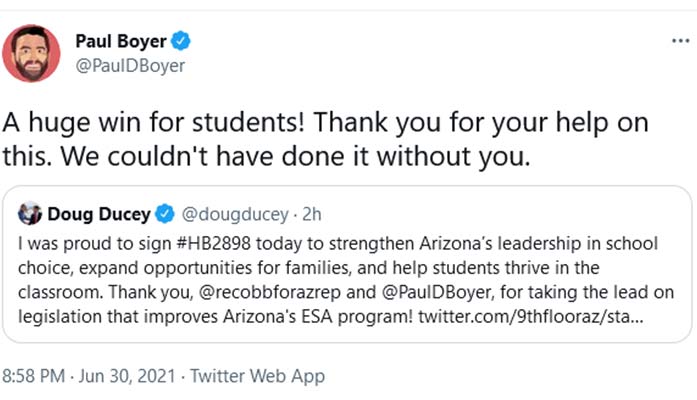
Ducey signed HB2898 on Wednesday along with the 10 other bills which make up the $12.8 billion Fiscal Year 2022 budget package. The new fiscal year starts Thursday.
ESA eligibility was not the only compromise necessary to get HB2898 to Ducey’s desk. An amendment added to the bill with limited debate earlier this week mandated controversial standards for civics curriculum. It faced pushback from Sen. Paul Boyer (R-LD20). Without Boyer’s vote, the entire K-12 budget bill was in peril.
Another compromise led to removal of the last minute civics amendment and Boyer then voted for HB2898.
Other education-related bills were sent to Ducey on Wednesday, including HB2241 which requires information about the Holocaust and other genocides to be taught at least twice between grades 7 and 12. The bill passed both chambers with overwhelming bipartisan support.
The other bill, SB1572, involves early literacy policy at the State Board of Education and the Arizona Department of Education. It impacts dyslexia training and screening requirements, establishes a literacy endorsement for qualified teachers, creates an entry evaluation tool for kindergarten pupils with parental notification requirements, and mandates a K-3 Reading Program report.