by Goldwater Institute | Jul 29, 2021 | Education, Opinion
By the Goldwater Institute |
The public’s business should be open to the public. And under Rhode Island law, it is. Yet when mom Nicole Solas sought to attend the meeting of a publicly funded committee that meets weekly to discuss and make recommendations on policies that apply across her daughter’s school district, she was told that the meeting was closed and parents were not welcome.
Now, the Goldwater Institute is pushing back: We’ve joined with the Stephen Hopkins Center for Civil Rights in Rhode Island to represent Nicole in a complaint before the state attorney general asserting that the school district has violated Rhode Island’s Open Meetings Act (OMA) by closing these meetings to the public.
Rhode Island’s OMA was enacted to ensure that “public business be performed in an open and public manner and that the citizens be advised of and aware of the performance of public officials and the deliberations and decisions that go into the making of public policy.” The presumption under that law is always in favor of public access.
Yet in March 2021, the South Kingstown School Committee signed an agreement with the South Kingstown BIPOC Advisory Board to hold weekly meetings where district policies ranging from student discipline to coaching to hiring would be discussed and where recommendations would be made on those issues by the Board to the School Committee. In other words, the Board was charged with advisory power by the School Committee over matters of significant public interest—the education of South Kingstown’s youth. The Board is also publicly funded with taxpayer dollars by the School Committee, and two members of the School Committee’s subcommittee on policy sit on the Board.
>>> READ MORE >>>
by AZ Free News | Jul 28, 2021 | Education, News
PHOENIX, AZ — Governor Doug Ducey urged Arizona’s Congressional Delegation to oppose federal legislation that will jeopardize critical funding the state’s public charter schools receive and put thousands of students at risk.
“I am writing to bring your attention to a hugely problematic section of the Fiscal Year 2022 Labor, Health and Human Services, Education, and Related Agencies Funding Bill. Section 314 of this legislation could have catastrophic effects on public charter schools in Arizona and throughout the nation,” Ducey wrote to Arizona’s two U.S. Senators and nine U.S. Representatives.
The legislation singles out public charter schools and threatens them with the potential loss of all of their federal funds if they contract with private companies for any services, with language stating: None of the funds made available by this Act or any other Act may be awarded to a charter school that contracts with a for-profit entity to operate, oversee or manage the activities of the school.
“This means that many of Arizona’s more than 230,000 public charter school students could be at risk of their school shutting down,” Governor Ducey states in the letter. “They educate over 21% of all public K-12 students in Arizona, the highest percentage in the country. It is unthinkable that support for public charter schools could be put at risk at all, much less as we are emerging from over a year’s worth of academic disruption brought on by the COVID-19 pandemic.”
The Arizona Charter Schools Association, U.S. Chamber of Commerce, and members of the Arizona State Legislature have also voiced concerns regarding Section 314 of the Fiscal Year 2022 Labor, Health and Human Services, Education, and Related Agencies Funding Bill.
by Terri Jo Neff | Jul 23, 2021 | Education, News
By Terri Jo Neff |
An investigation by the Arizona Auditor General has led to criminal charges being filed earlier this month against several people involved with the building of two new schools for the Higley Unified School District in Gilbert, including the district’s former superintendent, it was announced late Thursday.
Angela Denise Birdwell was indicted July 13 by a state grand jury for 18 counts related to procurement fraud, misuse of public monies, fraudulent schemes and practices, conflict of interest, filing a false state tax return, fraudulent schemes and artifices, and conspiracy. She served as Higley’s superintendent from 2009 until her retirement in 2015.
“Public officials with oversight authority have a responsibility to properly manage the administration of money and property entrusted to them and must ensure that sufficient internal controls are designed and implemented to protect those assets,” according to the Auditor General’s report. “Nevertheless, a system of internal controls will not succeed when those in a position to oversee those operations are perpetrating unlawful behavior and concealing their misconduct.”
Among the more serious issues identified by the Auditor General was Birdwell’s possible misuse of public monies from December 2012 to November 2013 when she authorized or caused the unlawful use of $6 million in restricted public funds toward construction of two new schools in the Higley district, which serves about 10,000 PK-12 students.
Also indicted were Gary Aller and Steven Nielsen, both corporate officers of Educational Facilities Development Services (EFDS) which was awarded a $2.5 million project development service contract related to construction of the new schools. Investigators believe EFDS had access to “early and exclusive Project information” which provided the company an advantage over other prospective vendors.
Public records show Aller and Nielsen founded EFDS in 2012 just two weeks before the Higley District issued an RFP for project development services. The men are each charged with three felonies related to fraudulent schemes and practices, conspiracy, and fraudulent schemes and artifices. There is also an allegation Birdwell violated state procurement laws in connection to the EFDS contract.
“Dr. Birdwell was 1 of 3 selection committee members, and she evaluated EFDS with the only perfect score and recommended Higley award EFDS the Project development services contract, which the Higley Governing Board approved on July 12, 2012,” the report states.
Meanwhile, three felonies related to filing of a false state tax return were brought by the state grand jury against Kay Hartwell Hunnicutt, an attorney described in the Auditor General’s report as being a “close acquaintance” of Birdwell, with whom she shared a home as well as a checking account.
According to the Auditor General, Birdwell indirectly received or benefited from $43,000 paid by Hunt & Caraway Architects Ltd., which served as the district’s procurement advisor and was part of the EFDS development team. Hunt & Caraway, whose now deceased president was never registered in Arizona as an architect, issued checks to Hunnicutt or Hunnicutt’s law office, which were then deposited in a checking account held jointly by Birdwell and Hunnicutt.
Concerns have been rife for years about misconduct related to the school construction projects, according to State Rep. Jake Hoffman (R-LD12), who served as a Higley district board member from 2013 to 2015. Hoffman says he and another board member were criticized by Higley district administrators in response their attempts to look into concerns at the time.
“The level of apparent corruption is staggering and heartbreaking. I am proud to have actively fought against this abuse of power, misuse of taxpayer monies, and blatant disregard for the law during my tenure on the Higley governing board,” Hoffman said, adding that he plans to use the Auditor General’s findings to push for education reform during next year’s legislative session.
After retiring from Higley, Birdwell received eight checks totaling $57,000 from Hunt & Caraway before she was hired in 2016 by the Scottsdale Unified School District as its superintendent through June 2019.
The memo section on two of the Hunt & Caraway checks referred to “consulting” but the company failed to provide investigators any documents supporting the purposes of the checks.
But Birdwell’s time at SUSD was cut short, when she was given a $150,000 contract buyout in April 2018 after district officials alleged she failed to disclose a “substantial, personal interest” with Hunt & Caraway, which billed the Scottsdale District for nearly $2 million after Birdwell became its superintendent.
Birdwell is accused of not claiming the payments as income on her state income tax returns.
Court dates have not been announced for the four defendants who will stand trial in Maricopa County Superior Court.
by Loretta Hunnicutt | Jul 22, 2021 | Education, Opinion
By Loretta Hunnicutt |
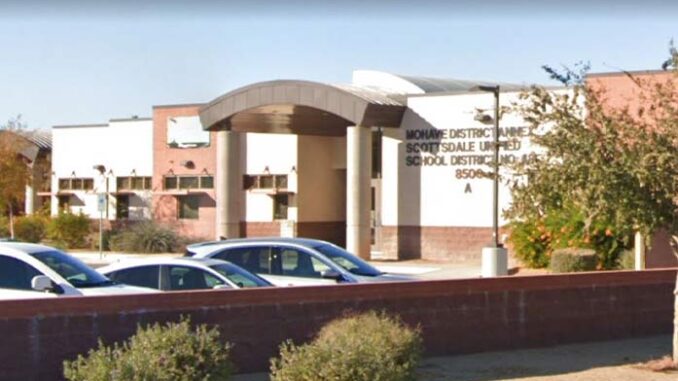
After vigilant parents sounded the alarm about a consent form they were asked to sign electronically that would have asked their children highly personal questions, Scottsdale Unified School District leadership apologized.
The District’s leadership advised parents that they would not be asked to authorize the District to “complete an emotional health and wellness screening of my child and to collect personal information, medical history or medical information, mental health history or mental health information, and quality of home and interpersonal relationships, student biometric information, or illegal, antisocial or self-incriminating behavior critical appraisal of individuals within a close relationship and gun/ammunition ownership.
The District claims those issues were mentioned inadvertently in a portion of students’ annual verification packet:
On May 4, 2021, Scottsdale Unified School District’s (SUSD) administration recommended that the Governing Board approve the FastBridge program as a social emotional learning screener for students in Kindergarten through 12th grades. It was already being used as an academic screener for grades K through 3.
This social emotional screening program, which the Board voted to adopt, is used to evaluate students overall general behavior including but not limited to, social, academic and emotional behavior. Screening is typically completed within three minutes, with results available immediately to parents and staff. These findings enable our teachers, social worker and guidance counselor professionals to help identify students who may be in need of additional support and intervention programs and to make that support available as early as possible.
The screening tool is optional and one that parents have a choice to authorize for use with their children each school year.
Notwithstanding this, SUSD’s initial parent acknowledgment form incorrectly stated that the FastBridge screener might ask for personal information about income family matters, medical or family medical history, mental health history and other categories of private information.
To be clear, the FastBridge screener does not and has never sought this information. The waiver form that initially appeared in ParentVUE as part of the parents’ annual acknowledgment was a standard waiver form that had not yet been properly tailored to SUSD’s use. The form has since been amended to reflect the information that is actually collected. We apologize for this oversight and offer our services that SUSD does not support, endorse or collect any family personal information through FastBridge.
Leadership goes on to claim that Scottsdale parents “have stressed to us how important it is for schools to support their students social emotional learning.”
“Our sole goal in acquiring FastBridge,” wrote leadership, “is to be able to support the whole child and offer help to students sooner when we see that academic and behavioral issues in the classroom are limiting their opportunities to learn and grow.”
This “apology” raises too many questions and red flags. From the implication that a child’s social emotional well-being can be assessed in three minutes, to the claim that leadership is responding to parents’ pleas that the schools support their students’ social emotional learning, the missive misses the mark for any discerning reader.
Any educator who believes that they can assess a child in any meaningful way in three minutes is misguided at best and likely committing educational malpractice at worst.
The fact that our schools continue to cater to the fear-mongering teachers’ unions, thus strongly encouraging masks and vaccines for students K-8, clearly shows that they have put the students’ social and emotional well-being far down their list of priorities.
While the apology is appreciated by many parents, I fear that it will prompt them to drop their guard and not look carefully at the other consent forms they are asked to sign. There is also the danger that parents might assume that their children are not turning over this information in their classrooms at all when nothing could be further from the truth.
Parents need to be on guard at all times, and at all times they must assume that their children are products – the data they produce, the insights they give, the very supplies they prefer to bring to school are all of value to those who benefit – in one way or another – from the education industrial complex.
by Terri Jo Neff | Jul 20, 2021 | Education, News
By Terri Jo Neff |
In a partial victory for 20 state attorneys general, the U.S. Department of Education (DOE) backtracked on Monday on plans that would have prioritized $5 million in grant funds for American history and civics lessons that focus on the issue of racial marginalization.
Arizona Attorney General Mark Brnovich was among those who signed a letter sent in May to Education Secretary Miguel Cardona expressing “deep concerns” with proposed changes to how American history and civics instruction programs would be taught in K-12 schools across the country.
DOE had announced in April that some of the agency’s grant funding for history and civics instruction would be prioritized for programs which reflect “the diversity, identities, histories, contributions, and experiences of all students into teaching and learning.” That plan, however, received a large backlash.
A notice on July 19 in the Federal Register states DOE will consider grant proposals which “promote new and existing evidence-based strategies to encourage innovative American history, civics and government, and geography instruction” including those which address “systemic marginalization, biases, inequities, and discriminatory policy and practice in American history.”
But DOE has promised to not give such proposals an automatic advantage or competitive edge over other history and civics instruction grant requests. The application period opened Monday.
“The Department recognizes the value of supporting teaching and learning that reflects the rich diversity, identities, histories, contributions, and experiences of all students,” Cardona wrote on the DOE website. “As every parent knows, when students can make personal connections to their learning experiences, there are greater opportunities for them to stay engaged in their education and see pathways for their own futures.”
The Federal Register notice marks a major change by DOE exactly two months after Brnovich and several colleagues complained to Cardona that the grant priorities announced in April were a “thinly veiled attempt” to promote the controversial teachings of the 1619 Project and Critical Race Theory (CRT).
The 1619 Project’s focus on America’s history is changed from 1776 to 1619 when the first Africans arrived at what was Colonial Virginia one year before the arrival of Pilgrims near Plymouth Rock. CRT views or interprets American history and civics primarily through the narrow prism of race.
The attorneys general argued to Cardona that DOE’s promotion of CRT and the 1619 Project and ideologies would be endorsing the teaching of a warped, factually deficient view of American history. Their letter asked that the proposed priorities not be adopted or that DOE make clear that grants may not be used to fund projects which characterize the United States as irredeemably racist or founded on principles of racism instead of principles of equality.
DOE’s notice in the National Register did not go as far as the attorneys general wanted, but it is seen as a partial victory which guarantees grant applications for for history and civics lessons which veer substantially from traditional lessons will not have an advantage.
by Terri Jo Neff | Jul 19, 2021 | Economy, Education, News
By Terri Jo Neff |
Arizona’s three public universities produced more degrees in the fiscal year ending June 30, 2020 than in any previous year, but the state continues to lag the national average for the number of residents with at least a bachelor’s degree, according to a report issued by the Arizona Board of Regents (ABOR).
The ABOR’s recent College Completion Report shows graduates at Arizona State University, Northern Arizona University, and University of Arizona earned a combined 47,531 degrees for FY2020. That represents a 29 percent increase over the last five years and includes 33,973 bachelor’s degrees, of which 21,425 were earned by Arizona resident students.
The report also shows all three universities significantly increased bachelor’s degrees in key STEM fields in FY2020, producing a combined 9,295 bachelor’s degrees, a 61.7 percent increase over the last five years. The universities also awarded substantially more bachelor’s degrees in health fields in 2020 – conferring 2,879 degrees, a 46.6 percent increase over the last five years.
At the same time, students earned 6,086 bachelor’s degrees in Business, far exceeding any other field of study. However, the ABOR report shows there was a decline in bachelor’s degrees awarded in Education by Arizona’s three public universities at only 1,586. There were also declines in the Agriculture & Agriculture Operations degree program as well as Foreign Languages & Linguistics program.
However, Architecture & Related Sciences saw an unexpectedly strong increase at a time when the U.S. Bureau of Labor Statistics is reporting the job market for the industry is expected to grow only one percent from 2019 to 2029.
Despite the upbeat focus of the ABOR report, U.S. Census records show only 29 percent of Arizonans hold a bachelor’s degree or more, far short of the national average of 35 percent.
In response, the regents are kicking off the “New Economy Initiative” which seeks to raise Arizona’s competitiveness by increasing educational attainment, “leading to increased prosperity for individuals and Arizona.”
The business plan of the ABOR’s $120 million New Economy Initiative is designed, according to the regents’ website, “to enhance Arizona’s competitiveness with strategic investments in areas of strength at our three public universities. This targeted approach to workforce development in high-value industries will yield a positive return on state investment.”
The website shows the funding includes $46 million for ASU to be used in part to design and launch “the largest center for engineering education and research in the United States” and to grow enrollments to more than 25,000. It also seeks to make metro Phoenix “the leading center for engineer talent production in America.”
NAU has been allocated $22 million to “provide talent in high demand fields with an emphasis on health care programs in regional locations, including mental and behavioral health, to address the state’s needs as highlighted by the COVID-19 pandemic.”
Meanwhile, UofA would receive $32 million through the New Economy Initiative to enhance medical professional and researcher training, to enhance capacity for students’ careers in national security, space technology, and planetary defense; and to develop Arizona’s only School of Mining into “a world-class leader in mining for the 21st century.”
Other highlights from the ABOR’s FY2020 College Completion Report include the fact a combined 13,558 graduate degrees were conferred in the same period, which represented a record number of master’s (11,387) and doctoral (2,171) degrees.
The most master’s degrees were in the fields of business management, education, engineering, health professions, and public administration, while the greatest numbers of doctoral degrees were in the fields of education, engineering, health, legal professions, and physical sciences.