Channel 12 continued its clumsy crusade against school choice this week with a breathless report about fraudsters abusing Empowerment Scholarship Accounts to buy diamond rings and necklaces, flights and hotel stays, and even lingerie.
It paints a picture of a program rife with abuse. But is it?
The Arizona Department of Education gave Channel 12 the records for more than 1.2 million ESA requests. Yet when askedrepeatedly what percentage of those requests were fraudulent, Channel 12’s reporter refused to comment.
Why? Because the truth undermines the anti-ESA narrative.
The salacious report is intended to persuade policymakers who support ESAs to impose regulations that would undermine the ESA program. It goes without saying that anyone engaged in fraud should be prosecuted to the fullest extent of the law, and the Arizona Department of Education is appropriately cracking down on fraudsters. But before policymakers rush to amend the ESA program, they should know the context that Channel 12 left out.
ESA Misspending Is a Tiny Fraction of Total ESA Spending
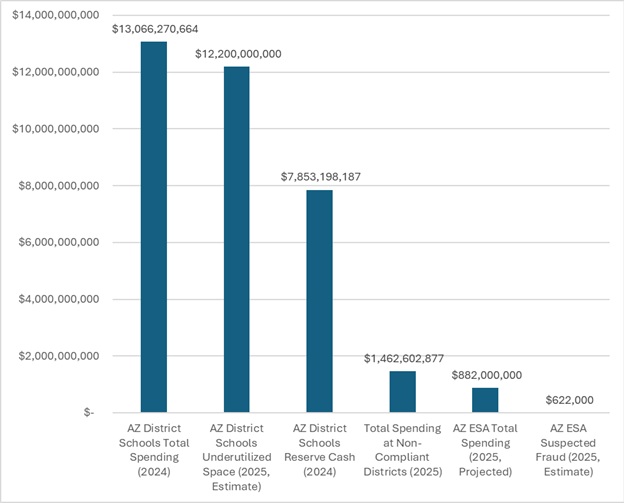
The ESA program currently serves about 90,000 students at a projected cost of $882 million this year and $939 million next year, or about 6.7% of the $14 billion spent on Arizona’s district schools. Families can use ESAs to purchase a wide variety of educational expenses to customize their child’s education.
The typical ESA student receives about $7,500 per year, compared with more than $15,300 per pupil at Arizona’s district schools. Students with special needs—who account for more than 19% of ESA students, compared with 14% of district school students—can receive more funding, although the accounts are still worth 90% of what the state spends on similarly situated students at public schools. According to the Common Sense Institute, “a disproportionate share of middle-income households use an ESA.”
On Tuesday, the Arizona Department of Education revealed that their internal audit had turned up $622,000 in ESA funds that are “possible fraud or misuse.”
That’s less than one-tenth of 1% of total ESA spending.
Ignoring Mountains, Covering Molehills
Meanwhile, there are 30 school districts that the Arizona Auditor General currently deems to be non-compliant with state reporting requirements or that have internal control deficiencies. The total spending in those districts is more than $1.4 billion, more than the total spending of the ESA program. Yet aside from its coverage of the disastrous overspending in the Isaac Elementary School District, Channel 12 has barely covered it at all.
For that matter, Channel 12 has ignored the $7.8 billion that Arizona school districts are holding in cash reserves. That’s about $7,000 per pupil. The reserves have grown $2 billion in two years, yet Channel 12 doesn’t evince even the slightest curiosity about why.
Nor is anyone at Channel 12 interested in the $12 billion worth of unused and underutilized buildings that districts are sitting on, often just to prevent private or charter schools from buying them.
Channel 12 found space in the aforementioned ESA exposé to mention that a judge recently ruled that the state supposedly “isn’t properly funding capital needs for its public schools,” but the station had no space to mention that school districts are sitting on $20 billion in cash reserves and underutilized buildings.
Indeed, Channel 12 has barely covered any of these facts even as they pump out multiple anti-ESA stories each week, despite the fact that the ESA program is dwarfed by the spending at non-compliant districts, district school cash reserves, and underutilized buildings.
School-choice opponents and their media allies are hyper-focused on ESA misspending because they want to pressure lawmakers to undermine the program via regulation.
The Arizona Department of Education adopted its risk-based auditing strategy—automatically approving ESA spending requests below $2,000, then auditing accounts on the back end—because Superintendent Tom Horne’s previous “review every penny” approach was causing massive backlogs and delays in approving expense requests and reimbursements.
There were nearly 11,000 transactions in quarter 3 of this year alone. It’s impossible for the department’s staff to review each transaction in a timely manner, but parents trying to teach their kids can’t wait months just to buy a textbook or pay their child’s tutor or school.
To Horne’s credit, he listened to parents and made some incremental improvements that make it easier for parents to use the program. Now a tiny percentage of ESA holders are taking advantage of the looser rules, but they will be forced to pay the money back and could face prosecution.
The Arizona Department of Education has suspended 400 accounts due to improper spending —just 0.4% of the total accounts—and has referred some to the Attorney General for further investigation and prosecution.
Punishing fraudsters is necessary. Every government program is subject to some amount of fraud and abuse, and it’s incumbent upon public officials to implement rules that keep fraud as close to zero as possible. But it is not in the public interest to undermine a program’s effectiveness, especially when that program is helping kids get access to a better education and a brighter future.
School-choice opponents are using misspending as a pretext. If that was their real concern, they’d be raising alarms about all the waste, fraud, and abuse in the district school system. They’re not really concerned with stopping the 0.4% of ESA holders committing fraud, they just don’t want the program to work for 99+% of families just trying to do right by their kids.
Supporters of education freedom and opportunity should ignore the manufactured outrage and work to ensure that the ESA program works well for the families it serves.
Jason Bedrick is a Research Fellow at The Heritage Foundation’s Center for Education Policy.
Have you heard the charge that Arizona families are using Empowerment Scholarship Accounts (ESA) for babysitting? Or that ESA families are sitting on millions of dollars that they’re using for expensive, overseas vacations? Or that the ESAs only benefit wealthy families who live in high-performing school districts?
These claims range from “lacking key context” to “lacking any evidence whatsoever.” The main source of these and other horror stories that school-choice opponents tell is reliably left-leaning Arizona media outlets such as Channel 12 and the Arizona Republic.
It’s no surprise. Reporters at these outlets, such as Craig Harris, have a history of inaccurate agenda-driven “reporting” on Arizona’s school choice policies. Recent articles and “news” segments from these and other outlets are in keeping with this history.
Award-Winning Errors
In 2018, the Republic released a series criticizing Arizona’s charter schools. The series won the paper a Polk Award. The only problem is that it was riddled with errors.
For example, the Republic claimed that Arizona’s traditional district schools outperformed the state’s charter schools as measured by the state’s A-F school grading system and graduation rates. Both these claims were demonstrably false, but the Republic never ran a correction.
Matthew Beienburg of the Goldwater Institute detailed at length the numerous errors the Republic made to reach those incorrect conclusions, describing the story as “astonishingly deceptive.” For example, they counted one charter school as having a graduation rate of 0% when the school only offered instruction through 9th grade. Two more schools that supposedly had 0% graduation rates had closed years earlier. Another charter school with a low graduation rate was an alternative school that operated under the Yuma County Juvenile Justice Center—hardly an apples-to-apples comparison for typical district schools.
In 2019, the Republic released an above-the-fold, front-page story claiming that 100 of Arizona’s then 544 charter schools were in imminent danger of closure. The report said it was a “near certainty” that at least 50 would close “in the near future.” You’d think such a sensational claim would warrant a healthy dose of skepticism, but the Republic was more than happy to breathlessly repeat the claims nearly unchallenged.
Six years later, 580 charters operate in the state, defying predictions of a mass extinction. In fact, on the most recent National Assessment of Educational Progress, Arizona’s charter school students scored over two grade levels higher than district students on 8th grade mathematics and by almost two grade levels on 8th grade reading. The state’s charter school students also scored higher than any other statewide average on both subjects.
You won’t see those facts reported by Arizona’s legacy media.
Journalism’s Credibility Crisis
For careful journalists concerned with their personal credibility and the declining credibility of their profession with the American public, these embarrassing errors might have sparked some self-reflection upon their sources and practices. For the Republic, it was merely a warmup for more of the same.
Author Amanda Ripley, interviewed for a book she wrote on deep problems of journalism, noted the “strange and insular world of journalism prizes,” which encourage simplistic “us versus them” stories. “This adversarial model that we’ve got going in education, journalism, and politics no longer serves us. There’s a good guy and a bad guy and everything’s super clear, it just breaks down. And we keep awarding prizes in that model. But 99 percent of stories are not that clear-cut,” Ripley noted.
In other words, as if journalism did not have enough problems amid a pronounced decline in public confidence, journalism awards—like the Polk Award given to the Republic team for their inaccurate and ideological anti-charter school series—encourage advocacy-style journalism.
There Is No Evidence Families Used ESAs for Babysitting
Channel 12’s recent anti-choice crusade involves a series of clumsy attacks on Arizona’s Empowerment Scholarship Account program.
One myth Channel 12 has been attempting to spread is the notion that participants in the ESA program are using their accounts to pay for “babysitting.” In fairness, this claim is based upon a since-corrected misstatement by a representative of the Arizona Treasurer’s Office. The ESA program, however, has a list of allowable uses for accounts, and babysitting is not now—nor has it ever been—an allowable use.
Despite the correction by the Treasurer’s Office, some in the media are still spreading the claim. Asked about this on KTAR days after the correction, reporter Craig Harris of Channel 12 (who authored or co-authored the erroneous Republic articles described above) artfully claimed that the Arizona Department of Education’s use of risk-based auditing on low-dollar purchases means that we really don’t know whether parents are using ESA accounts for babysitting or not.
We can likewise state that we really don’t know whether any random person has cheated on his or her federal income taxes. After all, the IRS does not audit every single income tax return—instead they use a technique known as “risk-based auditing” to detect and deter fraud. This is the same technique that Arizona law established to ensure accountability in the ESA program, as recommended by the Arizona Auditor General, and it is used by numerous government agencies.
Journalists have no evidence that anyone has ever used the ESA program for babysitting. But if it happened and they were caught, just like the hypothetical tax cheat, the hypothetical ESA offender would face fines or even jail time. The combination of risk-based auditing and consequences for fraud is why the United States has one of the highest tax compliance rates in the world.
ESA Parents Are Not Really “Subsidizing Vacations”
Channel 12 is likewise playing fast-and-loose with the facts when they claim that Arizona parents are “using education tax dollars to subsidize their vacations.” That phrasing gives the impression that ESA funds are being used for flights, food, or hotel stays—none of which are allowable expenses under the ESA statute.
The reality is that families are using ESA funds to buy tickets to museums, zoos, aquariums, and other educational venues that are—appropriately—allowable expenses under the ESA statute, and which public schools regularly purchase as well.
ESAs Expand Educational Opportunity
Stories from the same outlets also claim the ESA is “hurting high-performing public districts.” Even setting aside that such statements treat children as mere funding units for district schools, reporters’ use of the term “high-performing” is out of step with what most parents think it should mean.
The article notes that the “top five school districts losing students who left for [ESAs] are: Mesa, Deer Valley, Chandler, Peoria and Scottsdale,” and that all these districts received an “A” letter grade from the state except for Mesa, which received a “B.”
But are Arizona’s school letter grades a reliable indicator of quality? Absolutely not.
In the 2023-24 academic year, Arizona awarded 677 schools “A” grades, while only four schools “F” grades—yet only a third of Arizona students passed the state math exam.
By contrast, GreatSchools is a much harsher grader than state bureaucrats. In Maricopa County, the state awarded 325 “A” grades and only two “F” grades, while GreatSchools gave 49 “A” ratings and 111 “F” ratings. For obvious reasons, parents trust GreatSchools more than they trust state bureaucrats.
In the five districts that parents are fleeing most for ESAs, the percentage of students scoring “proficient” or higher on the state math test ranges from 30% in Mesa to 58% in Chandler. Fewer than half of students scored proficient in Deer Valley and Peoria as well.
Reporters who are hostile to parental choice in education might call that “high performing,” but most parents don’t.
Arizona families deserve accurate reporting on education policy, not sensationalized narratives built on flimsy foundations. Arizona media’s pattern of misrepresenting school choice programs—from the error-ridden charter school series to unfounded attacks on ESAs—undermines the public’s understanding of legitimate educational options.
While parents increasingly turn to alternatives like ESAs and charter schools that demonstrably outperform traditional districts, journalists have a responsibility to report these developments fairly, not perpetuate myths that serve no one except those invested in maintaining the status quo. Arizona’s children benefit when families have genuine choice in education, and they deserve journalism that illuminates rather than obscures the facts about their options.
Matthew Ladner is a Senior Advisor for education policy implementation and Jason Bedrick is a Research Fellow at the Heritage Foundation’s Center for Education Policy.
Every year, a horde of school district officials and their lobbyists come before the state legislature, rattling their tin cups, begging for more money for their supposedly underfunded schools. They tell sob stories about crumbling buildings and underpaid teachers who had to pay for school supplies from their own pockets. Their schools, they say, are financially starved.
Hogwash.
School bureaucrats don’t want you to know it, but school spending is at an all-time high, and Arizona’s school districts are sitting on more than $20 billion in cash reserves and buildings they don’t need while student achievement craters. A new report from the Common Sense Institute (CSI) reveals the shocking scope of waste plaguing our traditional public school system, and it’s time taxpayers demanded answers.
The numbers are staggering. As has been documented, Arizona’s school districts are already hoarding $7.8 billion in cash reserves, up $1 billion since the prior fiscal year. Now we learn they’re also sitting on $12.2 billion worth of excess real estate—78 million square feet of unused and underutilized space that could house 630,000 additional students. Combined, that’s over $20 billion in resources that could be put to better use serving Arizona’s children.
Since 2019, district school enrollment has declined 5% statewide, yet these same districts increased their building space by 3% and boosted capital spending by a jaw-dropping 67% to $8.9 billion. As CSI has documented, districts have added 499 new buildings while losing 47,500 students. This isn’t just inefficient, it’s fiscally reckless.
The massive spending on new buildings might be justifiable if schools were overcrowded or expecting a huge influx of new students, but they’re not. In fact, Arizona’s district schools are already significantly overbuilt, operating at just 67% capacity while charter schools run at 95% capacity and private schools at 75%. CSI estimates that the excess space in district schools could accommodate 630,000 additional students—nearly half the current statewide district school enrollment.
The excess capacity comes at an enormous cost. CSI estimates that the market value of excess district space alone—$12.2 billion—could fund a decade of capital expenditures. Alternatively, eliminating maintenance costs for unused space would save taxpayers $1 billion annually. That’s real money that could reduce taxes, improve education, or address Arizona’s other pressing needs.
There are plenty of willing buyers. Indeed, the fastest-growing school systems—charters and private schools chosen by increasing numbers of Arizona families—struggle to find adequate facilities. Yet school districts often go to incredible lengths to avoid selling buildings to them, such as when Tucson Unified School District sold an unused building for 25% less than what a Christian school had offered, just so that a “competitor” wouldn’t have it.
In response to such cases, Gov. Doug Ducey signed a law requiring school districts to sell buildings to the highest bidder, even if it’s a private or charter school. Now, rather than comply, school districts are just letting their underutilized space languish and forcing the taxpayers to pay the bill.
The wastefulness is also a slap in the face to teachers and students alike.
As we noted previously, the districts have enough cash reserves to raise the average teacher pay from $64,420 to more than $80,000 for 10 years and still have funds left over. If they sold off all their underutilized space, they could raise the average teacher pay to $100,000 for a decade and still have billions left over.
There is no evidence that spending on buildings is contributing to student learning. As the buildings have gone up, math scores have gone down, plummeting 25% since 2019. As CSI documents, the lowest-performing schools have the most excess space, operating at just 19% capacity, while high-performing schools run at 70% capacity.
This isn’t about helping kids learn; it’s about protecting a bloated bureaucracy that puts institutional self-interest above student needs.
Fixing the problem will require realigning incentives. CSI recommends more transparency—including a “Facilities Condition Index” that would give policymakers and the public objective information about the quality of existing school facilities—and more state oversight of severely underutilized facilities. In the meantime, any funding requests from the school districts should be greeted by state lawmakers with a healthy dose of skepticism.
Arizona’s children deserve better than a $20 billion monument to government inefficiency. They deserve a system that puts their education first, not one that hoards resources while performance plummets. If local officials can’t or won’t deliver, then state lawmakers will have to step in.
Jason Bedrick is a Research Fellow and Matthew Ladner is a Senior Advisor for education policy implementation at the Heritage Foundation’s Center for Education Policy.